
How audience loyalty develops through influencer engagement
Audience loyalty does not follow automatically from follower counts. It develops when an influencer consistently earns trust, and that trust converts passive viewers into committed advocates who buy, recommend, and return. Research published in Frontiers in Communication confirms that digital content marketing significantly enhances customer loyalty, with emotional attachment and emotional commitment acting as the key moderators that deepen the effect.
The mechanism works in a clear sequence. An influencer’s expertise, perceived attractiveness, and message credibility first attract followers. Trust then mediates the relationship between those qualities and actual loyalty behaviours, including repeat purchases and brand recommendations. Studies measuring this pathway find that trust predicts loyalty with a beta coefficient of 0.503 (p < 0.001), a strong effect by any social science standard. Without trust, reach is just noise.
Several forces drive this process:
- Expertise and credibility. Followers grant authority to influencers who demonstrate genuine knowledge. That perceived expertise reduces the cognitive effort required to make a purchase decision.
- Social attractiveness and homophily. People follow those who feel similar to them. When an influencer shares values, aesthetics, or life circumstances with their audience, the bond deepens.
- Parasocial relationships. Followers develop one-sided emotional connections that mimic real friendship. These pseudo-intimate bonds convert passive viewing into habitual return behaviour.
- Emotional attachment and commitment. Emotional attachment amplifies the effect of content on loyalty (path coefficient 0.148, p < 0.01); emotional commitment amplifies it further still (path coefficient 0.165, p < 0.001).
- Purchase intention and advocacy. Loyalty eventually surfaces as buying behaviour and word-of-mouth, the two outcomes brand managers care about most.
Understanding how audience loyalty develops through influencers, rather than the other way around, is the sharper framing. A loyal audience is what gives an influencer their commercial power. Without it, they are simply a broadcaster.
Key strategies to develop audience loyalty through influencer engagement
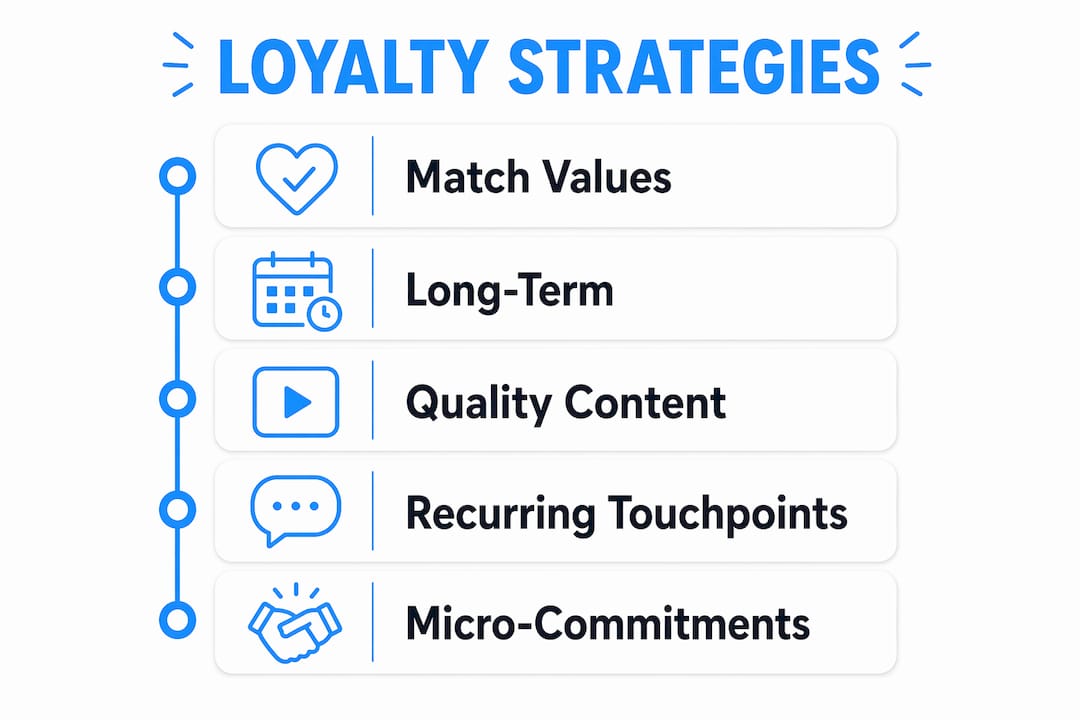
1. Select influencers whose values genuinely match your brand
Alignment is not a soft criterion. When an influencer’s stated beliefs, aesthetic, and audience demographics match your brand’s positioning, every piece of content they produce reinforces the same message. Misalignment, by contrast, creates cognitive dissonance in followers who sense the commercial mismatch immediately. Before signing any partnership, audit the influencer’s last 90 days of content for consistency of voice, topic, and community response.
2. Commit to long-term partnerships rather than one-off posts
A single sponsored post rarely moves the loyalty needle. Repeated, authentic appearances by the same influencer within a brand’s world signal to followers that the relationship is real rather than transactional. Long-term partnerships also give the influencer time to integrate the product naturally into their content, which reads as genuine endorsement rather than paid placement. Plan for a minimum of three to six months when structuring a loyalty-focused campaign.

3. Prioritise persuasive, high-quality content over pure entertainment
Message credibility, specifically argument strength and information quality, is a fundamental loyalty driver. Content that entertains but says nothing substantive about the product rarely converts viewers into loyal customers. The most effective influencer content combines genuine entertainment with clear, credible claims. Brief product demonstrations, honest reviews, and specific use-case storytelling all outperform vague lifestyle association.
4. Build recurring touchpoints into the content calendar
Habit is the structural backbone of loyalty. Consistent series formats, weekly Q&A sessions, or predictable posting schedules give followers a reason to return on a schedule rather than waiting for the algorithm to surface content. This recurring engagement pattern is what practitioners mean when they talk about habit loops: cue, routine, reward. The cue is the scheduled content; the reward is the sense of connection.

5. Use micro-commitments to deepen participation
Asking followers to take small, low-effort actions, such as saving a post, answering a poll, or joining a live session, progressively increases their investment in the influencer’s world. Each micro-commitment raises the psychological cost of disengaging. Over time, these small acts accumulate into a genuine sense of community membership, which is far stickier than passive viewership.
6. Choose engagement quality over follower volume
Micro-influencers typically generate stronger engagement quality, measured by thoughtful comments, shares, and saves, than macro-influencers with larger but less invested audiences. An engagement rate on Instagram around typical benchmarks is considered a sign of authentic community activity. Chasing reach at the expense of engagement quality is the most common and most costly mistake in influencer budget allocation. Micro-influencers typically yield engagement rates around 3% on Instagram, indicating real community investment.
7. Require transparency and disclosure as a non-negotiable standard
The UK’s Advertising Standards Authority (ASA) and the Competition and Markets Authority (CMA) both require clear disclosure of paid partnerships. Beyond legal compliance, transparency protects the trust that makes influencer marketing work at all. Followers who feel deceived do not simply disengage; they actively warn others. Disclosure, handled well, actually reinforces credibility rather than undermining it.
8. Activate community spaces beyond the feed
Discord servers, private newsletters, and WhatsApp communities extend the influencer relationship beyond the algorithm’s reach. These owned spaces allow deeper conversation, exclusive content, and direct interaction that feed posts cannot replicate. Community members who participate in these spaces show markedly higher loyalty and lifetime value than those who only consume public content.
9. Incorporate social proof at every stage
Testimonials, user-generated content, and visible community reactions all reinforce the sense that others have already committed to the brand. Social proof is particularly powerful at the point of first purchase, where uncertainty is highest. Influencers who actively share and celebrate their community’s responses create a self-reinforcing loyalty loop. For a deeper look at how this works in practice, the social proof for influencers guide from Greediersocialmedia covers the mechanics in detail.
10. Align influencer content with brand loyalty programme rewards
When an influencer promotes a specific loyalty programme benefit, such as early access, exclusive discounts, or members-only content, they give their audience a concrete reason to convert and stay. The influencer’s credibility transfers to the programme itself, reducing the scepticism that often greets loyalty scheme marketing. This integration is covered in more depth in section five.
11. Monitor and respond to community signals in real time
Loyalty erodes quietly before it collapses visibly. Tracking comment sentiment, save rates, and direct message volume gives early warning of disengagement. Influencers who actively respond to comments and questions sustain higher retention than those who post and disappear. Build response time into the partnership brief, not just content deliverables.
What psychology and theory tell us about influencer-driven loyalty
Relationship Marketing Theory (RMT), developed in the 1990s, provides the academic foundation for understanding why influencer-follower bonds produce loyalty. RMT holds that sustained, high-quality interactions between a brand and its customers build trust, reduce perceived risk, and increase commitment over time. Applied to influencer marketing, the theory explains why consistent, valuable content from a trusted creator outperforms any single high-reach campaign. The influencer effectively acts as a relationship proxy between the brand and the consumer.
Two psychological constructs sit at the heart of this process. Social attractiveness refers to how much a follower perceives the influencer as likeable, relatable, and similar to themselves. Homophily is the related tendency to trust and follow people who share one’s values, background, or interests. Both constructs predict engagement quality and, ultimately, loyalty. An influencer who feels like “someone like me” generates stronger parasocial bonds than one who feels aspirational but distant.
Parasocial relationships deserve particular attention. Research into influencer-follower emotional relationships confirms that affective commitment, loyalty, and para-socialisation all mediate the path from purchase satisfaction to repurchase intention. In plain terms: followers who feel emotionally close to an influencer are more likely to buy again when that influencer recommends something new. The emotional relationship is not a soft byproduct of good content. It is the mechanism.
Key empirical findings that validate these constructs:
- Digital content marketing has a positive impact on customer loyalty with a path coefficient of 0.480 (p < 0.001).
- Emotional attachment moderates this relationship positively (path coefficient 0.148, p < 0.01).
- Emotional commitment strengthens it further (path coefficient 0.165, p < 0.001).
- Trust predicts loyalty with a beta coefficient of 0.503 (p < 0.001), confirming its role as the central mediator in the influencer-to-brand loyalty pathway.
For brand managers, the practical implication is clear. Selecting influencers who can generate genuine emotional resonance, not just impressions, is the single highest-leverage decision in any loyalty-focused campaign. The role of followers in credibility is directly tied to how deeply those followers feel seen and understood by the influencer they follow.
How to measure the impact of influencer marketing on brand loyalty
Reach and impressions tell you how many people saw something. They tell you almost nothing about whether those people will come back, buy again, or recommend the brand to a friend. Measuring loyalty requires a different set of metrics entirely.
| Metric | What it measures | Why it matters for loyalty |
|---|---|---|
| Returning viewer rate | Percentage of audience who watch multiple pieces of content | Direct indicator of habitual return behaviour |
| Save and bookmark rate | Followers who store content for later use | Signals high-value content and intent to act |
| Comment depth | Length and quality of comments, not just volume | Reflects genuine community investment |
| Share rate | Content shared to personal networks | Indicates advocacy, the highest loyalty expression |
| Repeat purchase rate | Customers who buy more than once via influencer links | The commercial proof of loyalty conversion |
| Community growth rate | Growth of owned spaces (newsletters, groups) | Measures shift from rented to owned audience relationships |
The distinction between reach metrics and loyalty metrics is not semantic. A post can reach one million accounts and generate zero repeat behaviour. A post reaching ten thousand engaged community members can drive sustained purchasing over months. Tracking repeat behaviours such as returning viewers, saves, and comment depth gives a far more accurate picture of whether loyalty is actually developing.
Pro Tip: Build a simple loyalty scorecard for each influencer partnership. Score each campaign on five metrics: returning viewer rate, save rate, comment depth, share rate, and community growth. Review it monthly rather than post-by-post. Patterns across time reveal loyalty trends that single-post analytics hide entirely.
When assessing lifetime value impact, track cohorts of customers acquired through influencer channels separately from those acquired through paid advertising or organic search. Influencer-acquired customers who came through a trusted creator often show different retention curves. Measuring this distinction over a 12-month window gives you the data to justify long-term partnership investment to finance and leadership.
Integrating influencer marketing with brand loyalty programmes in the UK
The UK market has specific characteristics that shape how influencer-driven loyalty programmes perform. British consumers tend to be sceptical of overt commercial messaging and respond better to understated, credible endorsement than to high-energy promotional content. Cultural norms around authenticity and fair dealing mean that transparency in influencer partnerships is not just a regulatory requirement; it is a commercial advantage.
Aligning influencer messaging with loyalty programme benefits requires deliberate planning:
- Map influencer content themes to loyalty tier benefits. If your programme rewards early access, have the influencer demonstrate that access in real time rather than simply announcing it.
- Use consistent communication frequency. Irregular influencer appearances undermine the habit loops that loyalty depends on. A monthly touchpoint from the same trusted creator outperforms three posts in one week followed by silence.
- Create seamless transitions from influencer content to brand ecosystem. The moment a follower clicks through from an influencer post to a brand’s loyalty sign-up page, the experience must feel continuous. Disjointed landing pages break the trust transfer.
- Leverage community activation within loyalty schemes. Invite influencer community members into brand loyalty spaces with exclusive benefits. Community members show three times higher lifetime value than non-members, and influencer-driven communities are among the most pre-qualified audiences a brand can access.
- Respect UK regulatory requirements. The ASA’s guidelines on influencer disclosure and the CMA’s consumer protection rules apply to all paid partnerships. Non-compliance risks both financial penalty and the reputational damage that erodes the trust loyalty depends on.
The power of influencer marketing in building loyalty is amplified when campaigns are embedded within broader retention programmes rather than run as standalone activations. Influencers who actively promote loyalty programme enrolment, and who are themselves visibly part of the brand community, create a credibility bridge that paid advertising cannot replicate.
Pro Tip: Brief your influencer partners on your loyalty programme mechanics before any campaign launches. Influencers who genuinely understand the programme benefits communicate them far more convincingly than those reading from a product brief.
For UK brands working with micro-influencers specifically, the data on community building is particularly compelling. Gen Z audiences, a growing segment of UK consumers, show high levels of trust in micro-influencer recommendations within community settings. Building loyalty programme entry points directly into those community spaces, rather than relying on feed posts alone, is one of the most underused tactics in UK influencer marketing today.
What Greediersocialmedia has learned about authentic engagement and trust
Greediersocialmedia has supported over a million users since 2013, working specifically with UK businesses and creators to build genuine social media presence. The core lesson from that experience is straightforward: follower numbers that are not backed by real engagement do not convert into loyalty, and loyalty is the only metric that produces long-term commercial value.
The approach Greediersocialmedia takes centres on three principles:
Real followers, real signals. Growth built on authentic followers produces the engagement quality that loyalty metrics actually capture. Saves, thoughtful comments, and shares from real accounts carry weight with both audiences and platform algorithms. Inflated counts from inactive accounts produce none of these signals and actively damage credibility over time.
Secure, password-free service delivery. Trust is the product, not just the outcome. Greediersocialmedia’s model requires no account passwords, which removes a significant security concern for brands and creators who are rightly cautious about third-party access. This approach reflects the same trust-first principle that makes influencer marketing work at the audience level.
Ethical growth practices aligned with UK platform standards. Instagram, Facebook, and YouTube all penalise inauthentic engagement. Greediersocialmedia’s methods are designed to work within platform guidelines, protecting clients from the account restrictions and visibility penalties that follow artificial growth tactics.
The influencer trust signals that matter most to UK audiences, consistent posting, genuine community interaction, and visible expertise, are all easier to sustain when the underlying follower base is real. A creator with ten thousand engaged followers who comment, save, and share content is commercially more valuable than one with a hundred thousand passive accounts that produce no loyalty signals whatsoever.
For brand managers evaluating influencer partnerships, Greediersocialmedia’s framework for assessing authentic engagement provides a practical starting point. The authentic engagement guide covers the specific signals that distinguish genuine community activity from inflated metrics, which is the first filter any loyalty-focused campaign should apply.
Key takeaways
Audience loyalty develops through influencers when trust, emotional connection, and consistent engagement combine to convert followers into committed brand advocates over time.
| Point | Details |
|---|---|
| Trust is the central mechanism | Trust predicts loyalty with a beta coefficient of 0.503, making it the strongest single driver in the influencer-to-loyalty pathway. |
| Emotional commitment amplifies content impact | Emotional commitment strengthens the effect of digital content marketing on loyalty (path coefficient 0.165, p < 0.001). |
| Community membership multiplies lifetime value | Community members show three times higher lifetime value than non-members, making community activation a priority for UK brands. |
| Engagement quality beats follower volume | An engagement rate around 3% on Instagram is considered typical for authentic community activity; saves, shares, and comment depth matter more than reach. |
| Greediersocialmedia supports authentic UK growth | Greediersocialmedia’s real-follower, password-free model helps UK brands and creators build the genuine engagement that loyalty metrics actually reward. |
The shift that most UK brands are still missing
The conventional wisdom in influencer marketing still treats loyalty as a downstream outcome of reach. Get enough eyeballs on the right face, the thinking goes, and loyalty follows. It does not. Reach without trust produces awareness at best and scepticism at worst, particularly among British audiences who have grown up with advertising and can spot a hollow endorsement from three scrolls away.
What actually produces loyalty is the quality of the relationship an influencer has built with their audience before your brand ever enters the picture. That relationship is the asset you are accessing when you run an influencer campaign. If the influencer has built it on genuine expertise, consistent presence, and honest communication, your brand inherits a share of that credibility. If they have built it on inflated numbers and transactional content, you inherit nothing except the invoice.
The brands getting this right in the UK are not necessarily the ones with the biggest influencer budgets. They are the ones treating influencer partnerships the way they treat any other long-term supplier relationship: with clear expectations, regular communication, and a genuine interest in mutual success. A micro-influencer who has spent two years building a tight community of thirty thousand genuinely engaged followers in a specific niche is a more valuable loyalty asset than a macro-influencer with five times the reach and a fraction of the trust.
The multi-platform dimension is also changing the calculus. Influencers who maintain presence across Instagram, YouTube, and newsletter channels create multiple loyalty touchpoints that reinforce each other. A follower who watches a YouTube video, reads the newsletter, and sees the Instagram story has had three separate trust-building interactions. That depth of exposure is what converts a casual follower into someone who genuinely advocates for the brand.
The future of influencer-driven loyalty in the UK belongs to brands that invest in relationships rather than transactions, measure depth rather than breadth, and treat authenticity as a commercial strategy rather than a marketing platitude.
Greediersocialmedia: genuine growth for UK brands that need real results
Building audience loyalty through influencer marketing only works when the underlying follower base is real. Greediersocialmedia has been helping UK businesses and creators achieve exactly that since 2013, with a model built on authentic followers, likes, and views delivered without requiring account passwords.
The difference shows up in the metrics that loyalty campaigns actually depend on: saves, comment depth, share rates, and returning viewer rates. These signals come from real accounts, not inflated counts. For brands running influencer partnerships in the UK, that foundation is what makes the difference between a campaign that builds lasting loyalty and one that produces a temporary spike in impressions. Greediersocialmedia’s social media growth tactics are designed specifically for the UK market, with a focus on the authentic engagement that loyalty programmes require. Over a million satisfied users have used the platform to build the kind of presence that converts followers into advocates.
Further reading and credible sources
For marketing professionals who want to go deeper on the research and practice behind influencer-driven loyalty, these resources cover the key areas:
- The psychological mechanisms through which digital content marketing by online influencers affects customer loyalty — Frontiers in Communication, 2025. The most comprehensive recent study on emotional attachment, emotional commitment, and their moderating roles in loyalty development.
- The role of message credibility in building influencer loyalty and increasing purchase intentions — covers argument strength and information quality as loyalty drivers.
- Influencer-follower emotional relationship and repurchase intentions — examines affective commitment, para-socialisation, and loyalty as mediators of repurchase behaviour.
- Follower count vs engagement: uncovering best influencer strategy — Keller Center at Baylor University, with practical benchmarks for engagement quality.
- Building customer communities with influencers: a 2026 guide — covers community lifetime value data and community activation tactics.
- The power of influencer marketing in the digital age — Lindenwood University overview of trust as a loyalty mediator.
- Build a loyal audience: science-backed growth playbook — practical guide to loyalty metrics including returning viewers, saves, and comment depth.
- Influencer marketing strategies that drive real brand growth — covers how digital content marketing from influencers builds emotional commitment and loyalty.
- Greediersocialmedia: authentic engagement vs fake followers guide — practical framework for distinguishing genuine community activity from inflated metrics.
- Types of rewards for loyal followers — Greediersocialmedia’s guide to reward structures that sustain influencer-driven loyalty.
FAQ
How do influencers build a loyal audience?
Influencers build loyalty through consistent, high-quality content that generates trust, combined with genuine community interaction such as responding to comments and hosting live sessions. Emotional attachment and parasocial connection are the psychological mechanisms that convert passive followers into loyal advocates.
What are the 4 Cs of customer loyalty?
Definitions vary across frameworks, but a widely used version covers commitment, consistency, community, and credibility. In influencer marketing, all four apply: emotional commitment deepens loyalty, consistent content builds habit, community spaces sustain it, and credibility is the foundation that makes the other three possible.
How can loyalty be developed through social media?
Loyalty develops on social media when brands and influencers create recurring, trust-based interactions that give audiences a reason to return. Community-building tactics such as live sessions, newsletters, and private groups are more effective for sustained loyalty than one-off viral posts or follower-count growth alone.
What is the 5-3-2 rule on Instagram?
The 5-3-2 rule is a content balance guideline suggesting that for every ten posts, five should be curated content from others, three should be original brand content, and two should be personal or humanising posts. It is designed to prevent feeds from feeling purely promotional, which supports the authenticity that audience trust requires.
How does trust affect influencer marketing effectiveness?
Trust is the central mediator in the influencer-to-loyalty pathway. Research measuring this relationship finds that trust predicts loyalty with a beta coefficient of 0.503 (p < 0.001), meaning brands that select influencers with high audience trust see significantly stronger loyalty outcomes than those prioritising reach alone.
Recommended
- Buy Instagram Followers UK: The Complete 2026 Guide to Strategic Social Proof
- The Strategic Benefits of Buying Instagram Followers in the UK: A 2026 Professional Guide
- How to Grow Instagram Followers Fast: The 2026 Strategic Guide for UK Brands
- Non-Drop Instagram Followers UK: The 2026 Buyer’s Guide to Reliable Social Proof