
This authentic engagement vs fake followers guide breaks down exactly what separates the two.
TL;DR:
- Fake followers inflate metrics but harm actual engagement and algorithm performance.
- Prioritizing genuine interactions like comments, shares, and watch time builds lasting influence and better results.
Follower counts feel like a shortcut to credibility. They look impressive on a profile, attract attention from brands, and signal that someone must be worth following. But this authentic engagement vs fake followers guide exists precisely because that logic is broken. Fake followers inflate numbers while quietly destroying the metrics that actually matter. Algorithms penalise accounts with inauthentic audiences, brands walk away from deals, and real potential customers never see your content. Understanding the difference between genuine interaction and manufactured vanity is no longer optional. It is the foundation of any social media strategy worth building.
Table of Contents
- Key takeaways
- Authentic Engagement Vs Fake Followers Guide
- Spotting fake followers: red flags that matter
- How to build authentic engagement that lasts
- Verifying your audience: tools and ongoing practices
- My honest take on chasing follower counts
- Grow your audience the right way with Greediersocialmedia
- FAQ
Key takeaways
| Point | Details |
|---|---|
| Engagement rate reveals truth | A rate below 0.2% is a reliable signal that fake followers are distorting your metrics. |
| Profile patterns expose fakes | Generic usernames, no profile pictures, and empty histories are consistent red flags for inauthentic accounts. |
| Algorithms reward quality, not quantity | Platforms prioritise saves, shares, and watch time over raw follower numbers when distributing content. |
| Early engagement shapes reach | Posts that collect strong interaction within the first 30 to 60 minutes receive significantly broader distribution. |
| Manual audits catch more fraud | Human review identifies up to 23% more fake engagement than analytics tools alone. |
Authentic Engagement Vs Fake Followers Guide
Authentic engagement is not simply receiving a high number of likes. It is the measurable evidence that real people are genuinely responding to your content. The most meaningful indicators include comments that address the actual topic, shares that introduce your content to new audiences, saves that signal lasting value, and watch time that shows people stayed until the end.
Engagement rate is the clearest single metric to track. Genuine accounts typically maintain rates between 1% and 5%, varying by niche and account size. A micro-creator in a specific interest category may see 6% to 8%. When a large account posts to hundreds of thousands of followers and achieves 0.05%, something is wrong.
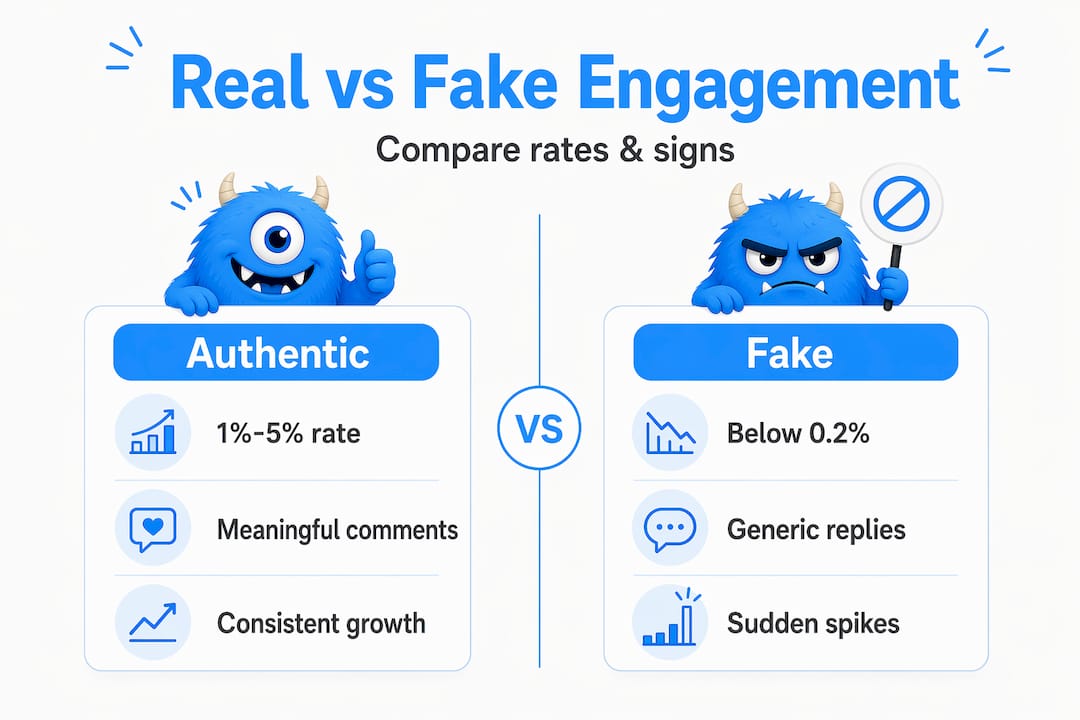
Platform algorithms have become increasingly sophisticated at reading these signals. Engagement quality now outweighs raw follower numbers when it comes to content reach and distribution. Instagram, TikTok, and YouTube all use engagement velocity and quality to decide whether content earns a wider audience or stalls.
The business case for prioritising genuine interaction is direct. A community of 4,000 engaged followers who comment, share, and save will consistently outperform an account with 40,000 passive or fake followers when measured against real commercial outcomes like click-throughs, enquiries, and sales.
- Comments should be relevant, specific, and conversational, not generic phrases like “great post” repeated across multiple accounts
- Shares and saves indicate that content holds enough value for someone to revisit or recommend it
- Watch time on video platforms signals sustained interest rather than accidental clicks
- Replies to stories and DMs represent the deepest level of audience connection
Pro Tip: Set a monthly reminder to check your engagement rate manually. Divide total interactions by total followers and multiply by 100. If the number is trending downward without an obvious cause, investigate your recent follower growth for signs of inauthentic accounts.
Spotting fake followers: red flags that matter
Roughly 15 to 20% of social media accounts involve some level of inauthentic engagement, with bot accounts making up approximately 10% of profiles across major platforms. That is not a fringe problem. For anyone doing influencer outreach, assessing a competitor, or auditing their own account, the ability to spot fakes quickly is genuinely useful.
The most reliable red flags fall into four categories.
Profile red flags are the quickest to spot manually. Look for accounts with no profile picture, usernames consisting of random letters and numbers, zero posts, and follower-to-following ratios that make no sense. An account following 4,000 people with 12 followers and no content is almost certainly not a real person.

Engagement red flags are where the numbers tell the clearest story. Fake engagement commonly features generic comments, repeated phrases across posts, and remarks completely unrelated to the content. A post about home interiors that receives comments like “Amazing!” and “So inspiring!” from accounts with no profile pictures is a textbook example. Real audiences reference the actual content.
Growth pattern red flags are worth monitoring over time. Organic follower growth is slow and steady. When you see an account gain 8,000 followers over a weekend with no notable viral post or press coverage, those followers were bought or manufactured. Most analytics platforms let you view a follower growth chart. A sharp vertical spike is almost always a red flag.
Save-to-like ratios and watch time discrepancies are more advanced signals. Low save rates relative to likes and short watch times on video content indicate that interactions are not coming from genuinely interested viewers.
| Signal | Authentic account | Suspicious account |
|---|---|---|
| Engagement rate | 1% to 5% | Below 0.2% or unnaturally above 20% |
| Comment quality | Specific, relevant, conversational | Generic, repetitive, off-topic |
| Follower growth | Gradual, consistent | Sudden spikes with no clear cause |
| Profile quality | Real photos, bio, post history | No picture, random username, no posts |
| Save-to-like ratio | Proportionate to content type | Disproportionately low saves |
It is also worth understanding that fake follower fraud accounts for 56.5% of marketing campaign fraud. Inauthentic comments add a further 20.8%. If you are paying for influencer campaigns, these numbers justify thorough vetting before any budget is committed.
Pro Tip: When auditing an influencer or checking your own account, scroll manually through the most recent 20 to 30 comments on three or four posts. Look for the same few accounts commenting on every post with generic phrases. That pattern alone is often enough to confirm inauthentic activity.
How to build authentic engagement that lasts
Attracting real followers and keeping them engaged requires consistency, specificity, and genuine effort. These are not difficult principles, but they do require sustained commitment.
Create content with a clear purpose. Every post should answer a question, solve a problem, entertain, or inform. Vague content gets ignored. Content that speaks directly to a specific audience gets shared and saved.
Use interactive elements deliberately. Polls, question stickers, and quizzes on stories are not gimmicks. They create a direct two-way conversation and signal to algorithms that your audience is active. Specific comment prompts generate significantly more genuine conversation than vague captions or no call to action.
Post with timing in mind. Strong early engagement within 30 to 60 minutes of posting is one of the most powerful signals platforms use to decide how widely to distribute content. Post when your existing audience is most active, then reply to every early comment to keep the momentum going.
Respond to comments personally. A reply that references the specific comment shows a real human is present. This builds loyalty in existing followers and signals quality to new ones. Generic replies like “Thanks!” provide almost no benefit.
Use niche hashtags strategically. Massive, overused hashtags bury content instantly. Niche and mid-sized hashtags connect your content with audiences who are genuinely interested in the topic. Test different combinations and track which drive engaged traffic versus passive impressions.
Measure and adjust consistently. Track which content types generate the highest saves, shares, and comment quality. You can find detailed frameworks for this approach in sustainable organic growth strategies that focus on long-term audience building rather than quick wins.
Pro Tip: Reply to comments within the first hour after posting. Not only does it increase the probability of further conversation, but it also sends a strong signal to the platform that the post is generating real interaction, which directly affects distribution.
Verifying your audience: tools and ongoing practices
Spotting fake followers once is useful. Building a process to check regularly is what actually protects your account over time. The importance of genuine engagement cannot be overstated here. An account that gradually accumulates fake followers, whether through purchasing or being targeted by bot activity, will see its organic reach erode steadily.
Several third-party platforms provide follower authenticity analysis. Tools such as HypeAuditor, Modash, and Audiense cross-reference engagement patterns, profile quality, and behavioural data to produce an authenticity score. These are worth using quarterly rather than as a one-off check.
Manual inspection remains genuinely valuable. Human audits catch around 23% more fake engagement than algorithmic tools alone. Running your own check on a random sample of followers every few months costs nothing except time and reveals patterns no automated tool will flag.
It is also worth distinguishing between fake followers and engagement pods. Engagement pods involve real users who agree to interact with each other’s content artificially. The profiles look real and the comments have more substance. However, the engagement is still manufactured, the audiences rarely convert, and platforms are increasingly able to detect and penalise pod behaviour.
Here is a simple ongoing verification checklist to build into your monthly social media review:
- Check your engagement rate across the last 30 days and compare it with the previous month
- Review your follower growth chart for unusual spikes or drops
- Manually inspect 20 to 30 recent followers for profile quality indicators
- Read through comment sections on recent posts for repetitive or generic patterns
- Track your save-to-like ratio to monitor content quality over time
- Use a third-party analytics tool to run a quarterly authenticity audit
If you discover fake followers on your account, remove or block them where possible and report obvious bots to the platform. Understand that paid follower scams create vanity metrics that distort engagement and invite algorithmic penalties. Cleaning up your audience may temporarily reduce your follower count, but your engagement rate and reach will recover and improve. Read more about why people buy followers and the real consequences that follow.
My honest take on chasing follower counts
I have watched a lot of accounts make the same mistake. They focus on the number at the top of their profile and treat everything else as secondary. In my experience, that misses the point entirely.
What I have seen consistently is that the accounts which actually grow revenue, land brand partnerships, and build loyal communities are almost never the ones with the biggest audiences. They are the ones with the most consistent engagement. A food creator with 9,000 followers whose audience genuinely trusts her recommendations will outsell an account with 200,000 followers whose community was partially purchased and never converted.
The uncomfortable truth about fake followers is not just that they waste money. It is the mental impact of fake followers on how creators and business owners make decisions. When your numbers look inflated, you start measuring success against a distorted baseline. You assume content is performing badly when it is actually reaching a fraction of the real audience it should.
My genuine advice is to treat your engagement rate as your primary success metric and your follower count as a secondary one. Build content that earns saves. Respond to every comment for the first three months with genuine effort and watch what happens to your reach. The accounts that consistently outperform their size are doing exactly that.
— Luna
Grow your audience the right way with Greediersocialmedia
If this guide has made one thing clear, it is that genuine growth is built on real interaction, not inflated numbers. At Greediersocialmedia, we have been helping UK businesses and creators build authentic social media presence since 2013, supporting over a million satisfied users in the process.
Our approach focuses entirely on real followers, genuine likes, and actual views, with no password required and no risk to your account. Whether you are just starting out or looking to recover from a period of inauthentic growth, our social media growth tactics are built around measurable, lasting results. Explore fast, authentic follower growth that works alongside your content rather than undermining it. You can also take a look at our affordable social media services to find the right fit for your budget and goals.
FAQ
What is a healthy engagement rate for a real account?
Genuine accounts typically maintain an engagement rate between 1% and 5%, depending on niche and account size. Rates consistently below 0.2% are a strong indicator that fake followers are distorting the numbers.
How can I tell if my followers are fake?
Look for profiles with no photos, random usernames, and no post history, and check whether your comment sections contain generic or repetitive phrases. Organic follower growth is gradual, so sudden large spikes in followers without a clear cause are a reliable red flag.
Do fake followers affect how algorithms distribute content?
Yes, significantly. Platforms prioritise engagement quality signals such as saves, shares, and watch time. A large proportion of fake followers dilutes these signals, which reduces how widely the algorithm distributes your content to real potential audiences.
What is the difference between fake followers and engagement pods?
Engagement pods involve real users who mutually boost each other’s metrics, whereas fake followers are typically automated bots. Both inflate metrics artificially, but pods are harder to detect because the profiles appear genuine.
How often should I audit my follower quality?
Run a manual check monthly and a full third-party analytics audit at least quarterly. Human review catches significantly more fake engagement than automated tools alone, so combining both methods gives the most accurate picture of your audience quality.