

The role of followers in credibility is bigger than most brands realise.
TL;DR:
- Follower count influences perceived credibility by acting as a rapid social proof signal that impacts trust and audience engagement.
- Authentic engagement, follower quality, and transparency are crucial to maintaining and building genuine influence and long-term reputation.
Follower count is a primary social proof signal that shapes perceived credibility within seconds of a profile visit. The role of followers in credibility is not cosmetic. Research shows that follower count correlates strongly with consumer perception and purchase behaviour, with R² values of .43 and .49 respectively. For social media users and marketers, understanding how followers build credibility, and where that influence breaks down, is the difference between a brand that earns trust and one that merely looks the part.
How does follower count function as social proof?
Social proof is the psychological principle that people judge quality by observing what others have already chosen. On social media, follower count is the fastest available proxy for that judgement. A profile with 50,000 followers reads as established. A profile with 500 reads as untested. The audience makes that call in under five seconds.

High follower counts act as a psychological trigger, signalling authority and lowering trust barriers immediately upon a profile visit. This is the bandwagon effect in action. When people see a crowd, they assume the crowd knows something they do not.
The practical consequences for brands are significant:
- Follower count influences whether a new visitor stays or leaves.
- It shapes whether a consumer trusts a product recommendation.
- It affects whether a business partnership enquiry gets a response.
- It determines how algorithms weight content for wider distribution.
Follower count also functions as a queue signalling popularity, helping audiences bypass independent credibility checks. That shortcut is powerful, but it is not unconditional. Audiences have become more discerning, and the shortcut only holds when other signals support it.
For small businesses, the stakes are particularly direct. Follower count impacts sales because it shapes the first impression a potential customer forms before reading a single word of your content.
What factors affect the impact of follower counts on trust?
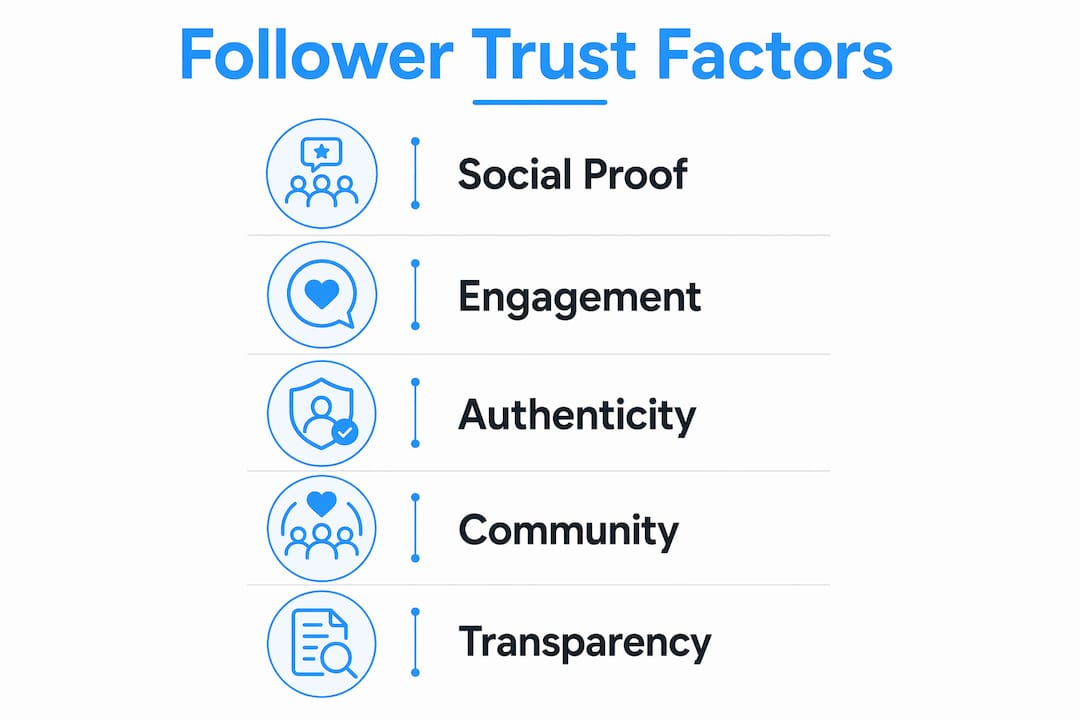
Raw follower numbers are not the whole story. The impact of followers on trust depends heavily on three variables: follower quality, engagement rate, and the type of presence you project.
Authentic versus idealised influencers
Research shows a clear split in how follower count affects credibility depending on influencer style. Authentic influencers benefit from smaller followings, where benevolence credibility is stronger. Idealised influencers, those who project aspirational lifestyles, require larger followings to activate competence credibility. The mechanism is trust mediation. For authentic creators, a tight, engaged community signals genuine connection. For aspirational brands, scale signals authority.
This distinction matters for marketers choosing between creator types. Matching the right follower profile to the right influencer style produces stronger purchase intent than simply chasing the biggest audience.
Engagement as a credibility check
More than 70% of users evaluate engagement metrics alongside follower count before making purchase decisions. That figure reflects a shift in audience sophistication. Gross numbers no longer guarantee credibility on their own. A profile with 200,000 followers and 0.1% engagement raises suspicion rather than trust.
Followers and brand credibility are most effectively built when both metrics move together. High follower counts with proportionate engagement confirm that the audience is real and responsive.
The fake follower risk
Fake followers, paid reviews, and undisclosed sponsorships create a trust crisis that damages credibility permanently, even when raw follower counts remain high. The damage is not temporary. Once an audience suspects inflation, the credibility shortcut reverses. A large following becomes evidence of manipulation rather than authority.
Knowing how to spot fake follower warning signs protects both your own brand and any partnerships you consider.
Pro Tip: Check the ratio of followers to average post engagement before partnering with any creator. A genuine audience typically produces an engagement rate of 1–5% on standard posts. Anything significantly below that warrants scrutiny.
How do followers shape latent authority and role model perception?
Credibility through social media engagement goes deeper than metrics. Followers do not just count a profile. They internalise it. Research confirms that credibility is built through latent authority and role model functions, validated by a seven-factor scale with a reliability coefficient of .800. Those seven dimensions include sincerity, trustworthiness, expertise, similarity, attractiveness, dynamism, and social desirability.
This matters because it explains why follower relationships are not passive. Audiences absorb a creator’s values and behaviours through repeated daily interactions. Over time, a content creator becomes a reference point, not just a source of entertainment.
The seven dimensions of follower-perceived credibility
- Sincerity. Followers assess whether the creator’s values feel genuine, not performed.
- Trustworthiness. Consistent, honest communication builds this over months, not days.
- Expertise. Demonstrated knowledge in a specific domain raises perceived authority.
- Similarity. Audiences trust people who reflect their own experiences and identity.
- Attractiveness. This includes personal appeal and the quality of content presentation.
- Dynamism. Energy, responsiveness, and consistent posting signal an active, credible presence.
- Social desirability. Followers align with creators whose public image they aspire to share.
These dimensions explain why two accounts with identical follower counts can produce entirely different levels of trust. The numbers open the door. The dimensions determine whether the audience stays.
Followers also view influencers as both friends and marketers, a tension that must be managed carefully to maintain credibility over time. When the commercial side becomes too visible, the friendship dimension collapses, and with it, the trust that drives engagement.
For a deeper look at how social proof for influencers translates into real audience trust, the principles above provide the foundation.
Practical ways to build credibility through follower dynamics
The importance of audience in perception means that how you grow your following matters as much as how many followers you gain. Credibility built on a genuine audience compounds over time. Credibility built on inflated numbers erodes the moment scrutiny arrives.
Prioritise follower quality over quantity
Statistical modelling shows that follower count is a biased influence proxy, often misrepresenting true influence compared to engagement-driven metrics. The Generalised Influence Model demonstrates that highly-followed accounts frequently overestimate their actual reach, while smaller, engaged audiences are consistently undervalued. Chasing raw numbers without attention to audience quality misallocates both time and budget.
Follower quality beats quantity as a long-term credibility strategy. A smaller audience that comments, shares, and buys is worth more than a large audience that scrolls past.
Build transparent community interaction
Responding to comments, acknowledging criticism, and crediting your sources are not optional extras. They are the behaviours that activate the sincerity and trustworthiness dimensions of the seven-factor credibility scale. Audiences notice when a creator goes quiet after a controversy or deletes negative feedback. Transparency is not just ethical. It is commercially protective.
Pro Tip: Allocate a fixed time each day to respond to comments and direct messages. Even brief, genuine replies signal that a real person is present behind the account, which directly strengthens benevolence credibility.
Combine follower metrics with qualitative trust signals
Follower count, engagement rate, and content quality work together. No single metric tells the full story. Marketers who build a social media audience with all three in mind consistently outperform those who optimise for one metric alone.
Pairing your follower growth strategy with social proof strategies that drive genuine engagement produces compounding credibility gains. The audience grows, the engagement rate holds, and the trust signals reinforce each other.
Key Takeaways: Role Of Followers In Credibility
Follower count builds credibility fastest when it is backed by genuine engagement, authentic content, and transparent community interaction.
| Point | Details |
|---|---|
| Follower count as social proof | High follower numbers lower trust barriers immediately, acting as a credibility shortcut for new audiences. |
| Engagement validates numbers | More than 70% of users check engagement metrics alongside follower count before trusting a brand or creator. |
| Influencer type changes the equation | Authentic creators gain credibility with smaller audiences; idealised creators need scale to activate authority. |
| Fake followers destroy trust | Artificial audience inflation permanently damages credibility, even when raw follower counts remain high. |
| Quality outperforms quantity | Engaged, genuine followers produce stronger purchase intent and long-term brand authority than inflated numbers. |
Why I think we are measuring credibility backwards
The conversation about followers and brand credibility almost always starts with the number. How many followers do you have? How fast are you growing? Those questions are not wrong, but they are incomplete in a way that costs people real money.
What I have observed consistently is that accounts with 10,000 deeply engaged followers outperform accounts with 100,000 passive ones in every metric that actually matters: click-through rates, conversion, repeat engagement, and word-of-mouth referrals. The credibility that drives behaviour is not the credibility that impresses at a glance. It is the credibility that survives a second look.
The trust crisis emerging from fake followers and non-disclosure is not just an ethical problem. It is a market correction. Audiences are learning to look past the headline number. Platforms are updating their algorithms to weight engagement over raw reach. Brands are demanding proof of genuine audience connection before signing creator partnerships.
My honest view is that the marketers who will win in the next three years are those who treat follower growth as a byproduct of genuine value creation, not as the goal itself. Grow the number, yes. But grow it by earning it. The authentic engagement versus fake followers debate is not really a debate. One builds a business. The other builds a liability.
— Luna
How Greediersocialmedia supports real follower growth
Building genuine credibility through social media takes a clear strategy and the right support behind it.
Greediersocialmedia has helped over a million UK users grow their social media presence since 2013, using real followers, likes, and views without requiring account passwords. The approach is built around authentic engagement, not artificial inflation, which means the credibility you build holds up under scrutiny. Whether you are a small business on Instagram or a creator building authority on Facebook, the platform offers targeted growth that translates into real audience trust. For practical tactics that work in 2026, the social media growth hacks guide covers the methods that produce lasting results.
FAQ
Does follower count directly affect purchase decisions?
Yes. Research shows follower count correlates with consumer purchase behaviour at R² = .49, making it one of the strongest predictors in influencer-driven marketing decisions.
Is a large following always better for credibility?
Not always. Authentic influencers with smaller, engaged audiences produce stronger benevolence credibility than idealised influencers with large but passive followings.
How do fake followers damage a brand?
Fake followers, paid reviews, and undisclosed sponsorships trigger a trust crisis that permanently damages brand reputation, even when overall follower counts remain high.
What engagement rate signals a genuine audience?
A genuine audience typically produces an engagement rate of 1–5% on standard posts. Rates significantly below this suggest audience inflation or low-quality followers.
How do followers build credibility beyond the numbers?
Followers internalise a creator’s sincerity, trustworthiness, and expertise through daily interactions, forming latent authority across seven credibility dimensions validated by a reliability coefficient of .800.