
If you want followers from Manchester, Bristol or Glasgow rather than from anywhere, you need to know where targeting stops being a promise and starts being a product. Country-level targeting is widely available and easy to check. City-level targeting is a different matter: it is mostly earned through local content, local partnerships and paid ads, and a package can only support it. This guide explains the difference, shows you how to measure where your audience lives, and sets out how a UK business or creator can build a following in a particular place.
TL;DR
- Country targeting means your new followers come from a chosen country, such as the UK. City targeting means they come from one town or city. The two are not the same, and most services only deal in the first.
- Check where your current followers live before you decide anything. Meta’s analytics show audience location, and your goals should follow the data, not a guess.
- For a single city, local content, local tags, community groups and location-aware ads do most of the work. A UK-targeted package gives you a base of social proof on top.
- Any purchase should be treated as a supplement to real activity, and you should read each platform’s rules on inauthentic engagement before you buy.
- Measure reach, follower growth and profile actions by location, not the follower count alone.
Table of Contents
- What targeting by city or country actually means
- Can you choose a city at all?
- How to decide: country, region or city
- Check where your followers are today
- How to attract followers in one UK city
- Which platform suits a city audience
- Perspective: where we stand on location and followers
- Where a UK-targeted package fits
- Risks and rules to read first
- How to measure whether it worked
- FAQ
- Sources
What targeting by city or country actually means
When people search for “city targeted followers”, they usually mean one of three different things.
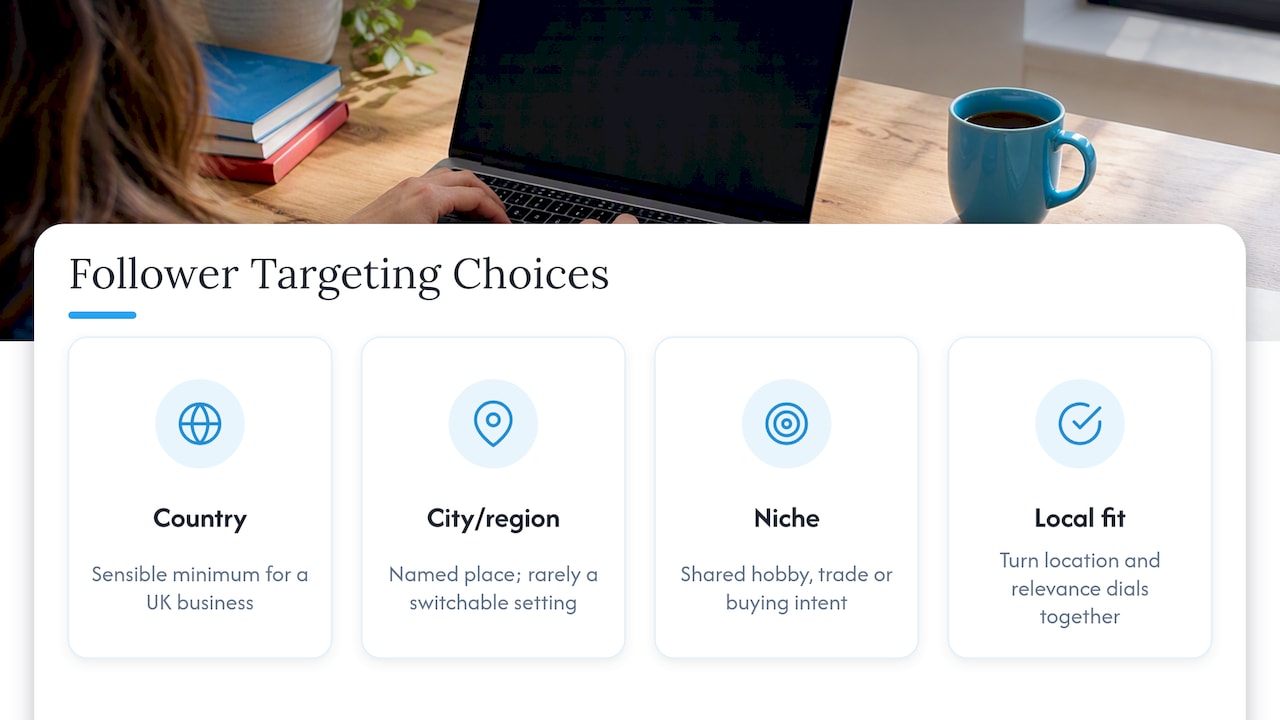
Country targeting. The followers you gain are based in a chosen country. For a UK shop, salon or creator, this is the sensible minimum: a Leeds bakery gains nothing from an audience that lives thousands of miles away and will never visit.
City or regional targeting. The audience is concentrated in a named place, for example Birmingham or the North East. This is usually the result of what you post, where you tag it, who you collaborate with and where you advertise. It is rarely a setting you can switch on.
Interest or niche targeting. The audience shares a hobby, trade or buying intent. This matters as much as location. Fifty thousand followers in Cardiff who don’t care about your product are worth less than five hundred who do.
Our guide to geo-targeted followers goes deeper on the terminology. The point to hold on to here is that location is one dial among several, and a local business needs the location dial and the relevance dial turned together.
Can you choose a city at all?
Honestly: for purchased engagement, you should expect to choose a country, not a street or a city. We deliver UK-targeted and UK/USA-targeted engagement, and we don’t describe it as city-by-city selection. If a provider tells you it can place followers in a named postcode, ask how it would prove that, and what you would see in your analytics afterwards.
There is a practical reason for this caution. Platforms report audience location from the profile and activity of each account, and you see the result in your own insights. Whatever a seller says, the only evidence that counts is what your dashboard shows after delivery. Our piece on buying UK-targeted followers and checking the provider lists the questions worth asking before you pay anyone.
For genuine city-level presence, the reliable tools are:
- Content that names the place and shows recognisable local scenes
- Location tags and local hashtags
- Collaborations with other businesses and creators in the same city
- Posts in local community groups, handled transparently
- Paid ads with a location radius
The rest of this guide shows how to use each.
How to decide: country, region or city
Government export guidance for businesses starts the same way for any market: research the target market and find out which channels its customers actually use, then localise your content to its culture, language and search terms. That advice is written for exporters, but it applies just as well when your “new market” is another UK city. The same guidance warns that if you can’t communicate in a market’s own cultural context, building a large following there is very hard.
In UK terms, that means local tone and local references. A post that says “nipped to the shops” lands differently in Glasgow, Cornwall and Tower Hamlets, and a regular who hears their own city named in your captions feels the difference.
A simple way to choose your level:
| Your situation | Sensible targeting level | Why |
|---|---|---|
| Shop, café or salon serving one town | City or a radius around it | Customers must be able to visit |
| Trades or services covering a county | Region, with named towns in content | Your catchment is wider than one city |
| Online shop shipping across the UK | UK-wide | Everyone in the country is a customer |
| Creator seeking brand deals | UK-wide, then your strongest cities | Brands want a UK audience and proof of local pull |
| Event or venue | The city, plus nearby commuter areas | Attendance is the goal |
The audience targeting guide covers the interest side of this decision in more detail, and why the UK market behaves differently is worth reading if you are used to US-centred advice.
Check where your followers are today
Before spending anything, find out what you already have. Evidence-based planning means using audience data to set channel goals rather than assumptions, and one practical route is to use native tools such as Meta Business Suite, which shows audience location, follower counts over time and benchmarks against similar organisations.
A short routine:
- Open your account’s insights and find the audience or followers section.
- Note the top countries and, where shown, the top cities. Write down the percentages.
- Compare them with where your customers actually are. A café in Norwich with most followers in another country has a targeting problem.
- Repeat monthly. Location mixes shift, particularly after a viral post or a campaign.
If you want to see how location data feeds into content choices, this piece on reading Instagram Insights to understand where followers sit shows how a UK brand can match Reels and TikTok formats to the audience it finds.
Once you have the numbers, set a target you can measure. “60% of followers in the UK, with Manchester in the top three cities” is a goal. “More local followers” isn’t.
How to attract followers in one UK city
This is where most of the long-term value comes from. None of it is exotic, but doing it consistently is what separates accounts that feel local from accounts that merely say they are.
Make your content unmistakably local
Name the neighbourhood. Show the high street, the market, the match-day crowd, the weather everyone is complaining about. Our overview of types of local social media content for UK small businesses gives plenty of formats, and the guide to geo-targeted post types shows how location tags and local references fit each one.
If you are planning a month of city-specific posts alongside a website that explains your services to local customers, a website built for a UK practice is a good example of how page content, event pages and social assets can be designed to work together.
Use location tags and local hashtags
Tag the place in every post and story where it makes sense. Use a small set of hashtags tied to the city and your niche, rather than generic ones with millions of posts. People who browse a location page or a local tag are already interested in that place.
Collaborate with neighbours
Team up with the café next door, the gym around the corner or a local creator. Shared giveaways, takeovers and tagged recommendations put you in front of audiences that already live where you operate. Keep any giveaway properly run: the Advertising Standards Authority has ruled against a prize draw where there was no evidence that entrants were selected randomly.
Be transparent in local community groups
Local Facebook groups can bring genuine customers, but promotion has to look like promotion. In a 2026 ruling the ASA found that representatives’ posts in public Facebook groups were marketing communications that were not obviously identifiable as such. If you post as a business, say so plainly.
Use ads with a location radius
Paid social ads let you set a place and a radius, which is the one route where city-level selection is a built-in control. A small, steady budget aimed at a ten-mile radius around your premises often teaches you more about local interest than a large one aimed at the whole country.
For a wider set of ideas, see ten local customer attraction tactics for UK businesses and our guide to local growth strategies with wider reach.
Which platform suits a city audience
Different platforms reward different local behaviour. Instagram suits visual businesses with a physical presence. Facebook is strong for events, pages and community groups. TikTok can send an unfamiliar venue viral, and YouTube suits longer local guides and tutorials. Our 2026 comparison of local UK platforms walks through the trade-offs. If you can only run one channel well, pick the one your own analytics show your local customers already use.
Perspective: where we stand on location and followers
We have worked with UK businesses and creators since 2013, and the question we hear most is some version of “can I get followers from my area?” Our answer is always the same. A follower count is a first impression, not a customer list. We deliver real, UK-targeted engagement without needing your password, and we’re clear that it works as social proof: it makes a new visitor to your profile more likely to stay and look.
What turns a visitor into a customer in your city is everything else: the local photos, the replies in the comments, the tag on the high street. We would rather you understood that than bought a promise of street-level precision that no honest provider can verify for you. Use a package to give a new or quiet account a credible starting point, then put your effort into the local content that keeps people there.
— Irwin Lee
Where a UK-targeted package fits
A purchase makes sense in a few specific situations: a new account that looks empty beside established local competitors, a launch week when you want your first posts to look active, or a creator who needs credible numbers before approaching brands. It doesn’t replace posting, replying or advertising.
Our packages are one-off, password-free and UK-targeted. Current published prices include:
- Instagram followers from £1.99 up to £229.99, one-off
- Instagram likes from £0.99 to £189.95, one-off
- Instagram video views from £0.59 to £54.99, one-off
- Facebook Page followers from £3.99 to £149.99, one-off, on the Facebook category page
- TikTok followers from £3.99 to £399.99, one-off, on the TikTok category page
- Auto Instagram followers from £15.00 to £100.00 per month
If you are new to this, start with the smallest package that suits your account, watch your insights for a week, and see how the audience location and engagement look before committing to more. Our page on what happens when you buy Instagram followers explains the process step by step.
Risks and rules to read first
Buying followers carries real trade-offs, and you should weigh them before you pay anyone, including us.
- Platform rules. Each platform has its own policies on inauthentic engagement. Read the current terms for the platform you use before ordering, and treat any account you cannot afford to lose with extra care.
- Audience quality. Followers who never interact can drag your engagement rate down, which matters if you pitch to brands. Pair any purchase with content that earns real comments and saves.
- Advertising rules. If you work with brands or run promotions, UK advertising rules apply to you as an individual or small business, as the ASA rulings above show. Prize draws need to be fair, and commercial posts need to be clearly labelled.
- Provider claims. Be sceptical of promises you cannot verify, such as an exact city or a guaranteed result. Ask what you will be able to see in your own analytics.
For a broader view of how UK-targeted followers pay off for smaller firms, see our three numbers for SMEs.
How to measure whether it worked
A higher count tells you little. Track these over four to six weeks:
- Audience location share. Has the percentage of followers in the UK, and in your target city, moved?
- Reach and impressions. Are more people seeing your posts, and are they in the right place?
- Follower growth over time. Is growth continuing after any purchase, or flat?
- Profile actions. Website taps, direction requests and messages are what local customers actually do.
- Referrals and location tags. Are people tagging your venue or mentioning it?
The official channel metrics suggested for this are reach, impressions, referrals, follower growth and location tags, measured against the goals you set for each channel. Write the goals down first and judge the result against them.
If you are focusing on Instagram, our guide to techniques for gaining more Instagram followers pairs well with this routine.
FAQ
Can I buy followers from one specific UK city?
Generally you can choose a country, such as the UK, but not a named city with any way of verifying it. We deliver UK-targeted engagement and don’t promise city-level selection. For a city audience, rely on local content, tags, collaborations and location-radius ads.
How do I see which cities my followers are in?
Open your account’s insights or Meta Business Suite and look at the audience section, which reports location. Note the top countries and cities, then check them again each month. Compare the result with where your customers really live.
Is country targeting enough for a local business?
It depends on your catchment. An online shop shipping across Britain is well served by UK-wide targeting. A café or salon needs people who can visit, so combine UK-targeted social proof with strong local content and a location radius on any ads.
Do UK-targeted followers help me rank in local searches?
We can’t point to evidence that a follower count alone changes local search results, so we don’t promise it. What helps is consistent local content, location tags and customers who interact with your profile.
Should I choose a country other than the UK?
Only if your customers are there. Research the market and the channels its customers use first, and adapt your content to its language and culture. For a business serving UK customers, a UK audience is the sensible default.
Sources
- How to use social media to sell internationally (business.gov.uk)
- Understanding your digital audiences on social media (Art UK)
- ASA ruling on Molly-Mae Hague
- ASA ruling on Juniper Technologies UK Ltd