
UK targeted followers value depends heavily on how genuinely engaged that audience actually is.
UK-targeted followers create real value only when three conditions line up: the audience is genuinely engaged, verifiably British, and matched to your niche. A large, untargeted follower count doesn’t buy you sales. Before spending a penny, check three numbers: engagement rate, UK audience share, and cost per engagement (CPE). If a creator or growth service can’t produce those, treat the follower count as decorative rather than commercial.
TL;DR:
- Targeted UK followers are most valuable when engagement rate, UK audience share, and cost per engagement are verified as high before investing.
- Engagement and relevance drive higher purchase intent and organic reach better than simply increasing follower volume.
- Niche, niche relevance, and engagement rate significantly influence influencer rates, often more than follower count alone.
- Fake engagement signs include sudden follower spikes, low likes relative to followers, and inconsistent audience location data.
- Starting with small, measurable pilot campaigns helps UK brands optimize ROI and avoid overpaying for low-quality or inflated followers.
Table of Contents
- What is UK-targeted follower value, and why does the UK market matter?
- How targeted followers actually create commercial value
- Follower tiers and what UK brands typically pay
- The formulas that tell you if a follower base is actually worth paying for
- Spotting fake engagement and protecting your brand’s reputation
- A step-by-step checklist for assessing a creator before you pay
- What Greediersocialmedia has learned from a decade of UK follower growth
- What actually moves the needle for UK SMEs
- Growing your UK following without the guesswork
- UK Targeted Followers Value: Sources
- FAQ
What is UK-targeted follower value, and why does the UK market matter?
The UK influencer economy runs on scale most marketers underestimate. Statista’s UK influencer marketing data shows earnings vary sharply by follower tier, which is exactly why “value” can’t be judged on raw numbers alone. Platform reach backs this up: DataReportal’s Digital 2023 United Kingdom report puts Instagram and TikTok among the country’s most used social platforms, with tens of millions of active British accounts between them.
Age matters more than most brands realise. Sprout Social found that 84% of UK Gen Z and 68% of UK millennials follow influencers, meaning a huge share of buying decisions in these groups are shaped by who they follow, not just what adverts they see.
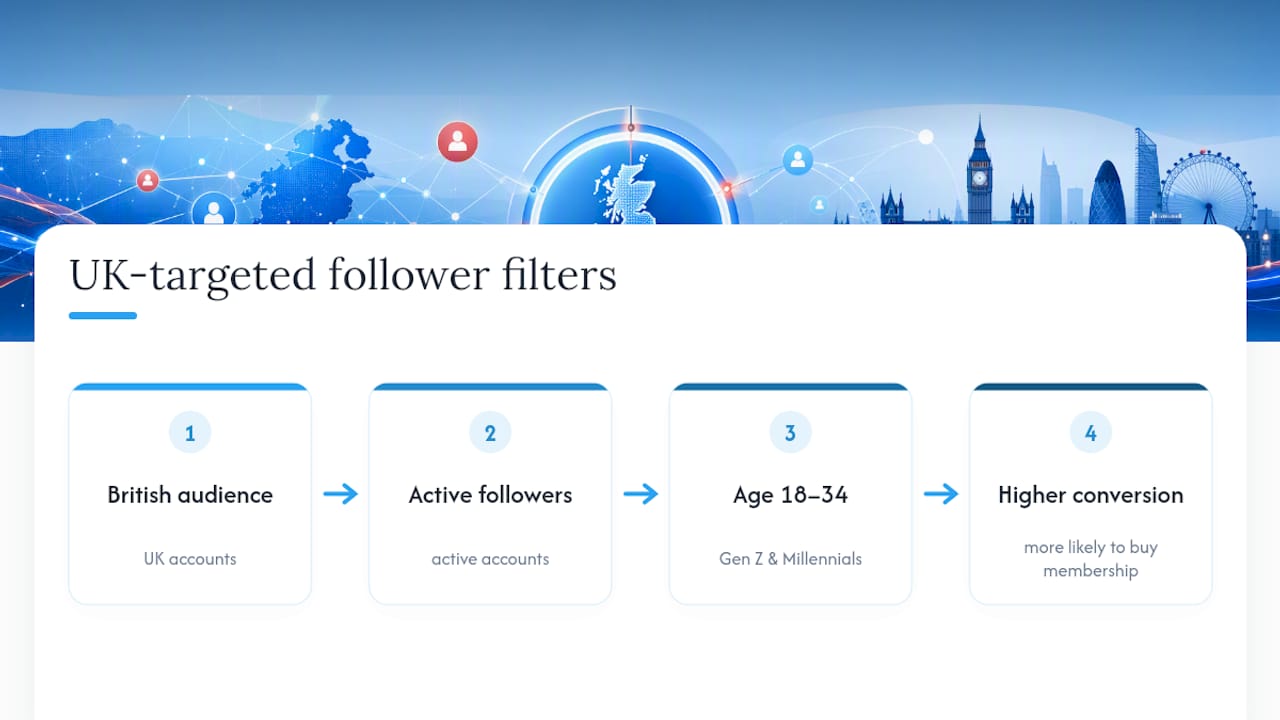
Why does this push up the price of a UK-targeted follower? Because a follower who is British, active, and in the right age bracket is statistically more likely to convert than a follower anywhere else in the world with no connection to your market. A UK gym brand chasing 18 to 34 year olds needs followers who fit that description, not a global number padded with accounts that will never buy a membership. That’s the entire logic behind paying a premium for UK targeting rather than volume.
How targeted followers actually create commercial value
Relevance beats reach. A follower based in Manchester who’s genuinely interested in artisan coffee is worth more to a Manchester roastery than a thousand followers scattered across three continents with no purchase intent. That’s the mechanism behind “audience fit”: targeted followers signal to the algorithm and to human visitors that your account matters to people like them.
Engagement acts as a multiplier. A modest UK following that comments, shares, and saves posts pushes content further into the Explore tab and into more UK feeds than a passive, oversized crowd ever could.
- Relevance drives purchase intent, not just impressions
- Engagement extends organic reach beyond your existing followers
- Social proof helps SMEs win trust fast, particularly with local or niche audiences
- Follower volume misleads when engagement is flat or followers sit in the wrong country
Pro Tip: Before judging any account by follower count, scroll the last ten posts and count genuine comments, not emoji spam. A UK account with 40 real comments per post usually outperforms one with 400 followers and three.
Micro-influencer pricing data backs this up directly: engagement rate predicts return on investment better than follower count, and a smaller, mostly UK audience with strong engagement can beat a bigger international one on results.
Follower tiers and what UK brands typically pay
Influencer and follower pricing in the UK breaks down into recognisable bands, and knowing them stops you overpaying or underestimating a quote.
- Nano (small follower tier): Often paid in product or a small fee; strong for hyper-local trust and authentic-feeling endorsements
- Micro (moderate follower tier): The SME workhorse tier, usually the best cost-to-engagement ratio for niche UK brands
- Mid-tier/Macro (larger follower tier): Bigger reach, but engagement rate typically drops as the audience grows more general
- Mega (largest follower tier): Best for brand awareness campaigns, weakest for direct-response results relative to spend
SocialBrandMatch’s rate calculator uses a working formula, CPM multiplied by an engagement modifier and a niche multiplier, to estimate fair UK fees rather than guessing off follower count alone. Niche and engagement can move the final price by 20 to 60%, according to SocialBrandMatch’s pricing guide, which explains why two accounts with identical follower counts can command wildly different rates.
Follower count sets the starting point; engagement and niche decide the real number.
The formulas that tell you if a follower base is actually worth paying for
Three calculations separate a good deal from an expensive guess.
- Engagement rate = (likes + comments + shares) ÷ followers × 100. Anything meaningfully above the account’s tier average signals a genuinely active audience rather than a dormant one.
- Cost per engagement (CPE) = total spend ÷ total engagements. Dash Social’s UK benchmarks give you a reference point to check whether a quoted CPE sits in line with what UK accounts typically deliver.
- Cost per acquisition (CPA) = total spend ÷ number of tracked conversions, using a unique discount code or UTM link so you can attribute sales directly to the campaign rather than guessing.
Once you have those three figures, compare them against your existing paid-social customer acquisition cost and CPM. If an influencer’s CPA comes in below what you already pay through paid ads, the follower base has proven its worth in hard numbers, not vibes. If it comes in higher with no brand-lift benefit to offset it, that’s your answer too.
Spotting fake engagement and protecting your brand’s reputation
Purchased or low-quality followers leave fingerprints. A sudden spike of a few thousand followers overnight, likes that never climb past a couple of dozen despite a big following, or a follower base weighted toward countries with no obvious link to the account, all point to inflated numbers rather than a real UK audience.
Three checks catch most of it fast:
- Audit the last 20 posts for consistent, proportionate likes and comments relative to follower count
- Pull the audience location breakdown and confirm the UK share genuinely matches the claim
- Check whether engagement holds steady over months or collapses the moment paid promotion stops
There’s a regulatory angle too. The UK’s advertising rules require influencers to disclose paid partnerships clearly, and a creator with a history of undisclosed ads or engagement-pod behaviour is a reputational liability you inherit the moment you work with them.
Pro Tip: Run a quick manual audit before signing any contract: if an account’s follower count has doubled in a month with no viral moment to explain it, treat that as a red flag rather than a bonus.
A step-by-step checklist for assessing a creator before you pay
- Define your objective and your target UK audience precisely. Age, region, and interest all shape which tier and platform actually fits.
- Request a media kit and full audience breakdown, then calculate the expected CPE using their stated engagement rate before agreeing a fee.
- Run a small pilot campaign with a tracked link or discount code, then compare the resulting CPA against your existing paid-social baseline.
- Scale only with contingencies in place, covering content usage rights, reporting cadence, and a clear exit clause if performance drops.
Pro Tip: Treat your first campaign with any creator as a pilot, not a commitment. A single tracked link tells you more in two weeks than any media kit will tell you upfront.
Combining a smaller, credible UK creator with an occasional larger placement tends to balance cost against reach better than betting everything on one big name, a strategy Sprout Social’s UK research also points to. For brands weighing organic growth against paid creator work, this guide to influencer marketing strategies that drive brand growth is worth a read before you commit budget.
What Greediersocialmedia has learned from a decade of UK follower growth
A selected social media growth service has supported UK brands and creators with real, UK-targeted followers, likes, and views for several years, working with a large number of clients across that time. The pattern that shows up again and again: targeted followers work best as one part of a wider approach, sitting alongside organic content and, where budget allows, paid promotion, rather than as a standalone fix.
The advice Greediersocialmedia gives UK customers stays consistent regardless of platform: verify authenticity before paying anyone for reach, start with a modest pilot rather than a full campaign, and measure engagement and conversions before scaling spend. That combination protects your budget and your reputation at the same time. Detail on how a relevant UK audience beats an inflated global one sits in this guide to the strategic benefits of buying Instagram followers in the UK.
What actually moves the needle for UK SMEs
If there’s one thing the data keeps confirming, it’s that follower count is a vanity metric dressed up as a business one. Engagement rate and UK audience share tell you far more about whether a follower base will ever buy anything from you.
For a small UK brand, buying targeted followers makes sense as a credibility boost, giving a new account the social proof it needs to stop looking like a ghost town, provided you pair it with genuine content and don’t mistake the follower count itself for the finish line. It makes far less sense as a substitute for a content strategy, because followers alone don’t write captions or answer customer questions.
Measure everything, question anything that looks too good, and treat every campaign as a test you can improve on next time.
— Luna
Growing your UK following without the guesswork
Certain services offer a faster, lower-effort route to reaching the UK audience, delivering real, targeted followers and engagement without asking for your password.
Here’s what that looks like in practice for a UK business or creator:
- Delivery targeting users in the UK to better match your intended audience
- Services that offer password-free, rapid delivery to reduce security risks and waiting time
- Customer support based in the UK to assist with any issues promptly
If you’ve read this far and you’re wondering how your current follower base stacks up against the benchmarks above, the fastest way to find out is to see what a targeted boost does to your own numbers. Explore the social media growth packages and pick the option that matches the tier you’re aiming for.
UK Targeted Followers Value: Sources
- Sprout Social — UK influencer insights
- Influencer marketing in the United Kingdom (UK) — Statista
- Digital 2023 United Kingdom — DataReportal
- UK social media benchmarks — Dash Social
FAQ
Who is the number one influencer in the UK?
There’s no single official ranking, as “number one” depends on category, platform, and the metric used (followers versus engagement), but UK creators with the highest engagement rates in their niche typically outperform those with the largest raw follower counts.
How much does an influencer with 50,000 followers make per post?
Using UK rate calculators like SocialBrandMatch’s, a micro to mid-tier UK influencer with an appropriate follower count and strong engagement can command a meaningfully higher fee than the base CPM rate once engagement and niche multipliers are applied, with beauty and finance niches typically pricing highest.
Is 10,000 followers enough to be considered an influencer?
Yes, follower counts at the higher end of the nano tier and entry point of the micro tier, combined with strong engagement, are often more commercially valuable to UK SMEs than far larger, less engaged accounts.
What are the top social media platforms used in the UK?
Instagram and TikTok lead usage among younger UK demographics, according to DataReportal’s Digital 2023 United Kingdom report, with Facebook and YouTube also holding substantial UK audiences across older age groups.