
Choosing a growth service UK businesses can actually trust starts with knowing what to check first.
Buy paid social growth as a short, tactical boost tied to a specific campaign, not as a replacement for content you should be posting anyway. It works best on a new account launch, a product drop, or a hero post that needs early momentum. It fails when it’s the only thing you’re doing.
Walk away immediately if a provider asks for your password, promises thousands of followers overnight, or won’t discuss a retention guarantee. Legitimate operators only need a public username or content link.
- Password requested at checkout
- “10,000 followers in 24 hours” type promises with no mention of retention
- No refund policy or contact address listed anywhere on the site
Greedier Social Media targets UK accounts with password-free, drip-fed delivery, which makes it a sensible starting point if you’re ready to test the waters on the main service page.
TL;DR:
- Using paid growth services is most effective for new account launches, product drops, or campaigns needing early social proof, not as the sole strategy.
- Verify providers require no passwords, offer UK-specific targeting, use drip-feed delivery, and provide clear refund policies with retention guarantees.
- Achieving more than 80% follower retention after 30 days indicates genuine accounts, while steep drops suggest bot accounts.
- Start with small test orders of 500 to 2,000 followers and monitor engagement, retention, and organic reach over four weeks before scaling.
- Paid growth works best as a catalyst alongside a strong content plan and targeted campaign, never as a substitute for consistent, quality posting.
Table of Contents
- What paid growth services actually deliver to UK brands
- How do you vet a growth service before buying?
- Will buying followers get my account flagged?
- How much should a UK small business budget for growth services?
- Why Greedier Social Media suits UK buyers who want a safer trial
- What are the legal risks of buying social media growth in the UK?
- Do UK advertising rules affect how you can use bought engagement?
- What should you ask a provider about GDPR and data privacy?
- How have UK businesses used growth services successfully?
- Luna’s practical view: quick rules of thumb for UK small businesses
- Choosing A Growth Service UK: Ready To Try?
- Sources
- FAQ
What paid growth services actually deliver to UK brands
Providers sell four core products: followers, likes, views, and auto-engagement subscriptions that top up new posts automatically. Delivery comes in two speeds. Instant-blast dumps the full order within hours; drip-feed spreads it over days, which mimics how real audiences grow and draws far less attention from platform detection systems.

Speed matters because of how distribution algorithms work. A burst of several hundred quality interactions within the first 20 minutes of posting makes a post far more likely to get flagged as trending and pushed to wider audiences. UK-based accounts and British-English bios help too, since localised engagement supports regional discovery features that platforms use to serve content to nearby users.
Three scenarios where bought engagement genuinely earns its keep:
- Launch day for a new account or product – early social proof convinces the algorithm and human viewers alike that the content is worth showing.
- Event promotion – a countdown post or ticket announcement benefits from a visible early spike.
- Partnership or press moments – a collaboration post or feature article looks more credible with engagement that matches the claim.
How do you vet a growth service before buying?
Treat this like hiring a supplier, not clicking “buy now” on impulse. Five checks separate the acceptable providers from the ones that will get your account flagged or your money lost.
- Confirm password-free fulfilment. Any request for login credentials is disqualifying on its own. Reputable services only need a public username or content link to complete an order.
- Ask for proof of UK targeting. Request specifics: UK IP ranges, British bios, regional account filters. A provider that can’t answer this in one sentence probably isn’t doing it.
- Check for drip-feed and a retention guarantee. Ask directly: “What happens if followers disappear within 30 days?” A proper answer includes a refill policy, not a shrug.
- Demand a visible refund policy and real contact details. No support email or live chat is a warning sign, as is a refund policy buried three clicks deep or absent altogether.
- Run a small test order first. Buy a modest batch, then watch what happens over the following fortnight before spending more.
Pro Tip: Order on a Tuesday or Wednesday rather than right before a weekend campaign. That gives you a clean week to watch retention data before you need the results for anything important.
Starting with 500 to 2,000 followers on a new account is enough to judge quality without risking a meaningful budget. Cheap click-farm bots tend to vanish fast and look nothing like real accounts, whereas aged profiles with posting history and realistic bios are far harder for platforms to flag. That distinction alone explains most of the price difference between providers.
Will buying followers get my account flagged?
It can, but only if the delivery pattern looks unnatural. Platforms watch for sudden spikes with no matching content activity, followers from geographies that don’t match your audience, batches of accounts created on the same day, and engagement that arrives in suspiciously round numbers at suspiciously regular intervals.
You reduce that risk with a handful of habits:
- Stagger delivery across days rather than taking everything at once.
- Mix follower, like, and view purchases instead of boosting the same metric every time.
- Insist on UK-local profiles with real bios, not blank accounts with default avatars.
- Avoid boosting every single post. Reserve it for launches, hero content, and campaigns that need the extra push.
On the operational side, check your analytics daily for the first week after an order. If reach drops instead of rising, pause new purchases and investigate before adding more. A staircase approach, small test, brief pause to observe, then a slightly larger order, protects you far better than one large purchase up front.
Retention above 80% at the 30-day mark signals real-account delivery; bot-driven orders typically collapse within a week or two once a platform runs its next cleanup cycle. That single number tells you more about a provider’s quality than any testimonial on their homepage.
How much should a UK small business budget for growth services?
Keep your first order modest and treat it as a diagnostic, not a commitment. A one-off test of 500 to 2,000 followers is the standard starting point for judging whether a provider delivers real, retained accounts. Beyond that, a monthly spend of roughly £50 to £200 is usually enough for a small brand to give key posts a consistent, modest boost without overspending on a tactic that only supports content, not replaces it.
Track four numbers to know if it’s working:
- Follower retention rate at 7, 14, and 30 days.
- Engagement rate on boosted posts compared with your unboosted baseline.
- Organic reach per post, watching for any decline that would suggest algorithmic suspicion.
- Conversions or enquiries you can trace back to a specific boosted post.
Run this as a four-week test. If either metric slips, stop and switch. Buying engagement without a content plan behind it wastes the spend; it works as a catalyst for good content, never as a substitute for it.
Why Greedier Social Media suits UK buyers who want a safer trial
Greedier Social Media builds its process around the two safeguards this article keeps returning to: password-free delivery and UK-focused targeting, so orders arrive without ever asking for your login. The platform has supported over a million users since 2013, and clients report increased interactions and stronger brand authority after using the service on Instagram and Facebook.
If you’re ready to test it, follow the same discipline outlined above.
- Choose a drip-feed delivery option rather than an instant blast.
- Request UK targeting specifically when you order.
- Start with a small package, not your full monthly budget.
- Monitor retention and engagement for the first two weeks before reordering.
| Point | Details |
|---|---|
| Test before scaling | Order 500–2,000 followers first to judge a provider’s real-account quality. |
| Watch the 30-day mark | Retention above 80% signals genuine delivery; steep drop-off signals bot accounts. |
| Password-free is non-negotiable | Any provider requesting login credentials should be ruled out immediately. |
| Greedier Social Media fits UK buyers | Offers password-free, UK-targeted delivery and has served over a million users since 2013. |
What are the legal risks of buying social media growth in the UK?
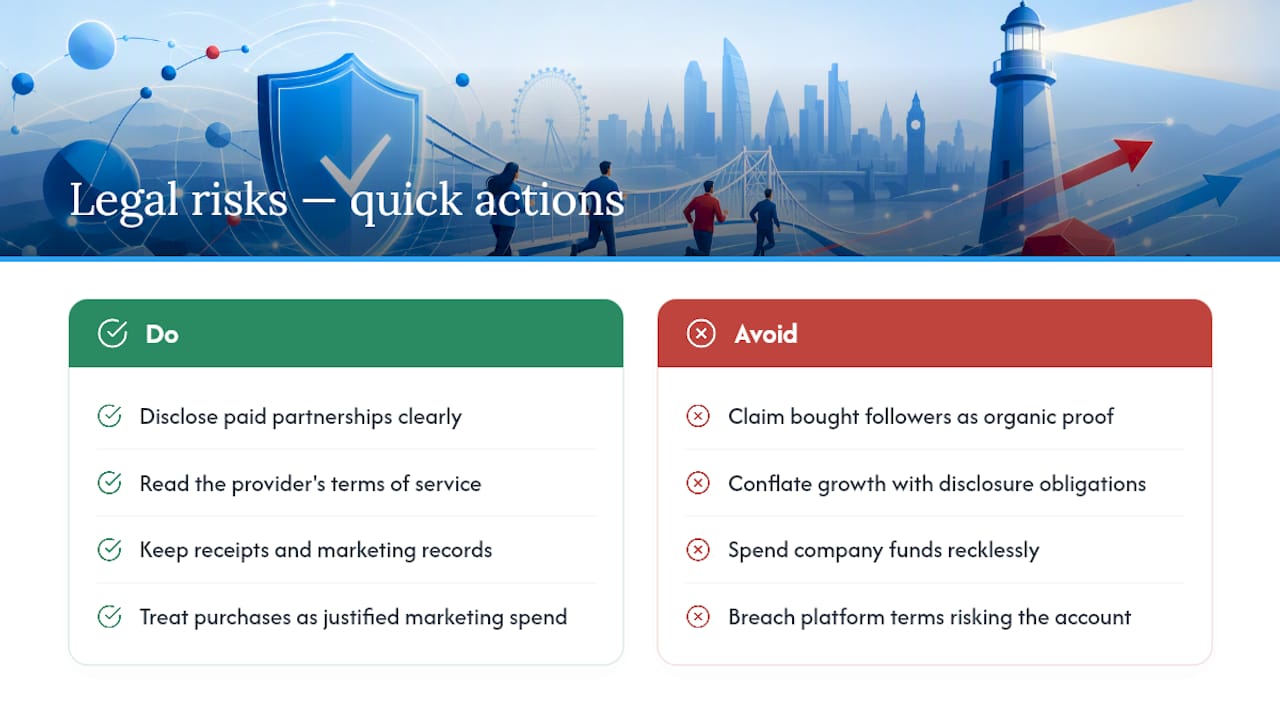
There’s no UK law banning the purchase of followers, likes, or views for a personal or business account. What matters legally is honesty in how you present that growth to others. The Advertising Standards Authority and the Committee of Advertising Practice require that advertising and marketing claims aren’t misleading, so presenting bought followers as proof of organic popularity to secure a brand deal or investment could cross into misrepresentation territory.
If you’re an influencer using paid growth alongside sponsored content, disclosure rules still apply exactly as they would otherwise. The CAP Code requires clear labelling of paid partnerships regardless of how your follower count was built. Growth services and disclosure obligations are separate issues, and conflating them is a common mistake among newer creators.
Company directors also carry a general duty of care under the Companies Act 2006 to act in the company’s best interests, which in practice just means don’t spend company funds on something reckless enough to damage the brand’s reputation or breach a platform’s terms of service in a way that risks losing the account entirely. Read a provider’s terms, keep receipts, and treat the purchase like any other marketing line item you’d need to justify to a co-founder or accountant.
Do UK advertising rules affect how you can use bought engagement?
Yes, indirectly, through how you talk about your numbers rather than the numbers themselves. The CAP Code and its broadcast counterpart, the BCAP Code, govern how UK businesses present themselves in ads, and both hinge on the principle that marketing claims must be “legal, decent, honest and truthful.” A follower count itself isn’t an advertising claim, but using it as evidence of demand, popularity, or customer satisfaction in an ad (“Trusted by 50,000 followers”) edges into claim territory the ASA can query.
This matters most for businesses running paid ads alongside organic growth. If your Instagram ad references audience size to build trust, and a chunk of that audience isn’t a real, reachable customer base, you’re on shakier ground if a competitor complains to the ASA. The safer approach is to let follower counts sit quietly as a credibility signal rather than featuring them as a headline claim in paid creative.
UK GDPR intersects here too. Any advertising that involves audience targeting must respect the same consent and data-handling standards as the rest of your marketing, regardless of how your organic reach was built. None of this makes bought engagement problematic in itself. It just means the regulatory attention falls on your advertising claims, not on the growth tactic that supports them.
What should you ask a provider about GDPR and data privacy?
Ask what personal data they collect when you place an order and how long they keep it. A password-free provider should need almost nothing beyond your username or content link, an email address for order confirmation, and payment details processed through a third party. If a provider wants more than that, ask why.
Confirm where their servers and data processing take place. Under UK GDPR, businesses must ensure any transfer of personal data outside the UK has adequate safeguards, so a provider processing UK customer data through unclear international infrastructure is worth a direct question before you hand over any information.
Ask how they handle data deletion requests and whether they have a published privacy policy that names a contact for data protection queries. A provider without a privacy policy on its own website is unlikely to handle your customers’ data carefully either, which matters if any part of the service ever touches your customer list or account analytics. Five short questions cover it: what data do you collect, where is it stored, how long is it kept, can I request deletion, and who do I contact about a data protection concern. A provider that answers all five without hesitation has done this before.
How have UK businesses used growth services successfully?
The pattern among UK small businesses that get real value from paid growth is consistent: it always sits alongside an active content plan, never in place of one. A boutique launching a new product line uses a boosted hero post to hit early velocity, then lets a week of genuine customer photos and behind-the-scenes content carry the momentum forward. A local event organiser boosts a countdown post in the final 72 hours before tickets go live, when early visibility has the most compounding effect on algorithmic reach.
Creators building a UK-based audience from scratch often use a modest follower boost at launch specifically to clear the credibility threshold where new visitors decide whether an account is worth following. Once that threshold is cleared, organic growth tends to do more of the work, because purchased engagement functions best as a catalyst rather than a strategy on its own. Businesses that skip the content plan and treat the purchase as the whole strategy are the ones who see the numbers rise and then flatten with nothing behind them.
Luna’s practical view: quick rules of thumb for UK small businesses
Buy when you’re launching a new account or running a campaign with a clear conversion goal attached. Skip it when your content isn’t ready yet or you have no plan to measure what happens next. Bought engagement without a content plan is just an expensive way to inflate a number nobody’s checking.
My rule of thumb: test small, measure hard, then scale only what the data supports. Anything less disciplined than that is a gamble dressed up as a growth strategy.
— Luna
Paid social growth works when it accelerates a content plan you’re already committed to, and it fails as a substitute for one.
| Point | Details |
|---|---|
| Verdict first | Buy as a targeted boost tied to a launch or campaign, not as your only growth tactic. |
| Vet before spending | Insist on password-free, UK-targeted, drip-fed delivery with a retention guarantee. |
| Retention is the test | Above 80% at 30 days signals real accounts; steep drop-off signals bots. |
| Budget modestly | Test with 500–2,000 followers, then run £50–£200 monthly for ongoing boosts. |
| Greedier Social Media fits the brief | Password-free, UK-focused delivery with over a million users served since 2013. |
Choosing A Growth Service UK: Ready To Try?
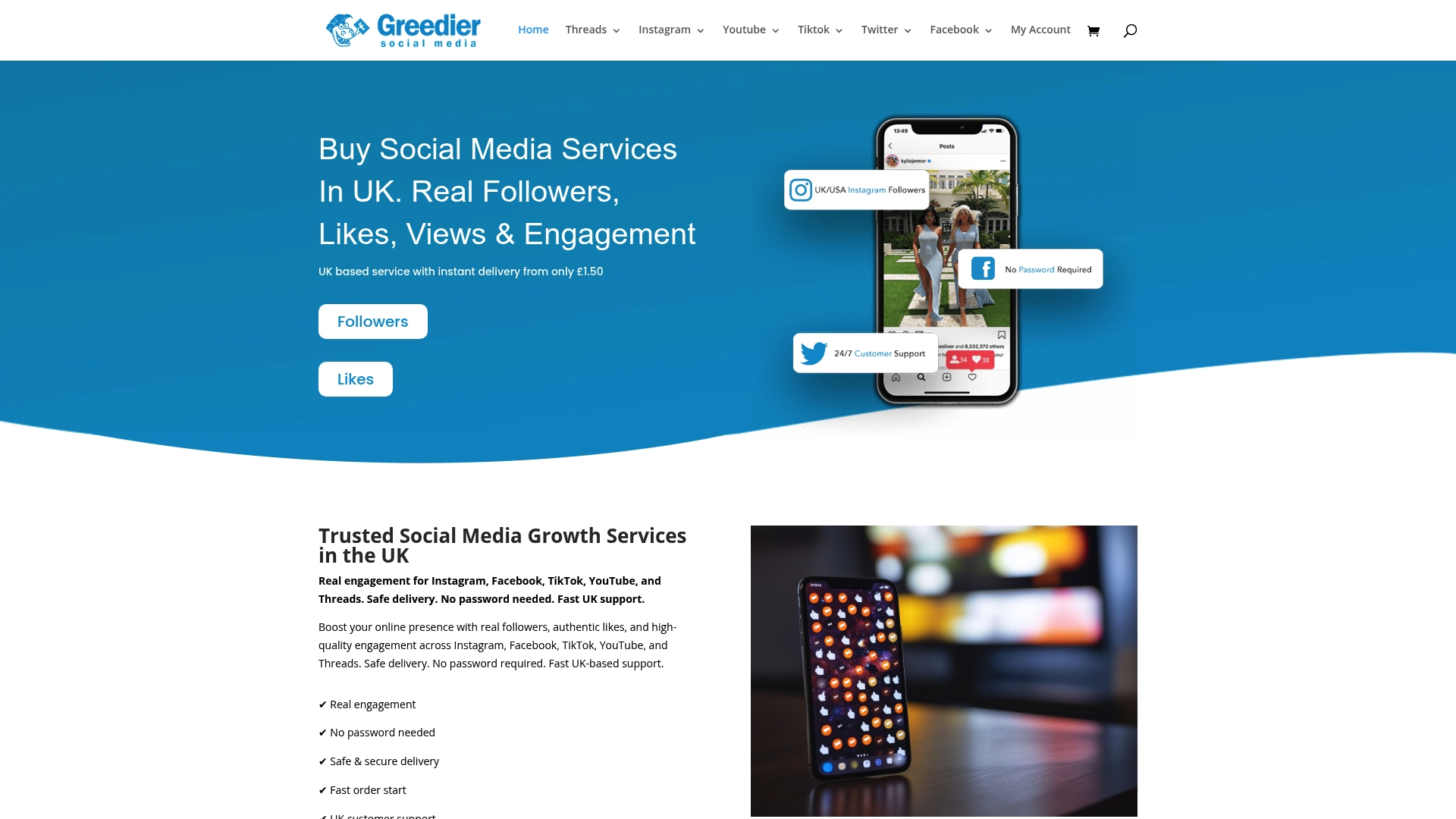
Most agencies charging for social growth lock you into monthly retainers and vague “strategy calls” before you see a single result. Greediersocialmedia skips that entirely: you choose a package, get password-free delivery targeted to UK profiles, and see the boost land within days, not after a discovery call and a proposal.
If you run a website alongside your social accounts, pairing this kind of visibility boost with a landing page built to convert that traffic makes the spend go further, which is where a specialist like Coleman Web Designs fits into the wider picture. For the social side specifically, start where this article recommends starting: small, drip-fed, and measured. Browse the starter growth packages and place a modest test order this week, then judge the results against the 80% retention benchmark before committing a larger budget.
Sources
- Elitemagzine
- 5 Mistakes to Avoid When Buying Social Media Engagement in the UK
- Social Media Growth Service UK: The 2026 Guide to Building Digital Authority
FAQ
Is it legal to buy followers in the UK?
Yes. There’s no UK law against purchasing followers, likes, or views, though advertising rules under the CAP Code require honesty in how you present that growth to customers or investors.
How much does a growth service typically cost in the UK?
A one-off test of 500 to 2,000 followers is a common starting point, with ongoing monthly budgets of roughly £50 to £200 sufficient for small businesses boosting key posts.
Will buying followers get my account banned?
It’s unlikely if delivery is password-free, drip-fed, and UK-targeted with real accounts. Risk rises sharply with instant-blast bot orders that show sudden spikes and geographic mismatches.
How do I know if a growth service is trustworthy?
Check for password-free fulfilment, a visible refund policy, drip-feed delivery, and a retention guarantee. Greedier Social Media builds its process around these exact safeguards for UK clients.
What’s a good retention rate after buying followers?
Anything that drops sharply within the first fortnight usually points to bot-generated accounts.