
Understanding what is social media ad spend actually covers helps businesses budget more accurately.
TL;DR:
- Social media ad spend refers to amounts paid directly to advertising platforms like Meta, TikTok, LinkedIn, and Pinterest. It excludes agency fees, creative costs, and software subscriptions, which are part of the broader marketing budget. Properly separating these expenses ensures accurate measurement of return on ad spend and effective budgeting decisions.
Social media ad spend is the money paid directly to advertising platforms, such as Meta, TikTok, LinkedIn, and Pinterest, to display paid content to targeted audiences. It does not include agency fees, creative production costs, or software subscriptions. US social network ad spend is forecast to exceed $121 billion in 2026, capturing nearly 32% of total US digital advertising investment. That scale confirms paid social is no longer a supplementary channel. For marketing professionals and small business owners, understanding what social media ad spend actually covers is the foundation of every sound budgeting decision.
What is social media ad spend and what does it include?
Ad spend covers only the invoices paid directly to advertising platforms. Every pound or dollar you transfer to Meta Ads Manager, TikTok Ads, LinkedIn Campaign Manager, or Pinterest Ads counts as ad spend. Nothing else does.
The following costs sit outside ad spend and belong in your wider marketing budget:
- Agency retainers and management fees paid to external media buyers or consultants
- Creative production costs including video editing, copywriting, and graphic design
- Marketing software subscriptions such as analytics tools or scheduling platforms
- Staff salaries for in-house social media managers
This distinction matters because mixing these costs into your ad spend figure distorts your performance metrics. A campaign that appears to have a poor return may actually be performing well once agency fees are stripped out.
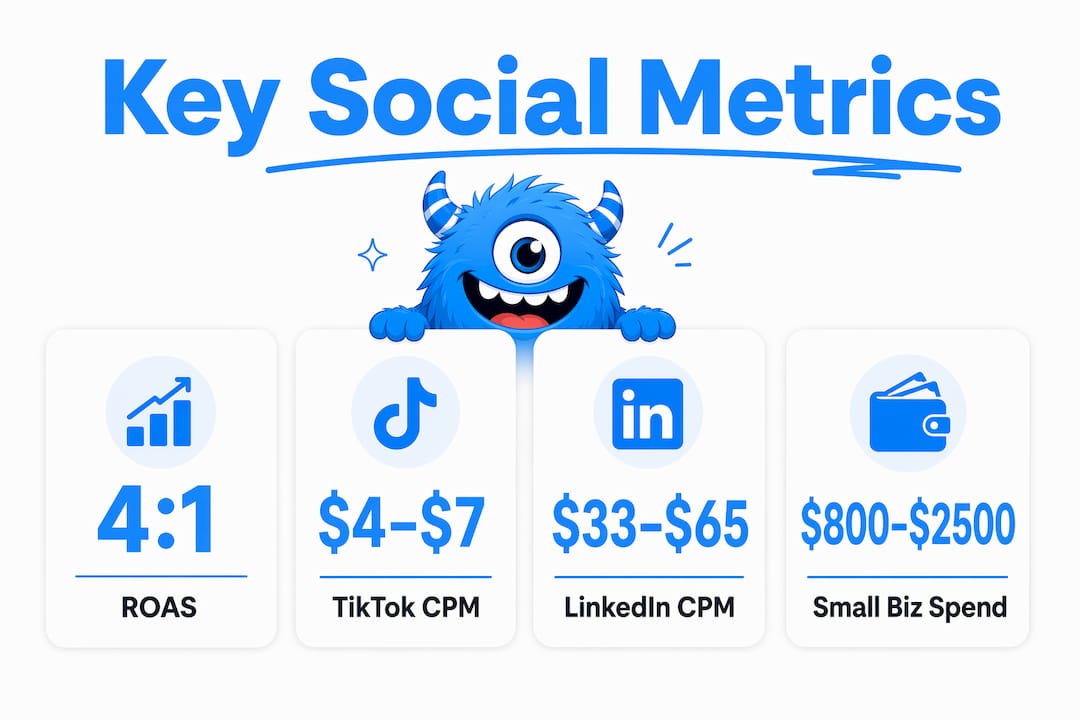
The two metrics most affected by this separation are ROAS and ROI. ROAS equals attributed revenue divided by ad spend alone. ROI, by contrast, accounts for profit minus all costs, including creative, agency, and overhead. A break-even ROAS of 2:1 is typical for low-margin direct-to-consumer campaigns, while 4:1 is considered an acceptable baseline for most paid social activity. High-margin products such as SaaS or information products can target 10:1.
Pro Tip: Use ROAS to make daily campaign decisions and ROI to report overall marketing performance to leadership. Conflating the two leads to poor optimisation calls.
How much do social media ads cost by platform in 2026?
Cost per thousand impressions, known as CPM, is the standard pricing unit across paid social platforms. Average CPM costs in 2026 vary significantly depending on the platform, audience, and campaign objective.

| Platform | Average CPM range | Key note |
|---|---|---|
| TikTok | $4–$7 | Cost-effective for broad awareness and younger audiences |
| Meta (Facebook/Instagram) | $7–$14 | Widest audience reach with mature targeting options |
| $4–$9 | Strong for product discovery and purchase intent | |
| $33–$65 | Premium pricing reflects high-value B2B audiences |
LinkedIn commands a significant premium because its audience targeting is built around professional attributes: job title, seniority, company size, and industry. For B2B marketers selling high-ticket services, that premium is often justified by the quality of leads generated. TikTok and Pinterest, by contrast, offer lower entry costs and suit brands building awareness or targeting consumer purchase decisions.
CPMs also shift based on auction dynamics, targeting specificity, time of year, and ad quality scores. Running campaigns in november and december, for example, pushes CPMs up across every platform as advertiser competition intensifies. Campaign objectives also affect pricing. An awareness objective typically costs less per thousand impressions than a lead generation or conversion objective, because the platform is optimising for a harder action.
Pro Tip: Start with a broad audience and a lower-cost objective such as traffic or video views to gather data cheaply before shifting budget to conversion campaigns.
How much should small businesses spend on social media ads?
Small and medium-sized businesses should start with £800–£2,500 (roughly $1,000–$3,000) per platform per month. That range is not arbitrary. Platforms like Meta and TikTok use a learning phase during which their algorithms test different audience segments and creative combinations to find the best-performing configuration. Budgets below this threshold rarely generate enough conversion events for the algorithm to exit the learning phase, which means campaigns stall before they ever reach their potential.
Industry benchmarks suggest allocating 7–15% of gross revenue to marketing overall, with social media advertising representing 30–50% of that total for growth-focused businesses. A company turning over £500,000 per year might therefore allocate £35,000–£75,000 to marketing, with £10,500–£37,500 directed specifically at paid social.
Practical budgeting tips for small businesses:
- Pick one or two platforms first. Concentrating spend on a single platform builds data faster and exits the learning phase sooner than splitting a small budget across five channels.
- Match budget to deal size. A business with a £50 average order value needs a lower cost per acquisition than one selling £2,000 consultancy packages. Budget accordingly.
- Account for the sales cycle. Longer B2B sales cycles require sustained spend over weeks or months. Short consumer purchase cycles can be tested with smaller, time-limited bursts.
- Review monthly, not weekly. Weekly fluctuations in CPM and ROAS are normal. Monthly reviews give a cleaner picture of true performance trends.
- Build in a testing budget. Reserve 20% of your monthly ad spend for creative and audience testing. This prevents your entire budget from riding on a single untested assumption.
For guidance on local marketing budget allocation, the principles of concentrating spend and tracking cost per acquisition apply equally to paid social and local search campaigns.
How do you optimise social media ad spend for better returns?
The single biggest lever in paid social is creative quality. A winning creative can achieve 2–5 times the click-through rate of an average ad for the same spend. That improvement directly reduces your effective cost per click and cost per acquisition without increasing your budget.
A/B testing is the method that surfaces winning creatives. Test one variable at a time: the opening hook in a video, the headline in a static image, or the call to action button text. Run each variant long enough to gather statistically meaningful data, typically at least 1,000 impressions per variant, before drawing conclusions. The types of campaign objectives you select also shape which creative formats perform best, so align your testing to the objective you are optimising for.
Key optimisation practices that improve returns:
- Concentrate budget on fewer campaigns. Spreading budgets too thin prevents any single campaign from gathering enough conversion data to optimise. Run two strong campaigns rather than eight weak ones.
- Use ROAS as your primary campaign metric. Track revenue attributed to each campaign and compare it against spend. Pause campaigns consistently below your break-even ROAS threshold.
- Refresh creative regularly. Ad fatigue sets in quickly on social platforms, particularly on Meta and TikTok. Rotate new creative every two to four weeks to maintain click-through rates.
- Adjust bids by placement. Instagram Stories, Facebook Feed, and TikTok For You Page each perform differently. Review placement-level data and reallocate spend toward the placements generating the lowest cost per result.
For a deeper look at how campaigns are optimised in live environments, the principles of learning phase management and creative rotation are covered in detail.
Key takeaways
Social media ad spend covers only direct platform payments, and separating it from total marketing costs is the prerequisite for accurate ROAS measurement and sound budget decisions.
| Point | Details |
|---|---|
| Ad spend definition | Ad spend is direct platform payments only; exclude agency fees, creative, and software costs. |
| Platform cost variation | LinkedIn CPMs ($33–$65) far exceed TikTok ($4–$7), reflecting audience value differences. |
| SMB starting budget | Spend £800–£2,500 per platform monthly to exit algorithm learning phases and gather usable data. |
| Creative quality matters | Winning creatives achieve 2–5 times higher CTR, reducing cost per acquisition without extra spend. |
| ROAS vs ROI | Use ROAS for daily campaign decisions and ROI for overall business performance reporting. |
Why most businesses get their ad spend wrong from the start
The mistake I see most often is not overspending. It is underspending in the wrong way. A business allocates £300 per month to Meta ads, sees poor results after four weeks, and concludes that paid social does not work for them. What actually happened is that the algorithm never had enough data to optimise. The campaign spent its entire life in the learning phase, testing audiences and creatives without ever settling on a winning combination.
The second mistake is treating ad spend and marketing budget as the same number. When you include your agency fee and video production cost inside your ad spend figure, your ROAS looks terrible. You then cut the ad budget when the real problem was the creative quality or the agency fee, not the platform performance.
My honest recommendation is to pick one platform, commit to a meaningful monthly budget for at least three months, and invest seriously in creative testing. The businesses I have seen succeed with paid social are not the ones with the largest budgets. They are the ones who understand that budget size determines reach but creative quality determines efficiency. Get the creative right first, then scale the spend.
Platform auction behaviour is also shifting. CPMs on Meta and TikTok fluctuate more than they did two years ago, partly because more advertisers are entering the auction. Flexible monthly budgets that allow you to increase spend during high-performing periods and pull back during expensive auction windows will outperform rigid annual allocations every time.
— Luna
How Greediersocialmedia supports your paid social growth
Paid ad spend gets your content in front of new audiences. What converts those audiences into followers, customers, and brand advocates is the credibility they see when they arrive at your profile.
Greediersocialmedia has helped over a million UK businesses and creators build that credibility since 2013, through real followers, likes, and views delivered without requiring account passwords. When your paid campaigns drive traffic to a profile that already shows strong engagement, conversion rates improve. Explore the social media growth strategy resources on Greediersocialmedia to see how paid and organic growth work together to maximise the return on every pound of ad spend you invest.
FAQ
What does social media ad spend include?
Social media ad spend covers only the money paid directly to advertising platforms such as Meta, TikTok, LinkedIn, and Pinterest. It excludes agency fees, creative production costs, and software subscriptions.
What is a good ROAS for social media advertising?
A ROAS of 4:1 is considered an acceptable baseline for most paid social campaigns. Low-margin direct-to-consumer brands typically break even at 2:1, while high-margin products can target 10:1.
How much should a small business spend on social media ads?
Small businesses should budget £800–£2,500 per platform per month as a starting point. This range provides enough data for platform algorithms to exit the learning phase and begin optimising effectively.
Why does LinkedIn cost so much more than other platforms?
LinkedIn CPMs range from $33 to $65, compared to $4–$7 on TikTok, because LinkedIn’s audience targeting is built around professional attributes such as job title, seniority, and industry. That precision commands a premium from B2B advertisers.
What is the difference between ROAS and ROI in paid social?
ROAS measures attributed revenue divided by ad spend alone and is used for campaign-level decisions. ROI accounts for profit minus all costs including creative and agency fees, making it the right metric for overall business reporting.