
Understanding what is demand generation social media wise separates long-term brand building from quick lead chasing.
TL;DR:
- Social demand generation nurtures buyer interest through persona-specific content to build awareness and trust over time. It differs from lead generation by focusing on education and relationship-building before prospects are actively searching. Success requires long-term consistency, platform tailoring, and tracking pipeline-related KPIs rather than surface metrics.
Demand generation social media is the process of nurturing buyer interest through persona-tailored content on social platforms to drive long-term engagement and pipeline growth. Unlike lead generation, which captures declared intent for near-term sales, demand gen builds awareness and authority over a longer horizon, often before prospects are actively searching. Platforms like LinkedIn, Instagram, Facebook, and TikTok are central to this approach because social media is already embedded in buyer behaviour. The result is a full-funnel system that moves people from first awareness to purchase readiness, with measurable impact on pipeline and revenue.
What is demand generation social media and how does it differ from lead gen?
Social media demand generation is defined as engaging buyers with relevant content throughout the buyer journey to nurture prospects until they are ready to purchase. It is not a campaign. It is a sustained system of education, trust-building, and intent mapping across social channels. HubSpot draws a clear line between the two disciplines: demand generation covers both the creation and capture phases of interest, while lead generation focuses on capturing declared intent for near-term conversion.

The practical difference matters enormously for small businesses. A lead generation post asks someone to fill in a form. A demand generation approach on LinkedIn or Instagram builds the category understanding that makes that form fill feel obvious weeks later. Demand gen covers both creation and capture phases, often before prospects are in-market at all. That upstream influence is where most of the long-term value sits.
Measuring success in demand generation also looks different. Brand awareness, follower quality, marketing-qualified leads, pipeline contribution, and revenue influenced are the benchmarks that matter. Likes and shares alone tell you very little about whether your social activity is actually driving growth.
How does social demand generation work in practice?
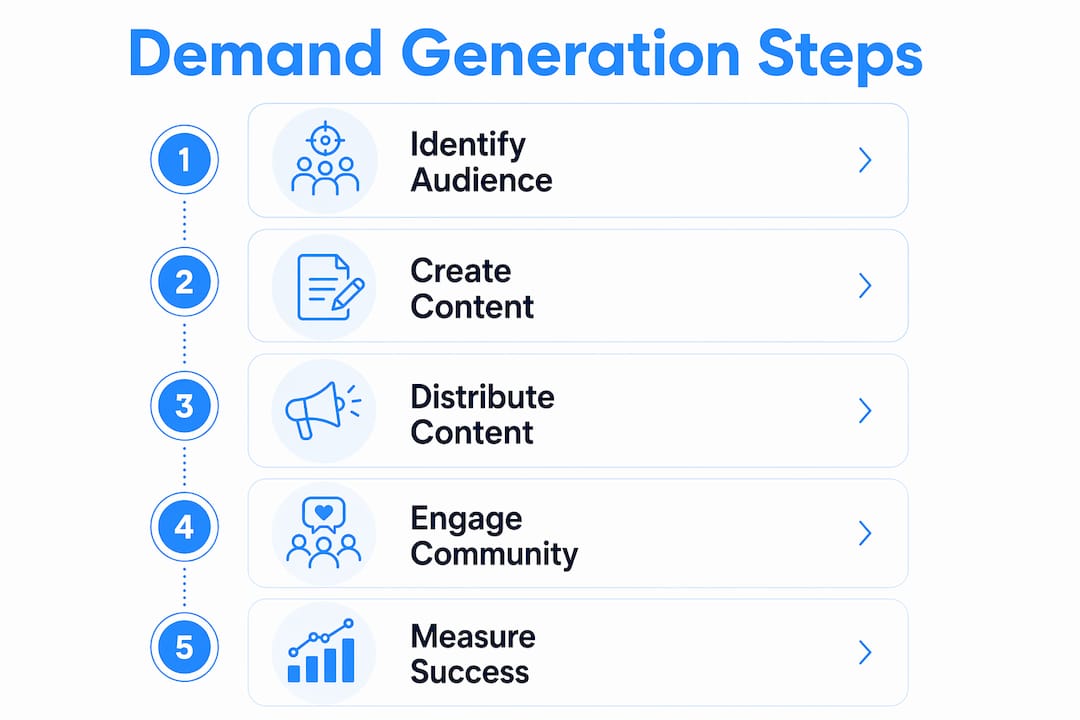
Social demand generation is not just posting content. It is an intent-and-journey system that requires education, trust-building, and careful mapping of content to buyer stages. A prospect at the awareness stage needs a different message than one who has already engaged with your brand three times. Treating every post as if it speaks to the same person at the same moment is the most common mistake marketers make.
The mechanism works across four interconnected activities:
- Content distribution: Publishing educational posts, thought leadership, and proof-led creative that earns attention before asking for anything in return.
- Direct engagement: Responding to comments, joining conversations, and treating replies as relationship signals rather than noise.
- Community building: Creating spaces, whether LinkedIn groups, Facebook communities, or TikTok comment sections, where buyers gather around shared problems.
- Social listening: Monitoring mentions, keywords, and competitor conversations to identify buyer signals before they surface as formal enquiries.
Integrating content, distribution, community, and direct engagement moves prospects from passive engagement to qualified leads. The pipeline impact becomes measurable when these activities are treated as one system rather than separate tasks.
Pro Tip: Set up social listening alerts for the problems your product solves, not just your brand name. Buyers describing their pain points publicly are the warmest prospects you will ever find, and they have not yet spoken to a competitor.
What demand generation techniques work best on social media?
The right technique depends entirely on the platform and the buyer persona. The same content that performs on LinkedIn will underperform on Instagram, and vice versa. Tailoring content to buyer persona and platform is a requirement for effectiveness, not a nice-to-have.
Platform and content format comparison
| Platform | Best content format | Primary demand gen role |
|---|---|---|
| Long-form posts, carousels, thought leadership | B2B authority building and pipeline nurturing | |
| Reels, Stories, user-generated content | Brand awareness and community trust | |
| TikTok | Short educational videos, behind-the-scenes | Top-of-funnel reach and category creation |
| Groups, live video, community posts | Community engagement and retargeting |
Effective demand generation techniques across platforms share three qualities. They educate before they sell. They reflect the specific language and concerns of a defined buyer persona. They give the audience a social-native next step, such as a comment prompt or a save, rather than immediately pushing to a landing page.
The most effective content types for generating demand include:
- Educational posts that answer the questions buyers are already asking in search and in communities.
- Thought leadership from founders or senior team members that builds personal authority alongside brand authority.
- User-generated content and client results that provide social proof without feeling like an advert.
- Proof-led creative that shows outcomes, not just features, because buyers respond to evidence.
Combining organic and paid social activity accelerates results. Organic builds the audience and trust base. Paid amplifies the content that has already proven it resonates. Running paid spend on content that has not yet earned organic engagement is a common waste of budget.
Pro Tip: Before boosting a post with paid spend, let it run organically for 48 hours. If it earns strong comment engagement without promotion, it is a signal the message resonates. That is the post worth amplifying.
For small businesses building a social media growth strategy, starting with one platform done well beats spreading thinly across five.
Which KPIs actually measure social demand generation success?
Vanity metrics are not demand generation metrics. Likes, shares, and follower counts tell you about reach and content appeal. They do not tell you whether your social activity is contributing to revenue. Demand gen metrics include engagement and pipeline contribution, not just surface-level engagement numbers.
The KPIs that indicate real demand generation impact fall into two tiers:
Top-of-funnel indicators:
- Follower quality (are the right people following you?)
- Content reach among target personas
- Engagement rate from defined audience segments
- Social share of voice versus competitors
Pipeline and revenue indicators:
- Marketing-qualified leads sourced from social
- Pipeline contribution attributed to social touchpoints
- Cost per lead from social channels
- Revenue influenced by social engagement
Multi-touch attribution is the measurement model that captures this properly. A buyer might see your LinkedIn post in january, engage with an Instagram Reel in march, and convert via email in april. Last-click attribution gives email all the credit. Multi-touch attribution shows social’s role in the journey. Without it, you will consistently undervalue your social demand generation activity.
Mixing demand and lead metrics incorrectly shrinks the audience of potential buyers you are educating, which harms long-term efficiency. Design demand creation and lead capture as one connected system, not two separate campaigns with separate budgets and separate success criteria.
Greediersocialmedia has a detailed breakdown of the social media KPIs worth tracking in 2026, including platform-specific benchmarks for engagement and pipeline measurement.
How to integrate social demand generation into your wider marketing strategy
Social demand generation produces its strongest results when it connects directly to your email campaigns, CRM, and sales conversations. Social engagement as qualification signals means that a comment on a LinkedIn post or a reply to an Instagram Story is not just a vanity interaction. It is an early indicator of buyer intent that can be routed into a nurture workflow.
Practical integration looks like this:
- Connect social signals to your CRM. When a prospect engages repeatedly with your content, that behaviour should trigger a follow-up sequence, not wait for a form fill.
- Align social content with email themes. If your email campaign is running a series on a specific problem, your social content should reinforce the same message. Consistent messaging across channels accelerates trust.
- Use account-based marketing principles on LinkedIn. Target specific companies with content relevant to their industry and stage. LinkedIn’s targeting capabilities make this achievable even for small teams.
- Build post-click conversion paths that match the content. A prospect who clicks from a thought leadership post should land on a page that continues the conversation, not a generic homepage.
- Brief your sales team on social engagement data. A salesperson who knows a prospect has been engaging with your content for six weeks starts the conversation with far more context than one going in cold.
For B2B businesses, social demand generation builds category understanding and keeps your brand top of mind until buyers enter the active purchasing cycle. Consistent persona-aligned presence is what makes that happen. It is not a sprint. It is a long-term commitment to being the most useful voice in your buyer’s feed.
Audience engagement strategies that connect social activity to downstream sales conversations consistently outperform those that treat social as a standalone broadcast channel.
Key takeaways
Social demand generation works because it builds buyer trust and category awareness before prospects are ready to purchase, making conversion easier and more efficient when the moment arrives.
| Point | Details |
|---|---|
| Demand gen is not lead gen | Demand generation builds awareness and trust over time; lead generation captures declared intent for near-term sales. |
| Platform tailoring is non-negotiable | LinkedIn, Instagram, TikTok, and Facebook each require different content formats and messaging approaches. |
| Measure pipeline, not just likes | Track marketing-qualified leads, pipeline contribution, and revenue influenced, not only engagement rates. |
| Use multi-touch attribution | Social often influences buyers weeks before conversion; last-click models miss this upstream value. |
| Integrate with CRM and email | Route social engagement signals into nurture workflows rather than waiting for form fills alone. |
Why most social demand generation fails before it starts
The single most common mistake I see from marketing professionals and small business owners is treating social media as a content output channel. They build a posting schedule, stick to it for six weeks, see no immediate pipeline movement, and conclude that social demand generation does not work for their business. It does not fail because the strategy is wrong. It fails because the timeline expectation is wrong.
Demand generation on social is a compounding activity. The first month builds almost nothing visible. The third month starts to show audience quality improvements. The sixth month is where pipeline contribution becomes measurable. Most businesses quit at week seven. The ones that stay consistent are the ones that eventually own their category in their buyers’ feeds.
The other pattern I see regularly is over-indexing on one platform because it feels comfortable. A B2B founder who is confident on LinkedIn ignores Instagram entirely, even though their buyers are there too. Platform diversification does not mean spreading yourself thin. It means understanding where your specific buyers spend time at different stages of their journey and showing up there with the right message.
Testing matters more than perfection. A post that earns strong comment engagement from the wrong audience tells you something. A post that earns modest engagement from exactly the right people tells you something more valuable. Refine based on audience quality, not just volume. That discipline, applied consistently over six months, is what separates brands that generate real demand from those that simply generate content.
— Luna
How Greediersocialmedia supports your demand generation growth
Building a social demand generation system from scratch takes time, consistency, and a clear understanding of what actually moves the needle for your audience.
Greediersocialmedia has supported over a million satisfied users since 2013, helping UK businesses and creators build genuine social presence through authentic engagement strategies. Whether you need to grow your follower base on Instagram or Facebook, increase content visibility, or establish the social proof that makes demand generation work, the platform offers real followers, likes, and views without requiring your password. For businesses ready to accelerate their social growth, the social media growth hacks guide covers the practical tactics that complement a strong demand generation strategy.
FAQ
What is demand generation on social media?
Demand generation on social media is the practice of using social platforms to build buyer awareness, trust, and interest over time through relevant, persona-tailored content. It is a full-funnel approach that nurtures prospects from first awareness through to purchase readiness.
How is demand generation different from lead generation?
Demand generation creates awareness and educates buyers before they are ready to purchase, while lead generation captures declared intent from buyers who are already in-market. Both are part of one connected system, not separate strategies.
Which social platforms work best for demand generation?
LinkedIn is the strongest platform for B2B demand generation due to its targeting and thought leadership formats. Instagram and TikTok excel at top-of-funnel reach and brand awareness, while Facebook Groups support community-driven nurturing.
What KPIs should I track for social demand generation?
Track marketing-qualified leads sourced from social, pipeline contribution, cost per lead, and revenue influenced by social touchpoints. Avoid relying solely on likes and shares, which measure reach but not commercial impact.
How long does social demand generation take to show results?
Social demand generation is a long-horizon activity. Meaningful pipeline contribution typically becomes visible after three to six months of consistent, persona-aligned content and engagement activity.