
Understanding what is organic reach, in plain terms, is the first step to actually improving it.
TL;DR:
- Organic reach measures the number of unique individuals who see your unpaid content, not total views. It is driven by genuine engagement signals like shares, saves, and comments, which help content reach new audiences beyond followers. To grow organic reach in 2026, create share-worthy content, post consistently, use platform features, engage actively, and track analytics carefully.
Most people assume organic reach is simply how many times a post gets viewed. It isn’t. Organic reach is the number of unique individuals who see your content without any paid promotion behind it. That distinction matters enormously if you’re a small business owner or content creator trying to grow your audience authentically. Paid views can be bought. Organic reach has to be earned. This guide breaks down the organic reach definition, explains what drives it on major platforms, and gives you practical ways to grow it in 2026.
Table of Contents
- Key takeaways
- What is organic reach, exactly?
- How algorithms decide who sees your content
- Organic reach benchmarks by platform in 2026
- How to increase organic reach: practical strategies
- Measuring organic reach accurately
- My honest take on organic reach in 2026
- Grow your presence with Greediersocialmedia
- FAQ
Key takeaways
| Point | Details |
|---|---|
| Organic reach counts unique people | It measures distinct individuals who saw your content without paid ads, not total views. |
| Engagement drives distribution | Shares and saves expand your reach beyond followers more than likes alone. |
| Platform reach is declining | Facebook averages around 5% of followers reached; Instagram has dropped 25–30% in recent years. |
| Connected vs unconnected reach | Separating follower and non-follower reach helps you understand discoverability and content resonance. |
| Quality beats quantity | Fewer, stronger posts with high watch time and shares outperform frequent, low-engagement content. |
What is organic reach, exactly?
The formal term used by social media platforms and marketers is simply organic reach, and it has a precise meaning. Sprout Social defines it as the total number of unique people who see your content through unpaid distribution. That means no boosted posts, no paid campaigns, and no sponsored placements.
Where people get confused is by mixing up reach with impressions. These are not the same thing. Impressions count every view, including when the same person sees your post three times in a single day. Reach counts that person once. If your post shows up in someone’s feed twice, that is two impressions but one unique reach.
Within organic reach, there is another important split:
- Connected reach: People who already follow your account and see your content through their feed.
- Unconnected reach: People who do not follow you but discover your content through discovery features, shares, or algorithmic recommendations.
The difference matters strategically. Connected reach tells you how well you are serving your existing audience. Unconnected reach tells you how effectively your content is being discovered by new people. Most growth comes from building the second category.
Here is a quick reference to clarify the key metrics:
| Metric | What it measures | Counts repeats? |
|---|---|---|
| Organic reach | Unique people who saw content unpaid | No |
| Impressions | Total content views, including repeats | Yes |
| Paid reach | Unique people who saw paid content | No |
| Engagement rate | Interactions relative to reach or followers | N/A |
Understanding organic reach at this level gives you a proper foundation before you start trying to improve it.
How algorithms decide who sees your content
Organic reach does not happen by accident. It arises from follower activity, genuine engagement, and algorithmic recommendation working together. Every major platform uses signals from your content to decide whether to show it to more people, fewer people, or no one beyond your existing followers.
The most influential signals in 2026 are:
- Shares and sends: When someone shares your post to their stories or sends it directly to a friend, the algorithm treats that as a strong signal of value. Shares and sends are the single biggest driver of unconnected reach growth.
- Saves: On Instagram and similar platforms, saving a post signals that the content has lasting value. Saves carry more algorithmic weight than a passive like.
- Comments: A genuine comment, especially one that starts a thread, tells the algorithm your content is sparking real conversation.
- Watch time: On video-based platforms, how long people watch matters. Posts where viewers stay until the end are heavily rewarded.
- Likes: These still count, but primarily for strengthening reach among your existing connected audience rather than pushing content to new people.
The practical implication is straightforward: stop optimising purely for likes. A post with 50 shares and 200 saves will travel further than a post with 1,000 likes and no other engagement.
Pro Tip: When writing captions, end with a specific prompt that invites a share or save rather than a generic “what do you think?” Try “Save this for the next time you’re stuck on content ideas” and watch how the save rate affects your next post’s distribution.
Platforms like Instagram, TikTok, and LinkedIn all use discovery surfaces including Explore pages, For You feeds, and suggested content sections to extend content beyond a creator’s follower base. Getting content onto those surfaces is the goal of every organic reach strategy worth taking seriously.
Organic reach benchmarks by platform in 2026
Knowing what to expect from each platform helps you set realistic goals and allocate your effort wisely. Here is the current picture:
| Platform | Average organic reach | Key trend |
|---|---|---|
| ~5.2% of page followers | Significant decline over past five years | |
| ~9.8% per post | Down 25–30% recently | |
| 10–15% | Relatively strong; rewards professional content | |
| TikTok | Highly variable | Discovery-first model benefits new creators |
Facebook’s organic reach has declined to roughly 5% of page followers, which means if you have 2,000 followers, only about 100 people see your post organically. Instagram averages around 9.8% per post and has seen a 25–30% drop in recent years. The message from both platforms is clear: they want you to pay for reach. That does not mean organic growth is dead. It means you have to earn it more deliberately.
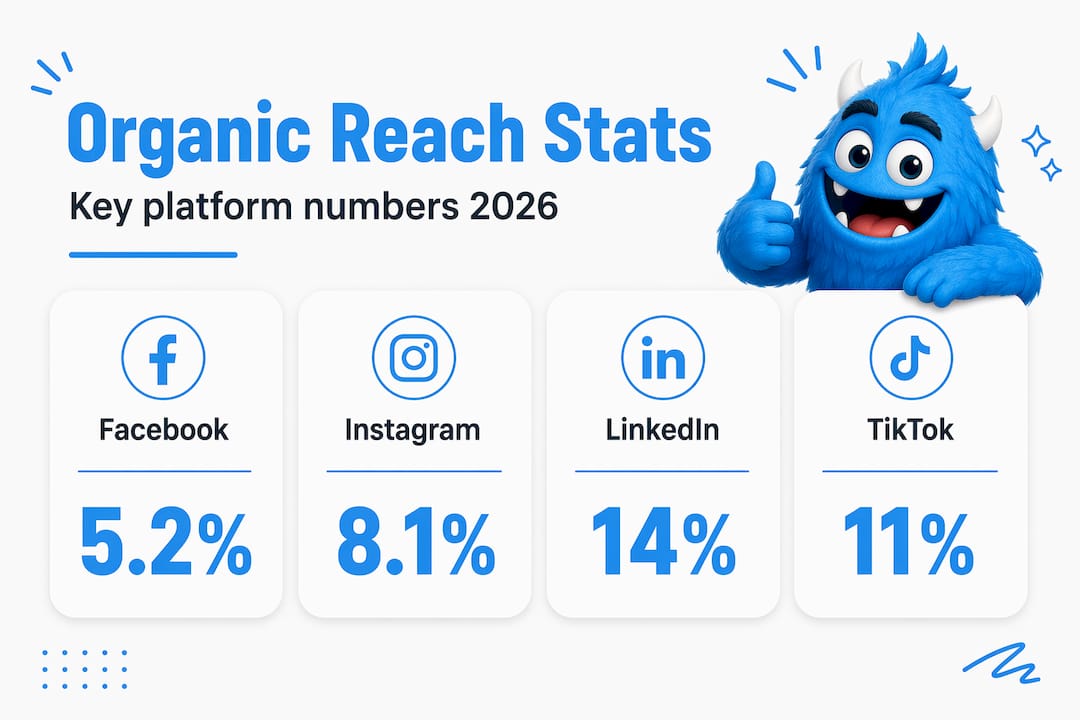
LinkedIn remains the strongest platform for organic reach among professional content. It rewards consistency, personal storytelling, and posts that generate comments. TikTok’s discovery model is uniquely powerful for new creators because content is shown to non-followers first and then scaled based on performance. A single high-performing video can reach hundreds of thousands of people with zero followers.
The content types that consistently earn better organic reach across platforms are polls, questions, behind-the-scenes posts, educational carousels, and community-driven content. Promotional posts, by contrast, earn the weakest organic distribution. Audiences scroll past them; algorithms learn from that behaviour.
How to increase organic reach: practical strategies
The good news is that the benefits of organic reach are real and sustainable. You are building a genuine audience that trusts your content, and that trust compounds over time in a way paid reach never does. Here is how to grow it deliberately.
Focus on share-worthy content first. Before you write a caption or film a video, ask yourself whether someone would send this to a friend. If the answer is no, rethink it. Content optimised for engagement signals such as strong watch time achieves 20–30% better organic results than content optimised for appearance alone.

Post consistently without spamming. Algorithms reward accounts that post regularly. But flooding your feed with low-effort content actively harms your reach because each underperforming post trains the algorithm to show your content to fewer people. Three strong posts per week beat seven mediocre ones.
Use platform-specific features. Instagram Reels, LinkedIn newsletters, and TikTok Duets all receive additional algorithmic preference because platforms want creators using new tools. Explore these features before they become saturated. Check out these Instagram engagement strategies for platform-specific tactics that work.
Never buy fake followers. This point is non-negotiable. Fake followers destroy your organic reach because they do not engage with your content. The algorithm reads low engagement against a large follower count as a trust signal failure. Your content gets shown to fewer real people as a result. Read more about authentic engagement versus fake followers before making any decisions about audience growth.
Engage with your community actively. Reply to comments within the first hour of posting. Comment on other accounts in your niche. The algorithm tracks your own engagement behaviour, not just how others engage with you.
Pro Tip: Pin your strongest performing post from the previous month at the top of your profile. New visitors see it first, which increases engagement velocity on older content and signals to the algorithm that your account consistently produces worthwhile posts.
Measuring organic reach accurately
Tracking your organic reach sounds straightforward until you realise that different tools produce different numbers for the same posts. Hootsuite’s API aggregates daily reach data in a way that can diverge noticeably from figures reported in native platform analytics. Neither is wrong. They are measuring slightly different things with slightly different timeframes.
Here is how to measure it reliably:
- Use native analytics as your primary source. Instagram Insights, Facebook Page Insights, and LinkedIn Analytics report organic reach as the platform itself defines it. These numbers are your baseline.
- Align timeframes across reports. When comparing data from third-party tools, confirm they are using the same date range and post grouping as your native reports.
- Separate connected and unconnected reach. Many analytics dashboards blend follower and non-follower reach into a single figure. Break these apart to understand whether you are growing discoverability or just maintaining your existing audience.
- Combine reach with engagement rate. High reach with low engagement means shallow distribution. Combining engagement rate with reach data helps you distinguish posts with genuine resonance from posts that simply appeared in many feeds.
- Track trends over time, not individual posts. A single post’s reach tells you almost nothing. Monthly averages reveal whether your organic reach strategy is actually working.
For a deeper look at how analytics drives better marketing decisions, tracking the right combination of metrics consistently is what separates creators who grow from those who stall.
My honest take on organic reach in 2026
I’ve worked with enough small business owners to know that most of them are chasing the wrong number. They obsess over raw reach figures and feel deflated when a post only reached 300 people. What I’ve learned is that 300 genuinely interested people who save your post and share it with friends is worth ten times more than 3,000 passive scroll-bys.
The biggest mistake I see is over-posting to compensate for declining reach. More content does not fix an engagement problem. It usually makes it worse. The algorithm builds a reputation for your account based on how your content performs, and a string of low-engagement posts is the fastest way to suppress your future distribution.
What actually works, in my experience, is treating your organic reach strategy like a conversation rather than a broadcast. Create content that invites a response. Respond to every comment in the early hours after posting. Experiment with formats you haven’t tried. Organic reach rewards the creators who treat their audience as real people, not metrics.
I’ll also say this: patience is genuinely required. I’ve seen accounts where organic growth felt invisible for three months before a single well-crafted post unlocked the algorithm’s recommendation engine. That breakthrough almost never happens if you’ve padded your follower count with inactive accounts. Build real, and the reach follows.
— Luna
Grow your presence with Greediersocialmedia
Organic reach is the foundation of sustainable social media growth, but it works best when paired with a smart strategy for visibility. If you’re a small business or creator looking to accelerate results without compromising authenticity, Greediersocialmedia has helped over a million UK users do exactly that since 2013.
Greediersocialmedia offers social media growth hacks designed specifically for businesses that want real traction, not inflated vanity numbers. From tailored engagement strategies to proven social media growth packages built around authentic interaction, the platform gives you the tools to build credibility and reach the audiences that matter. No passwords required, no shortcuts that backfire. Just genuine growth that supports everything you’re already doing organically.
FAQ
What is organic reach on social media?
Organic reach is the number of unique individuals who see your content without paid promotion. It includes your followers and anyone who discovers your content through shares, recommendations, or discovery features.
How does organic reach differ from impressions?
Organic reach counts each person once regardless of how many times they see your post. Impressions count every single view, including multiple views from the same person.
Why is organic reach declining on Facebook and Instagram?
Both platforms have shifted algorithmically to prioritise paid content and reduce unpaid distribution. Facebook’s organic reach now averages around 5.2% of page followers, while Instagram posts reach approximately 9.8% of an account’s audience.
What content types improve organic reach?
Posts that generate shares, saves, and comments consistently earn the strongest organic distribution. Educational carousels, polls, questions, and behind-the-scenes content outperform promotional posts on almost every platform.
Can buying followers hurt organic reach?
Yes, significantly. Fake followers do not engage with your content, which lowers your engagement rate relative to your follower count. Algorithms interpret this as low-quality content and reduce how widely your posts are distributed to real people.