
TL;DR:
- A balanced social media content mix combines educational, curated, and promotional posts to boost engagement and trust. Following frameworks like the 70/20/10 rule helps brands build goodwill before promoting products, which improves organic reach. Regularly reviewing content type performance ensures the mix remains effective across different platforms and audience needs.
A social media content mix is the deliberate combination of content types, including educational, curated, and promotional posts, used to maximise audience engagement and trust. Most marketers recognise three core categories: value-driven content, curated content, and promotional content. The industry standard for balancing these is the 70/20/10 framework, which directs 70% of posts toward audience value, 20% toward curated material, and 10% toward direct promotion. Getting this balance right is not optional. Platforms reward genuine engagement with organic reach, and audiences disengage quickly when feeds feel like catalogues of adverts.
What is a social media content mix and why does it matter?
A content mix is not simply a posting schedule. It is a strategic part of a broader social media plan that aligns every post with a business objective. Think of it as a relationship bank account: every educational or entertaining post makes a deposit of goodwill, and every promotional post makes a withdrawal. Without enough deposits, your withdrawals stop working.

Social media platforms prioritise posts that generate genuine engagement and penalise promotional content with lower organic reach. That single fact explains why brands that post nothing but product announcements see their reach collapse over time. A well-constructed mix keeps the algorithm on your side by consistently delivering content people actually want to see.
For small businesses, the stakes are especially high. You rarely have the advertising budget to compensate for poor organic performance. A disciplined content mix gives you a cost-effective way to build visibility, authority, and trust simultaneously.
What are the main types of social media content and their purposes?
Content types describe the purpose of a post, not its format. A video can be educational, promotional, or curated. Understanding this distinction is the foundation of any effective mix.
The three primary types are:
- Value-driven content: Educational how-to posts, tips, industry insights, and entertaining content that serves the audience directly. This category forms the backbone of the 70/20/10 rule and keeps followers coming back.
- Curated content: Sharing relevant articles, studies, or community posts with your own commentary. This positions your brand as a trusted filter rather than a self-promotional megaphone.
- Promotional content: Product launches, service announcements, offers, and direct calls to action. Effective only when the audience has been primed with sufficient value content first.
Beyond these three, models like the Willow Model introduce additional categories. These include personal content (behind-the-scenes glimpses of your team or process), workplace content (culture and values), and purely entertaining posts. The Willow Model recommends 40–50% educational content and 10–15% promotional posts, with the remainder spread across these supplementary categories.
Pro Tip: Distinguish between content type and content format before you plan your calendar. A carousel, a reel, and a text post can all serve the same educational purpose. Choosing the right content format is a separate decision from choosing the right content type.
What frameworks and ratios work best for planning a content mix?
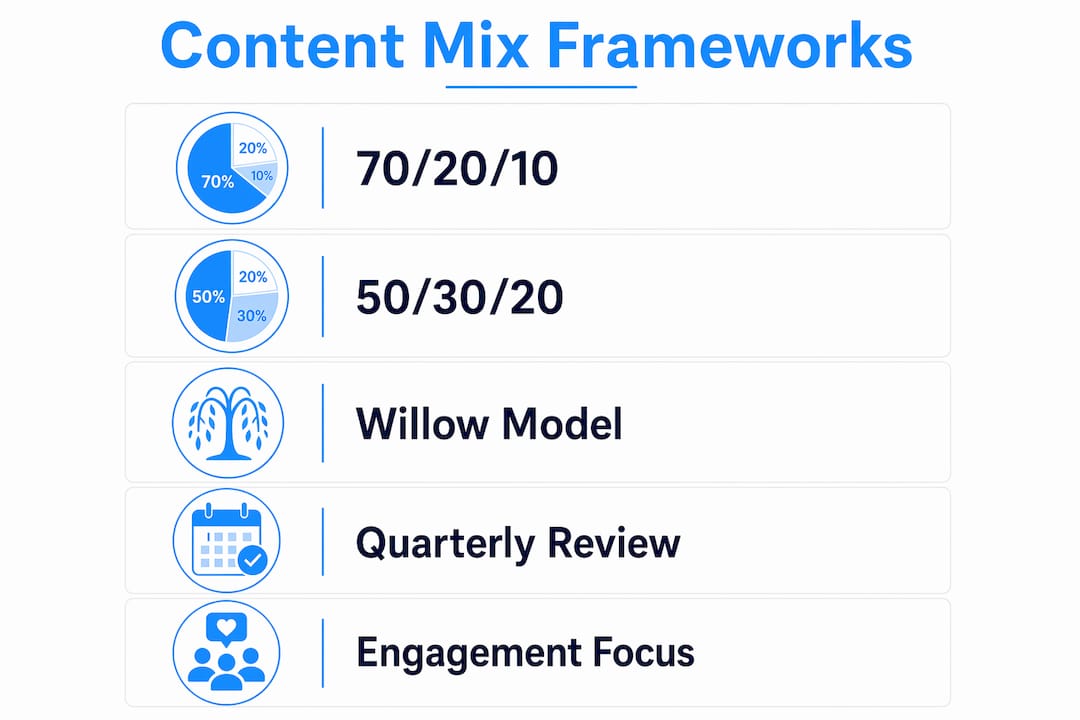
Three frameworks dominate content mix planning in 2026. Each suits a different audience type and business goal.
| Framework | Value-driven | Curated | Promotional | Best suited for |
|---|---|---|---|---|
| 70/20/10 rule | 70% | 20% | 10% | B2C brands, community building |
| 50/30/20 split | 50% insight | 30% story | 20% promotion | B2B audiences, LinkedIn, X |
| Willow Model | 40–50% educational | 25–35% personal/workplace | 10–15% promotional | Mixed audiences, SMEs |
The 70/20/10 rule is the most widely cited starting point. It builds goodwill at scale, making the 10% of promotional posts land with far greater impact than they would in isolation. The rationale is straightforward: audiences tolerate promotion from brands they trust.
The 50/30/20 split is optimised for B2B audiences where insight-driven content drives credibility. The story layer (30%) humanises the brand without tipping into entertainment-heavy territory that can feel out of place on LinkedIn or X. Brands using this split report engagement two to three times higher than single-type posting strategies.
The Willow Model adds nuance by separating personal and workplace content as distinct categories. This matters for small businesses where the founder’s story and company culture are genuine differentiators. Spreading content across five categories also reduces the creative pressure of producing only educational posts.
Pro Tip: Start with the 70/20/10 rule for your first quarter, then review which content type drives the most engagement. Use that data to decide whether the 50/30/20 or Willow Model better fits your audience before committing to a new ratio.
How do audience type and platform affect your content mix?
B2B and B2C audiences differ significantly in what they expect from a brand’s social feed. B2B audiences prioritise insight-driven content that helps them do their jobs better or make smarter decisions. B2C audiences respond more strongly to story-driven posts that create an emotional connection. Applying a B2C-style mix to a LinkedIn audience, or vice versa, produces measurably weaker results.
Platform differences compound this further. What works on LinkedIn does not necessarily convert on TikTok or YouTube. Each platform has its own content norms, algorithm logic, and audience expectations:
- LinkedIn: Insight-driven posts, case studies, and professional commentary perform best. The 50/30/20 split aligns well here.
- X (formerly Twitter): Short-form opinion, curated links with commentary, and timely reactions to industry news drive engagement.
- TikTok: Entertainment-first content with a strong hook in the first two seconds. Educational content works when it is fast and visually driven.
- YouTube: Long-form educational content and tutorials. Value-driven posts dominate, with promotional content reserved for end-of-video calls to action.
Selecting the right content format complements but does not replace strategic decisions about content type. A polished video on the wrong platform with the wrong content type still underperforms. Always match type to audience, then choose the format that suits the platform.
Understanding your social media growth strategy at the platform level is what separates brands that grow consistently from those that plateau after an initial burst of activity.
How to create, measure, and refine your content mix
Building a content mix that actually works requires a process, not just a ratio. Follow these steps to move from theory to results.
- Define your goals and audience needs first. A brand focused on building awareness needs a different mix from one focused on driving direct sales. Write down your primary goal before you assign any percentages.
- Tag every post by content type in your content calendar. This is the single most underused tactic in social media planning. Tagging posts by content type lets you track which category drives the most engagement, saves, and shares, rather than guessing.
- Set a posting schedule that you can sustain. Consistency matters more than frequency. Three well-crafted posts per week outperform seven rushed ones.
- Review engagement rates per content type every quarter. Adjusting the content mix quarterly improves performance substantially. Platforms and audiences shift, and a ratio that worked in january may underperform by april.
- Avoid the most common pitfalls. The “humble brag” story post is one of the most damaging mistakes in content planning. Effective storytelling requires a clear challenge and an honest lesson, not a thinly veiled boast about a win. Audiences recognise the difference immediately, and engagement drops accordingly.
A content calendar does not need to be complex. A simple spreadsheet with columns for date, platform, content type, format, and post copy is enough to start. The goal is visibility into your mix at a glance, so you can spot imbalances before they affect performance.
Pro Tip: Use high engagement post formats as a reference when planning your value-driven content. Knowing which formats your audience responds to makes your educational posts significantly more effective.
Another common mistake is treating content mix rules as rigid. Successful creators adjust ratios every quarter to respond to platform and audience changes. The frameworks are starting points, not permanent rules. Your data is always more reliable than any generic ratio.
Key takeaways
A well-balanced social media content mix, anchored by the 70/20/10 rule or an equivalent framework, is the most reliable method for building audience trust and sustaining organic reach.
| Point | Details |
|---|---|
| Content mix definition | A deliberate balance of value-driven, curated, and promotional posts aligned to business goals. |
| 70/20/10 rule | Allocate 70% value, 20% curated, and 10% promotional content to build goodwill before promoting. |
| Framework selection | Choose between 70/20/10, 50/30/20, or the Willow Model based on your audience type and platform. |
| Measure by content type | Tag every post by type and review engagement quarterly to refine your mix with real data. |
| Platform matters | Adapt your mix per platform since LinkedIn, TikTok, and YouTube each reward different content types. |
Why the content mix is the most underrated tool in a small business’s kit
Most small businesses I work with make the same mistake. They spend weeks perfecting their brand visuals and then post almost exclusively about their products. The mix is completely inverted: 80% promotional, 10% curated, and a token educational post once a fortnight. Then they wonder why their follower count stalls and their engagement rate sits below 1%.
The content mix is not a marketing theory. It is a description of how human relationships actually work. You would not walk into a networking event and immediately pitch everyone in the room. You build rapport first. Social media is no different, and the data from frameworks like the 70/20/10 rule simply formalises what good communicators have always known.
What I find most interesting is how resistant some business owners are to reducing their promotional content. There is a fear that posting less about the product means selling less. The opposite is true. When you prime an audience with genuine value, your promotional posts convert at a higher rate because the audience already trusts you.
My honest advice: treat your content mix as a living document, not a set-and-forget decision. Review it every quarter, be willing to shift ratios based on what the data tells you, and never let a framework override your own audience’s behaviour. The best content mix is the one your specific audience responds to, not the one that looks best in a blog post.
— Luna
How Greediersocialmedia supports your content mix strategy
Building the right content mix is one thing. Getting enough eyes on it to generate meaningful data is another challenge entirely.
Greediersocialmedia has supported over a million users since 2013, helping UK businesses and creators build real visibility on Instagram, Facebook, and beyond. When your content mix is in place and you need to accelerate its reach, the social media growth hacks available through Greediersocialmedia give you a practical way to build the audience your content deserves. Real followers and authentic engagement mean your carefully balanced mix actually reaches people who are likely to respond to it, rather than disappearing into an empty feed.
FAQ
What is a social media content mix in simple terms?
A social media content mix is the planned balance of different post types, typically educational, curated, and promotional, that a brand uses to engage its audience without over-promoting.
What is the 70/20/10 rule for social media?
The 70/20/10 rule directs brands to make 70% of posts value-driven, 20% curated from other sources, and 10% directly promotional, building trust before asking for anything in return.
How often should I review my content mix?
Reviewing and adjusting your content mix every quarter is the standard recommendation, since platform algorithms and audience preferences shift regularly enough to make older ratios less effective.
Does the content mix differ between B2B and B2C brands?
B2B brands perform better with insight-heavy mixes such as the 50/30/20 split, while B2C brands typically benefit from the story-driven and entertainment-rich balance of the 70/20/10 rule.
What is the difference between content type and content format?
Content type describes the purpose of a post, such as educational or promotional, while content format describes how it is delivered, such as video, carousel, or text. The two decisions are independent of each other.