
Understanding how social media discovery works explains why some content spreads and most doesn’t.
TL;DR:
- Social media discovery uses AI algorithms to personalize content based on engagement signals and viewer intent. Prioritizing meaningful interactions, content retention, and niche consistency enhances visibility and reaches. Focusing on authentic engagement metrics like saves and shares yields better growth than follower count or vanity metrics.
Social media discovery is the AI-powered process platforms like Instagram, Facebook, TikTok, and Google Discover use to personalise and prioritise content for each user based on predicted interest and engagement. The industry term for this is algorithmic content recommendation, and understanding how social media discovery works is now a commercial necessity. 44% of online adults use social media to research brands before purchase. That single figure tells you discovery is not a vanity metric. It is the front door to your sales funnel.
How does social media discovery work at its core?
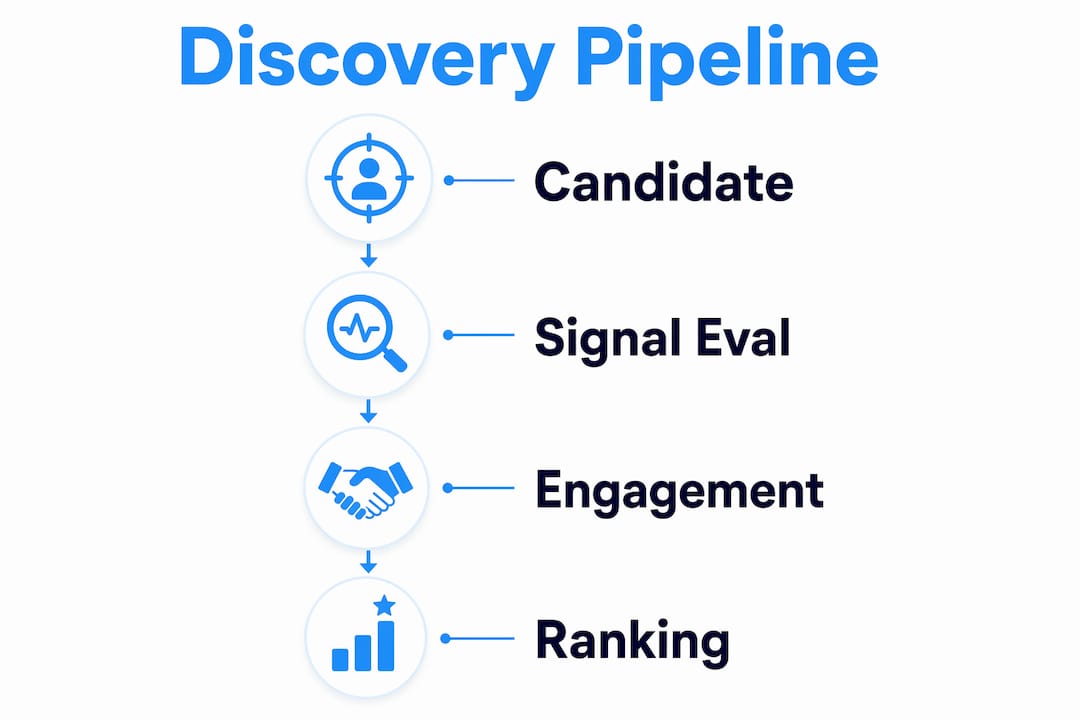
Every major social platform in 2026 runs a four-stage recommendation pipeline: candidate gathering, ranking signal evaluation, engagement prediction, and fast ranking. This pipeline narrows from hundreds of millions of posts down to a personalised shortlist for each user, all within milliseconds. The speed is made possible by AI embeddings, which are mathematical representations of content meaning that allow platforms to match posts to users without relying on hashtags alone.

The shift away from hashtags is significant. Platforms like Instagram and TikTok now use transformer-based semantic matching, the same underlying technology that powers large language models. A post about running shoes does not need the hashtag #runningshoes to reach runners. The algorithm reads the content itself and matches it to users whose viewing history signals an interest in fitness.
The interest graph has replaced the follow graph as the primary distribution model. Your follower count matters far less than whether your content passes performance thresholds when tested against a small initial audience cluster. Content is tested incrementally, and only posts that clear engagement benchmarks get pushed to wider networks.
Pro Tip: Do not optimise for follower count. Optimise for the performance of each individual post. A single high-performing post on a 500-follower account can outreach a mediocre post from a 50,000-follower account.
Which signals actually influence discovery algorithms?
Not all engagement is equal. Direct message sends on Instagram Reels carry more weight in distribution algorithms than likes or comments. Saves and shares follow closely behind. A like tells the algorithm a user noticed your post. A DM send tells it the post was worth interrupting a conversation for. That is a fundamentally different signal.
Here are the engagement signals ranked by influence across major platforms:
- DM sends and shares: The strongest indicators of genuine value. Instagram Reels and TikTok both weight these heavily.
- Saves: Signal that a user wants to return to the content, which implies high relevance.
- Watch time and retention: Audience retention beyond 10 seconds exponentially increases reach on Instagram and TikTok, surpassing simple like counts.
- Substantive comments: Comments that contain sentences or questions carry more weight than single-word reactions.
- Likes: Useful but the weakest signal of the group.
Platform priorities differ. Instagram favours Reels saves and shares. Facebook values meaningful interactions, particularly from close connections. TikTok prioritises watch time and trending audio. Google Discover operates differently again: it requires high-quality images of at least 1,200px wide and technical metadata such as og:image and og:title tags. Missing that metadata significantly reduces visibility and click-through rates on Discover cards.
Algorithms also do not evaluate content in isolation. They predict entertainment value by comparing your individual viewer’s patterns with broader population patterns. Session time and retention matter more than superficial tags or keyword placement.
How does user behaviour shape personalised content pathways?
AI-mediated discovery is not a retrieval system. It is a decision system that interprets user intent, selects content pathways, and reinforces those pathways over time. This distinction matters enormously for creators and businesses.
When a user watches three cooking videos in a row, the algorithm does not just note an interest in cooking. It builds a pathway. Future sessions start with cooking content as the default. Alternatives are progressively deprioritised. The system is self-reinforcing by design.
“Discovery systems continuously reinforce pathways that perform well for users, meaning content misaligned with these pathways struggles for reach regardless of quality.”
This creates the well-documented filter bubble problem. Algorithmic curation improves relevance but simultaneously limits the variety of content shown to users. For new or niche creators, breaking into an established pathway is genuinely difficult without consistent, high-quality signals that align with what the algorithm already knows about a target audience.
The practical implication is this: consistent content clusters speed up audience learning. If you post about three unrelated topics, the algorithm takes longer to build a reliable pathway for your account. If you post consistently within one niche, the algorithm learns faster, tests your content against more relevant audiences, and scales distribution more quickly. Understanding social media reach as a metric helps you track whether your pathway is strengthening or stalling.
How can businesses optimise content for discovery in 2026?
Practical optimisation starts with understanding what the algorithm rewards, then building content that earns those rewards naturally.
Prioritise retention over reach
Create content that holds attention past the 10-second mark. For video, this means front-loading value. Do not spend the first five seconds on a logo animation or a slow introduction. State the most interesting point immediately. For static posts, use visuals that create a reason to pause while scrolling.
Build for early engagement velocity
Early engagement in the first 60 minutes after posting is critical. Posts with fast, high-quality engagement can achieve over 70% of their eventual reach during this window. Post when your audience is most active. Respond to every comment within that first hour. Ask a direct question in your caption to prompt substantive replies from close connections.
Compare follower-led vs performance-led strategies
| Approach | Focus | Algorithm response |
|---|---|---|
| Follower-led | Growing audience size first | Slow; reach depends on existing base |
| Performance-led | Maximising engagement per post | Fast; algorithm tests content beyond followers |
| Hybrid | Combining paid reach with organic signals | Balanced; works well for established accounts |
The performance-led approach aligns directly with how interest graph models work. Content is tested against small clusters and only scales if it passes thresholds. A large follower count does not guarantee that test is passed.
Optimise metadata and visuals
For Google Discover and Facebook, quality metadata and content optimisation can substantially improve ranking and visibility. Use appropriate og:image tags, keep image widths above 1,200px, and write descriptive titles that match user intent rather than clever wordplay.
Pro Tip: Avoid buying fake followers or low-quality engagement. Platforms detect inauthentic behaviour and suppress distribution. Genuine audience signals, even from a small account, outperform inflated vanity metrics every time. Read the authentic engagement guide for a full breakdown.
Key Takeaways: How Social Media Discovery Works
Social media discovery works through a multi-stage AI pipeline that rewards genuine engagement signals, content retention, and niche consistency far more than follower count or hashtag use.
| Point | Details |
|---|---|
| Four-stage AI pipeline | Every major platform uses candidate gathering, signal evaluation, engagement prediction, and ranking to personalise feeds. |
| Retention beats likes | Audience retention beyond 10 seconds exponentially increases reach on Instagram and TikTok. |
| DM sends are the strongest signal | Direct message shares carry more algorithmic weight than likes, comments, or even saves. |
| Early engagement window | Over 70% of a post’s eventual reach is determined within the first 60 minutes of publishing. |
| Niche consistency accelerates distribution | Posting within a consistent content cluster helps algorithms learn and scale your reach faster. |
Why I think most creators are optimising for the wrong thing
After years of watching businesses chase follower counts and obsess over posting frequency, I have come to a firm conclusion: most people are solving the wrong problem. The algorithm does not care how often you post. It cares whether each post earns a genuine reaction from the people who see it.
The shift from follow graph to interest graph changed everything, and most creators have not caught up. I have seen accounts with fewer than 2,000 followers consistently outperform accounts with 200,000 because their content earns saves, shares, and DM sends. The smaller account is winning the signal game, and the algorithm rewards it accordingly.
What concerns me more is the growing tendency to treat algorithm updates as the enemy. Platforms change their ranking criteria regularly, and that is frustrating. But the underlying logic has not changed since 2020: show users content they genuinely want to see, and reward creators who produce it. If your content strategy is built on authentic value rather than gaming specific features, algorithm updates become far less threatening.
My advice is to stop monitoring likes and start monitoring saves, shares, and audience retention rates. Those three metrics tell you whether your content is actually working. Likes tell you someone scrolled past and tapped a button. Saves and shares tell you someone found your content worth keeping or worth sending to a friend. That is the difference between noise and signal.
Explore how social campaigns are optimised to see how these principles translate into measurable campaign performance.
— Luna
How Greediersocialmedia helps you win at discovery
Understanding the algorithm is step one. Acting on it consistently is where most businesses fall short. Greediersocialmedia has supported over a million users since 2013, helping UK businesses and creators build genuine visibility on Instagram, Facebook, and beyond without compromising account security.
Whether you are starting from zero or trying to break through a growth plateau, the social media growth hacks resource covers the tactics that align directly with how discovery algorithms reward content in 2026. From authentic engagement strategies to platform-specific optimisation, Greediersocialmedia offers packages built around real performance signals, not vanity metrics. If you are serious about social media growth for small businesses, this is the practical starting point.
FAQ
What is content discovery on social media?
Content discovery is the process by which social media platforms surface relevant posts, videos, and accounts to users who do not already follow the creator. It is driven by AI recommendation systems that predict what each user is most likely to engage with.
How do social media algorithms decide what to show?
Algorithms use a four-stage pipeline: candidate gathering, signal evaluation, engagement prediction, and ranking. They prioritise content that earns strong early engagement, particularly saves, shares, and watch time, over content that simply has a large follower base.
Why does early engagement matter so much?
Posts can achieve over 70% of their total reach within the first 60 minutes of publishing. Substantive comments and shares from close connections during this window signal quality to the algorithm, which then tests the content against progressively wider audiences.
Does follower count still matter for discovery?
Follower count matters far less than individual post performance. Platforms now use interest graph models that test content against small audience clusters first. If a post passes engagement thresholds, it scales regardless of how many followers the account has.
What is the difference between a follow graph and an interest graph?
A follow graph distributes content to people who already follow an account. An interest graph distributes content based on predicted interest, using semantic embeddings to match posts to users who have never encountered the creator before. TikTok pioneered the interest graph model, and Instagram and Facebook have since adopted similar approaches.