
Knowing what is a social media audit, in practice, is the first step before fixing anything.
TL;DR:
- A social media audit thoroughly reviews a brand’s presence across all platforms to improve strategy. It identifies gaps in profiles, content, audience engagement, and security, guiding targeted actions. Regular audits enable small businesses to make evidence-based decisions and drive consistent growth over time.
A social media audit is a comprehensive, structured review of your brand’s presence across every social platform, evaluating account performance, content effectiveness, and audience alignment. For small business owners and marketers, understanding what is a social media audit means knowing it goes far beyond a monthly analytics report. It is a full strategic reset that tells you what is working, what is wasting your time, and where your next opportunity lies. Greediersocialmedia has supported over a million users since 2013, and the businesses that grow fastest are those that audit before they act.
What does a social media audit cover?
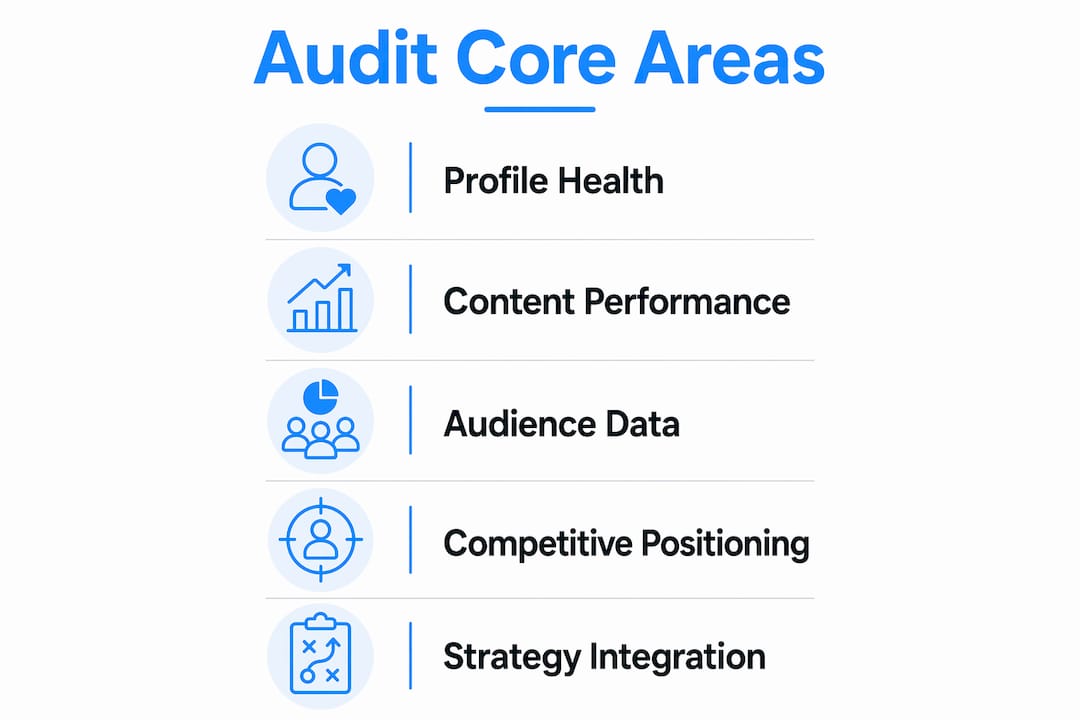
A social media audit covers five core areas: profile health, content performance, audience data, competitive positioning, and security. Each area reveals a different layer of your brand’s online presence. Miss one and your strategy will have a blind spot.
Profile health and branding
Your profiles are the first thing a potential customer sees. Auditing them means checking that every bio, profile image, cover photo, and link is current, consistent, and functional. Actionable CTAs in bios aligned to your goals directly improve conversion. Marketers frequently overlook whether their bios actually tell a visitor what to do next.

Content performance and audience fit
Content performance covers your top formats, engagement rates, reach trends, and follower growth over time. You are looking for patterns, not one-off wins. A post that performed well three months ago tells you something about your audience’s preferences. Tracking key metrics like engagement rate and referral traffic gives you a factual basis for your next content calendar.
A thorough social media audit checklist for marketers covers these items as a minimum:
- Profile completeness: bio, links, profile image, cover image, and username consistency across platforms
- Content audit: top five performing posts by reach and engagement for each platform
- Audience demographics: age, location, and active hours compared against your customer profile
- Engagement rate per post type: video, image, carousel, and text
- Follower growth rate over the past quarter
- Referral traffic from social to your website
- Conversion rate from paid social campaigns
- Competitive positioning: how your engagement benchmarks compare to similar accounts
- Security check: search for impostor or unauthorised accounts using Google and platform search bars
- Platform-specific goal alignment: brand awareness on Instagram, lead generation on LinkedIn
Pro Tip: View every profile as if you are a first-time visitor who knows nothing about your business. That perspective reveals gaps that internal familiarity hides.
How to conduct a social media audit effectively
The steps for a social media audit follow a clear sequence. Skipping steps or doing them out of order produces incomplete findings and weak action lists.
- List every account your brand owns. Include dormant profiles. An old, unbranded account can confuse customers and damage trust.
- Gather your analytics data. Use native platform analytics as your starting point. Consolidated social management tools reduce the total time from 90 minutes to around 60 minutes by pulling data into one place.
- Audit each profile against your checklist. Work through profile health, content performance, audience demographics, and security in that order.
- Benchmark against competitors. You do not need to name rivals directly. Compare your engagement rate and posting frequency against the average for your sector.
- Assess platform-specific goals. Each platform serves different objectives, so apply KPIs that match. Instagram suits brand awareness; LinkedIn suits lead generation; Facebook suits community building.
- Build an explicit action list. Every finding must produce a task. “Engagement is low on Twitter” is an observation. “Test video posts on Twitter for four weeks and measure click-through rate” is an action.
- Set your next audit date. Most brands run full audits quarterly with lighter monthly check-ins focused on content and analytics.
Time allocation matters. A 50-item audit takes roughly 60 minutes when you use integrated tools. Manual data collection, logging into each account separately, adds at least 30 minutes. For a small business with limited time, consolidated tools are not a luxury. They are a practical necessity.
Pro Tip: Keep a running spreadsheet with one tab per platform. Update it monthly so your quarterly audit starts with three months of data already organised, not three months of catching up.
For a broader view of how audit findings connect to planning, the guide on social media strategy planning at Greediersocialmedia covers how to turn raw data into a working roadmap.
Common mistakes that undermine social media audits
The most damaging mistake is confusing a report with an audit. A report tells you what happened. An audit asks what needs to change. Treating them as the same thing produces strategies built on assumptions rather than evidence.
Other frequent errors include:
- Applying the same KPIs to every platform. A one-size-fits-all approach dilutes results. Instagram engagement rate and LinkedIn click-through rate are not comparable metrics. Tailor your KPIs platform-specifically to get meaningful data.
- Ignoring security. Impostor accounts and unauthorised profiles are a real risk for growing brands. A security check using Google and platform search bars takes five minutes and protects your reputation.
- Skipping the customer perspective. Auditing your own profiles from the inside creates blind spots. Log out, open an incognito window, and view your profile as a stranger would. You will notice broken links, outdated offers, and missing CTAs immediately.
- Collecting data without acting on it. An audit that produces no documented action list is a wasted hour. Every finding must feed directly into a strategy update, a bio edit, or a content experiment.
Pro Tip: After every audit, create a simple three-column table: Finding, Action, Owner. Assign each action to a specific person with a deadline. Without ownership, audit findings sit in a document and expire.
The role of social media in branding is a useful reference for understanding why profile consistency and CTAs matter beyond aesthetics.
How to integrate audit results into your social media strategy
Audit findings are only valuable when they change behaviour. The integration step is where most small businesses lose momentum, because translating data into decisions requires discipline.
Start by updating your content calendar based on what your top-performing posts reveal. If carousel posts on Instagram consistently outperform single images, shift your production ratio. If your audience is most active on Thursday evenings, schedule your highest-priority content for that window. Data from your social media performance evaluation should drive these decisions, not gut feeling.
Next, align each platform’s goals with your current business objectives. A business launching a new product line needs brand awareness metrics at the front of its audit. A business focused on repeat customers needs engagement and retention metrics. Objectives shift, and your audit framework must shift with them. The guide on aligning social media objectives covers this in detail for 2026 conditions.
The table below maps common audit findings to the strategy actions they should trigger.
| Audit finding | Recommended action | KPI to monitor |
|---|---|---|
| Low engagement on image posts | Test short-form video for four weeks | Engagement rate per post |
| Follower growth stalled | Increase posting frequency and use platform-specific hashtags | Follower growth rate |
| High reach, low conversion | Add clear CTAs to top-performing posts and bio links | Referral traffic and conversion rate |
| Inconsistent branding across profiles | Standardise profile images, bios, and link destinations | Profile audit score at next review |
| Impostor account found | Report to platform and add a verified badge application | Brand mention monitoring |
Monitoring KPIs after each audit cycle closes the loop. Without post-audit measurement, you cannot tell whether your actions worked. Schedule a monthly check-in focused purely on the metrics tied to your action list. That check-in feeds your next quarterly audit with real evidence rather than guesswork.
A content audit runs parallel to a social media audit and helps identify which content types drive the most traffic across channels, adding another layer of strategic clarity.
Key takeaways
A social media audit is the single most reliable method for aligning your social presence with your business goals and identifying exactly where to focus your effort.
| Point | Details |
|---|---|
| Define the audit correctly | An audit resets strategy; a report only tracks past performance. Treat them as separate tools. |
| Cover all five areas | Profile health, content, audience, competitive positioning, and security must all be assessed. |
| Use integrated tools | Consolidated tools cut audit time to around 60 minutes and reduce manual data errors. |
| Tailor KPIs by platform | Apply platform-specific goals to avoid diluting your findings with irrelevant comparisons. |
| Act on every finding | Document each finding as a task with an owner and a deadline, or the audit produces no value. |
Why audits changed how I think about social media strategy
The first time I sat down with a small business owner to run a proper social media audit, we found three things within the first 20 minutes: an impostor account with 400 followers pretending to be their brand, a bio on their main Instagram profile linking to a page that no longer existed, and a Facebook page that had not been posted to in 14 months but still ranked on the first page of Google for their business name. None of those issues showed up in their monthly analytics report. That is the point.
Small businesses tend to treat social media as a publishing exercise. Post regularly, check the likes, move on. An audit forces a different question: is any of this actually working for the business? The answer is almost always more nuanced than the monthly numbers suggest. I have seen accounts with strong follower counts and almost no referral traffic, and accounts with modest followings that drive consistent sales. The difference is almost always strategic alignment, which only an audit reveals.
The businesses I have seen grow most consistently are those that treat audits as a quarterly habit rather than an annual panic. They are not looking for dramatic revelations. They are making small, evidence-based corrections every three months. Over a year, those corrections compound into a social presence that actually serves the business rather than just existing alongside it.
— Luna
Greediersocialmedia and your next social media audit
Running a thorough audit tells you where your social presence stands. Acting on those findings is where growth actually happens.
Greediersocialmedia has helped over a million UK businesses and creators build genuine visibility on platforms like Instagram and Facebook since 2013. The focus is always on authentic engagement, real followers, and growth that holds up over time. Once your audit identifies the channels and content types worth investing in, the practical social media growth tactics at Greediersocialmedia give you a clear path forward. For small businesses ready to move from audit findings to measurable results, the growth strategy guide for small businesses is the logical next step.
FAQ
What is a social media audit in simple terms?
A social media audit is a structured review of all your brand’s social accounts, assessing profile health, content performance, audience data, and security. It tells you what is working and what needs to change.
How often should a small business run a social media audit?
Most brands run full audits quarterly and lighter monthly check-ins focused on content and analytics. Quarterly is the minimum for meaningful strategic insight.
How long does a social media audit take?
A thorough 50-item audit takes around 60 minutes using integrated tools. Manual data collection across separate accounts can add 30 minutes or more.
What is the difference between a social media audit and a report?
A report tracks what happened over a set period. An audit resets strategy by asking what needs to change. Confusing the two leads to assumption-based decisions rather than evidence-based ones.
What should a social media audit checklist include?
A social media audit checklist covers profile completeness, content performance by format, audience demographics, engagement and reach metrics, referral traffic, conversion rates, competitive benchmarks, and a security check for impostor accounts.