
Knowing the rules around VAT on buying followers UK sellers charge can save an unpleasant surprise later.
If you’re VAT-registered and buying from an overseas supplier, the reverse charge usually means you self-account for that VAT rather than escaping it. Whatever your situation, check how the seller treats VAT before you pay, keep every invoice, and track your turnover against the £90,000 registration threshold.
TL;DR:
- UK creators must track all income sources, including brand deals and platform revenue, to avoid missing the £90,000 VAT registration threshold.
- When buying from overseas, the reverse charge shifts VAT accounting to the buyer, typically resulting in no net VAT cost if properly recorded.
- Buying followers may be deductible if backed by documentation proving it supports specific, measurable business objectives, not just personal reputation.
- Proper invoicing and detailed campaign notes are essential for compliance and to substantiate business purpose if HMRC queries the expense.
- Using UK-based services like Greediersocialmedia simplifies VAT compliance and provides instant, UK-issued invoices suitable for record-keeping.
Table of Contents
- VAT on buying followers UK: which rules actually apply
- When do creators need to register for VAT?
- Buying followers from abroad: does the reverse charge apply?
- Is buying followers a deductible business expense?
- Invoicing, VAT returns and staying compliant
- How Greediersocialmedia supports UK clients with compliance
- Organic growth vs. paid engagement: does VAT treat them differently?
- Recent HMRC guidance on digital marketing services
- VAT on followers versus VAT on advertising spend
- What the rules actually mean for UK creators
- Buy followers through a UK service built for compliance, not confusion
- Sources
- FAQ
VAT on buying followers UK: which rules actually apply
The starting point is simple: paid engagement services, whether that’s followers, likes, views or comments, are treated as a supply of services for VAT purposes. That means the usual VAT machinery kicks in, the same machinery that governs any digital marketing purchase. Two things then decide what actually happens on your invoice: where the supply is deemed to take place, and what rate applies to that type of service.
Place of supply is the concept that tells HMRC (and you) which country’s VAT rules govern the transaction. For business-to-business digital services, the general rule is that the supply is treated as made where the customer is based, not where the supplier is based. So a UK business buying engagement services from a supplier anywhere in the world is generally looking at a UK-taxable supply, at least in terms of which country’s rules apply. The place of supply of services guidance sets this out in detail, and it’s worth reading if your supplier is based outside the UK.
Rate is the more straightforward part. Most marketing and digital services in the UK are standard-rated, meaning 20% VAT applies unless the specific service is listed as reduced-rated or exempt. Buying followers doesn’t fall into any of the narrow exemption categories (things like certain financial services, education, or health), so you should expect the full standard rate to apply when a UK-registered supplier issues an invoice.
Where it gets less predictable is when a marketplace or platform sits between you and the actual provider. A few scenarios worth knowing:
- If you buy directly from a UK-registered supplier, that supplier charges VAT on the invoice and you pay it as part of the price.
- If a marketplace facilitates the sale on behalf of an overseas seller, the marketplace itself can become liable to account for UK VAT under rules covering overseas goods and services sold to UK customers.
- If you buy from an overseas supplier directly and you’re VAT-registered, the reverse charge typically applies instead of the supplier charging VAT upfront.
None of these routes lets you dodge VAT entirely. They just change who’s responsible for accounting for it, and that distinction matters when you’re trying to work out why one supplier’s invoice shows 20% VAT and another shows none at all.
When do creators need to register for VAT?
You must register for VAT once your taxable turnover exceeds £90,000 in any rolling 12-month period, and you need to do it within 30 days of crossing that line, according to gov.uk’s registration guidance. “Rolling” is the word that catches people out. It’s not a fixed tax year window; it’s a constantly moving 12-month lookback, checked every month.
For creators, that threshold sneaks up faster than it sounds. Here’s what typically counts towards it:
- Brand deal income — sponsored posts, ambassador fees, and affiliate commissions all count as taxable turnover.
- Digital product sales — templates, courses, presets, or anything else you sell directly to your audience.
- Platform monetisation — ad revenue shares, creator funds, and tips or subscriptions through platform tools.
- Merchandise and services — anything from print-on-demand sales to paid consultancy or coaching.
Practitioner commentary on influencer income backs this up: creators often underestimate how quickly combined streams add up, because no single income source looks close to £90,000 on its own until you total them. Simplr Accounting’s analysis flags this as one of the most common reasons creators miss their registration date entirely.
Miss it, and the consequences aren’t gentle. HMRC can backdate your VAT liability to the date you should have registered, meaning you owe VAT on sales you never charged VAT on in the first place. Penalties stack on top of that, and once registered you’re also pulled into Making Tax Digital, which requires digital record-keeping and quarterly returns filed through compatible software rather than a spreadsheet emailed to your accountant.
Buying followers from abroad: does the reverse charge apply?
Buying from an overseas supplier doesn’t make VAT disappear if you’re VAT-registered in the UK. Instead, the reverse charge shifts the responsibility for accounting for VAT from the seller to you, the buyer.
Here’s the mechanism in plain terms: normally a UK supplier adds VAT to your invoice, collects it, and pays it to HMRC. Under the reverse charge, an overseas supplier doesn’t add VAT at all. You, as the VAT-registered buyer, effectively charge yourself that VAT on your own return, then reclaim it as input VAT if the purchase genuinely relates to your taxable business activity. The VAT reverse charge guidance walks through exactly how this self-accounting works for digital and telecoms-type services.
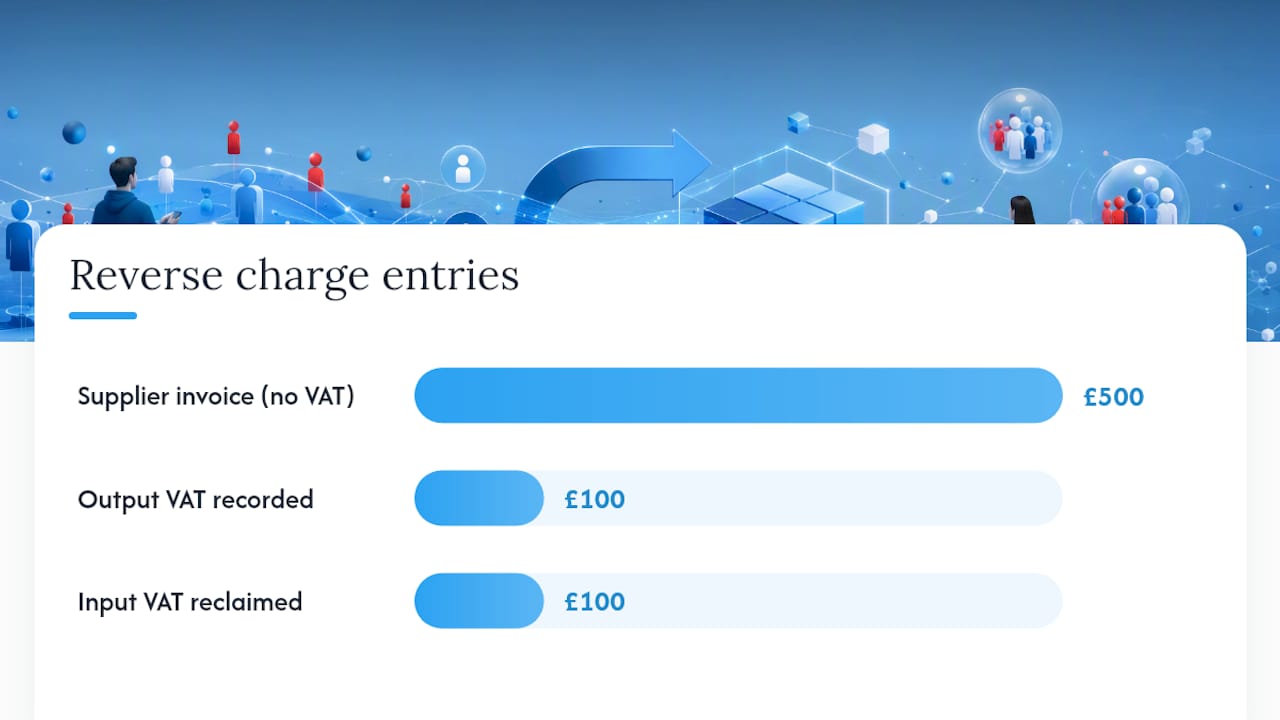
In practice, this usually nets out to zero cost. You record the output VAT and the input VAT in the same return, they cancel each other out, and there’s no cash impact, only an administrative entry you need to get right.
A worked example makes this clearer:
- You’re a VAT-registered UK business buying a £500 engagement package from an overseas supplier who charges no VAT.
- Under the reverse charge, you record £100 of output VAT (20% of £500) on your VAT return.
- If the purchase is for business use, you simultaneously reclaim that same £100 as input VAT.
- Net VAT payable on the transaction: £0, but two entries now appear on your return where a UK supplier’s invoice would have shown one.
Pro Tip: Before paying any overseas supplier, ask whether their invoice includes VAT or not. If it doesn’t, and you’re VAT-registered, that’s your cue to apply the reverse charge yourself rather than assume the transaction is VAT-free. Getting this wrong on a VAT return is one of the more common triggers for an HMRC query.
The insight that trips people up most is thinking a cheaper overseas quote saves them the VAT. For a VAT-registered buyer, it usually doesn’t. The reverse charge closes that loophole by design.
Is buying followers a deductible business expense?
It can be, but only if you can show the purchase was made “wholly and exclusively” for your trade, which is HMRC’s core test for any deductible business cost. That phrase comes directly from HMRC’s internal manual on business expenses, and it’s stricter than most people assume. Buying followers because it feels good for your ego, or because a bigger number looks impressive on your profile, is not the same as buying them for a documented commercial reason.
The distinction HMRC draws is between personal reputation and business purpose. Followers bought to support a specific campaign, launch, or measurable growth objective have a plausible business rationale. Followers bought with no link to any business activity, just for personal “clout”, are far more likely to be disallowed if HMRC ever asks questions.
What actually counts as evidence of business purpose:
- A campaign brief or marketing plan showing what the purchase was meant to achieve.
- Before-and-after metrics linking the purchase to a business goal, like a product launch or event promotion.
- A dated invoice from the supplier showing the transaction, ideally alongside a note of the business reason.
- Timestamps that tie the purchase to a specific business activity rather than sitting isolated with no context.
Red flags that invite scrutiny include vague or missing documentation, purchases with no connection to any campaign, and expense claims made well after the fact with no contemporaneous notes. HMRC’s own guidance is explicit that a payment made primarily for personal standing, rather than a demonstrable commercial purpose, is likely to fail the wholly-and-exclusively test.
Statistic callout: HMRC’s business expenses manual states plainly that expenditure “not incurred wholly and exclusively for the purposes of the trade” cannot be deducted, and the burden of showing that purpose sits with the taxpayer, not HMRC. Poor documentation is the single most common reason legitimate business expenses get disallowed on review, simply because there’s nothing on file to prove the commercial link. A guide on what happens when you buy Instagram followers covers how to tie a purchase to measurable outcomes, which is exactly the kind of paper trail this test rewards.
Invoicing, VAT returns and staying compliant
Getting the paperwork right matters as much as understanding the rules, because HMRC’s questions almost always start with your invoices, not your intentions.
- Check the invoice has everything it needs. A valid VAT invoice must show the supplier’s name and address, their VAT registration number, the date, a description of the service, the amount charged, and the VAT amount separately. The full list of required invoice fields is worth checking against anything you receive, because an invoice missing the VAT number or breakdown can’t be used to reclaim input VAT.
- Record UK and overseas purchases differently. UK supplier invoices go straight into your bookkeeping with VAT shown as input tax. Overseas purchases under the reverse charge need both an output VAT entry and, where eligible, a matching input VAT entry, recorded on the same return.
- File through Making Tax Digital-compatible software once registered. Spreadsheets alone no longer satisfy HMRC’s digital record-keeping requirement for VAT-registered businesses.
- Get an accountant involved before you hit the threshold, not after. The most common pitfalls are registering late because combined income streams weren’t tracked, and misclassifying platform income or brand deals as something other than taxable turnover.
None of this is exotic accounting. It’s the same discipline any small business applies to supplier invoices, just extended to a category of spend that’s easy to treat casually because it happens in a few clicks rather than through a formal contract.
How Greediersocialmedia supports UK clients with compliance
Greediersocialmedia operates specifically for UK clients, which means every transaction is structured around UK expectations from the outset, including invoicing that fits into standard bookkeeping. Delivery is password-free and instant, so there’s no security compromise involved in getting your order fulfilled, and support is on hand if you need documentation clarified for your own records.
That matters directly for the “wholly and exclusively” test covered above. An invoice on its own only gets you halfway there. Paired with campaign notes, dated engagement metrics, and a clear business reason for the purchase, it becomes exactly the kind of paper trail HMRC’s guidance asks for.
- UK-focused service, built around UK clients rather than adapted from a generic overseas offering.
- Password-free, instant delivery with no account access risk.
- Customer support available to help clarify order details for your own bookkeeping.
- Invoices you can file alongside campaign documentation to support a business-purpose claim.
Pairing an invoice with a documented campaign objective, as covered in the strategic benefits guide, is what turns a simple purchase into a defensible business expense.
Organic growth vs. paid engagement: does VAT treat them differently?
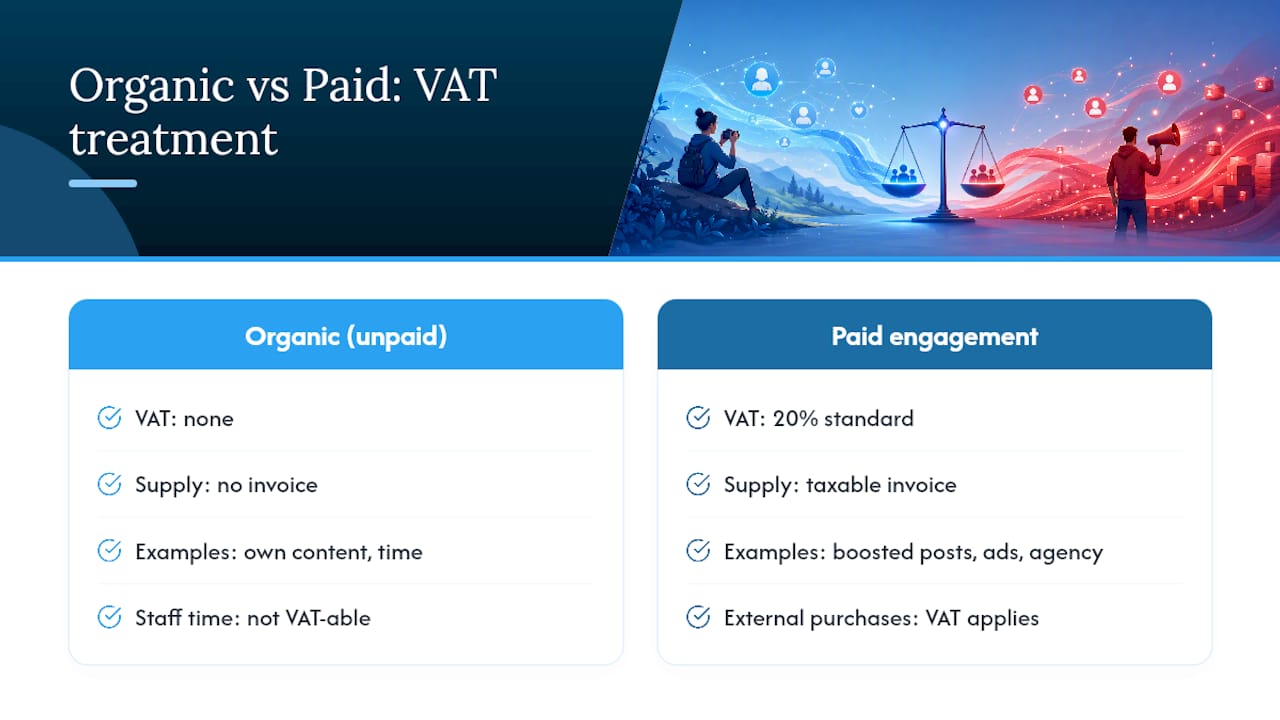
Organic growth, in the sense of unpaid effort, content creation, and audience building through your own time, has no VAT implications at all. There’s no supply, no invoice, no transaction, so there’s nothing for VAT to attach to. That’s the fundamental difference: VAT only ever applies where money changes hands for a service.
The moment you pay for engagement services, whether that’s a boosted post, a paid engagement package, or a management retainer with an agency, you’ve created a taxable supply, and the standard 20% rate applies just as it would for any other marketing service. This is where creators sometimes get confused, because organic content and paid engagement can look identical on the outside; a follower is a follower on the profile page. But VAT doesn’t care about the outcome, it cares about whether a supply of services occurred for consideration.
There’s a secondary distinction worth flagging too: internal staff time spent on organic growth, even if you value it at an hourly rate for your own accounting, is not a VAT-able supply either, because you can’t invoice yourself. Only external purchases, whether that’s paid engagement, paid advertising, or a freelancer’s invoice for content creation, bring VAT into the picture. A comparison of authentic engagement versus fake followers is useful reading if you’re weighing which route fits your marketing plan, separately from the VAT question.
Recent HMRC guidance on digital marketing services
HMRC hasn’t published a bespoke ruling specifically naming “purchased followers” as a VAT category, and that absence is itself worth understanding. Digital marketing services, including engagement packages, are assessed under the same general rules that apply to any other digital service: standard place-of-supply tests, the standard 20% rate, and the reverse charge for qualifying overseas purchases.
What has shifted in recent years is enforcement focus rather than the underlying law. HMRC’s continued expansion of Making Tax Digital, and its tightened attention on platform-based income reporting, means creators and small businesses buying or selling digital services are more likely to have their turnover cross-checked against platform data than they were a few years ago. That doesn’t change what VAT you owe, but it does change how likely you are to be asked about it.
Practically, this means treating engagement purchases with the same rigour you’d apply to any other marketing spend: proper invoices, a clear business rationale, and turnover tracked against the £90,000 threshold on a rolling basis rather than reviewed once a year. The rules haven’t been rewritten for social media specifically; they’ve simply been applied more consistently as platform income becomes easier for HMRC to see.
VAT on followers versus VAT on advertising spend
Where they genuinely differ is in how easily each one supports the “wholly and exclusively” business-purpose test.
Advertising spend, whether that’s a paid social campaign or a print ad, comes with an obvious, almost self-evident commercial link: you paid to promote something specific, to a defined audience, for a business reason. Buying followers needs that same link made explicit, because on its own it can look like a purchase for personal reputation rather than commercial gain. The VAT treatment is identical; the documentation burden to justify the deduction is not.
For a business genuinely using engagement services as part of a wider marketing push, say alongside a paid ad campaign or product launch, the case for deductibility strengthens considerably, because the purchase sits inside a broader, demonstrably commercial activity. Buying followers in isolation, with no wider campaign around it, is the scenario most likely to draw questions. The influencer marketing ROI guide covers how businesses typically frame and measure this kind of spend, which is useful context for building that documentation trail regardless of which specific service you’re buying.
What the rules actually mean for UK creators
The conventional advice on this topic tends to stop at “check if VAT applies”, as though that’s the hard part. It isn’t. The genuinely difficult part, and the one most guides skip, is building a business-purpose case that survives HMRC scrutiny months or years after the purchase happened.
I’d argue the real risk for most creators isn’t VAT at all; it’s the £90,000 threshold catching them off guard because nobody totals brand deals, platform income and product sales together until it’s too late. That’s a bookkeeping failure dressed up as a VAT problem.
My priority order for anyone reading this: track rolling turnover monthly, keep every invoice with a note on why you bought what you bought, and treat engagement purchases as a documented marketing line item rather than a quiet, unexplained spend. Get those three habits right and the VAT compliance side of things becomes almost mechanical.
— Luna
Buy followers through a UK service built for compliance, not confusion
Greediersocialmedia is the practical route for UK creators and small businesses who want engagement growth without the guesswork that comes from buying through an overseas seller with unclear VAT treatment. Every order is UK-focused, delivered instantly without needing your password, and backed by customer support if you need help clarifying an invoice for your own records.
That matters because the biggest documentation gap covered throughout this guide, proving a purchase was for genuine business purpose, starts with having a clean, UK-issued invoice in the first place rather than chasing paperwork from a supplier abroad. Pair an order with your own campaign notes and metrics, and you’ve got exactly the kind of record HMRC’s wholly-and-exclusively test asks for.
If you’re planning a campaign that needs a documented boost, whether that’s followers, likes or views across Instagram, TikTok, YouTube or Facebook, browse the social media growth services available and place an order that fits the objective you’re already tracking.
This article is general information, not a substitute for advice from a qualified financial advisor. Consult a qualified financial professional about your own circumstances before acting on anything here.
FAQ
Do I have to pay VAT on foreign purchases?
Yes, generally. If you’re VAT-registered and buy digital services like followers from an overseas supplier, the reverse charge usually applies, meaning you self-account for VAT rather than avoiding it entirely.
Which items are exempt from VAT in the UK?
Exemptions are narrow and cover categories like certain financial services, insurance, education and health. Marketing and engagement services don’t fall into any exempt category, so the standard 20% rate applies.
Is VAT 20% on everything in the UK?
No, but it applies to most things, including digital marketing services.
Do influencers pay tax in the UK?
Yes. Influencers pay income tax and National Insurance on their earnings like any self-employed person, and must register for VAT once their combined taxable turnover, including brand deals and platform income, exceeds £90,000 in a rolling 12-month period.
Is buying followers a legitimate business expense?
It can be, provided the purchase meets HMRC’s wholly-and-exclusively test set out in its business expenses guidance, meaning it must be tied to a documented business purpose rather than personal reputation alone.
Recommended
- Boost Your UK Instagram Presence: Buy UK instagram Followers Now!
- Benefits of Buying TikTok Followers UK: A Strategic 2026 Guide for British Brands
- Buy YouTube Subscribers Cheap UK: The 2026 Guide to Affordable Channel Growth
- The Strategic Benefits of Buying Instagram Followers in the UK: A 2026 Professional Guide