
Your likes to followers ratio is the average likes on a recent post divided by your follower count, multiplied by 100. For most Instagram accounts a healthy figure sits between roughly 1% and 3%, but the right number depends heavily on how big you are: smaller accounts score higher, larger ones lower. Below, we show how to calculate it properly, what to compare it with, and what to do when your figure looks off.
TL;DR
- The formula is (average likes per post ÷ followers) × 100. Average 9 to 12 mature posts, not one.
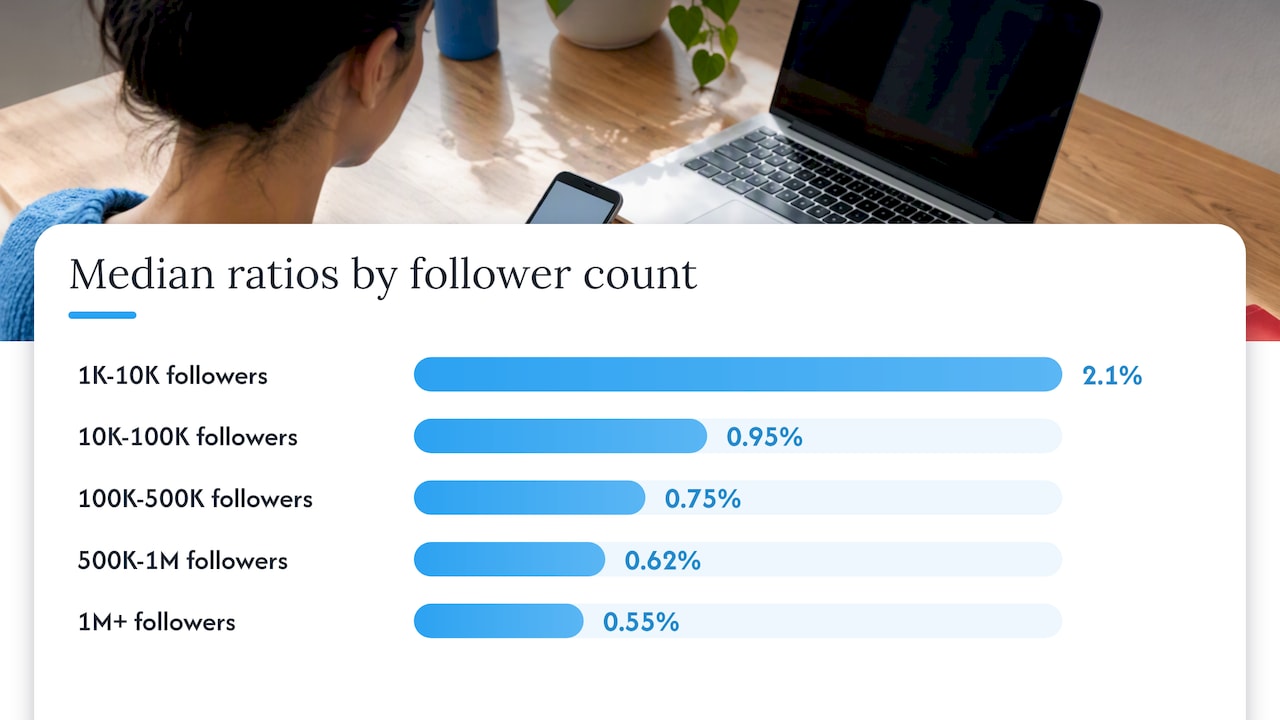
- There is no universal good number. Benchmark databases put the median at 2.1% for 1K to 10K followers and 0.55% for 1M+.
- An unusually high ratio is not proof of success. Research suggests both very high and very low ratios can damage perceived credibility.
- Likes are only one signal. Saves, shares, comments, reach and clicks usually tell a UK business more about what is working.
- If your ratio is low, fix content and audience fit first. Paid engagement should be small and in proportion if you use it at all.
Table of Contents
- How to calculate your likes to followers ratio
- What counts as a good ratio
- Followers vs likes vs comments: which number matters
- Why a very high ratio is not automatically good
- Why your ratio might be low
- Our perspective
- When the ratio is used to judge you: brands and influencer deals
- How to improve the ratio sensibly
- Where our services fit
- FAQ
- Sources
How to calculate your likes to followers ratio
The sum is simple: take the average likes on a recent post, divide by your follower count, then multiply by 100. Heepsy’s calculator gives the example of 300 average likes on 25,000 followers, which comes to 1.2%.
The quality of your answer depends on the posts you pick. A practical approach, based on this engagement-rate walkthrough:
- Take roughly 9 to 12 recent feed posts.
- Leave out pinned posts and anything less than 48 hours old, because likes are still arriving.
- Add up the likes, then work out both the mean and the median.
- Divide the median by your current follower count and multiply by 100.
The median matters. One post that got shared widely can drag the mean up and make an ordinary account look like a star. If your mean is 80 likes but your median is 35, 35 is the figure that describes a typical post.
Use the follower count that matches the period you are measuring. If you gained 2,000 followers last week, older posts were seen by a smaller audience, and dividing their likes by today’s count will make them look weaker than they were.
A worked example
Say a Manchester bakery has 4,200 followers. Its last ten posts earned 62, 48, 55, 140, 51, 44, 67, 58, 49 and 53 likes. The mean is 62.7, but the median is 54.5. The median ratio is 54.5 ÷ 4,200 × 100, or about 1.3%. That is below the typical figure for the size band, so there is room to improve, but nothing is broken.
What counts as a good ratio
The familiar rule of thumb is 1% to 3%. It is only a rough guide, not a platform standard. HypeAuditor notes that the result depends on audience size, content type and how active the account is. At 1,000 followers, the rule implies 10 to 30 likes per post.
Size-matched numbers are more useful. Heepsy’s database of roughly 10,000 active Instagram profiles (posted in the last 30 days) reports these medians. They are third-party figures, not published by Instagram.
| Followers | Median ratio | Typical middle-50% range |
|---|---|---|
| 1K to 10K | 2.1% | 0.97% to 4.4% |
| 10K to 100K | 0.95% | 0.40% to 2.4% |
| 100K to 500K | 0.75% | 0.26% to 1.9% |
| 500K to 1M | 0.62% | 0.20% to 1.8% |
| 1M+ | 0.55% | 0.19% to 1.4% |
Two things stand out. First, the ratio falls as accounts grow, because large audiences include many passive or dormant followers. Second, the ranges are wide. An account with 20,000 followers and 0.6% is inside the normal band, even though it would look weak against a 1% to 3% rule.
Some calculators label 3% to 6% as strong and anything above 6% as excellent. Treat those bands as directional only, and do not let them override a comparison with similar accounts.
How many likes should you get with 700 followers?
It depends on which benchmark you trust. Using the 1% to 3% guideline, 700 followers corresponds to about 7 to 21 likes per post. Using the 3% to 6% “strong” band, it is about 21 to 42 likes, as Flinque’s calculator applies it. Small accounts in the Heepsy data often sit higher than 1%, so 15 to 20 likes at 700 followers would be unremarkable. Judge yourself against your own median over time.
Followers vs likes vs comments: which number matters
People often ask whether followers or likes say more about an account, and where comments fit. They answer different questions.
- Followers show past interest. They are cumulative and can include people who stopped paying attention years ago.
- Likes show quick, low-effort approval of a post. They are the easiest signal to compare publicly, which is why the ratio is so popular.
- Comments take effort, so they signal stronger interest. A post with 40 likes and 12 thoughtful comments is often healthier than one with 90 likes and none.
- Saves and shares show that someone found the content useful enough to keep or pass on.
The likes ratio is also not the same as engagement rate. A fuller follower-based measure adds comments, saves and shares before dividing by followers. Instagram Insights metrics also separate post views, reach and profile views, and the denominator changes the question. Follower-based ratios suit public comparison, while reach- or view-based rates are more diagnostic for the account owner. Follower-based maths is especially imperfect for Reels and discovery-led content, where many viewers do not follow you.
For a local UK business, the commercially meaningful numbers are often profile visits, direction requests, calls and website clicks. A café with a modest 1% ratio but steady direction requests is doing better than a high-ratio account that never turns viewers into customers.
Why a very high ratio is not automatically good
It feels obvious that more likes per follower is always better. Research challenges that. A study on high and low likes-to-followers ratios reports that audiences judge credibility by comparing likes with the likely audience size, and that both unusually high and unusually low ratios can reduce perceived credibility.
In practice this means a 30% ratio on a 50,000-follower account will make an experienced marketer suspicious, not impressed. They will look at who is commenting, where the audience is based, and whether the likes arrive in odd bursts. Proportion is part of looking believable.
This is why we advise against chasing a headline number. Aim for a ratio that sits comfortably inside the range for your size band, and for engagement that your Insights data can back up.
Why your ratio might be low
Before you change anything, check the likely causes in this order.
- Dormant or mismatched followers. Old giveaway followers, follow-for-follow audiences and people outside your market dilute the ratio. This is the most common reason a growing account sees its percentage fall.
- Posting the wrong format. If your Reels reach strangers but your feed posts reach only existing followers, compare like with like.
- Weak early engagement. Hootsuite’s May 2025 guidance treats likes as an important distribution signal and suggests practical tactics: sharing posts to Stories, using Collab posts, working with creators and measuring what performs. It is practitioner advice, not an official Instagram ranking specification, and signals can change.
- Inconsistent posting. An audience that sees you once a fortnight forgets to react.
- Measuring too early. Posts under 48 hours old will look weak.
For practical fixes, our guides on boosting Instagram engagement, increasing Instagram likes organically and creative ways to get more likes go step by step.
Our perspective
We have worked with UK small businesses, creators and marketers since 2013, and the same pattern comes up again and again. People treat the ratio as a score to be won, when it is a mirror. A low figure usually says the audience and the content are not matched. A strangely high figure says something is off.
Our position is that social proof helps a new account get noticed, because people judge a page in seconds. A profile with a handful of followers and a single like per post gives a visitor little reason to stay. That is where a measured boost can help: it gives good content a fair start so it can be seen. It does not replace content people want to react to, and it will not turn a weak offer into a strong one.
That is also why we keep our packages proportionate and delivered without needing your password. We would rather you add likes in line with your follower count than inflate a single post far beyond what your audience would plausibly deliver. Keep your organic work going alongside, and judge the result by reach, saves and enquiries, not by one percentage.
— Irwin Lee
When the ratio is used to judge you: brands and influencer deals
If you are a creator pitching to brands, your ratio will be checked, and so will everything around it. Baker McKenzie’s UK guidance warns that likes and followers can be deceptive or misleading as measures of campaign impact, which is why careful brands look at authenticity, past engagement, audience fit and conversions instead of raw counts. Our own notes on how brand partnerships evaluate influencers and how to spot fake engagement cover what they look for.
If you are the brand, a ratio is a screening step, not a verdict. Ask for Insights screenshots, audience location and campaign links. For a wider view of choosing and working with creators, this overview of influencer marketing strategies for brand growth is a useful companion.
There is also a compliance side in the UK. ISBA’s contracts for influencer marketing address fake followers, bots and non-disclosure of commercial arrangements, so brands can require warranties and define artificial engagement in agreements. Separately, the ASA explains that commercial content must be obviously identifiable as advertising under Section 2 of the CAP Code. If you run paid collaborations, keep platform Insights and campaign records, and keep any paid amplification separate from your organic results. If you are unsure about a contract or disclosure, ask a solicitor or the ASA’s advice service before signing.
How to improve the ratio sensibly
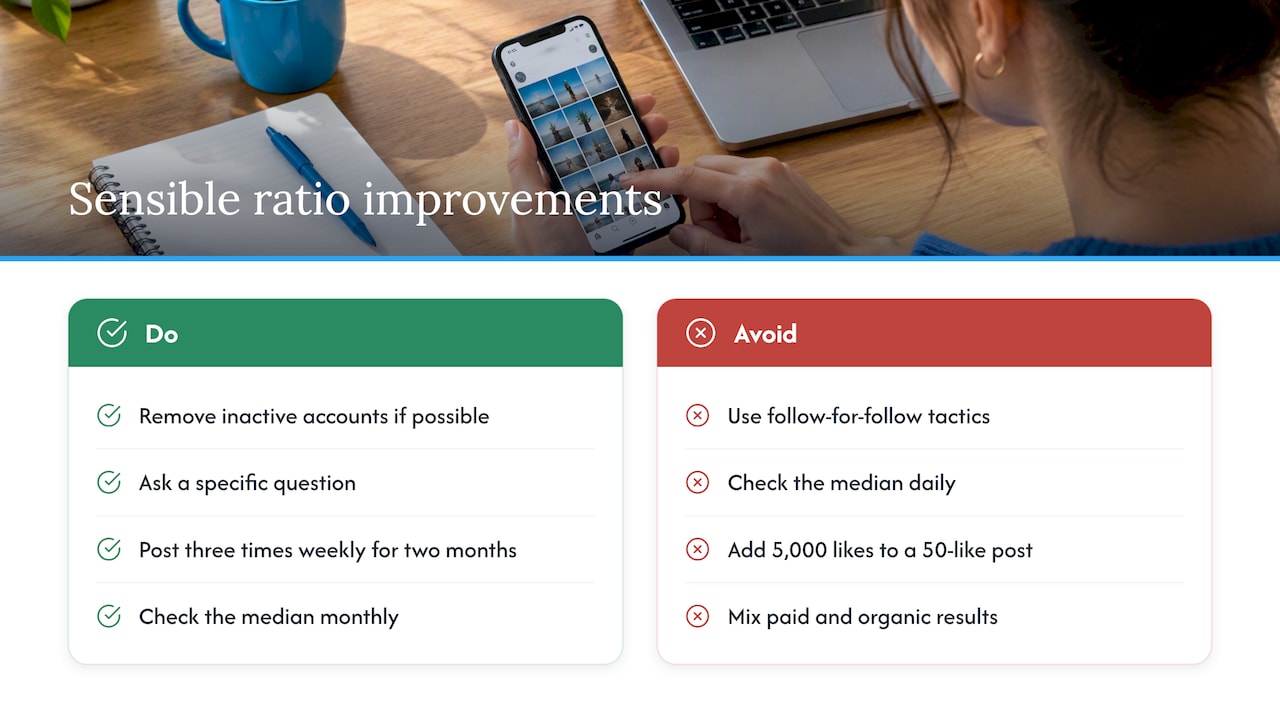
Fix the audience first. Remove obviously inactive or spam accounts if you can, and stop follow-for-follow tactics. A smaller, relevant audience produces a better ratio and better business results.
Post for reactions you can count. Ask a specific question, show a result, use clear first lines on carousels and cover images that stand out in the grid. Use Stories and Collab posts to send existing followers to new posts.
Be consistent. Three good posts a week for two months teaches your audience to expect you. Check the median again every month, not every day.
Give new content a fair start. Early traction matters, as the Hootsuite piece above notes. Our analysis of how 100 bought likes give hours of reach, not algorithmic impact is deliberately realistic about what a small top-up can and cannot do. Our guide to what happens when you buy Instagram followers and the one on authentic engagement versus fake followers set out the trade-offs plainly.
Keep numbers in proportion. If your posts normally get 50 likes, adding 5,000 to one post will look odd to anyone who checks, and the credibility research above suggests it can work against you. Think in steps that your account could plausibly reach.
Where our services fit
If you want a measured boost alongside your organic work, we offer Instagram followers, likes and video views for UK accounts, with no password needed. Instagram followers start at £1.99 and run to £229.99 depending on the package, Instagram likes range from £0.99 to £189.95, and video views from £0.59 to £54.99, all as one-off purchases. If you prefer steady top-ups, auto Instagram followers cost £15.00 to £100.00 per month, and auto likes are from £9.99 per month.
We also cover other platforms. TikTok followers run from £3.99, YouTube subscribers from £11.99, and Facebook page likes from £3.99. On Facebook the ratio question works differently, and our piece on Facebook followers versus page likes explains why.
A sensible way to start is to work out your median ratio, pick a package that moves you towards the middle of your size band rather than far beyond it, and then watch reach and saves over the next few weeks.
FAQ
What is a good likes to followers ratio on Instagram?
For many accounts, 1% to 3% is a reasonable guideline, though it is not an official standard. Size matters: Heepsy’s database shows a median of 2.1% for accounts with 1K to 10K followers and 0.55% above 1M. Compare yourself with accounts of a similar size and niche.
Is a high likes to followers ratio always better?
No. Research reports that both unusually high and unusually low ratios can reduce how credible an account looks. A ratio far above the norm for your size invites scrutiny of comment quality, audience location and reach, so proportion matters more than a record-breaking figure.
Which is more important, followers or likes?
Neither on its own. Followers show the size of your potential audience and likes show how many react, so the ratio connects them. For business results, add comments, saves, shares, reach, profile visits and clicks, because those are closer to customer action.
Do comments matter more than likes on Instagram?
Comments take more effort, so they usually signal stronger interest, and they show whether the engagement is genuine. Likes are still useful as a quick, comparable signal. Look at both, and read the comments for quality rather than just counting them.
How many likes should I get with 1,000 followers?
The 1% to 3% guideline implies about 10 to 30 likes per post. In Heepsy’s data, accounts in the 1K to 10K band have a median of 2.1%, which is around 21 likes at 1,000 followers. Work from your median over 9 to 12 posts, not a single post.
Sources
- Heepsy: Instagram likes to followers ratio calculator
- HypeAuditor: Instagram likes-to-followers calculator
- Flinque: Instagram likes to followers ratio calculator
- Instapect: How to calculate Instagram engagement rate
- DashThis: Instagram Insights metrics and dimensions
- UC3M research portal: When more likes is not better
- Hootsuite: Instagram likes
- Baker McKenzie: So you think you want to work with a social media influencer
- ISBA: contracts to improve influencer marketing effectiveness
- ASA: Recognising ads on social media and influencer marketing