
Bought likes can nudge a post’s visibility for a few hours, but the effect fades fast and carries genuine policy risk. Platforms increasingly weigh watch time, comments, saves and shares over raw like counts, so a purchased spike rarely becomes sustained reach. This article walks through the evidence, the policy exposure, and what reliably moves the algorithm instead.
TL;DR:
- Buying likes may temporarily boost post visibility in narrow, fast-moving hashtag feeds but does not generate lasting algorithmic advantage.
- Platforms primarily prioritize watch time, comments, saves, and shares over likes, making purchased likes an unreliable signal for sustained growth.
- Detection of inauthentic engagement has become more sophisticated, increasing the risk of account restrictions, content removal, or reduced organic reach over time.
- Short-term visibility gains from purchased likes are most effective for time-sensitive launches or quick content testing, but they rarely lead to increased conversions or long-term engagement.
- Focus on building authentic engagement through quality content and targeted campaigns, as these signals reliably improve algorithmic reach and conversion rates over time.
Table of Contents
- How algorithms treat likes and other engagement signals
- What the platforms say about buying engagement
- What the evidence actually shows about short-term visibility lifts
- Why vanity likes rarely turn into conversions
- When purchased likes might offer a short-term benefit
- Safer alternatives that reliably improve algorithmic reach and conversion
- How the algorithm effect differs across platforms
- What happens to account health over time
- The effect on influencer marketing and brand partnerships
- A publisher’s view on testing purchased engagement
- If you decide to test purchased engagement, do it cautiously
- Sources
- FAQ
How algorithms treat likes and other engagement signals
A “like” is one signal among many, and it is often the weakest one. Recommendation systems on Instagram, TikTok and YouTube weigh a basket of behaviours because any single metric is easy to fake and easy to misread. YouTube’s own guidance on how recommendations work states plainly that likes and dislikes are one of many signals the system considers, while watch behaviour and viewer satisfaction tend to carry more weight.
That basket typically includes:
- Watch time and completion rate, which tell a platform whether people actually stayed for the content, not just glanced at it.
- Comments, which suggest a stronger reaction than a passive tap.
- Saves and shares, which signal that someone found the content worth returning to or passing on.
- Likes, which are the easiest signal to fake and therefore the one platforms trust least in isolation.
This is a version of the “wisdom of crowds” principle: aggregated, authentic behaviour from many independent people is a decent proxy for quality, but only when the behaviour is genuinely independent. A thousand real people liking a post because they enjoyed it is meaningful data. A thousand purchased likes from accounts with no history of watching, commenting or following anything related is noise dressed up as signal, and increasingly, platforms know the difference.
There is also a structural distinction worth understanding: feed ranking versus recommendation systems. Feed ranking (the classic Facebook or Instagram grid) leans on your existing social graph, showing you content from people and pages you already follow, weighted by past interactions. Recommendation-driven surfaces (TikTok’s For You feed, Instagram Reels, YouTube Shorts) are built to surface content to strangers based on topic relevance and engagement quality, which makes them more sensitive to genuine watch and interaction patterns, and less swayed by a like count alone.
Account-level history moderates all of this. A page or profile with a long pattern of steady, authentic interaction is treated differently to one that suddenly spikes with disconnected engagement. Platforms build a trust profile over time, and an isolated batch of likes rarely overrides that history in either direction. This is part of why a single purchased boost tends to produce a short-lived bump rather than a lasting shift in how the algorithm treats an account, a pattern explored further in Do Paid Likes Help Reach? What Actually Moves It.
What the platforms say about buying engagement
Meta’s rules are unambiguous. Its business help documentation on inauthentic engagement explicitly forbids buying, selling or exchanging likes, shares, views and follows, and treats this behaviour as spam that can trigger account restrictions. YouTube’s engagement policies sit alongside similar spam and deceptive-practice rules, and enforcement on both platforms tends to follow a familiar pattern.
Typical consequences include:
- Reach restrictions, where a post or account is quietly deprioritised in feeds and recommendations.
- Content or engagement removal, where the platform strips out the likes it identifies as inauthentic.
- Account-level limits, ranging from temporary feature restrictions to suspension for repeat or severe cases.
- Loss of monetisation eligibility on platforms where creator payouts depend on maintaining policy compliance.
Meta’s transparency documentation lists buying or selling engagement, and like-and-share-gating, as explicit examples of spam behaviour that can draw enforcement. (Meta Transparency Centre) That single sentence is worth sitting with: this is not a grey area the platforms have left ambiguous. It is written policy, applied through automated detection that flags disconnected engagement patterns, unusual timing clusters, and accounts with no genuine interaction history behind the like.
Detection has become more capable, not less, as platforms invest in identifying coordinated inauthentic behaviour. Indicators typically include a burst of likes arriving in an unnatural time window, engagement from accounts with no prior interaction with similar content, and a mismatch between likes and other signals such as comments or shares. For a longer look at how this plays out for business pages specifically, see Buying Facebook page likes: is it actually safe in 2026? and the broader risk guide for UK businesses.
What the evidence actually shows about short-term visibility lifts
The clearest empirical demonstration of the “bought likes work briefly” effect comes from a proof-of-concept study on arXiv that tested exactly this mechanic. Researchers bought 100 likes for a test post and tracked its position within a hashtag’s feed.
A purchased batch of 100 likes moved a test post to the top of a hashtag’s feed for several hours, demonstrating that small-scale coordinated engagement can temporarily distort ranking before decaying.
Detecting coordinated inauthentic behaviour in likes on social media: proof of concept
The lift was real but short-lived, and it happened under specific conditions: a defined hashtag feed, a concentrated burst of likes arriving close together, and a content type where recency matters more than long-term relevance. That combination, a narrow topic, a fast-moving feed, and a tight delivery window, is precisely what produces the largest visible effect. Outside those conditions, the same tactic tends to do far less.
The study’s authors were also candid about the limits of detection. Coordinated inauthentic engagement is identifiable in some conditions but not all, which is part of why platforms keep refining their spam classifiers rather than declaring the problem solved. That cuts both ways for anyone considering a purchase: detection is imperfect, but it is also improving, and a tactic that works today is not guaranteed to work the same way in six months.
The decay pattern is the more important takeaway for marketers. A burst of purchased likes tends to produce a visible bump in displayed counts almost immediately, followed by a rapid fall-off in any associated reach or discovery, a pattern also observed in independent testing summarised in Bought Likes: 0-6 Hour Lift, No Lasting Discovery Reach.
The methodological caveat that matters most is variability. This was one test, on one platform’s hashtag feed, at one point in time. Ranking systems are updated constantly, and a mechanic that produced a several-hour lift under 2023 conditions will not necessarily behave identically on a different platform, a different content format, or after a subsequent algorithm change.
Why vanity likes rarely turn into conversions
The business case for buying likes hinges on an assumption that more likes lead to more sales. A meta-analysis of brands’ owned social media activity tested this relationship directly and found modest elasticities: a 1% increase in owned social media activity was associated with roughly a 0.137% increase in engagement and a 0.353% increase in sales, with the effect varying considerably by content type and context.
Those numbers describe genuine, owned activity, not purchased likes, and the gap between the two is the point. Inflated metrics without real audience interest do not carry the same relationship to sales, because the mechanism that makes engagement predictive (a real, interested audience) is exactly what a purchased like lacks.
Spotting inflated metrics is usually straightforward once you know what to look for:
- A high like count paired with very few comments often signals engagement that did not come from people who actually read the post.
- A follower count that dwarfs typical engagement rates for the niche suggests a mismatch worth investigating.
- Likes arriving in unnatural bursts rather than a steady trickle after posting point to a coordinated source rather than organic discovery.
Inflated metrics do more than look odd. They distort budgeting decisions, because a marketer who thinks a format or campaign is performing well based on like counts alone may pour spend into a channel that is not actually converting.
Pro Tip: Gate your conversion metrics behind a genuine A/B test: run identical content with and without any paid boost, then compare click-through and conversion rates rather than like counts alone.
When purchased likes might offer a short-term benefit
There are narrow situations where a brief lift in visibility has some practical value, and plenty where it has none. The distinction is mostly about timing and objective.
- Time-sensitive launches, where getting a post into a trending hashtag feed for even a few hours can capture attention during a narrow window, such as a product drop or live event tie-in.
- Social proof for a cold audience, where a low starting like count might otherwise discourage a first-time visitor from engaging, though this addresses perception rather than reach.
- Testing content variants quickly, where a temporary visibility bump can help you see which creative gets more organic pickup once it is briefly surfaced.
It is almost never useful for brand-building or long-funnel campaigns, where the goal is durable trust and repeat engagement over months, not a few hours of extra visibility. A purchased spike does nothing for the kind of account history that recommendation systems build trust on over time.
Before testing, work through a short checklist: define the specific goal (visibility window, social proof, or content testing), decide how you will measure it (reach, saves, click-through, not just the like count itself), set a fixed duration for the test, and agree in advance on the rollback criteria if you see any restriction or unusual account behaviour.
Safer alternatives that reliably improve algorithmic reach and conversion
The signals platforms consistently reward are the ones that are hardest to fake at scale: watch time, comments, saves and shares. Building tactics around these tends to produce compounding, durable results rather than a few hours of borrowed visibility.
Practical tactics that move these signals include:
- Format choices that extend watch time, such as short-form video with a strong hook in the first three seconds, which platforms reward with continued distribution.
- Clear, specific calls to action that prompt a comment or save rather than a generic “like if you agree”, since a comment is a heavier-weighted signal.
- Influencer collaborations with creators whose audience genuinely overlaps with yours, which tend to produce authentic engagement that compounds rather than decays.
- Targeted paid campaigns run through the platform’s own ad tools, which are built to optimise for real outcomes like clicks or conversions, not just impressions.
Measurement discipline matters as much as the tactic itself. Track reach, saves and click-through rate against a baseline, not just the like count, and attribute conversions using UTM parameters or platform-native attribution rather than assuming any correlation between likes and sales. A useful outside perspective on this comes from a partner piece on organic reach and lasting brand growth, which makes the case that durable growth compounds in a way a purchased spike cannot. Internally, Buying Likes: How to Get More Likes covers how to blend organic tactics with any paid engagement responsibly.
Pro Tip: Before spending on any growth tactic, paid or organic, run it against a control post with no boost for at least a week so you can see the real difference in reach and conversion, not just the raw numbers.
How the algorithm effect differs across platforms
Instagram, Facebook, TikTok and YouTube do not treat engagement signals identically, so the impact of a purchased like varies by platform. Instagram’s Reels and Explore surfaces behave more like a recommendation engine, sensitive to watch time and shares, which means a like-only boost has limited leverage there. Facebook’s feed still leans more heavily on the social graph, so buying likes on a page post interacts differently with distribution than it does on Instagram’s discovery surfaces.
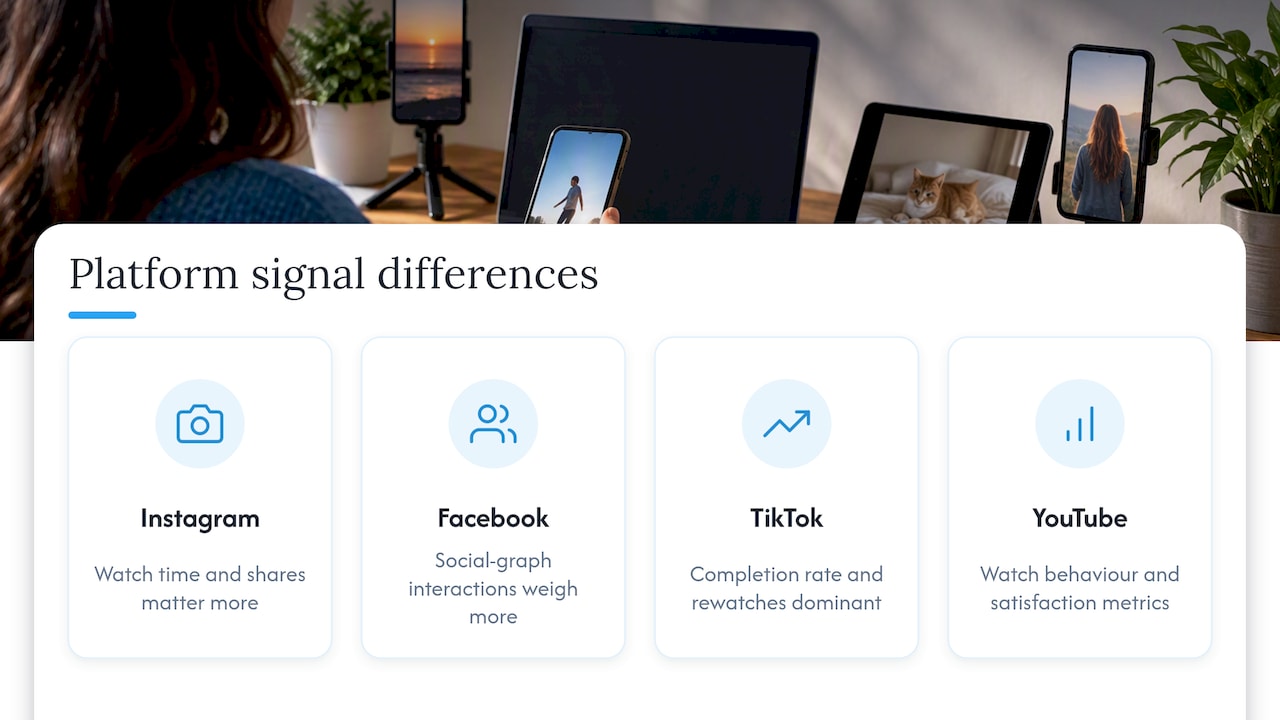
TikTok’s For You feed is arguably the most recommendation-driven of the major platforms, prioritising completion rate and rewatches over any single engagement type, which makes a like-only tactic weaker there than on a graph-based feed. YouTube sits somewhere in between: its own guidance on how recommendations work confirms likes are one of many signals, with watch behaviour and satisfaction metrics carrying more weight in practice.
The practical implication is that a tactic tested on one platform does not transfer cleanly to another. A short-lived hashtag lift observed on one network, as in the arXiv test, says little about how the same 100 purchased likes would behave inside TikTok’s completion-driven ranking or Facebook’s graph-weighted feed.
What happens to account health over time
A single burst of purchased likes rarely does lasting damage on its own, but a pattern of it changes how a platform’s systems treat an account. Trust profiles build up over months of consistent behaviour, and repeated inauthentic engagement is one of the clearest ways to erode that trust.
The practical risk is less about an immediate ban and more about a gradual dampening of organic reach, sometimes described informally as reduced distribution, where content simply stops surfacing as widely as it used to. Meta’s own transparency documentation on spam frames buying or selling engagement as behaviour that can draw account-level penalties, which is consistent with this slower, cumulative pattern rather than always being immediate.
For accounts that rely on algorithmic discovery for new audience growth, that dampening is the real cost. It is not a dramatic takedown so much as a quiet ceiling on how far new content can travel, which is far harder to notice and far harder to reverse than a one-off warning.

The effect on influencer marketing and brand partnerships
Brands vetting influencers increasingly look past follower and like counts to the ratio between engagement and audience size, and a mismatch is now one of the first things a competent partnerships team checks. An influencer with inflated likes but a comment and share rate that does not match their following size raises an immediate flag.
This matters commercially because brand partnerships are typically priced on expected reach and engagement, and a partner whose numbers do not hold up under scrutiny risks losing deals or having them renegotiated once the mismatch surfaces. Academic modelling of the economics of fake accounts shows that platform-level anti-fake investment shapes the incentives on both sides, meaning the environment influencers operate in is actively designed to make inflated metrics riskier to rely on over time, not less.
For creators building a partnership business, the safer long-term position is a following whose engagement patterns hold up when a brand’s team checks the numbers, since that scrutiny is now standard practice rather than the exception.
A publisher’s view on testing purchased engagement
We have experience delivering engagement services since 2013, and password-free delivery is a common question from cautious first-time buyers. That volume of orders gives us a fairly clear view: a short, well-defined test, on a single post, with a fixed budget, is a reasonable way to see how a boost interacts with your specific account. What we would not recommend is using purchased likes as a substitute for a genuine content or audience strategy, because the evidence throughout this article points the same way: the lift is real, but brief, and it does not replace the slower work of building comments, saves and shares.
— Irwin Lee
If you decide to test purchased engagement, do it cautiously
If you want to see how a short-term boost behaves on your own account, treat it as a measured experiment, not a growth strategy. 
We do not promise a guaranteed algorithmic lift, because the evidence in this article shows the effect is real but short lived. What we offer is a straightforward way to run that test: our Instagram engagement services let you order a fixed batch of likes without handing over your password, so you can compare a boosted post against a control post under the same conditions.
Keep the test small, keep the window short, and track click-through and saves alongside the like count itself. If you are testing on Instagram specifically, pair it with the guidance in our testing and safety notes before you commit any budget.
Sources
- Meta business help — policy on inauthentic engagement
- Detecting coordinated inauthentic behaviour in likes on social media: proof of concept (arXiv)
- YouTube help centre — how recommendations work
- A meta-analysis of the effects of brands’ owned social media on engagement and sales (SAGE Journals)
FAQ
Can Instagram detect bought likes?
Instagram’s systems can flag disconnected or unnatural engagement patterns, including bursts of likes from accounts with no interaction history, as outlined in Meta’s spam policy. Detection is not perfect in every case, but it has improved as platforms invest more in identifying coordinated inauthentic behaviour.
What is the 5-3-1 rule on Instagram?
The 5-3-1 rule is an informal content-planning guideline some marketers use, typically suggesting a mix such as five pieces of curated or repurposed content, three original posts, and one promotional post within a set posting cycle. Definitions vary across sources, so treat it as a flexible framework rather than a fixed platform requirement.
Do likes affect the YouTube algorithm?
Yes, but only as one of many signals. YouTube’s own guidance on recommendations states that likes and dislikes are considered, while watch time and viewer satisfaction typically carry more weight in ranking decisions.
What is the 5:3:2 rule for social media posts?
The 5:3:2 rule is another informal content-mix guideline, often described as five pieces of third-party or curated content, three original brand posts, and two personal or engagement-focused posts. As with similar ratios, there is no single official source, and practitioners adapt it to their own posting cadence.
Do bought likes give any lasting reach benefit?
No. Evidence from a proof-of-concept study shows a purchased batch of likes produced a lift lasting only several hours before decaying, with no sustained increase in organic discovery observed afterwards.