
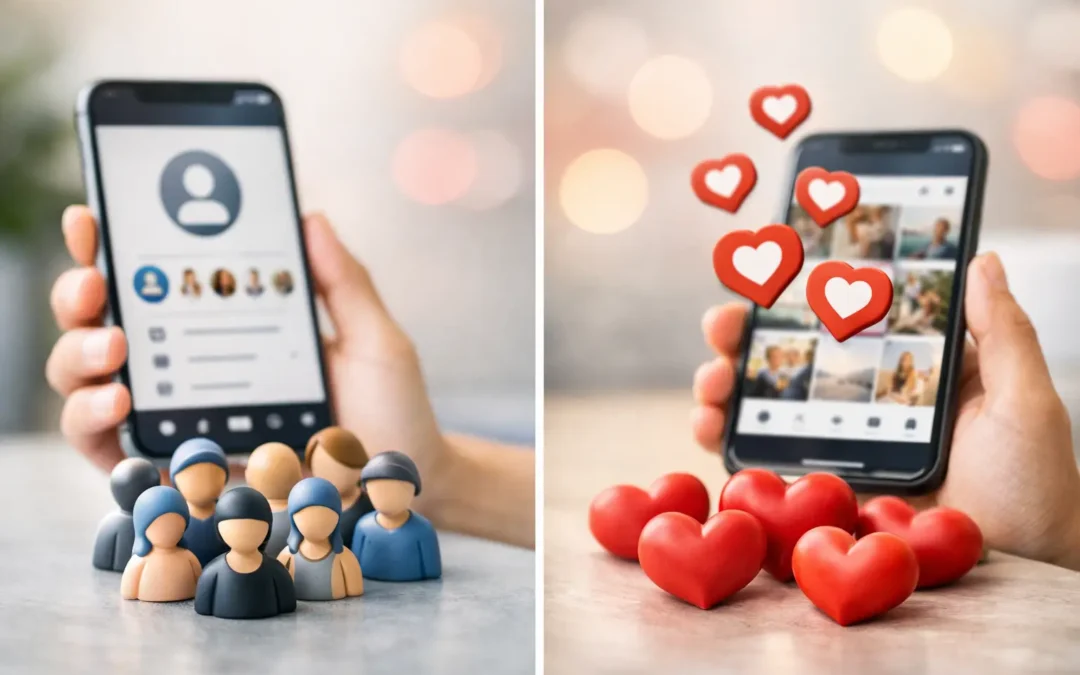
A post can collect 500 likes by lunchtime and still leave your account looking quiet. On the other hand, 10,000 followers can create instant authority, yet mean little if every post lands with barely any reaction. That is the real question behind instagram followers versus instagram likes: which signal moves the needle for your brand, and which one is simply there for show?
For UK creators, musicians, shops and ambitious small businesses, the answer is rarely one or the other. Followers and likes do different jobs. When they support each other, your profile looks active, credible and worth paying attention to – exactly what potential customers, collaborators and new visitors judge in seconds.
Instagram followers versus Instagram likes: the core difference
Followers are your audience base. They are the number people see when they visit your profile, and they shape the first impression of your authority. A stronger follower count can make a new customer more comfortable buying from you, a promoter more likely to take your music seriously, or a potential client more willing to enquire.
Likes are a reaction to individual content. They show whether a particular post has caught attention, created interest or earned approval. A healthy number of likes gives each post visible momentum. It tells anyone scrolling past that other people have stopped, noticed and engaged.
Think of followers as your shopfront and likes as the crowd around the latest display. The shopfront establishes scale. The crowd proves there is activity right now.
Neither metric is a magic button for revenue or reach. Instagram considers a much wider range of signals, including watch time, comments, shares, saves and how people interact with your account over time. But public social proof still matters because people make quick decisions. A profile with a credible audience and visible engagement can feel safer to follow, buy from or contact than an account that appears empty.
When follower growth should come first
Follower numbers matter most when your account needs to establish credibility from the first visit. This is especially relevant for a new business, an emerging artist, a local service provider or anyone pitching brands and partners. Before someone reads your captions or checks your website, they will often glance at your follower count.
A larger, relevant-looking audience can strengthen perceived authority. For an ecommerce business, it may reduce hesitation around an unfamiliar brand. For a creator, it can help position their page as a serious channel rather than a hobby. For a musician launching a track, it gives fans, venues and industry contacts a clearer signal that there is an audience behind the release.
Followers also create a stronger foundation for future campaigns. Every new Reel, product launch and announcement starts with a larger visible community around it. That does not mean every follower will see or engage with every post. Organic distribution is unpredictable, and inactive followers will not build a business on their own. Still, a low count can make a quality account look early-stage when it is ready to compete.
If your page has good content but the audience figure does not match the standard of your work, prioritising followers can be the smart first move. The goal is not to chase a vanity number. It is to remove the credibility gap between how professional your brand is and how established it looks online.
When likes matter more than followers
Likes become the priority when a post needs immediate proof that it is landing. A fresh product image, a competition post, a music teaser or a client result can all look far more convincing when the engagement count reflects the effort behind it.
This is where likes have real commercial value. People are naturally drawn to content that already appears popular. A post with visible engagement is more likely to earn a second look than one sitting on a flat number, particularly when users are discovering your brand for the first time.
For businesses, likes also help keep the profile grid alive. Visitors do not assess your account through one number alone. They scan recent posts. If the follower count is high but the latest content has very little response, the gap can create doubt. If your posts are consistently collecting likes, the profile feels current and active.
That said, likes are short-term signals. Yesterday’s popular post will soon drop down the grid. Followers remain attached to the account, so they carry more lasting profile value. Likes are best used to support specific content and maintain visible momentum, not as the only growth strategy.
Match the boost to the post
Not every post deserves the same level of attention. Put your effort behind content that has a purpose: a new collection, a launch date, a strong testimonial, a viral-style Reel, a booking announcement or a post designed to introduce your brand.
A steady pattern is more convincing than one huge spike surrounded by silence. If you are building up a profile, give priority to the posts that new visitors will see first. This creates a cleaner story: established audience, active content, clear offer.
The strongest accounts balance both
The best way to approach Instagram followers versus Instagram likes is to stop treating them as competing metrics. They are two parts of the same social-proof picture.
Imagine two profiles. The first has 20,000 followers but only a handful of likes on recent posts. The second has 600 followers and strong likes, but lacks the audience size that helps strangers see it as an established brand. Each has a weakness. The first can look inactive; the second can look unproven.
A balanced account avoids both problems. The follower count gives the profile weight. The likes show that the content is receiving attention. Add genuine comments, saves, shares and regular posting, and the page becomes far more persuasive.
This balance is particularly useful before a high-visibility moment. Perhaps you are approaching retailers, running paid advertising, contacting influencers, releasing a song or opening bookings for a service. When new people arrive, they should see evidence that your brand is already moving. Social proof cannot replace a good product, clear offer or responsive customer service. It can, however, make people more willing to give those things a chance.
Build social proof without making your profile look forced
Speed is valuable, but relevance matters. A sudden increase in followers followed by no visible engagement can look less natural than measured growth supported by active posts. Equally, adding likes to content that does not fit your usual brand voice will not fix a confused profile.
Start with the basics. Use a clear profile photo, a bio that says what you offer, and pinned or recent posts that introduce your strongest work. Then decide where the current gap is. Do visitors need more confidence in the size of your audience? Do your best posts need a stronger initial response? Is your account established but visually inactive?
Once you know the weak point, use growth tools with intention. Paid followers and likes can be practical visibility tools when they complement a real content plan rather than replace one. Choose delivery that does not require your password, keep your account secure, and avoid offers that demand access to personal details you should never share.
Greedier Social Media is built for that straightforward approach: quick, secure social-proof support for people who want a stronger-looking profile without unnecessary friction. The smartest campaigns pair that momentum with posts worth engaging with and a reason for new visitors to stay.
Measure what happens after the numbers rise
Do not judge a campaign only by the figure displayed beneath a post. Watch what happens next. Are more people visiting your profile? Are product enquiries increasing? Do your Reels receive more plays? Are potential customers responding more positively when they check your page?
For a creator, the meaningful outcome may be more collaboration messages. For a salon or local service business, it might be bookings. For an online shop, it could be improved confidence around a product launch. The right metric depends on your goal, which is why there is no universal answer to whether likes or followers are ‘better’.
Followers are usually the stronger choice for long-term profile authority. Likes are often the sharper tool for giving individual posts momentum. Use followers to make your account look established, and likes to show that your content is alive right now. Then keep giving every new visitor something good enough to follow for.