
Learning how to increase video views organic reach relies less on luck than most creators think.
TL;DR:
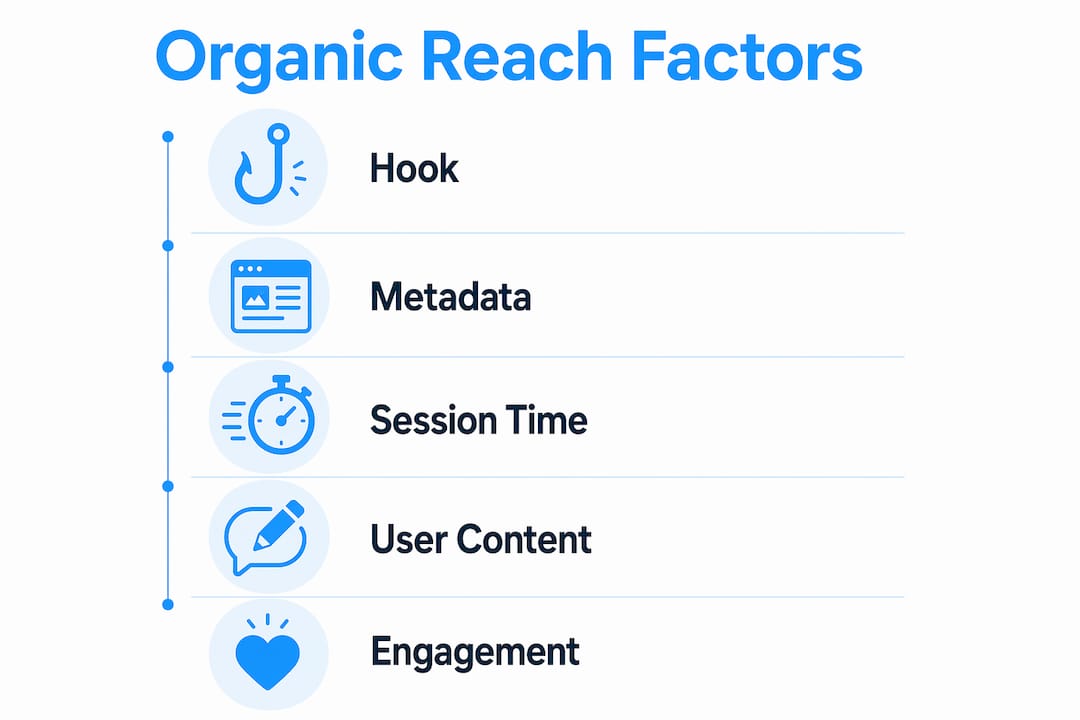
- Growing organic video reach depends on reducing skip rate in the first three seconds and optimizing metadata to enhance search discoverability. Creating high-quality, engaging hooks, selective hashtag use, and engaging user-generated content also increase viewers’ interaction and session time. Reposting videos with improved openings can recover up to 30% more views by signaling better viewer satisfaction to algorithms.
Organic reach is defined as the number of people who see your video without paid promotion. To increase video views organic reach, you must win on two fronts: getting viewers to click, and keeping them watching. The first 3 seconds of any video determine whether the algorithm distributes it further or buries it. Skip rate, completion rate, and high-intent signals like shares and saves are the metrics that drive distribution. Creators and small business owners who understand this dual-stage system grow faster than those chasing follower counts alone.
Why does skip rate determine your organic reach?
Skip rate is the percentage of viewers who abandon your video within the first few seconds. The first 3 seconds determine distribution; reducing skip rate outperforms likes and comments as a ranking priority. That means your opening moment is not a creative choice. It is a data filter.

A 70% completion rate for Shorts is an excellent benchmark to aim for. Hitting that threshold signals to the algorithm that your content satisfies viewers, which triggers wider distribution.
Most platforms auto-play videos on mute. An audio-only hook loses viewers before they even hear it. Adding high-contrast on-screen text in the first 3 seconds drops skip rates by 10–20 percentage points. That single change can be the difference between a video that stagnates and one that spreads.
Common mistakes in video intros include:
- Opening with a logo animation or branded intro card
- Starting with “Hey guys, welcome back” before delivering any value
- Using a slow zoom or fade-in with no text or motion
- Asking a question so vague it gives the viewer no reason to stay
Pro Tip: Film your hook last. Once you know exactly what your video delivers, write a single sentence that states the payoff directly. Put it on screen in bold text within the first 2 seconds.
How do keywords and hashtags grow your video audience organically?
Precise metadata tells platforms what your video is about and who to show it to. Platforms have shifted from 30-tag limits to 3–5 optimal hashtags, favouring niche-specific tags over bulk-tagging. Flooding a post with 20 generic hashtags now signals low-quality content to most algorithms.
Keyword-rich captions and video transcripts do more than describe your content. They feed the platform’s search index, which directly influences social search discovery and organic reach in 2026. Treat your caption like a short article title: lead with the most specific phrase a viewer would actually search for.
Practical steps for keyword and hashtag research:
- Type your topic into the platform’s search bar and note the autocomplete suggestions
- Use those exact phrases in your title, first line of caption, and video transcript
- Choose 3–5 hashtags that describe the specific sub-topic, not the broad category
- Review which hashtags your top-performing competitors use on their best videos
- Revisit and update metadata on older videos that still receive traffic
Pro Tip: Place your primary keyword in the first sentence of your caption, not buried at the end. Algorithms and viewers both read the first line first.
For creators targeting a specific community, niche audience targeting through precise keyword selection consistently outperforms broad, generic content strategies.
Why does user-generated content boost video engagement?
User-generated content (UGC) is any video, image, or post created by your audience rather than your brand. UGC achieves 4x higher click-through rates and 28% higher engagement than standard branded content. Algorithms read that engagement spike as a signal that the content delivers genuine value.
The reason UGC performs so well is social proof. When real people share their experience with your product or content, new viewers trust it more than a polished brand video. That trust converts into the high-intent interactions that matter most for reach.
Not all engagement carries the same weight. Shares and saves outperform likes as organic reach signals because they indicate a viewer found the content worth keeping or spreading. A video with 500 saves and 50 likes will typically outperform one with 500 likes and 5 saves.
Ways to encourage genuine UGC and quality engagement:
- Ask a specific question in your caption that invites a short, easy reply
- Run a challenge or prompt that asks viewers to recreate or respond to your video
- Feature audience comments or responses in a follow-up video
- Acknowledge saves and shares publicly to reinforce that behaviour
Understanding why authentic engagement outperforms fake metrics is the foundation of any sustainable organic growth plan. Manufactured signals erode algorithmic trust over time.
How does session watch time build channel authority?
Session watch time is the total time a viewer spends watching content on your channel in a single visit. Session watch time ranks higher than individual views as a ranking signal because it tells the algorithm your channel, not just one video, is worth promoting.
Playlists are the most direct tool for extending session time. Playlists increase session duration by 20–35% through auto-play, keeping viewers on your channel rather than drifting to another creator’s content. That sustained attention signals channel authority to the algorithm.
Four steps to build session time through playlists
- Group videos by topic or series with keyword-rich playlist titles
- Order videos so each one naturally leads to the next question a viewer would have
- Add end screens that link to the next video in the sequence
- Publish on a consistent schedule so returning viewers always find fresh content
Metrics to track for session watch time
| Metric | What it tells you |
|---|---|
| Average view duration | Whether viewers finish your videos or drop off early |
| Session time per visit | How many videos a viewer watches in one sitting |
| Click-through rate on end screens | Whether your internal linking is working |
| Playlist start rate | How often viewers enter your content via a playlist |
Pro Tip: Build a “Start Here” playlist for new visitors. Label it clearly and pin it to the top of your channel. New viewers who find a clear entry point stay longer and subscribe at higher rates.
For a broader view of proven YouTube engagement strategies, combining session time tactics with strong hooks creates compounding growth over time.
What mistakes kill organic video reach and how do you fix them?
The most common reason videos underperform is not poor content. It is poor packaging and neglected metadata. Uploading without optimising the hook or caption means the algorithm has no clear signal about who to show the video to.
Specific mistakes that reduce video visibility:
- Uploading with a vague title that contains no searchable keywords
- Using irrelevant or oversaturated hashtags that attract the wrong audience
- Ignoring the first 48 hours after posting, when early engagement velocity matters most
- Never reviewing analytics to identify where viewers drop off
- Treating every platform identically instead of adapting format and length
The fix for an underperforming video is often simpler than creators expect. Reposting with a rewritten opening can recover 10–30% more views by reducing skip rates and triggering algorithm re-tests. You do not always need new content. You need a better first impression.
Pro Tip: Check your analytics for the exact second where most viewers drop off. If it is before the 5-second mark, rewrite and reshoot only the opening. That is the highest-return edit you can make.
For creators who want a structured approach to long-term organic growth, consistent iteration on existing content often outperforms constantly publishing new videos.
Key Takeaways: Increase Video Views Organic Reach
The most effective way to grow video views organically is to master skip rate, metadata, and session time as a connected system, not as separate tactics.
| Point | Details |
|---|---|
| First 3 seconds are decisive | High-contrast on-screen text reduces skip rates by 10–20 percentage points on mute auto-play. |
| Use 3–5 niche hashtags | Precise hashtags outperform bulk-tagging and help platforms categorise your content accurately. |
| Shares and saves beat likes | High-intent signals carry more algorithmic weight and drive wider organic distribution. |
| Playlists extend session time | Auto-play playlists increase session duration by 20–35%, building channel authority over time. |
| Rewrite hooks to recover reach | Reposting with a revised opening can recover 10–30% more views without creating new content. |
The packaging trap most creators fall into
Video performance is a dual-stage system: packaging drives the click, satisfaction drives the reach. Most creators obsess over one and ignore the other.
I see this constantly with small business owners who invest heavily in thumbnail design and titles, then wonder why their views plateau after the first day. The click happened. The retention did not. The algorithm noticed.
The uncomfortable truth is that engagement velocity matters more than follower count. A channel with 2,000 highly active subscribers will consistently outperform one with 50,000 passive followers. Platforms reward content that people actually finish and share, not content from accounts with large numbers.
What I have found works in practice is treating every video as two separate briefs. The first brief is for the thumbnail and opening 3 seconds: make someone stop scrolling. The second brief is for everything after: make them glad they stopped. When those two briefs are written separately and executed deliberately, reach follows.
Watch out for the metric that looks good but means nothing: raw view count in the first hour. A spike from a notification blast tells you nothing about whether the algorithm will carry the video further. Watch completion rate and save rate instead. Those are the numbers that predict whether a video has legs.
— Luna
How Greediersocialmedia supports your organic video growth
Growing video views organically takes time, but the right support accelerates the process considerably.
Greediersocialmedia has worked with creators and small businesses across the UK since 2013, helping over a million users build genuine visibility without shortcuts that damage long-term reach. The social media growth hacks guide covers platform-specific tactics for boosting engagement and video distribution, from hook optimisation to hashtag strategy. For creators who want to understand exactly where their growth stands, the social media growth measurement guide provides a clear framework for tracking organic reach, session time, and engagement quality. Greediersocialmedia offers targeted, secure support designed for businesses and creators who want results they can trust.
FAQ
What is the most important factor for organic video reach?
Skip rate in the first 3 seconds is the single most important factor. Reducing it signals viewer satisfaction to the algorithm, which triggers wider distribution.
How many hashtags should I use on a video post?
Use 3–5 niche-specific hashtags rather than 20–30 generic ones. Platforms now favour precise tagging over bulk-tagging for content categorisation.
Do shares matter more than likes for video reach?
Shares and saves carry significantly more algorithmic weight than likes. They signal that a viewer found the content valuable enough to keep or spread, which platforms treat as a strong quality indicator.
How do playlists help grow a video audience?
Playlists trigger auto-play, which increases session watch time by 20–35%. Longer session times signal channel authority to algorithms and improve the ranking of all videos on your channel.
Can I recover views on an underperforming video?
Reposting a video with a rewritten opening can recover 10–30% more views. Algorithms re-test content when it is republished, so improving only the first 3 seconds is often enough to change the outcome.