
Boosting engagement after buying followers takes a deliberate, focused approach in the first few days.
Immediately after buying followers, the priority is identity-aligned, time-bound prompts that ask for simple participation rather than heavy promotion. Focus on three levers: timing your first ask within 48 to 72 hours, choosing formats that invite people to show themselves rather than just view a product, and using one easy call to action per touchpoint. Track results properly and keep your messaging honest about what you’re offering.
TL;DR:
- Engagement prompts should be specific and action-oriented, such as hashtag campaigns or short videos, to convert bought followers into active participants.
- The ideal timing for post-purchase engagement asks is within 48 to 72 hours and again between 7 to 14 days after delivery, to capitalize on peak curiosity and product use.
- Content that encourages followers to demonstrate their use or style of the product outperforms purely promotional posts in building authentic interaction and repeat purchases.
- Metrics like repeat purchase rate and review submissions, alongside engagement rate, better reflect the success of post-purchase engagement strategies than follower counts alone.
- Purchasing followers should be paired with genuine, identity-aligned content and transparent practices to maintain credibility and avoid platform policy violations.
Table of Contents
- How do you build engagement after buying followers?
- When should you ask for engagement after a follower purchase?
- What content actually gets purchased followers interacting?
- Which metrics actually prove engagement is working?
- What should you avoid saying or doing?
- How do you handle negative or neutral engagement after buying followers?
- What are the ethical and policy considerations around bought followers?
- What does successful engagement after buying followers look like?
- A practitioner’s view on making bought followers work
- If you want hands-on help with engagement after buying followers
- Sources
- FAQ
How do you build engagement after buying followers?
The gap between a follower count and real interaction closes through deliberate prompts, not patience. A bought follower is a blank slate: they’ve seen your name, maybe your profile, but nothing has asked them to do anything yet. Every tactic below exists to close that gap in the first two weeks, when attention is highest and the ask feels natural rather than forced.

Give people something specific to do. Vague invitations (“check us out!”) get ignored. Specific ones get answered. Try caption starters like “Tag someone who needs to see this” or a one-question poll sticker (“Which colour would you restock?”). These work because they ask for thirty seconds of effort, not an essay.
Here’s what that looks like in practice:
- UGC prompts: “Show us how you styled it” beats “share your photos” because it names the action.
- Branded hashtags: give customers a short, memorable tag (not your business name with a number added) so their post is easy to find and repost.
- Click-to-share links: a one-tap share button on a receipt or confirmation page removes the friction of copying a URL manually.
- Prewritten captions: offer a short line customers can edit and post, rather than a blank text box that invites nothing.
Incentives can help, but keep them light. A time-limited 10% discount for tagging your brand, or early access to a new drop for the first ten people to share, works because it rewards action without buying the interaction outright. Avoid stacking incentives on every single post. Reserve them for launches or slow periods, not routine content, because customers spot a pattern fast and start expecting payment for attention.
Where you place the invite matters as much as the invite itself. Order confirmations, shipping update pages, onboarding emails and physical receipts all get opened, which makes them far better real estate than a promotional post competing with everything else in a feed.
Pro Tip: Put the ask in the shipping notification, not just the confirmation email. Customers open delivery updates out of genuine curiosity about their parcel, which makes that moment far more receptive than a generic marketing email sent days earlier.
When should you ask for engagement after a follower purchase?
There’s a specific window when people are most likely to respond, and missing it wastes the ask. Post-purchase touchpoints such as order confirmations and shipping updates get opened at far higher rates than promotional email, which is exactly why transactional messages outperform promotional ones for prompting a follow or a share.
Two windows matter most:
- The 48 to 72 hour window. This is peak curiosity: the purchase is fresh, delivery is imminent, and a social invite feels like part of the experience rather than an interruption.
- The 14-day follow-up window. By now the product has arrived and been used once or twice, so a review or UGC request lands better than it would on day one.
- A simple three-step cadence: confirmation message with a soft social mention, a direct invite within 48 to 72 hours, then a reminder around day 7 to 14 tied to actual product use.
Triggering these on delivery or account activation, rather than a fixed calendar date, consistently performs better; delivery-triggered referral asks can convert three to five times better than the same ask sent on a delay.
What content actually gets purchased followers interacting?
Content that asks someone to show themselves, not just look at your product, converts far better than a straight promotional post. Research grounded in identity-based motivation theory backs this up directly: post-purchase messages that support how someone sees themselves outperform product-focused messaging for both engagement and repeat purchase intent. Ask people to demonstrate a use, a style, a result. Not just “buy again.”
Formats that tend to work:
- Customer stories and use-case showcases: a short clip of someone actually using the product does more than a studio shot ever will.
- Unboxing and 15 to 30 second how-to videos: low production cost, high completion rate, easy for a customer to imitate.
- Story templates: a preset sticker or template a customer can drop their own content into removes the blank-page problem entirely.
- Private or semi-private spaces: broadcast channels and small groups often produce higher-signal interaction than public feeds because the audience feels self-selected, not scrolling past.
Keep the mechanics simple: one hashtag, one clear CTA per post (“tag a friend” or “reply with your favourite”), never three competing asks at once. A partner guide on lasting engagement covers similar ground on planning identity-driven content over a longer arc.
Which metrics actually prove engagement is working?
Engagement rate on its own tells you almost nothing about whether the follower purchase paid off. Track it alongside story completion rate and comment rate, since those show whether people are actually watching and responding, not just seeing a number tick up.
The business metrics matter more: time-to-second-purchase, repeat purchase rate, and review submission rate all reflect whether interaction is translating into anything commercial.
Brands running structured post-purchase sequences report 20 to 30% higher repeat purchase rates than those without one, and the same benchmarking work flags repeat purchase rate, time-to-second-purchase and review submission rate as the clearest indicators of whether a post-purchase sequence is actually working.
Run a simple A/B test on timing and CTA wording before committing to one cadence. Split your list, send one half the invite at 48 hours and the other at 72, and compare click-through on the share link. With small samples, ignore single-post spikes; wait for a pattern across at least a week of posts before changing your approach, since one viral comment or one unusually quiet day rarely means anything on its own.
What should you avoid saying or doing?
Never describe bought followers as organic growth, in captions, pitch decks, or media kits. It’s an easy claim to make and an easy one to get caught on. Neutral language such as “growing our community” or simply not mentioning the source at all works better than an inflated claim that invites scrutiny.
- Don’t stack every post with a hard CTA; earn attention with value first, ask second.
- Watch for sudden engagement drops or unusual account flags. That’s often a signal worth investigating quickly.
- Keep customer support responsive. A slow reply to a genuine follower question undoes far more trust than a quiet growth strategy ever built.
- Be transparent about what you’re offering (a product, a discount, a community), not about the mechanics of how your following grew.
Pro Tip: If a follower asks directly how your following grew, don’t dodge. A short, honest answer costs you far less credibility than getting caught in a deflection.
How do you handle negative or neutral engagement after buying followers?
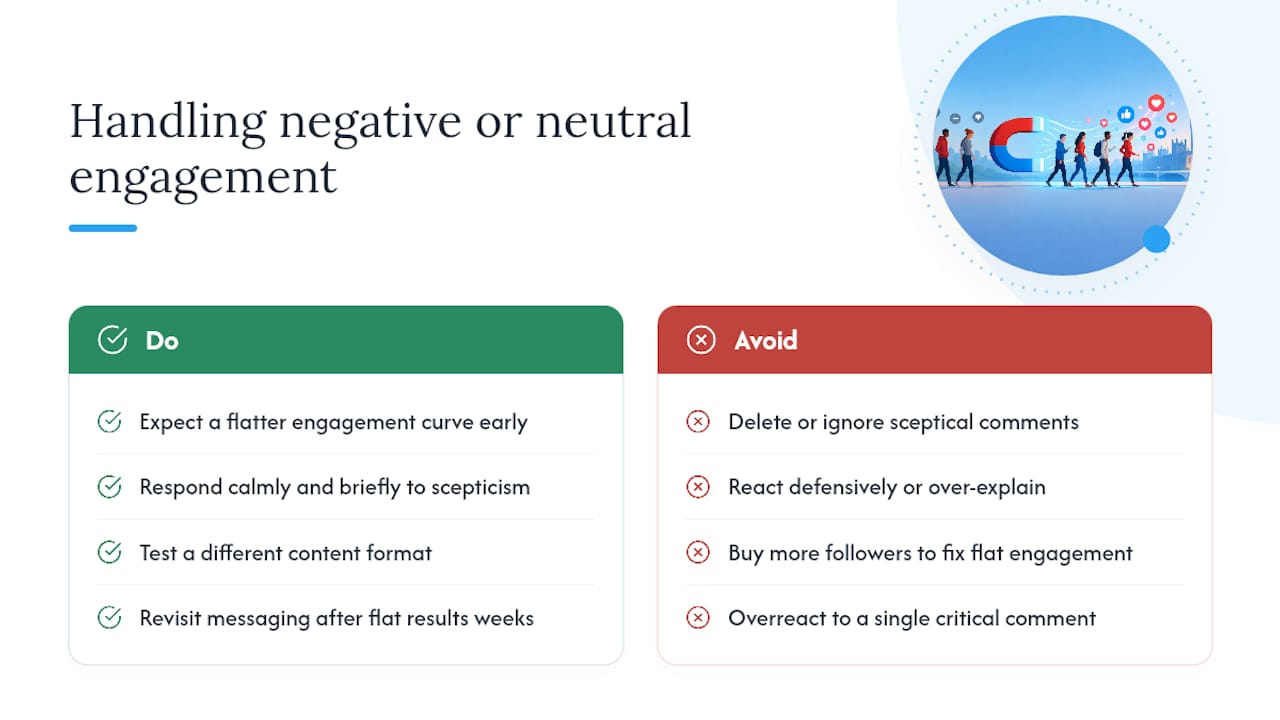
A quiet response isn’t a failure signal on its own. Purchased followers often behave differently from an organically grown audience, so expect a flatter engagement curve for the first few weeks rather than an immediate surge.
When comments turn sceptical or someone questions your follower count publicly, respond calmly and briefly rather than deleting or ignoring it. A defensive reaction draws more attention to the question than the question itself ever would. Something like “we’re always working on growing our community across platforms” closes the topic without confirming or denying anything specific.
Neutral engagement, meaning views without comments or likes without shares, usually points to a content mismatch rather than a fake-audience problem. Before assuming the worst, test a different format. Swap a static image for a 15-second video, or replace a product shot with a customer story. If interaction picks up, the issue was creative, not authenticity.
If engagement stays flat across several content types over a few weeks, treat that as a prompt to revisit your identity-aligned messaging rather than to buy a larger volume of followers. More followers on top of an unresponsive base rarely fixes the underlying mismatch between what you’re posting and what your audience actually wants to see.
Track sentiment loosely, not obsessively. One critical comment on a post with strong overall interaction isn’t worth a strategy change. A pattern across multiple posts, over multiple weeks, is the threshold that actually matters.
What are the ethical and policy considerations around bought followers?
Platform terms of service on Instagram, TikTok, YouTube and Facebook generally prohibit “inauthentic” activity such as bot-driven engagement or fake accounts, though enforcement focuses overwhelmingly on automated bot networks rather than real-account engagement services. That distinction matters for how you choose a provider: services built on genuine accounts sit in a different risk category to those using automated bots or click farms.
The ethical question is less about the purchase itself and more about what you claim afterwards. Presenting a purchased following as organic reach to advertisers, investors, or brand partners is a misrepresentation with real commercial consequences, independent of what any platform’s rules say. If you’re pitching a brand deal on the strength of your numbers, be ready to show engagement data that actually supports the pitch.
Consumers have also grown more attuned to manufactured social proof generally, which is part of why identity-aligned, participation-based content performs better than a broadcast-style promotional push. It reads as more genuine because it asks something of the follower rather than just displaying a number at them.
The practical takeaway: choose services that deliver real accounts rather than bots, keep your public claims modest and specific, and put your energy into the engagement tactics that convert a follower into an active participant. That’s a more durable strategy than any number alone.
What does successful engagement after buying followers look like?
Small UK retailers running a purchased-follower campaign alongside a structured post-purchase sequence tend to see the clearest results, because the follower boost and the engagement prompts reinforce each other rather than working in isolation.
A boutique clothing brand, for example, might buy a follower package to strengthen its Instagram presence ahead of a seasonal launch, then pair that with a UGC prompt embedded in every shipping confirmation (“tag us in your outfit photo for a chance to be featured”). The follower count gives the brand credibility to a browsing visitor; the UGC prompt gives existing customers a reason to actually post. Neither works as well alone.
A food and drink brand following a similar pattern, using branded hashtags on packaging and a reminder email around day ten asking for a photo review, tends to see interaction concentrate around delivery and first use, exactly the pattern the 48 to 72 hour engagement window would predict.
The common thread across cases that work: the follower purchase buys visibility, and the post-purchase sequence, with its identity-aligned prompts and delivery-triggered timing, does the work of converting that visibility into interaction. Skip the sequence and the followers sit there. Build it properly and the numbers start meaning something.
A practitioner’s view on making bought followers work
Most businesses treat a follower purchase as the finish line. It’s the starting line. A follower count can give an impression of credibility with someone landing on your profile for the first time. What happens in the first few weeks after that are critical to determine whether the purchase was worth anything at all.
The trade-off I see most often is businesses skipping the engagement sequence entirely because it takes more effort than the purchase itself. That’s backwards. The purchase takes minutes; the sequence, done properly with delivery-triggered prompts and identity-aligned content, takes ongoing attention. Greedier Social Media has supported over a million customers since 2013 on the growth side of this equation, and the pattern holds consistently: clients who pair a follower or engagement purchase with a genuine content and messaging plan see far more durable results than those who buy and walk away.
My rule of thumb: if you have the time and creative capacity to run identity-aligned content consistently, invest organic-first and use paid engagement to accelerate what’s already working. If you don’t have that bandwidth yet, a paid boost with a secure, password-free provider buys you the credibility to start building it.
— Irwin Lee
If you want hands-on help with engagement after buying followers
There are plenty of ways to try building social proof yourself, from manual outreach to slow organic growth over months. Certain providers offer real engagement packages across Instagram, TikTok, YouTube, Facebook and Threads, delivered instantly and without needing your password.
The Instagram product range covers followers, likes, video views and Reel views, so you can build the specific type of social proof your current campaign needs rather than a generic bundle. For brands wanting engagement to build steadily rather than in one lump, the auto Instagram followers plan adds a set number of followers each month, which pairs naturally with the ongoing engagement cadence covered above. YouTube and TikTok creators have equivalent options through the YouTube service page and TikTok product range.
Orders typically do not require password entry, and support may be offered for questions about timing orders around launches or post-purchase sequences. Check providers’ sites to see current packages and pricing, then apply engagement tactics accordingly.
Sources
- Optimizing consumer engagement and repurchase intentions: The role of strategic post-purchase communication
- Post-Purchase Communications That Drive Loyalty (2026) – Shopify
- Post-Purchase Experience: Turn Buyers Into Repeat Customers
- The Complete Guide to Winning at Post-Purchase Growth in 2026 – D2C Times
FAQ
Do bought followers increase engagement on their own?
No, a follower count alone rarely moves engagement rate. Interaction comes from identity-aligned prompts, well-timed CTAs and formats that ask people to participate, not from the follower number sitting on your profile.
How soon after buying followers should you start engagement tactics?
Start within 48 to 72 hours, when attention and curiosity are highest, then follow up around day 7 to 14 once the audience has had time to engage with your content. This two-stage cadence is drawn from broader post-purchase communication research on when transactional touchpoints get opened.
What KPIs show engagement after buying followers is genuinely working?
Track engagement rate, comment rate and story completion alongside business metrics like repeat purchase rate and time-to-second-purchase. Structured post-purchase sequences are linked to 20 to 30% higher repeat purchase rates than sequences without a clear cadence.
Is it against platform rules to buy followers?
Platform policies generally target bot networks and fake accounts rather than real-account engagement services, so the provider you choose matters more than the purchase itself. Avoid presenting a purchased following as organic reach to advertisers or partners, since that misrepresentation carries its own risk separate from platform enforcement.
How much does it cost to buy Instagram followers through Greediersocialmedia?
Instagram follower packages range from £1.99 to £229.99 as a one-off purchase, depending on the size of the package. Auto Instagram followers, delivered monthly, run from £15.00 to £100.00 per month.