
No. Buying or artificially inflating YouTube views breaches the platform’s Fake Engagement Policy and puts your entire channel at risk, from removed metrics to termination. This risk has grown, not shrunk, since YouTube’s 2026 update changed how views are counted, making raw public totals a weaker vanity metric than ever. The safer, durable path is official paid promotion through YouTube Promote or organic growth built around engaged views.
TL;DR:
- YouTube’s 2026 update now counts a view as soon as a video starts playing, making public view totals less reliable for measuring genuine audience engagement.
- Artificially inflating views violates YouTube’s Fake Engagement Policy and can lead to metric removal, channel strikes, or even termination, regardless of when the views were purchased.
- YouTube’s algorithm emphasizes engagement signals like watch time and retention, which artificial views do not improve, leading to lower organic reach and long-term growth issues.
- Detecting purchased views involves analyzing sudden spikes, retention drops, suspicious traffic sources, geographic anomalies, and poor subscriber conversion.
- The safest growth method is paid promotion through YouTube Promote or organic strategies focused on genuine viewer interaction, not fake view counts.
Table of Contents
- Is buying YouTube views safe under the new view counting rules?
- What does YouTube’s Fake Engagement Policy actually prohibit?
- What actually happens when purchased views get caught?
- How can you spot bought or fake views in your own analytics?
- What are the legitimate paid options for growing engaged views?
- What has happened to channels caught using unsafe view practices?
- Does the algorithm treat suspicious view patterns differently?
- How do unsafe view practices affect long-term channel growth?
- Publisher perspective: why we build campaigns around engaged views
- Grow YouTube views the compliant way with Greediersocialmedia
- Sources
- FAQ
Is buying YouTube views safe under the new view counting rules?
The honest answer is no, and the 2026 change to how YouTube counts views makes that verdict even clearer. YouTube now registers a public view the moment a video starts playing, a shift confirmed in TechCrunch’s reporting on the update. Before this, a view required a few seconds of watch time to register. Now, a viewer who clicks and immediately scrolls past still counts.
That sounds like good news for anyone chasing big numbers, but it actually undercuts the entire premise of buying views. If public views can be triggered by a fraction of a second of playback, they say almost nothing about whether anyone actually watched your content. Forbes describes this as YouTube handing marketers two numbers instead of one: a public view count that measures reach, and an engaged view count, still tracked in Analytics, that measures genuine attention.
Monetisation, YouTube Partner Programme thresholds, and recommendation weighting all still hinge on engaged metrics and watch hours, not the inflated public number. The Verge frames this as bringing YouTube in line with how TikTok and Instagram already count views, which tells you something: the industry has been moving away from headline view counts as a trust signal for a while.
Here’s what that means practically for anyone tracking channel performance:
- Report engaged views and average view duration to sponsors and partners, not the public total.
- Treat a rising public view count with more scepticism than you did a year ago.
- Use watch time per session as your real proxy for content quality.
- Expect advertisers to start asking specifically for engaged-view figures in media kits.
Pro Tip: When a brand asks for your “view count,” send both figures with a one-line explanation of the difference. It signals you understand the platform better than most creators pitching them.
What does YouTube’s Fake Engagement Policy actually prohibit?
YouTube’s policy is broader than most creators assume. It doesn’t just ban obvious bot views. The Fake Engagement Policy prohibits any artificial inflation of views, likes, comments, or subscribers, whether that’s done through automated tools, click farms, or incentivised exchanges where people are paid or pressured to engage.
The policy also explicitly targets the supply side. Promoting third-party services that offer artificial engagement is itself treated as prohibited content, which means a creator who merely links to or endorses a bought-views provider can face consequences, not only the provider.
Enforcement isn’t limited to a single warning. Depending on severity and repetition, YouTube applies a range of outcomes:
- Removal of the artificially inflated metric, which can cause a visible, public drop in view count.
- A Community Guidelines strike against the channel.
- Removal of the specific video, or in serious cases, termination of the entire channel.
- Retroactive audits that reach back through historical uploads, not just recent ones.
That last point catches people off guard. A channel that bought views months or years ago can still be flagged today if an automated audit sweep detects the pattern, because the policy doesn’t have a statute of limitations. Hiring a third party to “boost engagement” doesn’t transfer the risk away from you either. The channel that benefits is the one that gets penalised, regardless of who technically ran the campaign.
What actually happens when purchased views get caught?
The gap between what a bought-views service promises and what actually happens to your channel is where creators get hurt. Technically, the pattern is predictable: a sudden spike in views followed, sometimes weeks later, by a sharp correction when YouTube’s systems detect and strip the artificial activity. Anyone who checks their public totals against YouTube Studio’s engaged view data will often see a widening gap between the two the longer artificial engagement sits on a video.
The business consequences run deeper than a dented vanity metric:
- Your eligibility for the YouTube Partner Programme can be reviewed or revoked if inflated engagement is detected.
- Ad revenue tied to affected videos can be withheld or clawed back.
- Brand partners doing due diligence increasingly cross-check public views against engaged views and retention curves, and a mismatch damages trust fast.
- Recovery isn’t instant. Rebuilding a channel’s standing after a strike or audit can take months, and some creators never regain the algorithmic reach they had before.
The worst outcome isn’t the strike itself. It’s the compounding effect: lower algorithmic trust leads to reduced organic reach, which leads to slower real growth, which pushes some creators back toward artificial shortcuts, deepening the cycle. Recovering from that spiral takes considerably longer than the growth the purchase was supposed to deliver in the first place.
How can you spot bought or fake views in your own analytics?
You don’t need specialist tools to catch this. YouTube Studio gives you everything required to audit your own channel, provided you know what to look for and check it in the right order.
- Open the Realtime report and compare view spikes against anything you actually published or promoted; unexplained surges are the first red flag.
- Check Audience Retention for the affected video. Genuine viewers show a gradual decline; bought traffic often produces a sharp drop within the first few seconds.
- Review Traffic Sources. A flood of views from “external” or unidentified referrers, with no matching social post or campaign, is suspicious.
- Look at Geography. A sudden concentration of views from a single country you have no audience in is a common artificial-traffic signature.
- Compare views to subscriber conversion. Genuine discovery traffic tends to convert a portion of viewers into subscribers; artificial traffic almost never does.
The most reliable diagnostic is retention across time bands. Comparing how many viewers remain at 15 seconds, 30 seconds, and one minute across different traffic sources reveals artificial activity clearly: it produces high initial views but retention that falls off a cliff, with almost no matching subscriber growth. If you spot that pattern on a video you didn’t buy views for, pause any active promotion immediately and investigate the traffic source before it grows.
What are the legitimate paid options for growing engaged views?
YouTube Promote, the platform’s own official ad product, is the paid growth route that doesn’t carry policy risk. Views and subscribers gained through Promote are treated as legitimate by YouTube, since the traffic originates from the platform’s own ad auction rather than an external, undisclosed source.
The key is setting the right campaign objective. Rather than optimising purely for view count, set objectives around watch time or the percentage of viewers completing
or more of your video. That keeps paid spend aligned with the engaged metrics that actually influence recommendations and revenue, instead of buying reach that evaporates the moment the ad budget stops.
Alongside paid promotion, several organic tactics consistently move engaged views rather than vanity numbers:
- A/B test thumbnails and titles using YouTube Studio’s built in testing tools.
- Rework your first ten seconds specifically. Retention data shows most drop off happens almost immediately, so a strong hook there compounds across your entire channel.
- Use end screens and playlists to move viewers from one video into the next, extending session watch time.
- Collaborate with creators whose audience genuinely overlaps with yours; cross-pollinated audiences retain far better than cold traffic.
- Tighten titles and descriptions around genuine search intent. A video SEO approach built around what people actually search for consistently outperforms keyword stuffing.
Pro Tip: Set your campaign’s primary KPI to average view duration, not views. If that number climbs, your public views and subscriber count tend to follow within a few weeks.
For a fuller breakdown of tactics that move the needle without touching policy limits, see proven strategies for higher engagement.
What has happened to channels caught using unsafe view practices?
The pattern across creator communities and reporting on enforcement sweeps is consistent, even when individual channel names rarely surface publicly. A channel sees an unexplained spike, often after engaging an outside “growth” service, followed weeks or months later by a correction once YouTube’s systems flag the anomaly. What’s instructive isn’t any single incident. It’s the shape the damage takes every time.
Channels affected by this typically report the same sequence: a strike notification, a sudden drop in recommended placements, and a scramble to figure out which video triggered the review. Because retroactive audits can reach back through a channel’s entire upload history, creators are sometimes penalised for engagement they purchased long before the current owner even ran the channel, in cases involving acquired or repurposed accounts.
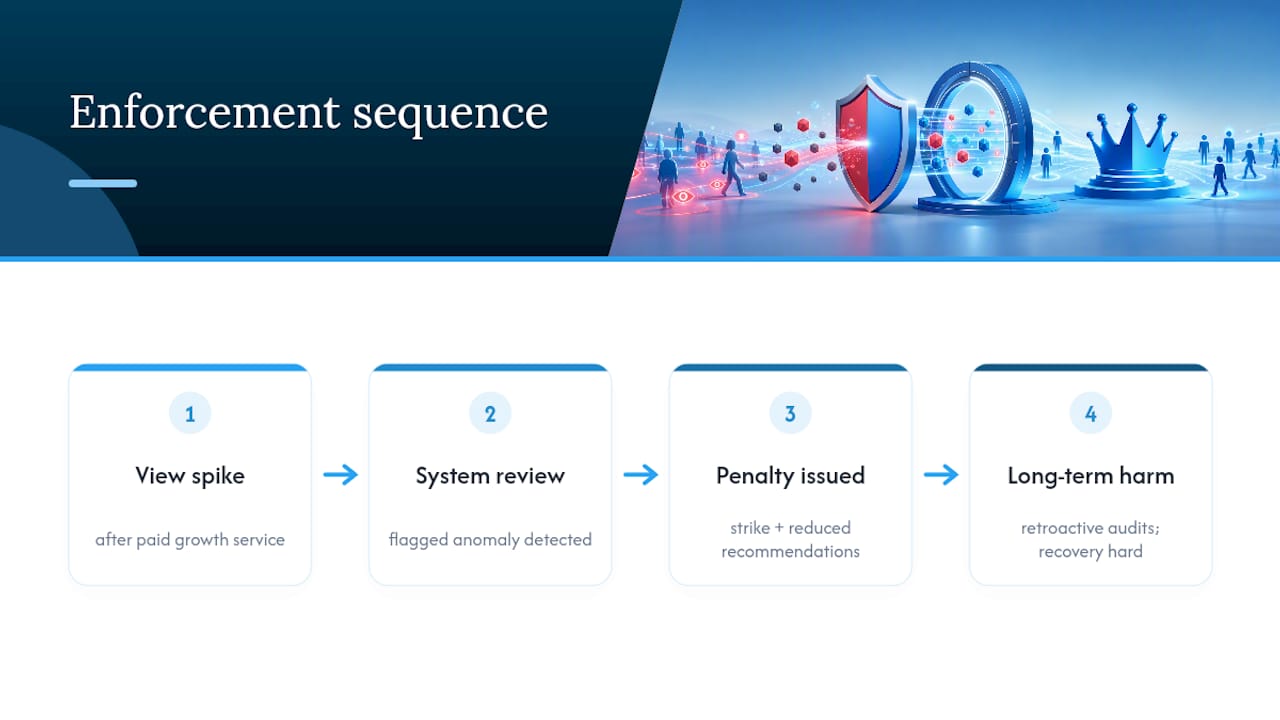
The common thread in most of these cases is that the creator didn’t buy the views directly from a bot farm. They hired a “growth agency” or “engagement service” that used artificial methods behind the scenes, without disclosing exactly how the numbers were generated. That’s precisely why the policy holds the channel responsible regardless of who executed the campaign. Due diligence on any paid promotion service, checking whether it uses YouTube’s own ad infrastructure or something else entirely, is the single most effective safeguard against this outcome.
Does the algorithm treat suspicious view patterns differently?
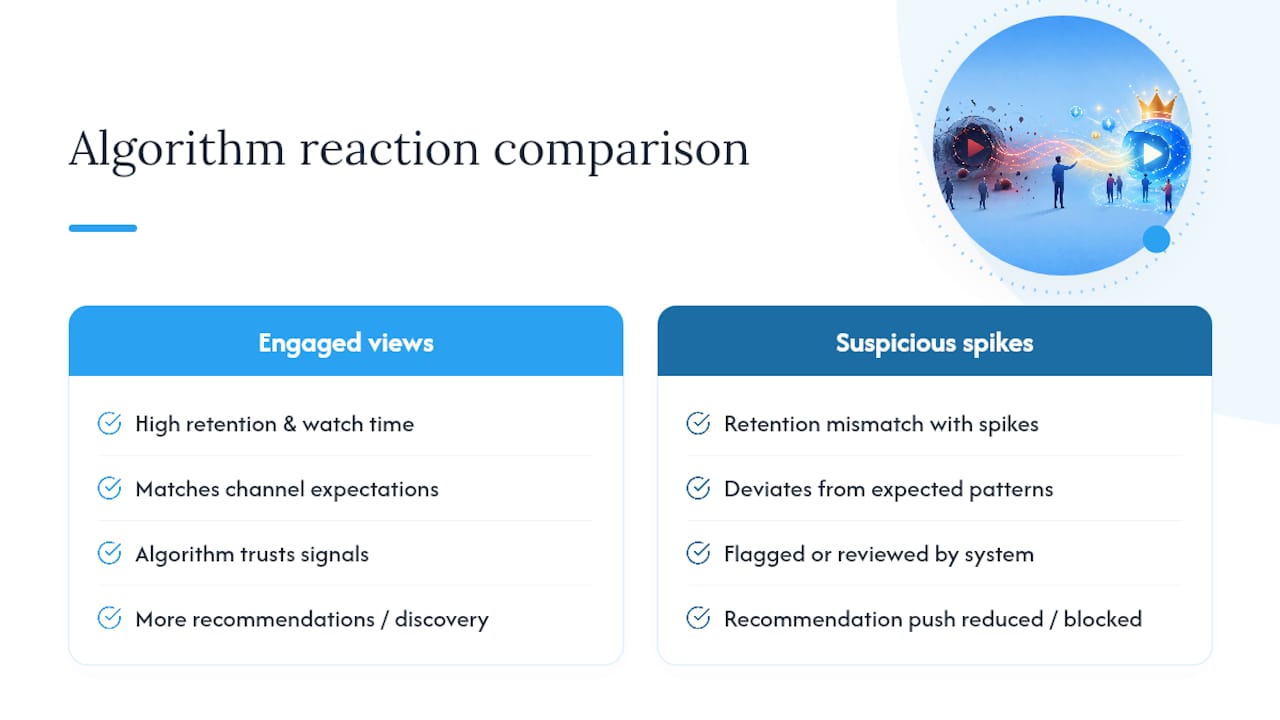
Yes, and this is where a lot of creators misunderstand how recommendation systems actually work. YouTube’s algorithm isn’t just counting views; it’s constantly weighing engagement quality signals like retention, session duration, and click-through consistency against expected patterns for a channel’s size and niche.
When a video shows a view spike that doesn’t match its retention curve, click-through rate, or subscriber conversion, that mismatch itself becomes a signal. Rather than rewarding the spike with more recommendations, the system is more likely to flag it for review or simply stop pushing the video further, because it can’t confirm real audience interest behind the numbers.
This is part of why the shift toward engaged views matters so much. A channel that plays the counting change straight, focusing on genuine retention and watch time, sends the algorithm consistent, trustworthy signals. A channel chasing inflated public views creates statistical noise that recommendation systems are specifically designed to discount or investigate. Suspicious patterns don’t just risk a policy strike; they actively work against the discovery mechanics you’re trying to benefit from.
How do unsafe view practices affect long-term channel growth?
The damage compounds well beyond any single strike. A channel flagged for artificial engagement typically sees reduced algorithmic trust that persists after the immediate penalty is resolved, meaning even fully compliant videos published afterwards can struggle to reach the audience they would have earned organically.
Monetisation suffers on a parallel track. Advertisers and brand partners increasingly check engaged views and retention against public totals before agreeing to sponsorships, and a channel with a history of inflated numbers becomes a harder sell even once the artificial activity has stopped. Rebuilding that credibility takes considerably longer than the original violation did to occur, often outlasting the short term boost the purchased views ever delivered. The channels that grow sustainably are consistently the ones that treated engaged views, not public totals, as the number worth optimising from day one.
Publisher perspective: why we build campaigns around engaged views
Since 2013, Greediersocialmedia has focused on authentic engagement rather than raw numbers, because we’ve watched what happens to accounts that chase the opposite. Every campaign we design for YouTube prioritises retention and genuine viewer interaction over inflated public totals, precisely because that’s what actually holds up against policy scrutiny and algorithmic evaluation.
We think the 2026 counting change is a genuine turning point for how creators should think about promotion. It exposes public view counts as a reach metric, not a trust metric, and rewards the campaigns that were already built around watch time and real audience response. If you’re weighing paid promotion, ask what it’s actually optimised to deliver, engaged attention or a number that looks good for a week and then quietly falls apart.
— Luna
Grow YouTube views the compliant way with Greediersocialmedia
There are alternative services to gambling on anonymous “engagement services” that can’t tell you how their views are generated. Every YouTube package is built around targeted, password-free delivery aimed at real engagement, not the kind of anonymous spike that trips YouTube’s automated audits.
Getting started is straightforward. Some services offer diagnostics on channel metrics and propose campaigns shaped around engaged views and watch time rather than public totals, setting measurement plans to track progress. If you’re ready to grow views without gambling on your channel’s standing, consider exploring available YouTube growth services for tailored proposals.
Sources
- Fake engagement policy – YouTube Help
- YouTube will now count a view as soon as a video starts playing | TechCrunch
- YouTube changes how it counts views, handing marketers two numbers instead of one | Forbes
- YouTube will now count a view as soon as a video starts playing | The Verge
FAQ
Is it safe to buy YouTube views?
No. Buying views typically breaches YouTube’s Fake Engagement Policy and risks strikes, metric removal, or channel termination, with retroactive audits meaning the risk doesn’t disappear once the purchase is made.
How can you tell if someone is buying YouTube views?
Check for a mismatch between a high public view count and poor audience retention, low subscriber conversion, or a sudden surge from a single unfamiliar country in the Traffic Sources report.
Does YouTube pay $3 for 1,000 views?
YouTube doesn’t pay a fixed rate per view; ad revenue depends on factors like advertiser demand, audience location, and engaged watch time, so any flat per thousand figure you see quoted online is a rough estimate, not a guaranteed rate.
Is it worth buying YouTube views?
Generally, no. Purchased views rarely convert into engaged views, subscribers, or ad revenue, and the policy risk can undo far more growth than the purchase ever delivered, making official promotion or organic tactics a more reliable investment.
Are YouTube Shorts views held to the same safety standard?
Yes. YouTube Shorts views are covered by the same Fake Engagement Policy as standard videos, and artificially inflated Shorts views carry the identical risks of strikes, metric removal, or channel penalties.