
Understanding YouTube views retention explains why some videos keep climbing long after upload.
Buying sustained YouTube views is possible and often works, but it carries genuine platform risk if you buy it wrong. The safest approach uses gradual, drip delivery, an explicit retention or refill guarantee, and daily metric monitoring for the first fortnight. A password-free, region-focused delivery model that includes those three protections is worth considering for safety from the start.
TL;DR:
- Gradual, drip-fed delivery paired with a clear retention guarantee is more likely to sustain views without triggering detection or penalization.
- Instant spikes in views strongly correlate with retention drops and increased risk of account penalties, especially if delivery is rapid or incomplete.
- Providers should disclose delivery speed, offer a clear refill or retention guarantee, and require only the video’s URL for a safe purchase.
- Testing with small batches on videos with decent existing retention helps verify the provider’s quality before larger investments.
- Monitoring key metrics like retention, watch time, and revenue within the first two weeks is essential for detecting issues and ensuring long-term value.
Table of Contents
- What “YouTube views retention” means for buyers
- How does YouTube police fake engagement?
- How do you evaluate a paid-views provider?
- What does a safe buying checklist look like?
- How do you measure retention and what’s normal?
- What should you expect on timelines and pricing?
- Publisher perspective: what actually separates safe buys from risky ones
- Greedier Social Media’s approach to sustained YouTube views
- Sources
- FAQ
What “YouTube views retention” means for buyers
In this context, YouTube views retention refers to paid or sustained view packages: third-party services that deliver ongoing or drip-fed views to a public video link, with the goal of keeping the visible view count stable over time rather than just spiking it once. That’s a different question from the audience-retention analytics YouTube Studio shows you (watch time, drop-off curves), which measures how much of your video people actually watch. This guide sticks to the buying side.
Providers typically offer three delivery types. A spike pushes the full order through in a short burst, usually within hours. A drip-feed spreads the same order across days or weeks, mimicking organic growth. A recurring or auto package tops up views on a schedule, useful for creators publishing regularly who want visible counts to keep climbing alongside new uploads.
How does YouTube police fake engagement?
YouTube’s Fake Engagement Policy bans artificially inflating views, likes, or comments, and the enforcement ladder runs from stripped view counts through warnings and strikes to full channel termination, according to YouTube’s own policy framework. The severity tends to track how the views arrived, not just that they arrived.
Evidence from creator reports and buyer investigations points to a consistent pattern: instant, spiked delivery correlates far more often with collapsed retention and account harm, while gradual delivery paired with decent existing retention tends to pass without incident, according to an analysis of buyer outcomes. Three outcomes recur in that reporting:
- Views get silently stripped with no lasting gain, wasting the spend but causing no real damage.
- A sudden spike triggers detection, and retention and watch time collapse within days.
- Gradual delivery on a video with solid organic retention holds up, with no visible penalty.
Watch for the warning signs of detection yourself: a sharp drop in view count a few days after delivery, a retention percentage that falls off a cliff rather than tapering, or RPM (revenue per thousand views) suddenly dropping even though the raw view number looks fine.
How do you evaluate a paid-views provider?
Most sellers say remarkably little about how they actually deliver. Investigative reviews of seller pages found that only a minority publish delivery speed or pricing before checkout, which leaves buyers guessing about the one variable that predicts outcomes, according to research on buying evidence. Insist on the following before you hand over any card details.
- Delivery speed disclosed upfront. The provider should state whether delivery is instant, drip, or configurable, and roughly how long an order takes.
- A stated retention or refill guarantee. Look for a specific window, not vague reassurance, and check what triggers a refund versus a free refill.
- No-password, link-only delivery. You should only ever need to supply the public video URL, never login credentials.
- Signals of real accounts. Profile photos, posting history, and plausible follower ratios distinguish genuine delivery from bot networks that vanish during a platform purge, per guidance on avoiding common buying mistakes.
- Transparent pricing and small test orders. If a seller won’t quote a price or sell you a small batch first, that’s a red flag worth walking away from.
Pro Tip: Run the small test order on a video that’s already live and performing reasonably well, not a fresh upload. That way any change in retention is easier to attribute to the purchase rather than the video’s own natural settling period.
What does a safe buying checklist look like?
Treat the purchase as a small experiment, not a one-off gamble.
- Before you buy: place a modest test order (a few hundred views is enough to judge quality, as buyer guidance on test sizing suggests), pick a video with active recent content, and screenshot your baseline metrics first.
- During delivery: check retention, watch time, geolocation spread, and device mix daily for the first two weeks. Anything that moves sharply out of line with your normal pattern needs investigating immediately.
- After delivery: use the refill or refund window if metrics drop, and avoid repeat-buying from the same provider if retention or watch time keeps sliding. Feed the results back into your content optimisation rather than just buying more.
- Throughout: pair the purchase with a strong on-screen call-to-action and a burst of organic promotion, since that combination gives YouTube’s algorithm more genuine signal to amplify.
How do you measure retention and what’s normal?
YouTube Studio gives you everything you need: average view duration, total watch time, impressions, click-through rate, subscriber conversion rate, and the retention curve itself. Track all six against a baseline you captured before the order went live, and watch percentage change rather than absolute numbers.
Gradual, well-delivered orders should only produce a modest dip in retention, if any at all, because delivery speed is the variable creators most reliably cite as predictive of outcome. A sharp, sudden fall in retention alongside a spike in raw views is the clearest signal something has gone wrong, and it’s your cue to invoke a refund or refill guarantee rather than wait it out.
What should you expect on timelines and pricing?
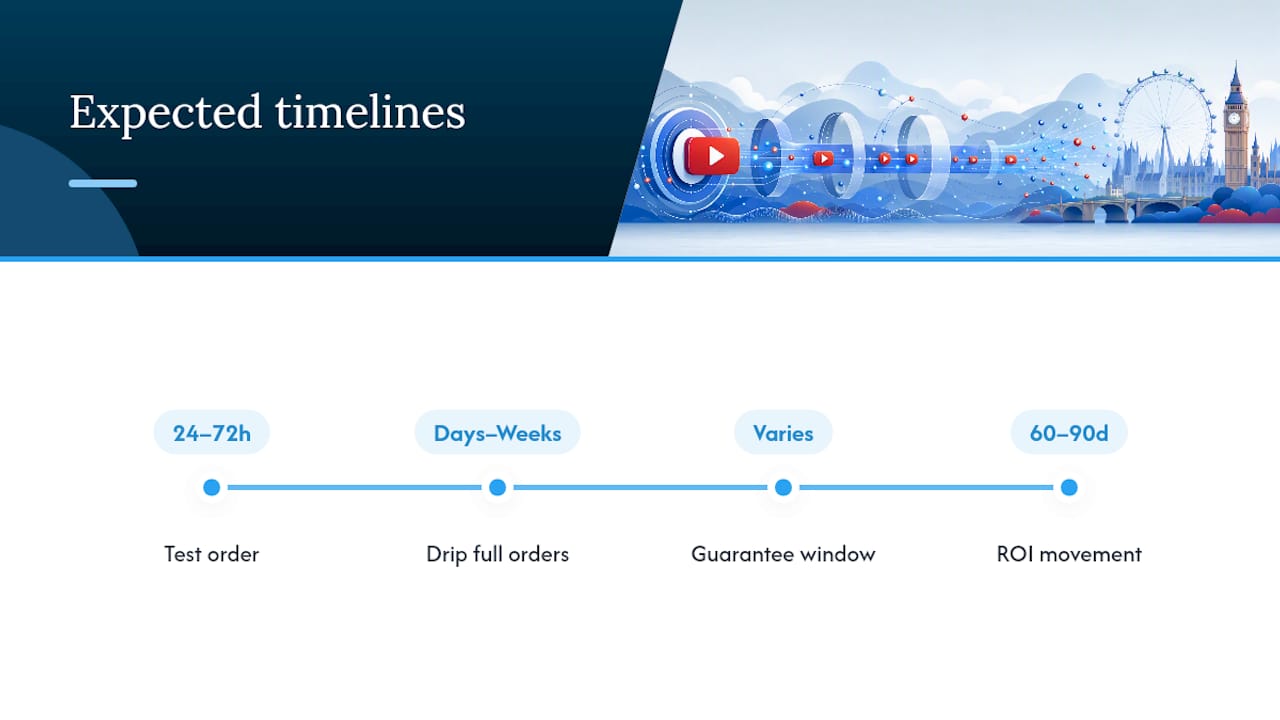
Expect a test order within 24 to 72 hours, with full orders following on a drip schedule that can run days to a few weeks depending on volume. Refill or guarantee windows vary by provider, so check the exact number of days before you buy, not after something goes wrong.
Pricing tends to come in three shapes: small test packs, ongoing drip subscriptions, and larger bulk buys with a lower per-view cost. Judge the offer on cost per retained, useful view rather than the headline number, since a cheap batch that gets stripped within a week costs more than a slightly pricier one that holds.
Paid views work best as amplification, not rescue. YouTube content shows real durability, with a meaningful share of lifetime views and clicks landing more than 30 days after publish, so paid promotion on strong content can lift long-term ROI rather than just inflating one day’s count. Combined with consistent publishing and stronger titles or thumbnails, many small businesses see measurable movement in cost-per-lead within 60 to 90 days.
Publisher perspective: what actually separates safe buys from risky ones
Most guides on this topic treat “buy views” and “grow organically” as opposing camps, and that’s a false choice. The data on delivery speed makes the real dividing line obvious: it’s not whether you buy views, it’s how fast they arrive and whether the content underneath them can hold the attention those views bring.
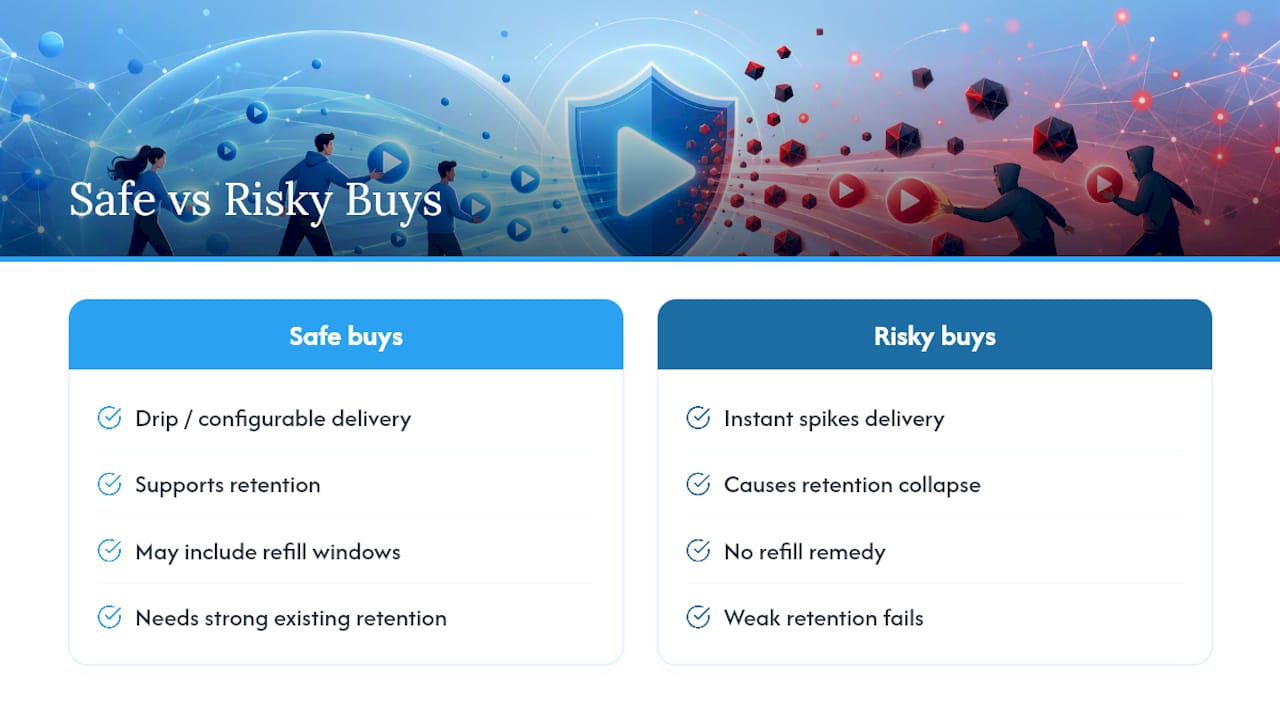
Some providers build their YouTube view packages around that distinction. Delivery may be password-free and drip-configurable by design, because instant spikes are the behaviour most associated with retention collapse in independent reporting. Refill windows may exist so a buyer who spots a metric drop has a potential remedy rather than a sunk cost.
The tactical advice worth repeating: never buy views for a video with weak existing retention and expect the purchase to fix it. Paid views amplify what’s already working. They rarely rescue what isn’t. Pair every order with an active publishing cadence and a clear on-screen ask, and the numbers tend to move in the right direction together.
— Irwin Lee
Greedier Social Media’s approach to sustained YouTube views
There are services that offer password-free delivery, configurable drip speeds, and a stated retention guarantee, aimed at creators and small businesses needing view counts to hold rather than spike and vanish. Such models typically do not require login details from buyers, and delivery windows are disclosed before checkout rather than afterward.
If you’re testing the waters, start small. Order a modest batch against a video with decent existing watch time, then run the two-week monitoring routine covered above, checking retention and watch time against your baseline. Pair the order with the organic momentum tactics that keep the algorithm interested once the paid views land, and lean on video SEO fundamentals to make sure the content itself earns the attention. When you’re ready to commit properly, the YouTube views packages page sets out current pricing and delivery options, and it’s the natural next step once your test order has proven the approach works for your channel.
Sources
- YouTube ROI and creator marketing strategy (Think with Google excerpt)
- Buying YouTube Views: What the Evidence Actually Shows
- 5 mistakes to avoid when buying social media engagement in the UK
- How small businesses can harness the power of YouTube (Entrepreneur)
FAQ
Is buying YouTube views against the rules?
YouTube’s Fake Engagement Policy prohibits artificially inflating views, and enforcement can range from stripped metrics to channel termination, so how a provider delivers views matters more than the fact you bought them.
Does drip-fed delivery really lower the risk?
Creator reports and buyer investigations consistently link gradual, drip-fed delivery to preserved retention, while instant spikes correlate far more often with detection and collapsed metrics.
How many views should I order for a test?
A modest number of views is generally enough to judge a provider’s quality and delivery pattern before committing to a larger order.
What metrics should I check after buying views?
Track average view duration, total watch time, impressions, click-through rate, subscriber conversion rate, and the retention curve in YouTube Studio, comparing each to your pre-purchase baseline.
Does Greedier Social Media offer a retention guarantee?
Some YouTube view packages include a stated retention or refill guarantee window and password-free delivery, giving buyers a remedy if metrics move outside expected ranges.