
Understanding why reviews boost online presence explains a big part of modern local search.
TL;DR:
- Online reviews are crucial ranking signals that influence local search results and AI-generated answers in 2026. Detailed, recent reviews with high response rates enhance digital visibility, trust, and engagement, making review management a key content strategy for small businesses. Consistently fostering authentic, keyword-rich reviews and integrating them into web pages can double organic traffic and boost brand credibility.
Online reviews are a direct ranking signal for search engines and AI systems, making them one of the most powerful tools a small business can deploy for digital visibility. Platforms like Google Business Profile and Trustpilot do not simply collect opinions. They feed structured data into algorithms that determine where your business appears in local search results and AI-generated answers. Reviews contribute 15–17% to local pack ranking factors in 2026, placing them alongside links and on-page content as a primary driver of organic reach. Understanding why reviews boost online presence means understanding how modern search actually works.
Why reviews boost online presence through search rankings
The mechanism is more technical than most business owners realise. Google’s algorithm reads review content the same way it reads your website, extracting signals about what your business does, where it operates, and how customers experience it. Google applies Named Entity Recognition to detailed review text, pulling out business names, services, staff mentions, and measurable outcomes to build richer, more accurate business profiles than your own website copy typically provides.

This matters because AI search systems, including ChatGPT and Perplexity, now rely on review consensus as a trust signal. AI systems use review consensus to assess local business authority, effectively replacing backlinks as the primary credibility indicator for location-based queries. A business with 200 detailed reviews describing specific services and outcomes carries far more weight in an AI-generated answer than one with a polished website and no review activity.
Three factors drive the most ranking value from reviews:
- Volume signals that a business is active and widely used, but it is the least important of the three.
- Recency tells search engines the business is currently trading. A dormant review profile signals inactivity, which suppresses rankings.
- Response rate is the most overlooked factor. Businesses with a 90%+ response rate rank an average of 2.1 positions higher in local results and receive a 52 percentage point increase in brand citations by AI systems. That is a significant competitive advantage available to any business willing to reply consistently.
“Reviews have transitioned from soft social proof to core, scalable content channels that feed AI search and local rankings alike.” — newframedigital.com
On the technical side, review schema markup increases click-through rates by an average of 30% by generating star ratings directly in search results. Rich snippets make your listing visually distinct before a user even clicks, which compounds the ranking benefit with a conversion benefit.
What review content actually moves the needle for SEO
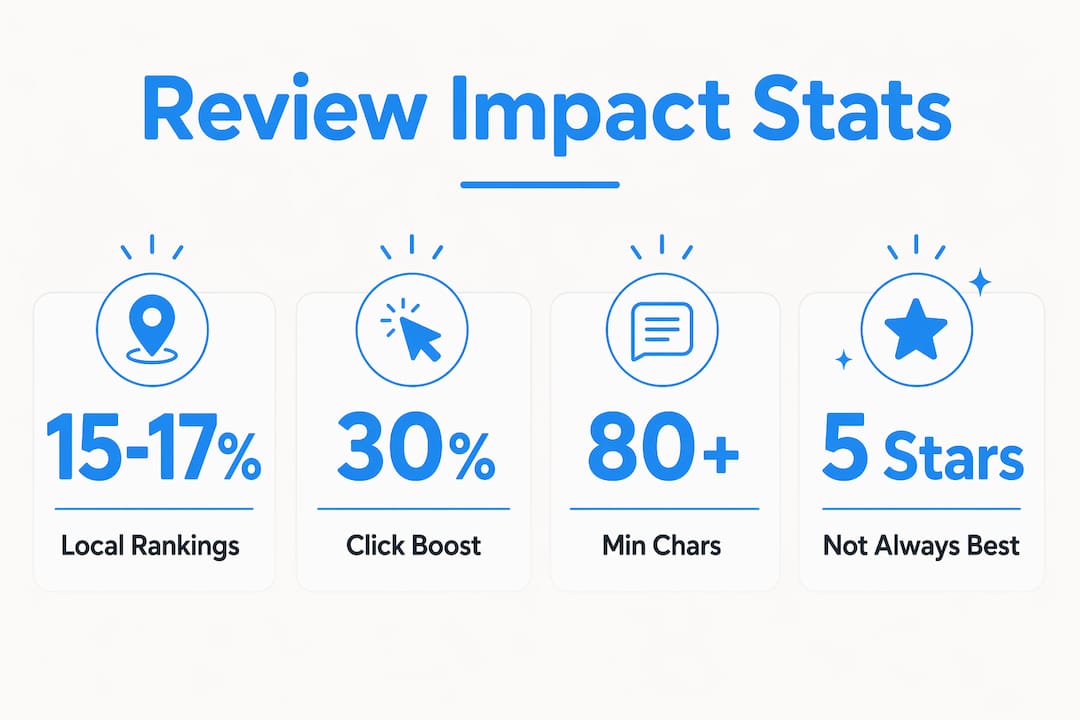
Not all reviews carry equal weight. A five-star rating with the text “Great service!” contributes almost nothing to your search visibility. Google’s entity recognition cannot extract meaningful signals from a single adjective. The reviews that drive the strongest impact are those that read like a short case study: named service, specific outcome, timeframe, and staff member where relevant.
Detailed reviews with named services and measurable outcomes provide stronger AI visibility than polished brand copy. This is a counterintuitive finding for many marketers who spend considerable effort crafting website messaging, only to ignore the far more credible, third-party language sitting in their review profiles.
Review recency and velocity outweigh total volume in local search rankings. An active stream of new reviews signals to Google that your business is currently relevant, not just historically popular. A business that collected 300 reviews three years ago and has received none since will consistently underperform a competitor with 80 reviews gathered steadily over the past six months.
Pro Tip: When requesting reviews, give customers a short prompt rather than a blank page. Ask them to mention the specific service they used, what changed as a result, and roughly how long it took. This structure produces the keyword-rich, entity-dense content that search engines extract most effectively.
A mix of ratings also matters more than many businesses acknowledge. A profile with exclusively five-star reviews triggers scepticism in both users and algorithms. Moderate reviews, handled with a thoughtful public response, signal authenticity and active management. Responding consistently to reviews signals active management to Google, improving local trust signals and rankings directly.
How to integrate reviews into your SEO and content strategy
Reviews are not a standalone reputation tool. Used correctly, they become a scalable content channel that feeds your entire digital marketing operation. Here is a practical framework for doing that:
- Embed reviews as indexable HTML on product and service pages. Review content must be rendered as raw HTML or via schema markup rather than loaded in iFrames, so search engines can crawl the text. Using indexable review widgets from platforms like Yotpo or Trustpilot passes full SEO value to your pages.
- Mine review language for keyword research. User-generated review language mirrors authentic customer phrasing and outperforms generic marketing terms for keyword targeting. The phrases your customers use to describe your service are often more search-relevant than the phrases your marketing team invents.
- Maintain cross-platform consistency. Your business name, address, and service descriptions should match exactly across Google Business Profile, Trustpilot, Yelp, and your own website. Consistent entity data across platforms strengthens your Knowledge Graph profile, which is how AI systems identify and cite your business.
- Build a repeatable review generation system. Ad hoc review requests produce inconsistent velocity. A structured follow-up sequence, triggered after purchase or service completion, produces the steady stream of fresh content that rankings require.
| Strategy | SEO benefit |
|---|---|
| Indexable review widgets | Search engines crawl review text, passing full ranking value to pages |
| Voice of Customer keyword mining | Authentic phrasing improves content relevance and long-tail rankings |
| Schema markup implementation | Rich snippets in SERPs increase click-through rates by an average of 30% |
| Cross-platform entity consistency | Strengthens Knowledge Graph profile for AI citation and local rankings |
Integrating user-generated review content on product and service pages can double organic traffic and increase engagement by 29% over pages without such content. That figure alone justifies treating review management as a core marketing function rather than an afterthought.
Pro Tip: Prompting customers with a minimum character count, such as asking for at least 80 words, significantly increases the presence of specific keywords and service details in the reviews you receive. Longer reviews give search engines far more to work with.
How do online reviews shape customer behaviour and brand credibility?
The consumer psychology behind reviews is well established, but the scale of its effect still surprises most business owners. Online reviews drive 35% more revenue for small and medium businesses, a figure that reflects how directly review quality translates into purchasing decisions.
The mechanism is social proof. When a prospective customer sees that 150 people have used your service and described specific positive outcomes, the perceived risk of buying drops sharply. This is particularly powerful for service businesses where the product cannot be inspected before purchase. Reviews substitute for the direct experience the customer cannot yet have.
Several specific behaviours are shaped by review profiles:
- Click-through rates increase significantly when star ratings appear in search snippets, meaning reviews improve visibility and conversion simultaneously.
- Purchase hesitation decreases when reviews are recent and specific. Vague or outdated reviews have the opposite effect.
- Repeat business and referrals increase when businesses respond publicly to reviews, because existing customers see that their feedback is valued.
“Active engagement with reviews, including responding and soliciting specific feedback, is a ranking factor that distinguishes top local businesses.” — the66th.com
Negative reviews, handled well, often build more trust than a perfect five-star average. A business that responds to a complaint with a clear resolution demonstrates accountability. Prospective customers read those exchanges and draw conclusions about how the business treats people when things go wrong. That is a credibility signal no amount of positive reviews can replicate on its own. Customer feedback drives 20–40% revenue growth when businesses use it actively rather than passively collecting it.
Key takeaways
Online reviews boost your online presence by simultaneously improving search rankings, feeding AI citation systems, and converting more visitors into customers through social proof.
| Point | Details |
|---|---|
| Reviews as ranking signals | Reviews contribute 15–17% to local pack rankings, making them a primary SEO factor in 2026. |
| Response rate matters most | A 90%+ response rate produces a 2.1 position ranking improvement and a 52pp AI citation boost. |
| Quality beats quantity | Detailed reviews with named services and outcomes outperform high volumes of generic five-star text. |
| Technical implementation | Indexable HTML or schema markup is required for review content to pass SEO value to your pages. |
| Content channel potential | Embedding review content on service pages can double organic traffic and lift engagement by 29%. |
What I have learned from watching businesses ignore their review profiles
I have spent years watching small businesses invest heavily in paid social and content creation while their Google Business Profile sits with 12 reviews, the most recent from 18 months ago. The irony is that the review profile costs almost nothing to maintain and delivers compounding returns that paid channels cannot match.
The most common mistake is treating review requests as a one-off campaign. A business runs a push, collects 40 reviews in a month, then stops. Six months later, the velocity has dried up and the rankings begin to slip. The businesses that consistently outperform their competitors in local search are not the ones with the most reviews. They are the ones with the most recent reviews and the most consistent response behaviour.
There is also a missed opportunity in how most businesses use the content they already have. Your reviews contain the exact language your customers use to search for you. That language belongs in your service page copy, your meta descriptions, and your social media captions. Greediersocialmedia has seen this pattern repeatedly: businesses that mine their review content for social media visibility create a feedback loop where authentic language attracts more of the right customers, who then leave more useful reviews.
The uncomfortable truth is that most businesses are sitting on a content goldmine they have never opened. Your review profile is not a reputation management tool. It is a living content channel, and the businesses that treat it that way are the ones that compound their digital presence year on year.
— Luna
Grow your online presence with Greediersocialmedia
If this article has made one thing clear, it is that managing your online presence requires more than a good product. It requires a consistent, structured approach to visibility across every digital channel. Greediersocialmedia has helped over a million UK businesses and creators build genuine authority online since 2013, using authentic engagement strategies that compound over time. Whether you are starting from scratch or looking to accelerate what you already have, explore the social media growth tactics that pair directly with a strong review strategy. You can also browse the growth packages designed specifically for businesses ready to move from invisible to unmissable.
FAQ
Do online reviews directly affect search engine rankings?
Yes. Reviews contribute approximately 15–17% to local pack ranking algorithms in 2026, making them one of the strongest signals available to small businesses for improving search visibility.
How many reviews does a business need to rank well?
Volume matters less than recency and response rate. A steady stream of new, detailed reviews combined with consistent responses outperforms a large but dormant review profile in local search rankings.
What makes a review useful for SEO?
Reviews that name specific services, describe measurable outcomes, and include relevant timeframes provide the strongest SEO value. Generic text such as “Great service!” contributes almost nothing to entity recognition or keyword relevance.
Should businesses respond to negative reviews?
Responding to negative reviews signals active management to Google and builds credibility with prospective customers. A clear, professional response to a complaint often increases trust more than an additional five-star review would.
How do reviews influence AI search results?
AI systems like ChatGPT use review consensus as a trust signal to determine which businesses to cite in generated answers. Businesses with active, detailed review profiles receive significantly more AI citations than those with sparse or outdated review content.