
TL;DR:
- Paid reach provides targeted visibility through paid advertising, while organic reach depends on algorithmic engagement. Combining both strategies maximizes growth, trust, and retention over time.
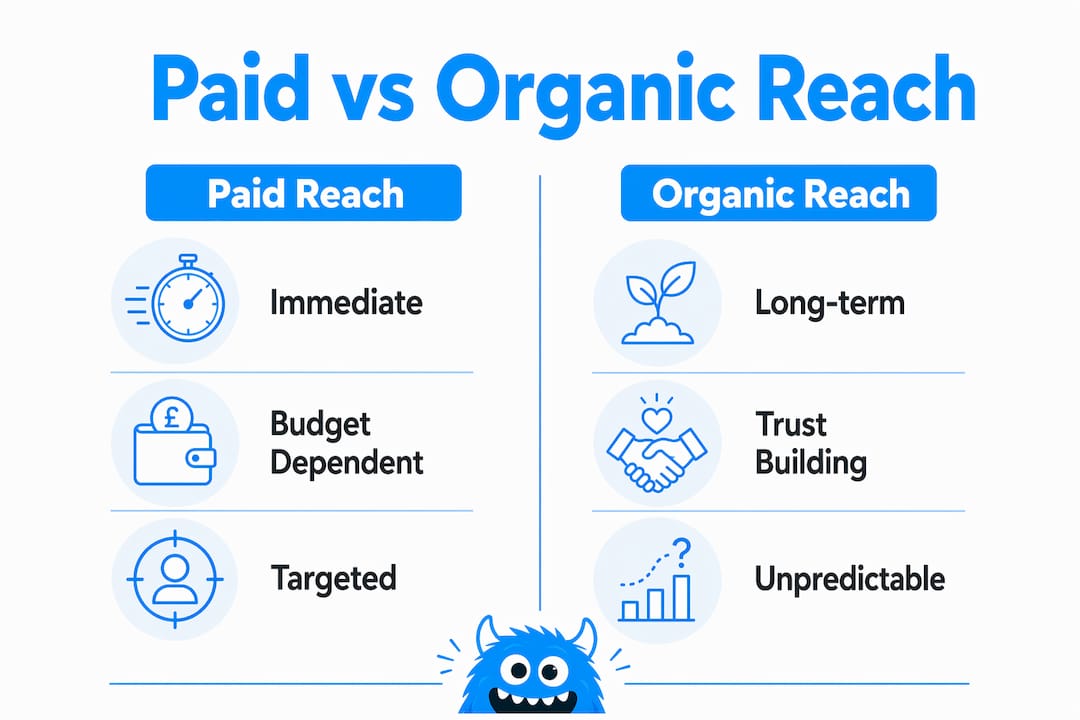
Paid reach is defined as the portion of your audience you access through direct financial investment in promotion, delivering targeted, predictable visibility on demand. Organic reach, by contrast, is the unpaid distribution your content receives through algorithmic selection based on relevance and engagement. Understanding why paid vs organic reach differs is not just a theoretical exercise. It shapes every budget decision, every content choice, and every growth target you set for your brand on social media.
Facebook’s organic reach has dropped from around 16% in the early 2010s to approximately 1.37%–2.2% by Q1 2026. That collapse is not accidental. It reflects a deliberate shift by platforms towards monetising feed space, and it is the single clearest illustration of why the differences between paid and organic reach have grown so stark. Greediersocialmedia has worked with over a million clients since 2013, and the question of how to balance these two reach types comes up in nearly every growth conversation.

Why paid vs organic reach differs at its core
The gap between paid and organic reach comes down to three forces: algorithmic prioritisation, platform monetisation, and audience behaviour.
Social media algorithms do not distribute content equally. Modern algorithms prioritise “value and relevance” over volume, penalising low-effort posts and rewarding content that generates genuine engagement. This means organic reach is not dead, but it is highly selective. Only content that earns strong early engagement signals gets pushed to a wider audience.
Platform monetisation is the second force. Meta, for example, has a direct commercial incentive to restrict how far unpaid posts travel. As organic reach shrinks, ad revenue per user grows. The platform profits when brands pay to reach the same audiences they once reached for free.
Paid reach operates on an entirely different logic. Paid social enables control over who sees your content, how often, and in what sequence. That engineered distribution is what makes paid reach predictable and measurable in ways organic simply cannot match.
The third force is audience trust. 76% of consumers trust organic-style content over ads. This trust gap means organic content often generates deeper engagement per view, even when it reaches fewer people overall.
- Algorithms reward engagement quality, not posting frequency
- Platforms restrict organic reach to grow paid ad revenue
- Paid reach gives you control over targeting, frequency, and sequencing
- Organic content earns higher trust but reaches a smaller, self-selected audience
How do the costs and time investments compare?
Organic reach carries a widespread misconception: that it is free. It is not.
Organic marketing requires significant upfront labour in content creation and community management, typically taking 12–24 months before the benefits compound and begin reducing your acquisition costs. A small business owner spending ten hours a week writing posts, filming videos, and responding to comments is investing real money in the form of time. That cost rarely appears in a marketing budget, but it is always there.
Paid reach, by contrast, has explicit costs that are easy to track and adjust. You set a budget, define an audience, and measure results against spend. The trade-off is dependency. The moment you stop paying, visibility stops too.
- Map your true organic costs. Calculate the hourly rate of everyone involved in content creation and multiply by hours spent per month. This gives you an honest baseline.
- Set a realistic timeline for organic growth. Expect 12–24 months before organic efforts meaningfully reduce your cost per acquisition.
- Track paid reach ROI weekly. Paid campaigns produce data fast. Use it to cut underperforming ad sets before they drain budget.
- Avoid treating organic and paid as separate budgets. They share the same goal: reaching the right audience. Integrate the planning.
Pro Tip: Run your organic content for two to four weeks before putting paid spend behind it. Posts that already show strong organic engagement almost always perform better as paid ads, because the social proof is built in.
What are the strengths and limitations of each reach type?
Paid and organic reach are not competing strategies. They are tools with different jobs, and confusing those jobs is where most marketers go wrong.
Where paid reach excels
Paid reach delivers immediate visibility for testing offers, running seasonal campaigns, and capturing audiences with active commercial intent. If you launch a product on a Tuesday and need sales by Friday, paid is the only mechanism that can deliver that speed. Paid also gives you the ability to test multiple creative variations simultaneously, which organic reach cannot replicate at scale.
The limitation of paid reach is real and worth stating plainly. Budget dependency means your visibility is rented, not owned. Authenticity is also a challenge. Consumers avoid content that feels overly polished or “ad-like,” and platforms deprioritise overtly promotional content even in paid placements when engagement rates fall below benchmarks.
Where organic reach excels
Organic reach builds brand authority over time in a way paid cannot replicate. Brands with active organic communities see up to 25% higher customer retention. That retention effect compounds: loyal followers share content, leave reviews, and return without needing to be retargeted with paid ads.
The limitation of organic reach is unpredictability. Algorithm changes can cut your reach overnight without warning. Growth is slow, and results are difficult to attribute directly to revenue in the short term.
| Factor | Paid reach | Organic reach |
|---|---|---|
| Speed of results | Immediate | 12–24 months to compound |
| Cost structure | Direct spend | Labour and time |
| Audience trust | Lower | Higher |
| Targeting control | Precise | Algorithm-dependent |
| Long-term value | Stops when budget stops | Builds over time |
Pro Tip: Use organic content to identify your best-performing messages, then put paid spend behind those specific posts. This approach reduces wasted ad spend and improves click-through rates because you are amplifying content that already resonates.
How can marketers combine paid and organic reach effectively?
The most effective social media strategies treat paid and organic reach as a single integrated system, not two separate channels.
Allocating approximately 70–80% of your social budget to paid campaigns while maintaining a consistent organic presence reflects 2026 industry best practice. This split gives you the acquisition speed of paid reach while keeping the trust and retention benefits of organic content alive.
Organic and paid efforts complement each other in a specific way: organic content identifies which messages resonate, and paid campaigns then amplify those messages to a wider audience. This loop reduces wasted ad spend and improves overall campaign efficiency. Integrated strategies consistently outperform siloed approaches.
Here is how to build that integration in practice:
- Use organic as a testing ground. Post content variations organically first. The posts that generate the highest engagement rates are your best candidates for paid amplification.
- Feed organic signals into paid targeting. Audiences who engage with your organic posts are warm leads. Build custom audiences from these groups and retarget them with paid campaigns.
- Maintain organic consistency even during paid campaigns. Brands that go dark on organic content while running ads lose community trust. Keep posting, even at a reduced frequency.
- Review paid performance to inform organic content themes. If a paid ad about a specific product benefit drives strong click-through rates, that benefit should feature prominently in your organic content calendar too.
- Measure organic reach effectiveness separately from paid. Mixing the two in a single report makes it impossible to understand what is actually driving results.
Improving user engagement across both paid and organic channels is the foundation of sustainable growth. Engagement signals feed algorithms, build trust, and make paid campaigns more efficient at the same time.
For small businesses with limited budgets, the practical starting point is to build a credible organic presence first, then introduce paid spend once you have content that demonstrably resonates. Launching paid campaigns with untested creative is one of the most common and costly mistakes in social media marketing.
Key takeaways
Paid reach offers speed and control, while organic reach builds trust and retention. The most effective approach combines both, using organic content to test and inform paid campaigns.
| Point | Details |
|---|---|
| Organic reach has declined sharply | Facebook organic reach fell to approximately 1.37%–2.2% by Q1 2026, driven by platform monetisation. |
| Organic is not free | Content creation and management typically require 12–24 months of labour before costs reduce. |
| Paid reach is engineered distribution | Paid social controls targeting, frequency, and sequencing in ways organic cannot match. |
| Organic builds deeper trust | 76% of consumers trust organic-style content over ads, driving higher retention rates. |
| Integration outperforms either alone | Allocating 70–80% of budget to paid while maintaining organic presence reflects 2026 best practice. |
The uncomfortable truth about relying on just one
Most marketers I speak with have a preference. They either love the control of paid campaigns or they believe deeply in the power of organic community building. Both instincts are correct, and both become liabilities when taken too far.
The brands that struggle most are those that pour budget into paid ads without any organic foundation. Their ads reach people who then visit a profile with three posts and no community. The trust signal is missing, and conversion rates suffer for it. On the other side, I have seen small businesses spend two years building a beautiful organic following, only to watch a single algorithm update cut their reach by half overnight.
The practical lesson is that organic content should be treated as your brand’s permanent record. It is what people see when they check whether you are credible. Paid reach is the amplifier. You would not turn up the volume on a signal that is not worth hearing. Get the organic content right first, then use paid reach to scale what already works. Measuring social media growth progress across both channels gives you the data to make that call with confidence rather than guesswork.
The one thing I would push back on is the idea that organic reach is dying. It is not dying. It is getting harder to earn. That is a different problem, and it has a different solution: better content, not more content.
— Luna
How Greediersocialmedia supports your reach strategy
Building a presence that works across both paid and organic channels takes more than good intentions. Greediersocialmedia has helped over a million UK clients grow their social media presence since 2013, using authentic engagement strategies that strengthen both reach types simultaneously.
Whether you are looking to build a credible organic foundation or amplify what is already working through paid promotion, Greediersocialmedia’s growth tactics are built around real followers, genuine likes, and verified views. No passwords required. The result is a profile that earns trust from both algorithms and real audiences, giving your paid campaigns a stronger platform to build on. Explore the paid vs organic breakdown to see which approach fits your current goals.
FAQ
What is the main difference between paid and organic reach?
Paid reach is audience access you buy through advertising, giving you control over targeting and timing. Organic reach is the unpaid distribution your content earns through algorithmic selection based on engagement and relevance.
Why has organic reach declined so much on Facebook?
Facebook’s organic reach fell to approximately 1.37%–2.2% by Q1 2026 because Meta deliberately restricts unpaid content visibility to grow ad revenue. The platform profits when brands pay to reach audiences they once accessed for free.
Is organic reach actually free?
Organic reach is not free. It requires significant investment in content creation and community management, typically taking 12–24 months before those efforts reduce your cost per acquisition.
How much of my budget should go to paid vs organic?
Industry best practice in 2026 recommends allocating approximately 70–80% of your social budget to paid campaigns while maintaining a consistent organic presence for trust and retention.
Can paid and organic reach work together?
Organic content identifies which messages resonate with your audience, and paid campaigns then amplify those messages to a wider audience. This integrated approach reduces wasted ad spend and consistently outperforms running paid and organic as separate, siloed strategies.