
Understanding why follower count impacts sales explains a lot about consumer psychology online.
TL;DR:
- Follower count signals social proof, which influences initial credibility and trust in online marketing. However, engagement quality and conversion strategies are more critical for actual sales, as micro-creators often outperform larger accounts due to trust density. Building a purposeful conversion path and focusing on active, targeted followers leads to measurable revenue rather than relying solely on follower numbers.
Follower count is a direct signal of social proof, and social proof is one of the most powerful drivers of consumer purchasing decisions online. When a potential customer lands on your Instagram or Facebook page and sees thousands of followers, their brain registers credibility before they read a single word of your copy. Yet why follower count impacts sales is far more nuanced than a simple numbers game. The real story involves engagement quality, algorithmic reach, and how effectively you convert attention into revenue. Greediersocialmedia has worked with over a million users since 2013, and the pattern is consistent: follower count opens the door, but engagement and conversion strategy close the sale.
Why follower count impacts sales through social proof
Social proof is the psychological mechanism by which people assume the actions of others reflect the correct behaviour in a given situation. In social media marketing, follower count functions as a visible, instant credibility signal. A brand with 50,000 followers on Instagram reads as more trustworthy than one with 500, even if the products are identical. This perception directly shapes whether a new visitor chooses to explore further or scrolls past.
The impact of followers on sales operates through several distinct channels:
- Perceived authority: High follower counts signal that others have already vetted and endorsed the brand, reducing the perceived risk of purchase.
- Algorithmic amplification: Platforms like Instagram and Facebook reward accounts with strong engagement signals by showing their content to wider audiences, compounding reach organically.
- Conversion readiness: Visitors arriving from a socially validated profile are already warmer leads. They arrive with a baseline of trust that a cold ad cannot replicate.
- Competitive differentiation: In crowded markets, follower count becomes a shorthand comparison tool. Buyers often choose the brand that appears more established.
The limitation appears when those followers are inactive or irrelevant. Inactive followers suppress content reach because platforms favour active, relevant audiences to determine visibility. A brand with 100,000 ghost followers may actually reach fewer real buyers than a competitor with 10,000 genuinely engaged ones. Social proof only converts when the audience behind the number is real and responsive.
Does follower quality matter more than quantity?

The short answer is yes, and the data makes this uncomfortable reading for anyone chasing raw numbers. Micro-creators with under 50,000 followers generate revenue per impression 6.7 times higher than influencers with over one million followers. That figure comes from Q4 2025 and Q1 2026 benchmarking data, and it reflects a structural truth about how trust operates at scale.
The concept behind this is called trust density. Smaller, niche audiences with fewer but genuinely engaged followers offer higher conversion efficiency than large, generic followings. When a creator or brand has built a tight community around a specific interest, every post lands in front of people who actually care. The result is that micro-creators average £0.14 to £0.27 revenue per impression compared to £0.02 to £0.05 for accounts with 500,000 or more followers. Follower growth and sales are not linearly related. Beyond a certain scale, returns diminish sharply.
| Follower tier | Revenue per impression | Key driver |
|---|---|---|
| Under 50,000 | High (6.7x advantage) | Trust density and niche relevance |
| 50,000 to 500,000 | Moderate | Broader reach, lower personal connection |
| Over 500,000 | Low relative to size | Generic audience, reduced engagement rates |
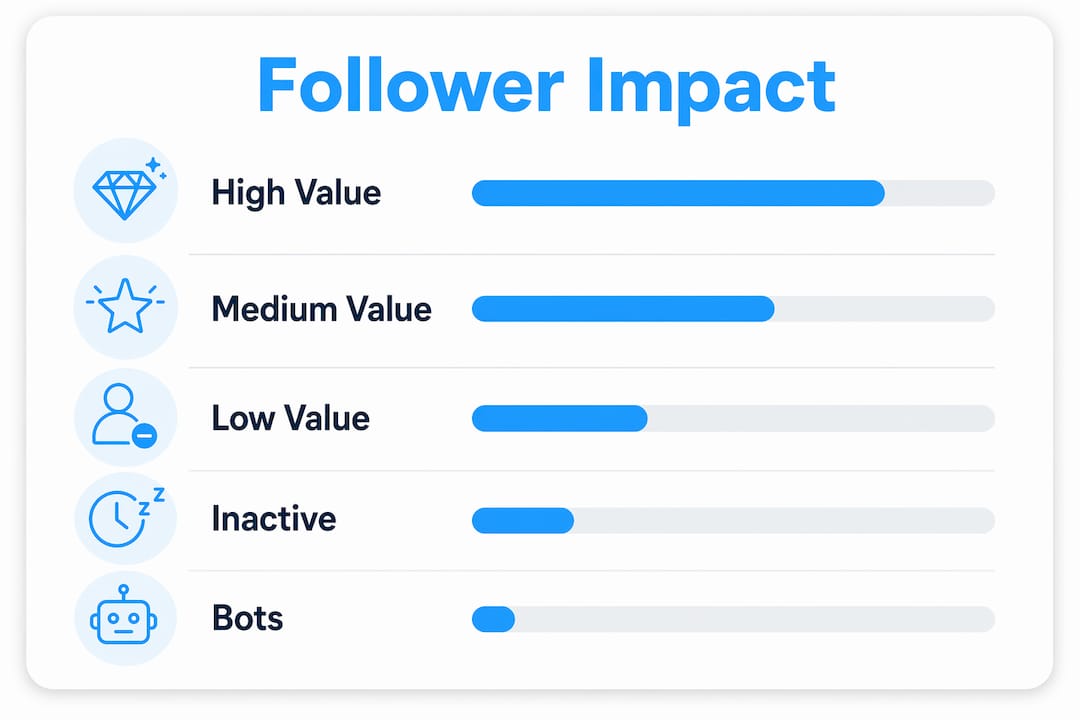
Active followers also determine how far your content travels. Algorithms penalise inactive followers by reducing content reach. A pruned, engaged audience drives better organic exposure and, by extension, better sales potential. This is why follower quality beats quantity as a strategic priority for any business serious about converting social media presence into revenue.
Pro Tip: Audit your follower list every quarter. Remove or report obvious bot accounts and track your engagement rate as a percentage of total followers. A healthy rate on Instagram sits above 2%. If yours is below 1%, your audience quality needs attention before your audience size.
Common misconceptions about follower count and sales in 2026
The most persistent myth in social media marketing is that more followers automatically equal more sales. Business strategist Marisa Murgatroyd describes follower count as a vanity metric because it fails to measure the resonance needed for sales. Smaller creators rely on emotional interaction and trust to drive conversions, not on the sheer weight of numbers.
Several related misconceptions compound this problem for small business owners:
- Virality guarantees revenue: A post that reaches one million people means nothing if none of those people have purchase intent. Attention and intent are entirely different things.
- Follower growth is a conversion strategy: Growing your audience is a top-of-funnel activity. Without a clear path from follower to customer, growth produces no sales.
- Large audiences are more valuable to partner with: Brands frequently overpay for macro-influencer campaigns when micro-creator partnerships deliver a measurably higher return per pound spent.
- A high follower count compensates for a weak offer: No amount of social proof overrides a confusing product page, a slow website, or a missing call to action.
Conversion depends on qualified attention plus trust and a clear next step, not a particular follower number. Public conversion benchmarks sit at 1.5% to 3%, meaning you need 33 to 67 site visits per sale regardless of how large your following is. Businesses that mistake follower attention for purchase intent consistently underperform because they invest in growth without investing equally in conversion infrastructure.
How to convert followers into customers and boost sales
Understanding the followers-sales correlation is only useful if you act on it. The gap between a follower and a customer is bridged by deliberate conversion architecture, not by posting more content and hoping for the best.
Set up DM automation with a sub-two-second response window. Active DM automation within 2 seconds increases conversion rates dramatically compared to delayed replies. Tools like ManyChat and Creatorflow allow you to trigger personalised responses the moment someone comments on a post or sends a keyword. This turns passive interest into a live sales conversation without requiring you to be online 24 hours a day.
Build a multi-touchpoint conversion path. A single Instagram post rarely converts a cold follower into a buyer. Map out a sequence: post generates comment, comment triggers DM, DM delivers lead magnet or offer, offer leads to landing page, landing page captures email. Each step qualifies the lead further. Multi-channel funnels can increase sales by 20 to 25% when combined with AI-generated content that maintains consistency across touchpoints.
Track qualified traffic, not vanity metrics. Use UTM parameters on every link you share from social platforms. This tells you exactly which posts, stories, or DM sequences are generating site visits and purchases. Google Analytics 4 and Meta Business Suite both provide this data at no cost.
Leverage stories and close-friends lists for high-intent audiences. Instagram Stories convert at higher rates than feed posts because they feel personal and temporary. Your most engaged followers, the ones who watch every story, are your warmest leads. Segment them and give them early access, exclusive offers, or behind-the-scenes content that deepens the relationship.
Align your content with purchase-stage intent. Awareness content (broad reach posts) serves a different audience than consideration content (product comparisons, testimonials) or decision content (limited-time offers, direct calls to action). Most brands post only awareness content and wonder why their social media KPIs never translate into revenue.
The average Instagram conversion rate for top brands sits at approximately 1.08%, but targeted DM automation can push this to between 15% and 25%. That is not a marginal improvement. It is a structural shift in how your social media presence generates revenue.
Pro Tip: Test a simple keyword-triggered DM campaign on your next product launch. Ask followers to comment a single word (such as “INFO” or “PRICE”) to receive details via DM. This creates a permission-based conversation and signals high intent to the platform’s algorithm, which then shows your post to more people.
Key takeaways
Follower count shapes social proof and opens the door to sales, but engagement quality, trust density, and a structured conversion path determine whether that door leads anywhere.
| Point | Details |
|---|---|
| Social proof drives initial trust | High follower counts signal credibility, but only active followers create genuine purchase confidence. |
| Micro-creators outperform at scale | Accounts under 50,000 followers generate 6.7x more revenue per impression than accounts over one million. |
| Vanity metrics mislead strategy | Follower count without engagement data or conversion tracking produces no reliable sales insight. |
| DM automation closes the gap | Responding within two seconds via automated DMs can lift conversion rates from 1% to over 15%. |
| Conversion needs a clear path | Every follower-to-customer journey requires multiple touchpoints, qualified traffic tracking, and purchase-stage content. |
The uncomfortable truth about chasing follower numbers
I have spent years watching small businesses pour budget into follower acquisition campaigns and then express genuine confusion when their sales figures do not move. The problem is almost never the follower count itself. It is the assumption that growth and conversion are the same activity.
The brands I have seen succeed on Instagram and Facebook are not always the ones with the largest audiences. They are the ones who treat their existing followers as a community worth investing in. They reply to comments within the hour. They share content that reflects a specific point of view rather than generic product photography. They use storytelling to make their audience feel something, because the best storyteller wins regardless of follower count.
There is also a trust-building dimension that most growth strategies ignore entirely. Building trust online through consistent, honest communication is what separates brands that convert at 15% from those converting at 1%. Follower growth matters. I am not dismissing it. But growth without a conversion strategy is like filling a leaking bucket. You can keep pouring in followers, but the sales will keep draining out the bottom.
My honest recommendation: fix your conversion path before you scale your audience. Then grow with purpose, targeting followers who match your actual buyer profile. That combination is what produces measurable, repeatable revenue from social media.
— Luna
Grow smarter with Greediersocialmedia
If this article has clarified one thing, it is that follower count and sales performance are connected by engagement quality and conversion strategy, not by raw numbers alone. Greediersocialmedia helps UK small businesses build the kind of social media presence that actually converts. From real followers and authentic engagement to targeted growth strategies that attract your ideal buyer, the approach is built around measurable outcomes.
Explore the social media growth hacks that Greediersocialmedia clients use to turn audience size into sales performance. For businesses ready to move beyond vanity metrics, the authentic engagement advantage is where sustainable growth begins. Visit Greediersocialmedia to find the right package for your stage of growth.
FAQ
Why does follower count affect sales at all?
Follower count creates social proof, which reduces perceived risk for new buyers and increases the likelihood they will engage with your brand. Without a minimum level of credibility signalled by your audience size, cold visitors are less likely to trust your offer.
Do more followers always mean more sales?
No. Public conversion benchmarks show that 33 to 67 site visits are required per sale regardless of follower count. Sales depend on qualified attention, trust, and a clear conversion path rather than audience size alone.
What follower engagement rate should I aim for?
A healthy Instagram engagement rate sits above 2% of your total follower count. Accounts below 1% typically have a high proportion of inactive or irrelevant followers, which also suppresses algorithmic reach.
How can DM automation improve my sales from social media?
Responding to follower messages within two seconds via automated DM tools like ManyChat dramatically increases conversion rates. The average Instagram conversion rate of 1.08% can rise to between 15% and 25% with targeted DM automation in place.
Are micro-creators more effective than large influencers for driving sales?
Yes. Micro-creators with under 50,000 followers generate revenue per impression 6.7 times higher than influencers with over one million followers, driven by trust density and niche audience relevance.