
Understanding why authentic engagement outperforms fake activity changes how you should measure real growth.
TL;DR:
- Focusing on authentic engagement builds genuine community and delivers higher algorithmic reach and conversions.
- Fake followers and inauthentic interactions erode trust, increase costs, and risk algorithm penalties, hindering long-term growth.
Chasing follower counts feels productive. It looks impressive on a dashboard. But the uncomfortable truth is that understanding why authentic engagement outperforms fake is what separates brands that actually grow from those that stagnate behind inflated vanity metrics. The social media landscape in 2026 is more sophisticated than ever. Algorithms detect behavioural patterns with precision, and audiences sense inauthenticity faster than any tool can measure it. If you run a small business, manage content for a brand, or create content for a living, this guide will reframe how you think about engagement entirely.
Table of Contents
- Key takeaways
- Why authentic engagement outperforms fake: the core distinction
- The real business impact of genuine interaction
- Why the human brain prefers real connection
- The real cost of fake engagement tactics
- How to build authentic engagement that lasts
- My perspective on authenticity and long-term growth
- Grow your presence the right way with Greediersocialmedia
- FAQ
Key takeaways
| Point | Details |
|---|---|
| Algorithms reward real behaviour | Posts with over 3% engagement rates receive approximately 40% more algorithmic reach than low-performing content. |
| Fake followers inflate costs catastrophically | Brands with 70% fake followers can face a cost per real person reached exceeding £13,000. |
| Audiences detect inauthenticity naturally | Generic voice and lack of specific experience reduce trust and suppress genuine interaction over time. |
| Authentic engagement converts; fake does not | Real audiences convert at measurable rates, whilst fake followers generate near-zero return on investment. |
| Vanity metrics mislead strategy | Saves, shares, sentiment, and conversion data provide far more strategic value than follower count alone. |
Why authentic engagement outperforms fake: the core distinction
Before we discuss outcomes, we need to be precise about what these terms actually mean in practice.
Authentic engagement is the kind that requires another human to make a deliberate choice. A reply that addresses something specific in your post. A save, because someone found it genuinely useful. A share to a friend with a personal note attached. A comment that asks a follow-up question or tells a story of their own. These are signals that your content landed with a real person and moved them to act.
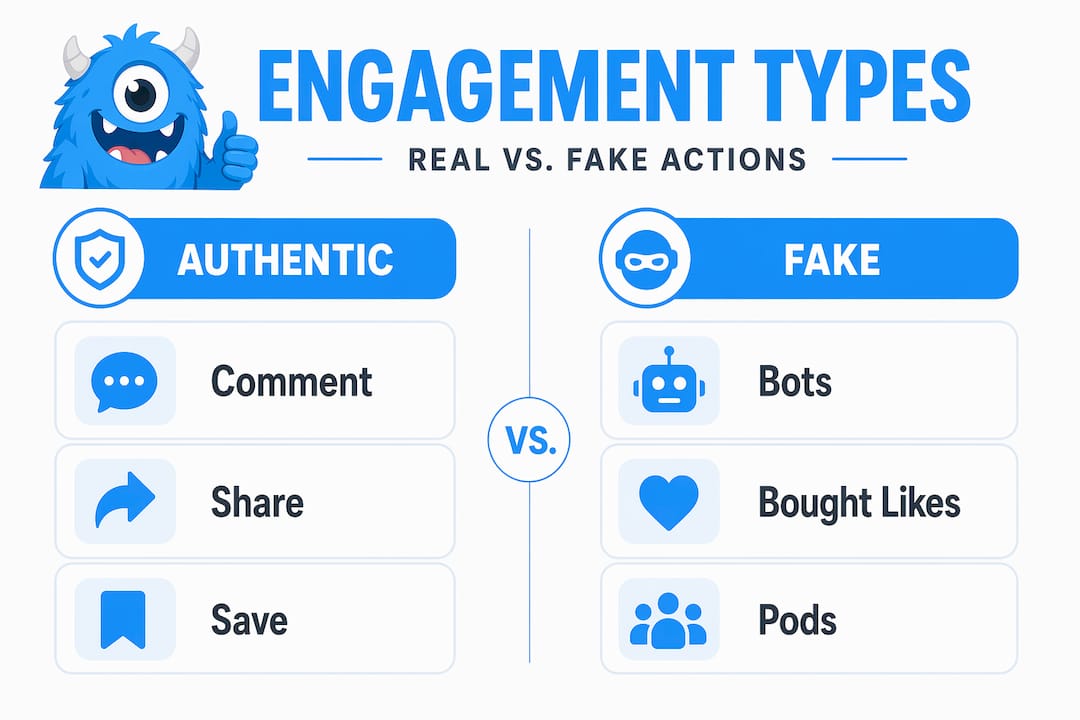
Fake engagement includes AI-generated comments, click farms, engagement pods, and purchased likes that manipulate metrics without driving any real user interaction. The numbers look real. The value is not.
Social platforms have become exceptionally good at distinguishing between the two. Algorithms no longer count interactions; they score them by quality of behaviour. A genuine save carries more weight than fifty generic “” comments left by accounts created last month. Follower quality now determines algorithmic distribution far more than raw follower count, and the gap widens every year.
Red flags that signal fake engagement on a profile include:
- Sudden spikes in likes within minutes of posting, regardless of posting time
- Comments consisting only of generic phrases or emojis with no specific reference to the post content
- Followers with no profile photo, zero posts, or accounts created in bulk around the same date
- Engagement rate far below 1% despite a large audience, which suggests inflated follower numbers
- Geography mismatches, such as a UK local business with most engagement coming from unrelated regions
Pro Tip: Check your engagement rate by dividing total interactions (likes, comments, shares, saves) by your follower count, then multiplying by 100. Anything consistently below 1% on a growing account warrants investigation.
The real business impact of genuine interaction
This is where abstract preference becomes hard financial data.
Posts with over 3% engagement receive approximately 40% more algorithmic reach than lower-performing content. That amplification is free distribution to people who have already signalled interest. You cannot buy that with inflated metrics.
The cost comparison between authentic and fake audience reach is stark. Brands where 70% of followers are fake can face a cost per real person reached that exceeds £13,000, compared to a fraction of that figure when genuine followers convert at around 2%. Wasted ad spend against a fake audience does not just fail. It compounds losses with every campaign.

Beyond reach and cost, there is the question of conversion. Authentic audiences buy, refer, and return. Fake followers do none of those things. The impact of real engagement on business performance is measurable when you connect participation to renewal rates, expansion revenue, and customer referral readiness rather than focusing purely on vanity figures.
| Metric | Authentic engagement | Fake engagement |
|---|---|---|
| Algorithmic reach bonus | Up to 40% greater reach | Negligible, often penalised |
| Cost per real person reached | Low to moderate | Potentially exceeding £13,000 |
| Conversion rate | Around 2% or higher | Near zero |
| Brand trust over time | Builds progressively | Erodes rapidly |
| Customer referral likelihood | High with loyal audience | None |
“High-impact engagement is a system-led outcome. Connecting participation to measurable business revenue outcomes is vital for sustainability, not just clicks and likes.” (Beyond clicks and likes: the new rules of high-impact customer engagement)
The long-term implications go further. Repeat customers acquired through genuine community cost far less to retain than new customers acquired through paid acquisition. Organic advocates who share your content because it genuinely helped them reach audiences no ad budget can replicate.
Why the human brain prefers real connection
This is not just a marketing observation. There is biology behind it.
Human brains release oxytocin and dopamine during real social interactions, and those are biological responses that digital approximations cannot genuinely replicate. When a person receives a thoughtful, personalised reply to a comment they left on your post, something real happens neurologically. They associate that positive response with your brand. That association builds over time.
Fake engagement cannot trigger that mechanism. And audiences know it, even when they cannot articulate exactly why.
Here is how audiences subconsciously detect authenticity problems:
- Generic voice. Content that reads as if it could apply to anyone reads as if it was written for no one. Audiences detect non-personal content and engage less with it, even when they cannot name what feels off.
- Absence of specific experience. Sharing exact client outcomes, named failures, or particular dates signals genuine human experience. Without that specificity, content feels borrowed or manufactured.
- Inconsistent tone. Authenticity includes idiosyncratic voice. Brands that sound completely polished in every direction often feel corporate and distant to audiences craving real dialogue.
- No genuine intellectual risk. Taking a clear position, sharing a genuine disagreement, or admitting you got something wrong are signals of authentic presence. Brands that never say anything interesting rarely build loyal communities.
Fake engagement erodes cognitive infrastructure for audience trust, and once that trust is gone, it is exponentially harder to rebuild. It is not merely a reputational setback. It rewires how your audience processes every future message you send them.
Pro Tip: Share one specific story from your last 30 days of business in your next post. Include a number, a name if appropriate, and an outcome. Specificity signals humanity more powerfully than any aesthetic.
The real cost of fake engagement tactics
Understanding the pitfalls of fake engagement helps you protect what you have built, not just warn against what to avoid.
The financial inefficiency is the first problem most businesses encounter. When a significant proportion of your followers are fake, every pound spent on paid promotion is partially wasted reaching inactive accounts. Monitoring engagement quality before investing in follower growth is not optional if you care about return on spend.
The reputational risks run deeper. Consider what happens when a potential client or journalist audits your account and notices that 10,000 followers produce 12 likes per post. That discrepancy raises questions that are difficult to answer convincingly. It undermines trust before a relationship even begins.
Platform-level consequences are real too. Platforms including Instagram and Facebook routinely purge fake accounts and penalise profiles exhibiting manipulative behaviour patterns. An account that spent months buying followers can lose visibility overnight during one of these updates.
Practical ways to identify and avoid fake engagement in your own strategy or in partnerships:
- Audit your follower list quarterly using engagement rate calculations, not just total numbers
- Read comments carefully. Specific, contextual comments signal genuine readers. Generic phrases signal automation.
- Before partnering with influencers or content creators, request audience demographic breakdowns and check comment quality personally
- Avoid services that promise unrealistic follower growth figures within hours, particularly those requiring account access
- Use consistent social media posting as a foundation, since organic algorithmic growth rewards sustained, regular content over one-off viral attempts
The value of true engagement becomes clearest when comparing campaign results between creators with genuine audiences and those with inflated numbers. The difference in conversion and referral rates is often an order of magnitude apart.
How to build authentic engagement that lasts
Now for the practical part. Here is how to build genuine community rather than just a number on a screen.
Post with purpose, not frequency alone. Consistency matters, but only if the content itself offers something specific and real. Posting six times a week with generic content trains your audience to scroll past you. Posting three times with concrete, opinionated, specific content trains them to stop and read.
Respond to every comment for the first 30 days of a new strategy. Especially early in community building, personal replies signal to both the algorithm and your audience that a real person is behind the account. That behaviour pattern compounds.
Ask questions that require genuine answers. Not “What do you think?” but “We made this mistake last quarter and here is what we learned. Has this happened to you?” Specific prompts produce specific responses.
Measure what matters beyond vanity metrics. Track saves and shares rather than just likes. Monitor sentiment in comments. Connect social performance to actual sales enquiries, website visits, and conversion events. Connecting engagement to business outcomes is what separates a growth strategy from a vanity exercise.
Use your authentic voice, including the uncomfortable parts. Campaigns succeed best when using organic, decentralised voices over scripted or overly produced content that audiences tune out. Saying something real, even something slightly risky, builds far more loyalty than another polished carousel.
Build community rituals. Weekly Q&A sessions, recurring content formats your audience comes to expect, or regular behind-the-scenes posts all create the kind of habitual engagement that drives long-term algorithmic favour.
Pro Tip: Once per month, personally reach out to a follower who left a particularly thoughtful comment. Thank them, ask a follow-up question, and treat the interaction as you would a networking conversation. That single act builds more loyalty than a week of broadcast content.
My perspective on authenticity and long-term growth
I have watched businesses obsess over follower counts for years, and the pattern is always the same. They inflate the numbers, the dashboards look good, and then the campaign results come back flat. The attribution never makes sense. The leads never materialise in proportion to the audience size.
In my experience, the brands that build something genuinely durable are the ones that accept the slower path. They respond to every comment. They share stories that feel slightly vulnerable. They take positions that might not appeal to everyone. And over 18 to 24 months, they end up with communities that refer clients, defend the brand publicly, and buy repeatedly without needing to be advertised at.
The hidden costs of fake engagement are almost never captured in a spreadsheet. The eroded trust, the reputation damage from an audit, the algorithm penalisation during a platform update, the wasted ad spend. Those costs are real, and they compound quietly until they become a crisis.
What I find most interesting is that authentic engagement aligns with how humans are biologically wired to build relationships. You are not fighting human nature when you choose authenticity. You are working with it. That is why the results, though slower to appear, tend to be far more permanent.
Prioritise the meaningful over the measurable, and the measurable results will follow.
— Luna
Grow your presence the right way with Greediersocialmedia
If this article has made you reconsider where your social media strategy currently sits, Greediersocialmedia is built precisely for this moment.
Greediersocialmedia has supported over a million users since 2013, helping UK businesses and content creators build genuine visibility without compromising account security. No passwords required. No bots. No shortcuts that erode the trust you have spent months building. From growth tactics that prioritise real audiences to understanding the three foundations of better engagement, Greediersocialmedia offers the tools and expertise to help small businesses compete with larger players without faking it. Sustainable growth is not slow. It is just built on something real.
FAQ
What does authentic engagement actually mean on social media?
Authentic engagement refers to real, deliberate interactions from genuine users, including meaningful comments, saves, and shares. These signals reflect actual audience interest, unlike automated or purchased interactions.
Why does fake engagement hurt your brand long term?
Fake engagement destroys audience trust and is exponentially difficult to rebuild once lost. It also triggers algorithmic penalties and wastes ad spend by inflating costs per real person reached.
How can I tell if an account has fake followers?
Look for a low engagement rate relative to follower count, generic or emoji-only comments, accounts with no profile images or posts, and geographic mismatches between audience location and brand relevance.
What metrics should I track instead of follower count?
Prioritise saves, shares, comment quality, sentiment, and conversion events tied to social referral traffic. These metrics connect engagement to real business outcomes rather than surface-level visibility.
How does authentic engagement affect algorithmic reach?
Posts that generate genuine engagement above 3% receive around 40% more organic reach from platform algorithms. Real behavioural signals are the primary driver of content distribution in 2026.