
Understanding why audience segmentation improves results explains a lot about wasted ad spend.
Audience segmentation improves marketing results by increasing relevance, cutting wasted spend and raising conversion rates. Field experiments on psychologically tailored advertising found up to 40% more clicks and 50% more purchases compared with unpersonalised messaging. That single figure explains why segmentation sits at the centre of most high-performing marketing programmes rather than at the edges.
Three outcome areas improve consistently when brands split audiences into meaningful groups:
- Engagement — open rates, click-through rates and time spent all rise when messaging matches the recipient.
- Conversions — offers that reflect a group’s actual behaviour or stage in the buying cycle close more often.
- Return on ad spend — budget stops leaking into impressions nobody was going to act on.
Key Takeaways
Audience segmentation improves marketing results because relevance drives attention, and attention converts more efficiently than reach alone.
| Point | Details |
|---|---|
| Segmentation lifts core metrics | Segmented email sees roughly 23% higher opens and 49% higher clicks than unsegmented sends. |
| Behavioural segments come first | Recency and purchase-based splits are quicker to test and typically outperform demographic-only segments. |
| Test before you scale | Narrow segments often need click-through rates to double just to break even, so validate with holdouts first. |
Table of Contents
- Why audience segmentation improves results across engagement and ROI
- Types of segmentation and when each one earns its place
- How segmentation actually moves the metrics
- Practical steps to implement segmentation in your marketing stack
- Measure and test: how to validate segmentation lifts
- Common pitfalls and how to avoid them
- What we’ve seen work in practice
- Why the simple segment usually beats the clever one
- Sources
- FAQ
Why audience segmentation improves results across engagement and ROI
The clearest evidence sits in email, where the data is easiest to isolate. Mailchimp reports segmented campaigns achieve roughly 23% higher open rates and 49% higher click-through rates than unsegmented sends. That gap alone justifies the setup time for most small teams.
The knock-on effects go beyond the open and the click:
- Wasted impressions fall because spend concentrates on people likely to respond, not a flat blast to everyone.
- Retention improves when post-purchase journeys reflect what someone actually bought, not a generic “thanks for your order” sequence.
- Creative and messaging budgets stretch further because you’re producing fewer, sharper variants rather than one message trying to please everyone.
- Attribution gets cleaner. When you know which segment saw which creative, you can trace a lift back to a specific decision rather than guessing.
Vendor data on mature programmes points to ROI improvements of 20 to 30 percent once segmentation is paired with ongoing optimisation rather than treated as a one-off setup. The pattern holds across sectors: relevance reduces waste, and reduced waste shows up directly on the ROI line.
Types of segmentation and when each one earns its place
Not every business needs every type on day one. Pick the one that matches your current data and problem.
- Demographic segmentation — age, income, job title. Fastest to set up, good for a first pass when you have almost no behavioural data yet.
- Geographic segmentation — location-based offers and timing, useful for local promotions, regional stock, or time-zone-sensitive send schedules.
- Behavioural segmentation — built on purchase history, lifecycle stage or engagement recency. This tends to be the highest-return category because it reflects what people actually did, not who they are on paper.
- Psychographic segmentation — values, motivations and tone preference. Powerful for creative and messaging decisions, but harder to measure and more ethically sensitive.
- Predictive and hybrid segments — modelled groups built from a customer data platform. Worth the investment once you have enough first-party data to train something useful, but overkill for a five-person marketing team just starting out.
How segmentation actually moves the metrics
Segmentation doesn’t just feel more relevant, it changes the mechanics of how a campaign performs. Attention is finite, and a message that matches someone’s actual situation gets more of it before they scroll past. That single shift, relevance over generic reach, cascades into everything downstream.

Budget concentration is the second lever. When spend focuses on high-propensity groups instead of spreading thin across everyone, return on ad spend climbs because you’re paying for attention that was already inclined to convert. Tailored creative compounds the effect: a message written for one clear group tends to convert more per impression than one written to avoid offending anybody.
There’s also a machine-learning angle worth knowing. Ad platforms optimise faster when they’re fed a well-defined, sufficiently large segment, because the signal is cleaner than it is with a broad, undifferentiated audience.
Field experiments using personality-congruent messaging generated meaningfully higher clicks and purchases than generic ads sent to the same population, evidence that psychological relevance, not just demographic accuracy, drives performance.
That finding comes from large-scale psychological targeting research, and it’s worth sitting with. Relevance isn’t just about knowing someone’s age bracket. It’s about matching tone and motivation.
Pro Tip: Before writing new ad copy for a segment, write down the one sentence that describes why this group would want your product, in their own words. If you can’t do that in one sentence, the segment probably isn’t tight enough yet.
Practical steps to implement segmentation in your marketing stack
Getting segmentation live doesn’t require a data science team. It requires a short, disciplined process.
- Audit your first-party data. List what you already collect (purchase history, email engagement, on-site behaviour) and flag the obvious gaps.
- Define three to five priority segments. Write a one-paragraph profile for each: who they are, what they want, what triggers a purchase.
- Choose your tooling. A CRM or CDP connected to your analytics and ad or email platforms is usually enough at this stage; you don’t need enterprise software to start. Our practical guide to audience targeting on social walks through channel-specific setup.
- Build channel playbooks. Each segment needs its own creative angle and cadence per channel, not a copy-paste of the same message everywhere.
- Set a refresh cadence and a consent check. Segments drift; review them regularly and confirm your data handling meets basic cyber hygiene standards.
Measure and test: how to validate segmentation lifts
Don’t assume a segment works because it feels logical. Test it.
- Run randomised holdouts or A/B splits so you’re measuring causal lift, not a coincidence of timing.
- Before scaling a narrow segment, run break-even maths. Modelling work on audience selection shows many narrow segments need click-through rates to roughly double versus an untargeted campaign just to break even.
- Track click-through rate, conversion rate, ROAS and retention as your primary signals, not vanity metrics like impressions.
- Account for data-quality shifts. Privacy changes such as Apple’s App Tracking Transparency make small, narrow segments more fragile, so broader segments built on first-party data tend to hold up better.
- Treat every segment as a draft. Revisit performance on a set schedule and retire what isn’t earning its keep.
Common pitfalls and how to avoid them
Most segmentation failures come from the same handful of mistakes, and they’re avoidable.
- Segments too narrow lose statistical power fast; keep enough reach in each group to draw a real conclusion, not a guess.
- Inconsistent identifiers across systems (email in one tool, device ID in another) quietly corrupt your data before you even test anything.
- Skipping consent and lawful basis documentation isn’t just a legal risk, it can also poison the very data you’re trying to segment on.
- A split that doesn’t map to a business KPI is a vanity split, not a strategy. Every segment should tie to a metric someone in the business actually cares about.
- Overcomplicating segmentation with too many variables often underperforms a simple behavioural split based on recency and purchase frequency. Start simple, then add layers once the basics are working.
What we’ve seen work in practice
Greedier Social Media has supported over a million users since 2013, working specifically with UK creators and small brands who need visibility fast without the guesswork of building segmentation infrastructure from scratch. That volume of accounts gives a practical view of what a low-effort segmentation activation actually looks like day to day.
- Splitting a client base by platform and content type, rather than treating “followers” as one blob, tends to be the fastest first move for a small brand.
- Prioritising engagement quality within each segment, not just volume, is what clients report translating into stronger perceived brand authority.
- Even a rough first-pass segment (new accounts vs established ones, for instance) beats no segmentation at all when deciding where to focus a growth push.
| Point | Details |
|---|---|
| Start with behavioural segments | Recency, frequency and purchase history are faster to test and yield clearer ROI than demographic splits alone. |
| Validate before scaling | Use randomised holdouts and break-even maths, especially for narrow segments vulnerable to data-quality shifts. |
| Concentrate budget, not just messaging | Higher ROAS often comes from spending more on high-propensity groups, not from cleverer creative alone. |
For a UK brand or creator wanting to move quickly, pairing a simple first segment with a targeted visibility push tends to outperform waiting for a perfect data model. Greedier Social Media’s social media growth hacks guide covers practical tactics for boosting presence around exactly this kind of activation, alongside services built for UK creators and small businesses who want instant, password-free engagement without waiting months for organic reach to catch up.
Why the simple segment usually beats the clever one
The temptation in this field is to chase sophistication, predictive modelling, psychographic clusters, machine-learned lookalikes, before the basics are even in place. The research doesn’t really support that instinct. Behavioural segments built on recency and purchase history are consistently faster to test, cheaper to build and more reliably tied to ROI than anything requiring a data scientist.
Where conventional advice falls short is in treating segmentation as a one-time setup task. It isn’t. A segment that performed well six months ago can quietly decay as your audience shifts, and the break-even maths on narrow segments changes as privacy rules tighten. Treat segment definitions as living things, not settings you configure once and forget.
If you take one thing from this, prioritise getting three behavioural segments genuinely right before you touch anything psychographic or predictive. Depth beats breadth here. A brand that deeply understands three groups will consistently outperform one that has twelve half-built personas nobody actually tests against.
Sources
Psychological targeting field experiments · Mailchimp segmentation data · Break-even modelling for narrow segments · Adobe on audience targeting benefits · Building a target audience profile
- Psychological targeting as an effective approach to digital mass persuasion — Matz et al.
- Audience Segmentation Tools for Targeted Campaigns | Mailchimp
- Selecting audience segments for online advertising (IJREMA article)
FAQ
How does audience segmentation work?
It groups people who share meaningful traits, such as purchase behaviour, location or demographics, so messaging, offers and budget can be tailored to each group rather than applied uniformly across everyone.
What are the benefits of customer segmentation?
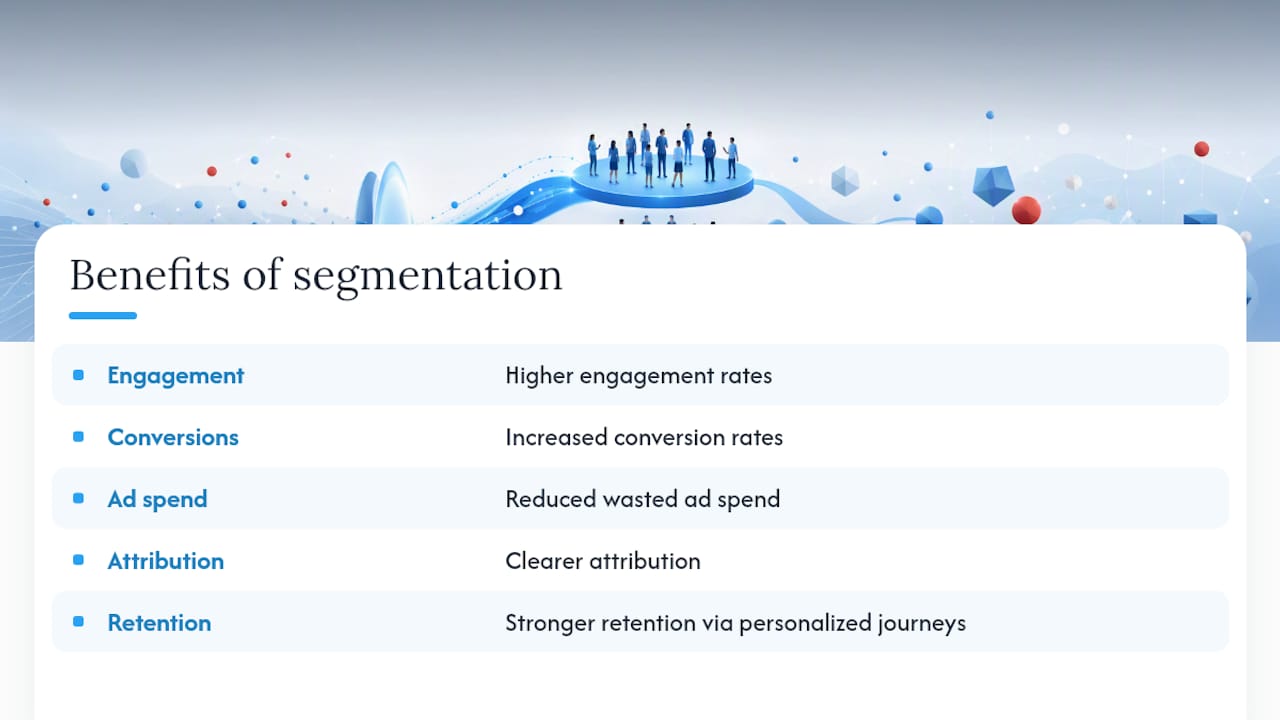
The main benefits are higher engagement and conversion rates, reduced wasted ad spend, clearer attribution, and stronger retention through more relevant, personalised journeys.
What are the advantages of having segmentation?
Segmentation concentrates budget on higher-propensity groups, which tends to raise return on ad spend, and it gives marketing teams clearer signals for optimising creative and messaging faster.
What are the benefits of demographic segmentation?
Demographic segmentation offers a quick, low-effort starting point for splitting an audience by age, income or job title, which is useful before you have enough behavioural data for a more precise approach.