
Understanding what is social media momentum explains why some content keeps growing long after posting.
TL;DR:
- Social media momentum is the ongoing spread of content driven by consistent engagement and emotional resonance. It builds gradually over weeks or months, creating a loyal audience and long-term growth, unlike viral spikes that fade quickly.
Social media momentum is defined as the sustained, organic spread of content driven by continuous audience engagement and emotional resonance over weeks or months. Unlike a viral spike that fades within days, momentum compounds. Each interaction signals to platform algorithms that your content deserves wider distribution, creating new waves of attention long after the original post. For small business owners and content creators, understanding what is social media momentum is the difference between a one-off hit and a growing, loyal audience. Greediersocialmedia has helped over a million UK clients build exactly this kind of lasting presence since 2013.
What is social media momentum and what drives it?
Social media momentum is the ongoing process where content continuously spreads and generates engagement without requiring a new push every time. The industry term for this is engagement velocity, which refers to how quickly and consistently your content accumulates interactions after posting. Momentum sustains content growth for weeks or months through organic sharing and interaction, while virality is a short, sharp spike that typically fizzles within days.
Four factors drive momentum most reliably in 2026:
- Engagement velocity. The speed of early interactions after posting tells algorithms whether to push content further. A post that collects comments and shares within the first hour gets distributed to a wider audience automatically.
- Emotional resonance. Content that triggers a genuine reaction, whether curiosity, humour, or recognition, earns saves and shares. Saves and shares carry far more algorithmic weight than passive likes.
- Content format alignment. Each platform rewards specific formats. Short video dominates TikTok; carousel posts outperform on LinkedIn. Posting the wrong format on the right platform kills momentum before it starts.
- Community interaction. Replying to comments, asking questions, and inviting responses keeps the conversation alive. Replying to comments consistently lifts engagement by up to 42% on Threads, 30% on LinkedIn, and 21% on Instagram. That lift directly feeds the next wave of distribution.
Pro Tip: Reply to every comment within the first hour of posting. Algorithms read early comment replies as a signal that your content is generating real conversation, which triggers broader reach.

How does social media momentum differ from virality?
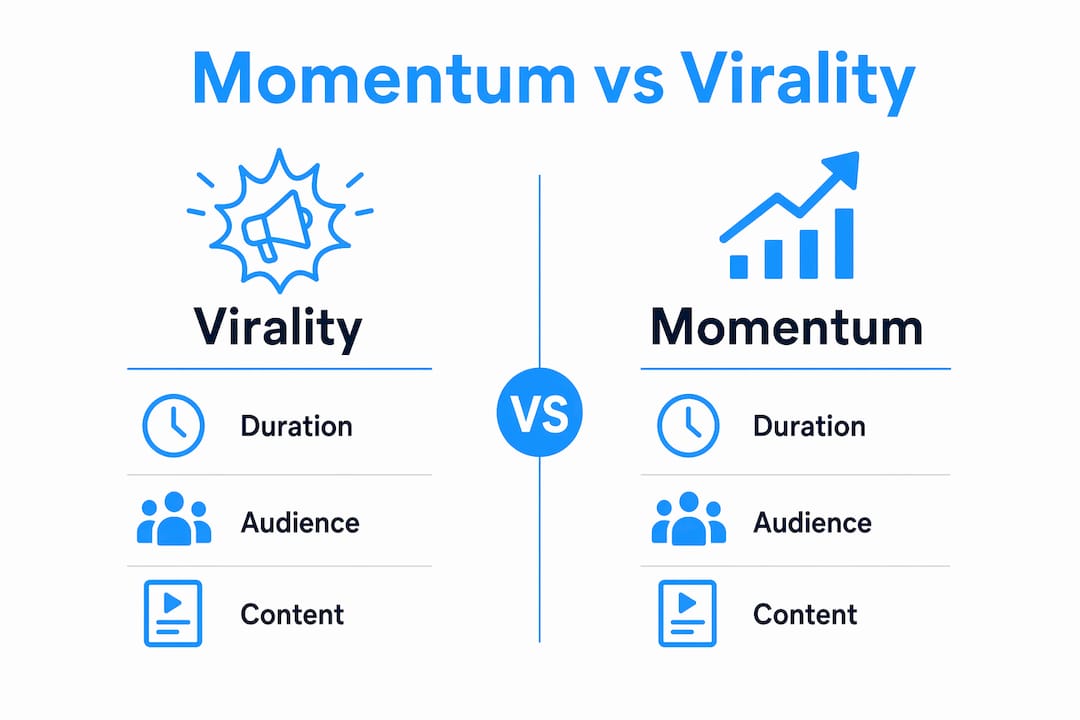
Virality is a short, sharp spike in attention. A post goes viral when it reaches a large audience quickly, often through a single share from a high-follower account or a trending moment. The problem is that viral spikes fade quickly, leaving no lasting community, no algorithm trust score, and no repeat audience.
Momentum, by contrast, is self-sustaining. It builds through consistent, meaningful content that an audience returns to, shares repeatedly, and recommends to others. The difference matters enormously for small businesses because chasing viral hits is expensive, unpredictable, and rarely converts into loyal customers.
“Consistent, meaningful content creates brand memory and sustainable growth. Viral spikes fade quickly. Momentum-driven brands build a trust score with algorithms and develop an engaged community over time.”
| Factor | Virality | Momentum |
|---|---|---|
| Duration | Days | Weeks or months |
| Audience relationship | Passive viewers | Active community |
| Algorithm trust | Minimal | Builds over time |
| Business impact | Short-term traffic | Long-term brand authority |
| Predictability | Low | High with consistent effort |
The practical implication is clear. A small bakery that posts consistently about its craft, replies to every comment, and builds a recognisable content rhythm will outperform a competitor whose single viral reel brought 10,000 views but zero repeat customers.
Which content strategies effectively build social media momentum?
The most effective approach to building momentum is a repeatable content system, not ad hoc posting. Creators focusing on specific niches outperform broad-topic creators even with fewer followers. Niching down and building content pillars gives your audience a reason to return and gives algorithms a clear signal about what your account represents.
Here is a practical framework for building that system:
- Define three to five content pillars. These are recurring themes your audience expects from you. A fitness coach might use: client results, myth-busting, and behind-the-scenes training. Every post fits one pillar.
- Post two to three quality pieces per week. Accounts posting regularly outperform those that go quiet for a week. Consistency matters more than volume.
- Ask a direct question in every post. Questions invite comments. Comments signal engagement velocity. Engagement velocity triggers distribution.
- Reply within the first hour. Early comment replies double comment count and signal content vitality to algorithms. This is the single highest-return habit in social media growth.
- Review your analytics weekly. Identify which posts generated the most saves and shares, not just likes. Saves and shares indicate that depth of engagement is driving distribution.
Pro Tip: Build a simple content calendar in a spreadsheet. Map your pillars across the week, batch-create content on one day, and schedule posts in advance. This removes the pressure of daily creation and keeps your rhythm consistent.
Alongside your content pillars, growing social media organically requires patience. The compounding effect of momentum takes four to eight weeks to become visible in your analytics. Stick with the system.
How to match your content to platform strengths
Each platform rewards different content types, and mismatching format to platform is one of the most common reasons momentum stalls. Understanding platform dynamics in 2026 is not optional. It is the foundation of any effective social media engagement strategy.
TikTok is the fastest-growing platform for organic creator reach. TikTok delivers five times more engagement than Instagram across follower tiers, and brand follower counts grew over 200% year on year. Short, punchy video with a strong hook in the first two seconds performs best. For a practical breakdown, TikTok marketing for brands covers the format specifics in detail.
LinkedIn has seen a 22% jump in median engagement in 2026, with median engagement rates reaching 4.7%. Carousel posts and text-based thought leadership drive the most comments and shares. LinkedIn rewards depth and professional insight over entertainment.
Instagram and Facebook remain reliable for reach, particularly for local businesses. Instagram rewards Reels for discovery and carousels for saves. Facebook Groups drive community engagement better than standard page posts.
Threads is rising in 2026 as a text-first platform where replying to comments lifts engagement by up to 42%. It rewards conversational, opinion-led content and is particularly effective for building community around a niche.
| Platform | Best format | Key engagement signal | Momentum driver |
|---|---|---|---|
| TikTok | Short video | Shares and replays | Hook in first 2 seconds |
| Carousel, long-form text | Comments and reposts | Professional insight | |
| Reels, carousel | Saves and shares | Visual consistency | |
| Groups, video | Comments and reactions | Community discussion | |
| Threads | Text, replies | Comment threads | Conversational tone |
Social proof strategies also play a role here. When your content earns visible engagement quickly, new viewers are more likely to interact, which compounds the momentum effect across every platform.
What practical steps build lasting momentum for small businesses?
Lasting momentum comes from building a content system rather than reacting to trends. The most common mistake small business owners make is posting without a plan, chasing whatever topic is trending, and then going quiet when the trend passes. That pattern destroys algorithm trust and resets your reach every time.
- Audit your current content. Identify your three best-performing posts from the last three months. Look for patterns in format, topic, and posting time.
- Set a posting schedule you can sustain. Two quality posts per week beats seven inconsistent ones. Commit to a schedule for 60 days before evaluating results.
- Engage actively in the first hour. Reply to every comment. Like and respond to replies. This is the primary trigger for algorithms to boost content visibility.
- Track the right metrics. Monitor saves, shares, and comment depth rather than follower count. Measuring social media impact accurately tells you whether momentum is building or stalling.
- Avoid trend-chasing without context. Jumping on a trending audio or hashtag only works if it connects naturally to your content pillars. Forced trend participation reads as inauthentic and rarely builds community.
Social media engagement in 2026 now directly influences AI search visibility. Social media citations in AI responses grew 4x in late 2025 and represent over 7% of citations across major AI platforms. That means a strong, consistent social presence now contributes to how your brand appears in ChatGPT and Google AI results. Momentum is no longer just a social media metric. It is a broader brand authority signal.
Pro Tip: Use a content automation tool to plan and schedule posts in advance. Content marketing automation tools help you maintain consistent posting rhythms without burning out on daily creation.
Key takeaways
Social media momentum is built through consistent engagement, repeatable content systems, and platform-matched formats, not through chasing viral spikes.
| Point | Details |
|---|---|
| Define engagement velocity | Reply to comments within the first hour to trigger algorithmic distribution on every platform. |
| Build content pillars | Choose three to five recurring themes so your audience knows what to expect and returns regularly. |
| Match format to platform | TikTok rewards short video; LinkedIn rewards carousels; mismatching format kills momentum early. |
| Prioritise depth over reach | Saves, shares, and comments drive momentum far more effectively than passive likes or follower counts. |
| Measure the right signals | Track saves and shares weekly to identify which content is compounding and which is stalling. |
Why I think most small businesses are solving the wrong problem
The brands I see struggling most on social media are not struggling because of bad content. They are struggling because they are measuring the wrong thing. They obsess over follower counts and reach figures, then feel deflated when a post gets 200 views instead of 2,000. But follower count is a lagging indicator. It tells you what happened, not what is happening.
What actually predicts growth is comment depth and save rate. When I look at accounts that have built genuine momentum, the pattern is always the same: a small, highly engaged audience that comments, saves, and shares consistently. That behaviour signals to algorithms that the content has real value, and distribution follows naturally.
The other mistake I see constantly is abandoning a content system after four weeks because “it is not working.” Momentum takes time to compound. The accounts that break through are almost always the ones that stayed consistent for three to six months before seeing exponential results. Patience is not passive. It is a deliberate choice to trust the system.
My honest advice: pick two platforms, define your pillars, post twice a week, and reply to every comment for 90 days. Do not look at your follower count. Look at your save rate. That number will tell you everything.
— Luna
How Greediersocialmedia can support your social media growth
Building momentum takes a clear system, consistent effort, and the right foundation of engagement to get algorithms working in your favour.
Greediersocialmedia has supported over a million UK clients since 2013, helping small businesses and content creators build real, visible presence on Instagram, Facebook, TikTok, and beyond. The service delivers real followers, likes, and views without requiring account passwords, making it a secure way to establish the initial engagement signals that feed momentum. For creators who want to accelerate the early stages of their content system, exploring social media growth tactics on the Greediersocialmedia platform is a practical next step. The team offers targeted support and quick turnaround, specifically for businesses that need to build trust and visibility fast.
FAQ
What is social media momentum in simple terms?
Social media momentum is the sustained, ongoing spread of your content driven by consistent audience engagement over weeks or months. It differs from virality because it builds gradually and compounds rather than spiking and fading.
How long does it take to build social media momentum?
Momentum typically becomes visible in analytics after four to eight weeks of consistent posting and active engagement. Accounts that post two to three quality pieces per week and reply to comments within the first hour see results fastest.
Which platform is best for building momentum in 2026?
TikTok delivers the fastest organic growth, with brand follower counts growing over 200% year on year and five times more engagement than Instagram. LinkedIn is the strongest platform for B2B momentum, with median engagement rates reaching 4.7% in 2026.
What is engagement velocity and why does it matter?
Engagement velocity is the speed at which your content accumulates interactions after posting. High engagement velocity in the first hour signals to algorithms that your content is valuable, triggering wider distribution and sustaining momentum.
How do I measure whether my social media momentum is growing?
Track saves, shares, and comment depth rather than follower count or total reach. These signals indicate genuine audience investment and predict whether your content will continue to compound in distribution over time.