
Understanding what is local social media marketing helps explain why some small businesses outperform bigger competitors nearby.
TL;DR:
- Local social media marketing focuses on engaging nearby audiences to drive foot traffic, bookings, and local loyalty. Concentrating on one or two platforms like Facebook and Instagram, along with authentic, community-focused content and prompt responses, builds trust and visibility. Combining consistent organic efforts with targeted paid ads and tracking meaningful metrics ensures measurable business growth over time.
If you run a shop, café, salon, or any community-facing business in the UK, you have probably wondered whether social media is actually worth your time. The answer depends entirely on how you use it. What is local social media marketing, exactly? It is not about going viral or chasing a global audience. It is about using social platforms deliberately to reach the people who can actually walk through your door, book your services, or recommend you to their neighbours. Done well, it builds the kind of trust that no paid advertisement can manufacture overnight.
Table of Contents
- Key takeaways
- What is local social media marketing?
- Choosing the right platforms for local marketing
- Content and engagement strategies that work locally
- Paid local social media advertising
- Measuring what actually matters
- My honest take on what local social media really requires
- How Greediersocialmedia can help your local business grow
- FAQ
Key takeaways
| Point | Details |
|---|---|
| Local social media is geographically focused | It targets people in your area, not a global audience, to drive real-world visits and enquiries. |
| Platform focus beats spreading thin | Concentrating on one or two platforms, such as Facebook and Instagram, produces better results than managing five poorly. |
| Engagement beats follower count | Responding to comments and messages consistently builds community loyalty far more than accumulating passive followers. |
| Paid ads extend your organic reach | Location-based targeting by postcode or radius makes paid social campaigns cost-effective for local businesses. |
| Meaningful metrics matter most | Track foot traffic, bookings, and enquiries rather than likes to measure genuine business impact. |
What is local social media marketing?
Local social media marketing means using social platforms to reach and engage people in a specific geographic area, with the goal of driving both online and offline customer actions. Local targeting combines business-generated content (promotions, behind-the-scenes posts, product announcements) with user-generated content (reviews, tagged photos, shared stories) all tied to a particular location.
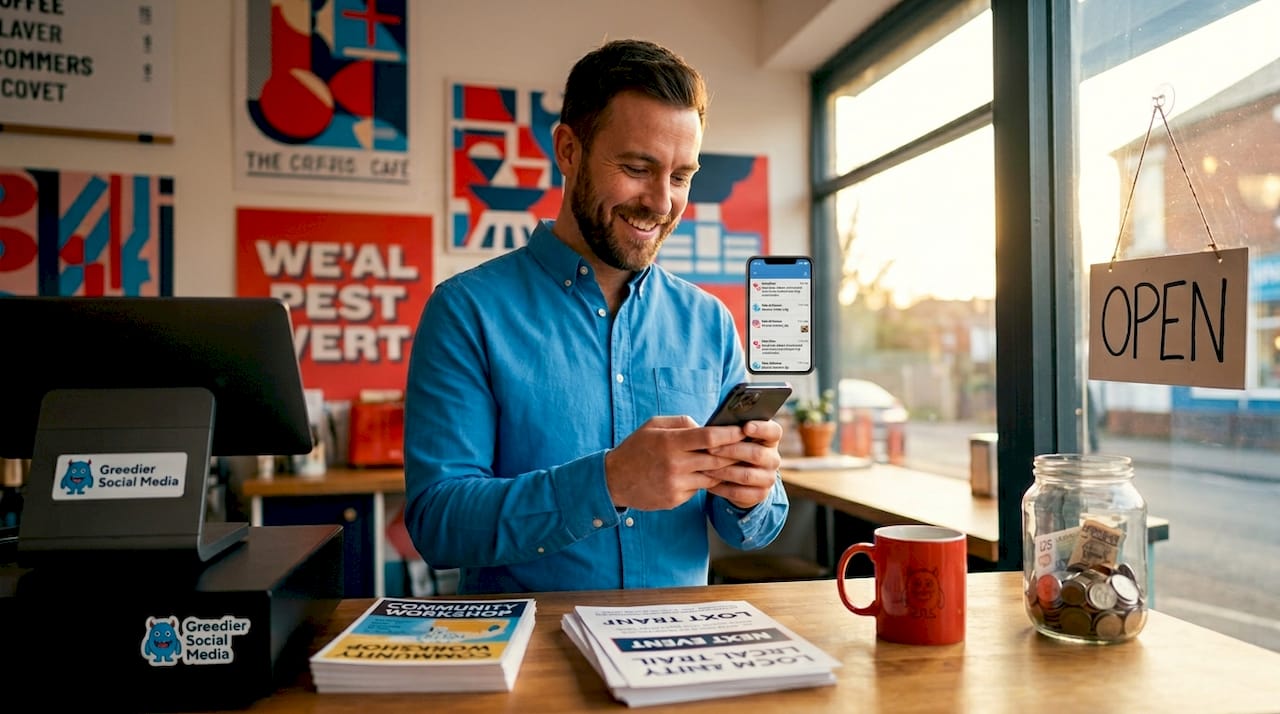
The distinction from a broad, global strategy is significant. A national brand might post content designed to appeal to millions of people with no specific location in mind. A local business in Leeds or Bristol, by contrast, wants to speak directly to people in that postcode, reference local landmarks, mention community events, and reflect the personality of that specific neighbourhood.
The core objectives of local business social media typically include:
- Driving foot traffic by promoting offers, opening hours, and location-specific events
- Building local brand loyalty through consistent community engagement and recognisable, authentic content
- Raising local awareness among residents who may not yet know your business exists
- Generating online enquiries that convert into bookings, calls, or purchases
- Encouraging word-of-mouth by making customers feel part of your business’s story
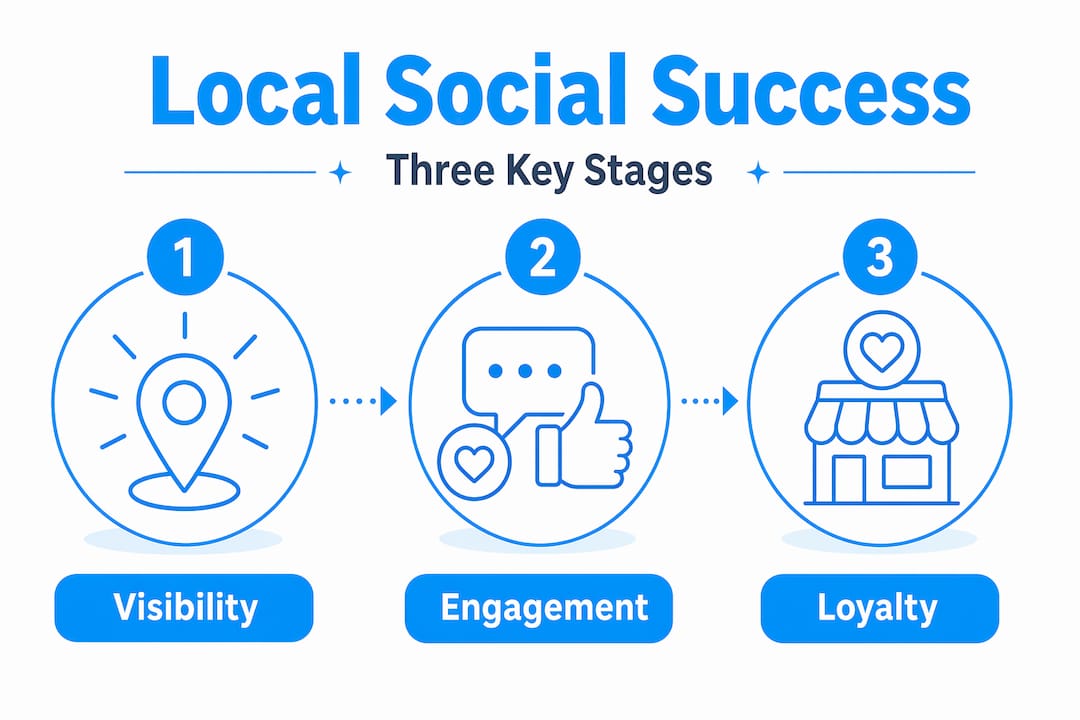
Understanding the importance of local social media becomes clear when you see it through a three-stage framework: visibility first, then engagement, then conversion. Each stage builds on the last.
Choosing the right platforms for local marketing
One of the most common mistakes local businesses make is attempting to maintain an active presence on every platform at once. The result is usually five accounts that all look neglected. Starting with one or two platforms, such as Facebook and Instagram, produces far better results than spreading your efforts too thinly. Quality and consistency matter more than omnipresence.
Here is how the main platforms compare for local business social media:
| Platform | Best for | Strengths for local marketing | Limitations |
|---|---|---|---|
| Most business types, older demographics | Local groups, events, detailed ad targeting, reviews | Organic reach has declined significantly | |
| Visual businesses: food, retail, beauty | Reels, Stories, location tags, shopping features | Requires strong visual content consistently | |
| TikTok | Younger audiences, lifestyle and food brands | High organic reach potential, trending audio | Time-intensive; less effective for professional services |
| Nextdoor | Hyperlocal neighbourhood businesses | Direct neighbourhood recommendations, no algorithm noise | Smaller user base; niche use cases |
For most UK small businesses, Facebook remains the most practical starting point because of its local groups and event features. Instagram works brilliantly alongside it for any business where what you sell looks good in a photograph. TikTok is worth exploring if your audience skews under 35 and your content can be entertaining rather than purely informational. Nextdoor, while less mainstream, is genuinely powerful for trades, cleaning services, and local shops wanting to reach neighbours directly.
Pro Tip: Before you create any new accounts, spend 20 minutes searching your business type and town name on each platform. Where are your competitors most active? Where are your customers already talking? That is where you should be.
Content and engagement strategies that work locally
Knowing which platform to use is only half the picture. What you post and how you respond to your audience matters just as much, if not more. A strong local social media strategy mixes three types of content: value-driven posts (tips, local information, educational content), engagement-focused posts (questions, polls, user-generated reposts), and promotional posts (offers, new products, services).
The most effective local content is hyper-specific. Think less “Buy our coffee” and more “We just sourced a new single-origin blend from a small farm in Rwanda, and it is available in our Harrogate shop from Saturday.” Name-drop the street. Mention the local event you are sponsoring. Post a photo of your team at the community fair. This kind of content tells your audience that you are part of their world, not just a business talking at them.
Local hashtags are underused by most small businesses. On Instagram, combining a broad hashtag like #independentcoffee with a location-specific one like #HarrogateEats increases discoverability meaningfully among local searchers. Research local hashtags your competitors use and the ones your customers already follow.
Active listening and responding to local conversations is what separates businesses that build real community affinity from those who merely post into the void. When someone comments on your post, reply. When someone sends a direct message, respond the same day. Businesses that respond promptly see up to 7x higher conversion rates. That figure is striking, but it makes sense. People buy from businesses they trust, and trust is built through conversation.
User-generated content is another underrated asset. When a customer tags your business in a post, reshare it with their permission. It costs nothing, builds community goodwill, and is far more credible to potential customers than anything you post about yourself. You can actively encourage this by creating a branded local hashtag and asking customers to use it when they visit.
Pro Tip: Test posting at different times across a two-week period and note which times generate the most engagement. For many UK local businesses, Tuesday to Thursday between 12pm and 2pm performs well, but your audience may differ. Let data, not convention, guide your scheduling.
Check out these tips for social media marketing for further practical guidance on building your local presence from scratch.
Paid local social media advertising
Organic content builds relationships over time. Paid advertising gets you in front of the right people right now. For local businesses, the combination of both is where real growth happens.
Set a geographic radius or postcode target. Facebook and Instagram allow you to target people within a specific number of miles from your location, or by postcode. Radius and postcode targeting makes paid campaigns measurably more cost-effective because you are not paying to reach people who can never visit you.
Align your ads with your organic content. Ads that feel out of step with your usual social presence look jarring and reduce trust. If your organic posts are warm and community-focused, your ads should be too.
Write a clear call to action. “Book a table for Saturday” works far better than “Find out more.” Tell the viewer exactly what you want them to do next.
Track cost-per-lead, not just clicks. Facebook and Instagram ads give you detailed data on how much you are paying per result. A click that never converts is worthless; a booking that costs £3 in ad spend is excellent value.
Avoid targeting too broadly. New advertisers often set their geographic radius far too wide hoping to catch more people. Tighter targeting usually lowers your cost per conversion.
Pro Tip: Start with a budget of £5 per day for two weeks before scaling. This gives you enough data to identify what messaging, imagery, and call to action works best before committing larger spend.
Measuring what actually matters
Vanity metrics are the enemy of real progress. Likes and follower counts feel satisfying, but they rarely tell you whether your local social media strategy is generating business. Social media goals should be expressed in downstream outcomes with CTAs that point to measurable results, not just engagement numbers.
Here is a practical framework for tracking what genuinely matters:
| Metric | What it tells you | Recommended action |
|---|---|---|
| Foot traffic uplift | Whether social activity is translating to physical visits | Ask customers how they found you; run location-specific offers |
| Enquiry volume | Whether posts are prompting direct messages or calls | Track enquiries weekly and link spikes to specific posts |
| Booking conversions | Whether social posts are driving appointments | Add booking links to posts; use unique discount codes per campaign |
| Reach vs. engagement rate | Whether content is resonating, not just being seen | Aim for engagement rate above 3%; adjust content if lower |
| Cost per conversion (paid) | Whether your ad spend is returning commercial value | Pause underperforming ad sets; reinvest in what converts |
Aligning social posts with landing pages is a critical step many businesses overlook. If you run an Instagram promotion for a 20% discount, the link in your bio should go directly to a page that reflects that offer. A confused customer who lands on a generic homepage simply clicks away.
Reviewing your metrics monthly, rather than obsessing daily, gives you the perspective to spot genuine trends and adjust your local audience engagement strategies accordingly.
My honest take on what local social media really requires
I have worked with dozens of UK small businesses that approach social media the same way. They post a few times, get a handful of likes, see no immediate spike in sales, and quietly give up. What I have learned is that this almost always comes down to a misunderstanding of the timeline involved.
Local social media is not a tap you turn on for instant revenue. It is more like the reputation you build in a town over years of being a good neighbour. The businesses I have seen do this well are the ones that treat every comment as a conversation worth having, every community event as content worth sharing, and every week of posting as a deposit into a long-term trust account.
Community trust and long-term loyalty built through consistent social presence frequently outperform the value of follower counts alone. I genuinely believe this. I have seen businesses with 400 followers and a packed diary because their 400 followers were the right 400 people, all local, all engaged, all recommending the business to friends.
The other thing I would push back on is the idea that maintaining brand consistency means every post looks the same. The businesses that win locally are those that let their personality breathe, reference local culture, and are not afraid to be a bit imperfect. Authenticity is a stronger local currency than polish.
If you manage multiple locations, centralised brand governance with local customisation is the only model that scales without chaos. You need guardrails, not a straitjacket.
— Luna
How Greediersocialmedia can help your local business grow
Building a consistent local social media presence takes time, creativity, and strategic thinking. Many small business owners simply do not have spare hours in the week to do it justice alongside running their actual business. That is where specialist support makes a real difference.
Greediersocialmedia has been helping UK businesses grow their social presence since 2013, supporting over a million satisfied users with authentic follower growth, real engagement, and no password sharing. Whether you want to grow your social media following faster or build genuine profile engagement that translates into local enquiries, the team offers targeted services designed specifically for businesses like yours. Getting seen by the right local audience does not have to take years when you have the right support behind you.
FAQ
What is the difference between local and national social media marketing?
Local social media marketing targets a specific geographic area to drive nearby customer actions such as visits, bookings, and enquiries. National marketing targets a broad audience with no location focus, typically for brand awareness rather than direct community engagement.
Which social media platforms work best for UK local businesses?
Facebook and Instagram are the most effective starting points for most UK local businesses. Facebook suits older demographics and offers strong event and group features, while Instagram works well for visual businesses such as food, retail, and beauty.
How often should a local business post on social media?
Most local businesses benefit from posting three to five times per week to maintain visibility without overwhelming their audience. Consistency matters more than frequency. Posting reliably twice a week beats posting daily for a fortnight and then going quiet.
How do I market locally on social media without a big budget?
Focus on organic content first: hyper-local posts, community engagement, and user-generated content cost nothing but time. When you are ready to invest in paid ads, even £5 per day with precise postcode or radius targeting can generate measurable local results.
What metrics should local businesses track on social media?
Track foot traffic changes, direct enquiries, bookings, and conversion rates from specific campaigns rather than follower counts or likes. Meaningful downstream outcomes give you a true picture of whether your social activity is generating commercial value.