
Knowing what is a social media strategy, in practical terms, changes how a business actually plans its content.
TL;DR:
- Most businesses treat social media as a megaphone without understanding the importance of a deliberate strategy. A social media strategy is a high-level plan outlining goals, audience, content direction, and measurement, distinct from posting schedules. Regular review cycles and clear goal setting ensure social media efforts directly support broader business objectives and adapt to platform shifts.
Most businesses treat social media like a megaphone. They post when they have something to say, celebrate a spike in likes, and wonder why none of it translates into real growth. Understanding what is a social media strategy means recognising it as something far more deliberate. A social media strategy is a documented, high-level plan that defines your goals, audience, content direction, and measurement framework to support your broader business objectives. It is not your content calendar. It is not your posting schedule. It is the thinking that makes both of those things worthwhile.
Table of Contents
- Key takeaways
- The core elements of a social media strategy
- Strategy vs content calendar: knowing the difference
- Planning timelines and review cycles
- Common pitfalls and how to avoid them
- My take on strategy and why most businesses get it wrong
- Grow faster with Greediersocialmedia
- FAQ
Key takeaways
| Point | Details |
|---|---|
| Strategy is not posting | A social media strategy defines goals and measurement, not just what to publish or when. |
| Goals must be S.M.A.R.T. | Set specific, measurable goals tied directly to business outcomes like leads or brand awareness. |
| Platform choice matters | Selecting the right platforms based on audience research prevents wasted time and budget. |
| Strategy and calendar are separate | Your content calendar manages timing; your strategy defines the purpose behind every post. |
| Review cycles drive results | Monthly check-ins and quarterly reviews keep your strategy responsive and data-led. |
The core elements of a social media strategy
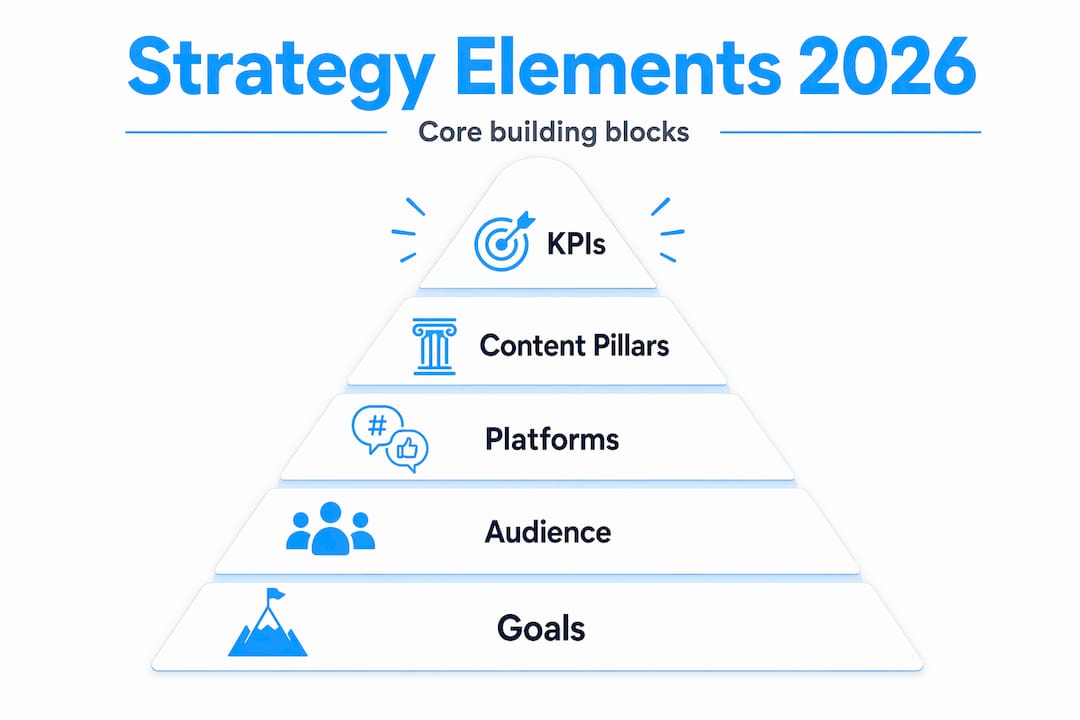
A social media strategy is only as strong as its components. Strategy connects brand to the right people on the right platforms through intentional planning and ongoing evolution. Here is what every complete strategy must include.
Goals aligned to your business
Every strategy starts with knowing what success looks like. Vague aims like “get more followers” do not cut it. You need S.M.A.R.T. goals: specific, measurable, achievable, relevant, and time-bound. SMART goals and measurable objectives can include brand awareness, lead generation, community engagement, or social commerce, each tied to a concrete metric you can track.
Audience research and segmentation
You cannot create content that resonates if you do not know who you are talking to. Audience research goes beyond demographics. It means understanding what problems your audience has, what platforms they use daily, what content formats they prefer, and what language they respond to. Identifying your audience precisely before selecting platforms or creating content prevents you from building in the wrong direction entirely.
Platform selection
Not every platform deserves your time. Choosing the right platforms means matching where your audience actually spends time with the formats that suit your content and goals. A B2B consultancy and a fashion brand have almost nothing in common when it comes to platform priorities. Spreading yourself across every channel dilutes your effort and produces mediocre results everywhere.
Content pillars and engagement tactics
Content pillars are the three to five core themes your brand consistently speaks about. They give your output structure and make your presence recognisable. Within those pillars, you choose formats: short video, carousels, long-form posts, stories, or live sessions. Your engagement approach should also be deliberate, covering how you respond to comments, encourage shares, and build community rather than just broadcasting.

KPIs and ROI measurement
Aligning KPIs to business objectives is what separates a real strategy from a guessing game. Key metrics include reach, engagement rate, click-through rate, follower growth, and conversion rate. The specific metrics you track should map directly to your goals. If your goal is lead generation, tracking likes alone tells you nothing useful.
Pro Tip: Set up a simple monthly reporting template before you launch any campaign. Tracking from day one means you have clean data to compare against, rather than scrambling to reconstruct what happened.
The final element is the review cycle itself. A strategy that never gets updated is a strategy that stops working. Regular insight analysis with ongoing tweaks is what keeps your social media plan effective as platforms change and audience behaviours shift.
Strategy vs content calendar: knowing the difference
This is where most teams get confused, and the confusion is costly. A social media strategy and a content calendar are not the same thing. They work together, but they operate at completely different levels.
| Element | Social media strategy | Content calendar |
|---|---|---|
| Purpose | Defines goals, audience, and success metrics | Organises what to post and when |
| Time horizon | Quarterly or annual | Weekly or monthly |
| Flexibility | Adapts based on data and business shifts | Adjusts for timing and logistics |
| Owned by | Senior marketer or business owner | Content team or social media manager |
| Key question answered | Why are we doing this? | What goes out on Tuesday? |
Strategy guides overall purpose; the calendar manages your posting schedule. Think of the strategy as the architect’s blueprint and the calendar as the builder’s daily schedule. One without the other creates either beautiful plans that never get executed or frantic activity with no clear direction.
Separating these two layers also helps teams avoid a common trap: rewriting the entire strategy every time a post underperforms. When you know the difference, you can adjust a content tactic without questioning your entire approach. That clarity saves time and prevents unnecessary panic.
Planning timelines and review cycles
Knowing how to create a social media strategy is one thing. Knowing how to sustain it is another. Most teams operate on a 30-day implementation plan with quarterly reviews and monthly check-ins to evaluate and adjust their approach.
Here is a practical planning cycle to follow:
- Set your strategy at the start of each quarter. Define goals, confirm your audience understanding, and select or reconfirm your platforms and content pillars.
- Build your content calendar for the first month based on your strategic priorities, not the other way around.
- Review performance monthly. Look at what content performed well, what missed, and whether your KPIs are moving in the right direction.
- Run a quarterly audit. Assess whether your goals still align with business priorities, whether your platform mix is still appropriate, and whether your audience has shifted.
- Adjust and repeat. Weekly or monthly insights reviews prevent wasted effort and keep your strategy responsive rather than reactive.
Coordination across your team matters here too. Assign clear ownership for strategy, content creation, scheduling, and reporting. When everyone knows their role, execution becomes far more consistent.
Pro Tip: Do not wait for your quarterly review to act on obvious data signals. If a content format is consistently outperforming others within the first two weeks of a month, shift more resource towards it immediately rather than waiting for permission from a future review date.
Common pitfalls and how to avoid them
Understanding the importance of social media strategy becomes very clear when you see what happens without one. UK businesses frequently struggle due to missing structure: unclear goals, platform overload, and content that talks about the brand rather than serving the audience.
Here are the most common mistakes and what to do instead:
- Unclear goals. Posting without defined outcomes means you cannot measure success or failure. Set specific goals before creating a single piece of content.
- Too many platforms. Being present on six platforms with mediocre content is worse than being exceptional on two. Focus where your audience actually is. Read more on choosing the right platforms for your business type.
- Self-centred content. Content that only promotes your products or services bores audiences quickly. Build content pillars around your audience’s questions, challenges, and interests.
- Ignoring data. Posting the same type of content regardless of what the numbers say is one of the most common and most avoidable mistakes in social media marketing strategy.
- Treating strategy as a one-off task. Social media strategy requires constant adaptation, not a single planning session. Build in regular review time from the start.
- Chasing vanity metrics. Follower counts and impressions feel good but rarely tell you whether your strategy is working. Track metrics that connect to actual business outcomes.
A strong social media plan prevents aimless posting and creates purpose-built content aligned with your goals. The businesses that see real results are the ones that treat their strategy as a living document, not a PDF filed away after a planning meeting.
My take on strategy and why most businesses get it wrong
I have worked with hundreds of businesses on their social media presence, and the pattern I see most often is the same. They have a content calendar. They post regularly. They even have decent creative. But they have no strategy underneath it, and they cannot understand why nothing seems to compound.
What I have learned is that the absence of strategy is not laziness. It is usually a misunderstanding of what strategy actually means. Most people think strategy is a big, complicated document. In reality, a working social media strategy can fit on a single page if it answers four questions clearly: who are we talking to, what do we want them to do, what will we say to move them in that direction, and how will we know if it is working.
The other thing I have seen consistently is that businesses underestimate how much platforms and audiences shift. A strategy that worked brilliantly eighteen months ago may now be producing diminishing returns simply because the algorithm changed or your audience moved to a different format. The businesses that grow are the ones that treat their strategy as something to be interrogated regularly, not defended.
My honest advice: start simpler than you think you need to. Pick one or two platforms. Define two or three content pillars. Set one primary goal per quarter. Then measure relentlessly and let the data tell you where to expand. Complexity can come later. Clarity has to come first.
— Luna
Grow faster with Greediersocialmedia
Having a strong social media strategy tells you what to do. Having the right support behind you determines how quickly it works.
Greediersocialmedia has helped over a million UK businesses and creators build genuine presence on platforms like Instagram and Facebook since 2013. If your strategy calls for growing your audience faster, their services are built around real engagement, no password required. Whether you want to increase your social media followers or build out your accounts from scratch, Greediersocialmedia offers a secure, transparent approach that complements the strategic work you are already doing. Pair a clear strategy with the right growth support and you stop waiting for momentum to arrive. You build it deliberately.
FAQ
What is a social media strategy?
A social media strategy is a documented plan that defines your goals, audience, platform choices, content direction, and measurement approach to support your business objectives. It is distinct from a content calendar, which only manages timing and scheduling.
What are the key elements of a social media strategy?
The core elements of a social media strategy include S.M.A.R.T. goals, audience research, platform selection, content pillars, KPIs, and a regular review cycle. Each element connects to the others to create a coherent, measurable approach.
How is a social media strategy different from a content calendar?
A social media strategy defines why you are on social media and what success looks like. A content calendar organises what you post and when. Strategy guides purpose; the calendar manages execution.
How often should you review your social media strategy?
Most teams benefit from monthly performance check-ins and a full quarterly review. Reviewing insights weekly or monthly prevents wasted effort and keeps your strategy responsive to real data rather than assumptions.
Why does a social media strategy matter for business growth?
Without a clear strategy, social media activity becomes disconnected from business goals, making it impossible to measure ROI or justify the time invested. A defined strategy turns posting into a purposeful, measurable growth activity.