

What if a higher subscriber count makes your channel look bigger but doesn’t bring more viewers? If you’re wondering what happens when you buy youtube subscribers, the first visible change may be a rise in your count. The added accounts may not watch, like or comment on your videos, and the number can fall if YouTube later removes subscribers it identifies as spam.
It’s reasonable to want a clear answer before making a decision, especially when channel growth, monetisation and your standing on YouTube are at stake. Buying subscribers to inflate a channel metric violates YouTube’s Fake Engagement Policy. Policy action can include content removal or channel termination, although the outcome for an individual channel can’t be predicted from the subscriber count alone.
This 2026 guide explains the changes you might see, why subscriber totals don’t tell the whole story, and how a purchase could affect monetisation eligibility. You’ll also learn which signals to monitor, including views, watch time and engagement, so you can assess your channel using evidence rather than the headline count alone.
Key Takeaways
- Understand what happens when you buy youtube subscribers, from a possible change in your visible count to outcomes that vary by channel.
- Compare subscriber totals with views, watch time and meaningful interactions to see whether audience response is changing too.
- Learn how YouTube’s Fake Engagement Policy applies, and why a higher subscriber count alone doesn’t ensure monetisation eligibility.
- Use YouTube Studio to review channel signals before and after a subscriber-count change, including returning viewers.
- Consider Greedier Social Media’s YouTube subscriber option as a metric choice, not a replacement for videos that connect with your audience.
What happens to your YouTube channel after you buy subscribers?
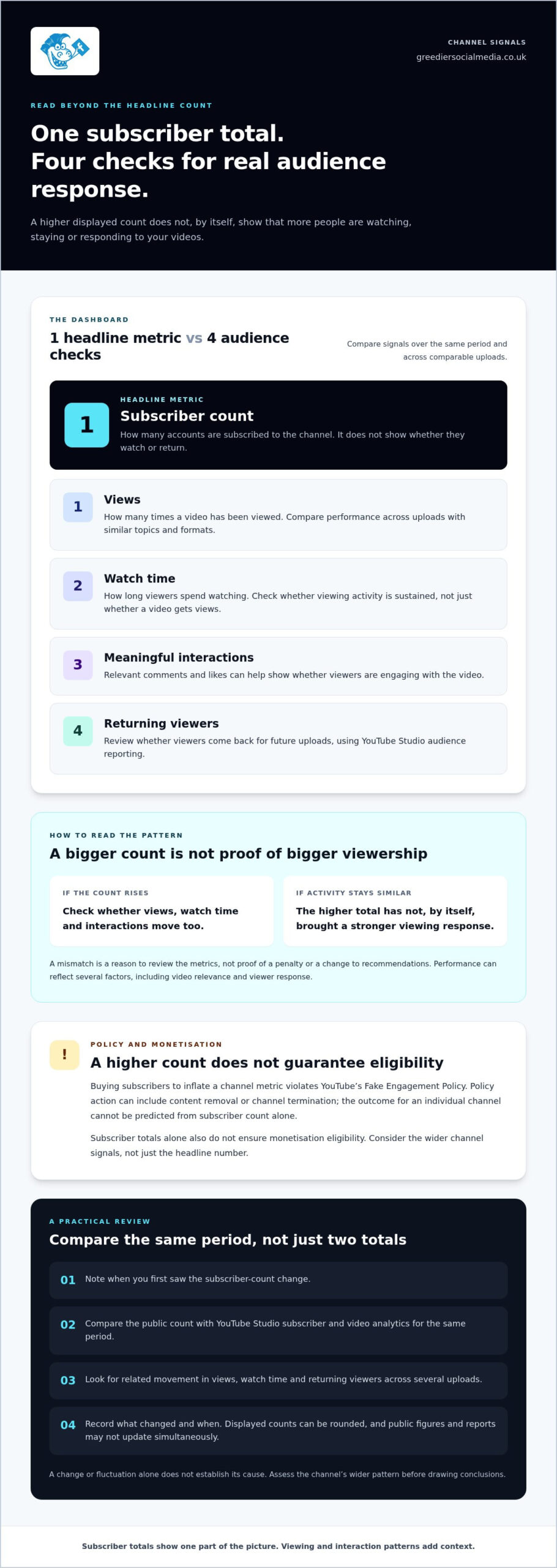
The visible subscriber count may change after a purchase, but what follows varies. The number on your channel page is only one measure. It doesn’t show whether the added accounts watch your videos, increase watch time, leave comments or return for future uploads. A rise in the total, on its own, can’t tell you how your audience is responding.
Typically, an order is placed, the service processes it, and subscriber accounts may then appear in the channel’s count. YouTube’s public figures and creator reporting may update at different times, so a change might not appear everywhere at once. The exact result and timing can vary, and the count alone can’t predict how a particular channel will be affected.
A subscriber-count change is a change in a displayed metric, not proof of audience growth. To understand the difference, track the other signals that show whether people are watching and returning.
What may change first on the channel?
You can see the public subscriber count on your channel page. YouTube Studio provides creators with channel and audience reporting, including subscriber totals and video performance information. The figures may not match at every moment: displayed counts can be rounded, and reports don’t necessarily update simultaneously. For broader context on the service behind these metrics, see this YouTube platform overview.
After a count changes, compare it with the response to your uploads. Check views, watch time, comments and returning viewers. For example, if the total rises but your next videos receive similar views and watch time, the higher count hasn’t, by itself, brought a stronger viewing response. That comparison doesn’t explain why the metrics differ, but it helps separate the headline number from audience behaviour.
Why the subscriber total may change again
YouTube can remove subscribers it identifies as spam or otherwise invalid. A count can therefore fall after it has risen. A later decrease might also reflect people choosing to unsubscribe or adjustments to displayed figures. The movement alone doesn’t establish which explanation applies, or whether a particular purchase caused it.
Review the dates before drawing conclusions. Note when you first saw a count change, then compare the public figure with YouTube Studio’s subscriber and video analytics for the same period. Look for related movement in views, watch time and returning viewers. Record what changed and when; don’t treat one fluctuation as a complete explanation.
Assess a purchase against the channel’s wider pattern, not just a before-and-after subscriber total. That gives you a clearer basis for understanding what happened without assuming that every increase, drop or reporting difference has the same cause.
How bought subscribers can affect views and engagement
Subscriber totals and audience activity measure different things. If you’re asking what happens when you buy youtube subscribers, one possible result is a higher displayed count without a matching rise in views, watch time or meaningful interactions. That gap is worth examining, but it doesn’t explain its own cause or predict how YouTube will distribute a video.
| Signal | What it tells you | What to compare |
|---|---|---|
| Subscriber count | How many accounts are subscribed to the channel | Changes over time, alongside other metrics |
| Views | How many times a video has been viewed | Performance across comparable uploads |
| Watch time | How long viewers spend watching | Whether viewing activity is sustained |
| Meaningful interactions | Responses such as relevant comments and likes | Whether viewers are engaging with the video |
Subscriber count versus active viewership
A subscriber is included in a channel’s audience total. A viewer is someone who watches a particular upload. Those measures aren’t interchangeable: subscribing doesn’t mean an account will watch every new video, watch it all the way through, comment or return later.
Assess views and watch time separately. A video might attract viewers who aren’t subscribed, while a subscriber may not watch that upload at all. Compare videos with similar topics and formats, while accounting for differences in publishing frequency, title, thumbnail and viewer interest. This gives you a more useful picture than treating the subscriber total as a forecast of views.
What an engagement mismatch can mean
If the count rises but viewing activity stays broadly similar, the channel may have a gap between its total subscribers and the people actively watching. That is a reason to review the metrics, not proof that YouTube has penalised the channel or changed recommendations. Performance can reflect several factors, including how relevant a video is to its intended audience and how viewers respond to it.
Subscriber totals alone can’t establish whether a channel is healthy; viewing and interaction patterns add context. Review several uploads rather than drawing a conclusion from one. Check whether views, watch time and relevant comments move in the same direction, then consider whether the videos cover topics that interest your intended audience. A mismatch may be temporary, persistent or connected to factors unrelated to a subscriber-count change.
A higher subscriber count doesn’t automatically lead to more recommendations or video views. Treat each signal as evidence about a different part of channel performance. Greedier Social Media offers YouTube subscribers as a paid metric option to weigh against your channel goals, not as a substitute for videos that give viewers a reason to watch and return.
What YouTube policy and monetisation rules mean for bought subscribers
YouTube’s rules matter independently of what appears on a channel page. Its Fake Engagement Policy prohibits artificially increasing metrics, including subscribers, and covers the use of third-party services that inflate engagement. If you’re asking what happens when you buy youtube subscribers, the policy position is clear: buying subscribers to inflate a channel metric is not permitted. The count alone can’t predict what YouTube will do in response to an individual channel.
How YouTube treats artificial engagement
YouTube may remove subscribers it identifies as spam or invalid. Depending on the circumstances, policy responses can also include content removal or channel termination. These are possible consequences, not a claim that every purchase triggers the same action. A visible increase, decrease or unchanged total doesn’t establish whether YouTube has reviewed a channel or taken action against it.
A policy breach can have consequences, but the response to an individual channel isn’t guaranteed or predictable. Don’t rely on claims that a purchase is undetectable or automatically safe. YouTube’s policy is the relevant standard; claims about what may happen to a particular account are not a reliable substitute.
Why monetisation depends on more than subscribers
Subscriber totals are only one part of YouTube Partner Programme (YPP) eligibility. As of October 2026, the full monetisation route requires 1,000 subscribers plus either 4,000 valid public watch hours in the previous 12 months or 10 million valid public Shorts views in the previous 90 days.
There is also an early-access tier for features such as Channel Memberships and Super Thanks. Its threshold is 500 subscribers, three valid public uploads in the past 90 days, and either 3,000 valid public watch hours in the past year or 3 million valid public Shorts views in the past 90 days. Meeting a displayed subscriber threshold doesn’t, by itself, satisfy these other conditions.
Numbers aren’t the only consideration. YouTube reviews channels for compliance with its monetisation policies, so meeting the thresholds doesn’t guarantee acceptance. A subscriber count alone also doesn’t guarantee earnings: monetisation depends on approval and the channel’s eligibility for the relevant features.
Keep the distinction clear: YouTube prohibits artificial subscriber inflation, while the outcome for an individual channel depends on its circumstances and the platform’s assessment. A displayed total is not proof that subscribers qualify for YPP or that the channel will be approved. Review the current YPP requirements and policy guidance before making a decision based on a target number.
How to assess what happened after a subscriber purchase
A careful review can help separate what changed from what you think caused it. If you’re investigating what happens when you buy youtube subscribers, don’t rely on a single screenshot or one upload’s results. Use YouTube Studio to compare channel performance across relevant dates, and record other changes that might affect the figures.
Which YouTube Studio metrics should you review?
Start by noting the date you observed a subscriber-count change. In YouTube Studio, review subscriber data alongside video analytics for the same period. Compare views, watch time, returning viewers and relevant interactions, such as comments that respond to the video’s subject. Where possible, compare similar time periods and uploads rather than a single video with a different topic or format.
Use a simple record to keep your review consistent:
- Record the dates: note when you observed the count change and which reporting periods you’re comparing.
- Track channel signals: log subscriber totals, views, watch time, returning viewers and interactions for comparable periods.
- Note content changes: include upload dates, topics, formats or publishing gaps that could influence performance.
- Review the pattern: look for changes across more than one upload before deciding what the metrics suggest.
For example, if subscribers rise during a period when views and watch time remain similar, record the difference. Then check whether you also changed your upload schedule or video topics. Timing can guide your investigation, but it doesn’t prove that one event caused another.
Allow for normal variation. A new subject may attract a different audience, and videos can perform differently from one another. Treat each figure as a clue, not standalone proof of purchase impact, audience quality or a YouTube policy decision.
How to decide on your next channel step
Choose a clear goal before acting on the figures. You might be aiming for greater awareness, more relevant viewers, stronger watch time or steadier performance across uploads. Then assess whether your content is reaching people who are likely to value the subject. A headline subscriber total can’t answer that on its own.
If your priority is relevant viewership, focus your next review on the videos and audience signals that match that goal. If consistency matters most, compare similar uploads over time and note what changed. Avoid making a major decision based only on a short-term rise or fall in one metric.
If you’re concerned about suspicious activity or a possible policy issue, follow YouTube’s current official Help guidance and account notifications. Don’t infer enforcement from a count fluctuation alone. Use the platform’s own information to decide whether further action is needed.
Once you’ve set a goal and reviewed your channel data, explore Greedier Social Media’s YouTube subscriber option as a metric-focused choice. Keep your decision separate from assumptions about viewing activity, audience fit or monetisation outcomes.
What to consider before choosing a YouTube subscriber option
Before making a decision, be clear about what you want the channel metric to represent. A larger subscriber total, more active viewers and long-term channel growth are different goals. They call for different ways to measure progress, and a change in one number won’t necessarily move the others.
Questions to answer about your channel goal
Ask yourself what matters most right now: visible social proof, active viewership or sustained channel growth? If your aim is active viewership, focus on views, watch time and returning viewers. If you’re assessing long-term growth, look at whether people who discover your videos keep watching and engage with later uploads. A subscriber total may describe scale, but it can’t answer those questions by itself.
Set a measure of success before choosing an option. Decide which channel signals you’ll review and over what period, then compare those figures with your current baseline. Avoid treating a particular count as a promise of future performance. Asking what happens when you buy youtube subscribers is useful, but no purchase can guarantee more views, lasting retention, monetisation approval or a specific policy outcome.
Keep platform rules in view too. YouTube prohibits artificially increasing subscriber metrics under its Fake Engagement Policy. A purchase should not be treated as a policy-compliant route to channel growth or a shortcut to YouTube Partner Programme eligibility. Consider the potential consequences alongside your goal before proceeding.
A measured next step for creators
Greedier Social Media offers a YouTube subscriber option. Consider it as a paid metric option, not a replacement for relevant videos, audience development or a clear content goal. Subscribers alone can’t ensure that viewers will watch, return or interact, and they don’t guarantee monetisation or a particular response from YouTube.
Before deciding, write down what you hope the option will change and what it can’t establish. If you’re aiming to build an engaged audience, keep evaluating the quality and relevance of your videos alongside the headline count. If your main goal is to understand channel performance, use YouTube Studio to track the measures that match that goal. This keeps your next step grounded in evidence rather than assumptions about what a subscriber number means.
If you’ve weighed the goal, policy considerations and limits, review Greedier Social Media’s YouTube subscriber option. Make the decision with clear expectations and outcomes you intend to measure.
Make your next channel decision with clear goals
Before you act, decide what you want your next step to achieve and how you’ll judge it. A channel decision is more useful when it’s based on a defined goal than on a number you hope to reach. Keep your expectations realistic, and choose measures that reflect the outcome you value.
Understanding what happens when you buy youtube subscribers can help you weigh a metric change against your wider plans for the channel. Greedier Social Media has operated since 2013 and offers YouTube subscribers as part of its social engagement services. This is a paid metric option, not a promise of views, audience response or monetisation.
If it fits your goals, explore Greedier Social Media’s YouTube subscriber option and make your next move with care. Set a clear plan for measuring the outcomes that matter to your channel.
Frequently Asked Questions
Does YouTube remove bought subscribers?
YouTube may remove subscribers it identifies as spam or artificial. A falling total doesn’t, by itself, show that this has happened; people may unsubscribe, and displayed figures can fluctuate for other reasons. Note the date and check YouTube Studio for changes across the same period. If you’re concerned, review YouTube’s current Fake Engagement Policy and account notifications rather than relying on the count alone to identify a cause.
Can buying YouTube subscribers get a channel banned?
A channel can face action for violating YouTube’s policies, but a purchase doesn’t mean a ban will automatically follow. Possible responses depend on what YouTube identifies and the circumstances. Don’t rely on claims that any purchase is risk-free. If you receive a policy notice, read it carefully, check your account status and follow the instructions in YouTube’s official guidance. Avoid making assumptions about enforcement based only on changes to your subscriber total.
Will bought subscribers watch my videos?
There’s no guarantee that subscribers will watch, comment on or return to your videos. For example, a channel count could change whilst views on a new upload stay similar. In YouTube Studio, compare video-level views and audience retention with your usual results, and look at whether comments relate to the video. These signals can help you assess activity, but they can’t establish why a particular account subscribed or whether it will watch later.
Do bought subscribers count towards YouTube monetisation?
Don’t assume a purchased count will qualify your channel for monetisation. YPP eligibility includes additional viewing requirements, and YouTube reviews channels before accepting them. Check the Earn tab in YouTube Studio and YouTube’s current eligibility guidance for the requirements that apply to your channel. Reaching a displayed subscriber threshold alone doesn’t guarantee approval, access to monetisation features or revenue. Eligibility rules may change, so use current official information when planning.
Why did my YouTube subscriber count go down after buying subscribers?
YouTube may remove subscribers it identifies as spam or artificial, but a decrease alone doesn’t confirm that this is what happened. Unsubscribes and reporting adjustments can also affect the displayed total. Note the dates, then compare the channel count with YouTube Studio reports for the same period. Check whether the change coincided with other account activity, but don’t infer a specific penalty or retention rate from the fluctuation.
Is buying YouTube subscribers against YouTube policy?
YouTube’s Fake Engagement Policy prohibits artificially increasing metrics, including subscriber numbers. Read the current policy wording directly, as a seller’s description doesn’t determine whether an activity complies with YouTube’s rules. If you’re assessing what happens when you buy youtube subscribers, factor in that policy before making a decision. No service description can establish that a purchase is permitted, undetectable or free from possible consequences.
What should I check after buying YouTube subscribers?
In YouTube Studio, review subscriber changes alongside views, watch time, returning viewers and audience retention. Compare similar-length periods and similar uploads, then note differences in topic, format or publishing frequency. For example, a change in upload schedule may affect comparisons between one month and the next. Record what you observe without treating timing as proof of cause. If account activity seems suspicious, consult YouTube’s current Help guidance and any notifications on your account.