
TL;DR:
- Social media reach measures the number of unique accounts that view content, serving as a vital indicator of audience awareness. It comprises organic, paid, and viral types that collectively influence overall distribution and growth. Focusing on increasing genuine reach through share-worthy content and strategic engagement is essential for long-term brand visibility.
Social media reach is defined as the total number of unique accounts that view a piece of content at least once, making it the foundational metric for measuring audience size and brand awareness. Unlike impressions, which count every single view including repeats, reach counts unique viewers only. If 1,000 different people see your post, your reach is 1,000, regardless of how many times each person views it. Platforms like Instagram, Facebook, and LinkedIn all report reach natively, and tools like Hootsuite and Buffer surface it as a primary performance indicator. As a top-of-funnel metric, reach is the precondition for everything else: trust, engagement, and conversion cannot happen without it.
What does reach mean on social media and why does it matter?
Reach is the social media reach definition that most marketers encounter first, and for good reason. It answers the most basic question in any campaign: how many people actually saw this? Without reach data, every other metric floats without context. A post with 500 likes means very little if you do not know whether 600 people or 600,000 people saw it.

Reach matters because it directly reflects your brand’s visibility. A business with growing reach is expanding its audience. A business with stagnant or declining reach is losing ground, regardless of how polished its content looks. For UK businesses and creators working to build authority on Instagram or Facebook, reach is the clearest signal of whether your content is being distributed or buried.
The importance of reach in marketing sits at the top of the funnel. Consideration, preference, and purchase all follow once reach is established. Treating it as a vanity metric misses the point entirely. Reach measures audience breadth, and breadth is what creates the pool from which engaged followers and paying customers eventually emerge.
What are the types of reach on social media?
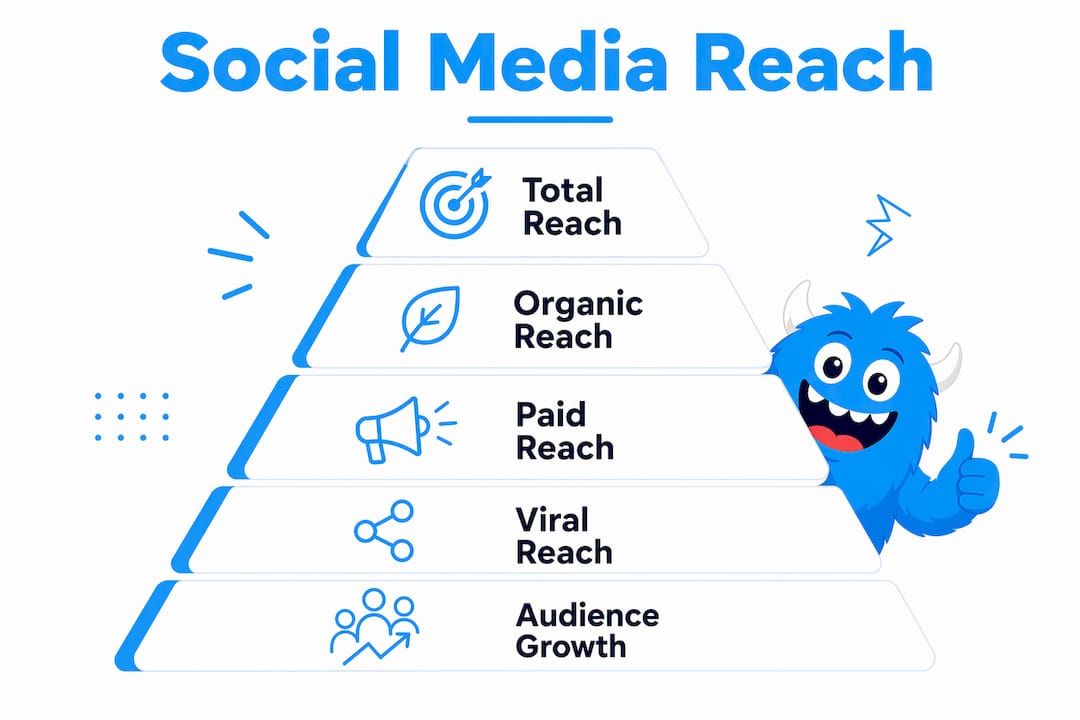
Reach is categorised into three types: organic, paid, and viral. Total reach is the sum of all three, and understanding each type helps you diagnose where your distribution is coming from and where it is breaking down.
Organic reach is the number of unique users who see your content through unpaid algorithmic distribution. When Instagram’s algorithm surfaces your post to a follower’s feed, or when LinkedIn shows your article to someone in your network, that is organic reach at work. It costs nothing directly, but it is constrained by platform algorithms and your existing follower base.
Paid reach comes from advertising. When you run a sponsored post on Facebook or a promoted tweet, the platform distributes your content to users who match your targeting criteria. Paid reach bypasses organic caps and lets you reach audiences who have never heard of your brand.
Viral reach is driven by shares and amplification. When a user shares your post with their own followers, your content reaches people entirely outside your network. Shares can multiply organic reach significantly, sometimes exposing content to audiences 100 times larger than your follower count alone would allow.
Each type feeds into your total reach figure. A campaign that relies entirely on organic reach will plateau. One that combines organic content quality with paid promotion and share-worthy material can grow reach across all three channels simultaneously. For a deeper look at how these categories play out in practice, Greediersocialmedia’s guide to organic reach strategies covers the mechanics in detail.
How does reach differ from impressions and engagement?
These three metrics are the most commonly confused in social media analytics, and conflating them leads to poor decisions.
| Metric | Definition | What it measures | Best used for |
|---|---|---|---|
| Reach | Unique accounts that saw content at least once | Audience size | Brand awareness, distribution |
| Impressions | Total views including repeat views | Content frequency | Ad frequency, content saturation |
| Engagement | Actions taken (likes, shares, comments) | Audience response | Content quality, community health |
Impressions count total exposures including repeats, while reach counts unique viewers only. A post with 1,000 reach and 2,500 impressions means the average viewer saw it 2.5 times. That ratio, impressions divided by reach, is called frequency. A frequency of 2 to 3 is generally healthy for paid campaigns. Above 5 or 6, you risk audience fatigue.
Engagement rate uses reach as its denominator. Engagement rate is calculated as total engagement actions divided by reach, which is why reach is the baseline metric rather than an optional extra. A post with high reach but low engagement signals that your content is being seen but not resonating. A post with low reach but high engagement suggests strong content quality trapped behind poor distribution.
Pro Tip: If your impressions are climbing but your reach is flat, you are showing the same content to the same people repeatedly. Refresh your creative or broaden your targeting before frequency becomes a problem.
What factors influence social media reach?
Several forces determine how far your content travels, and follower count is only one of them.
Follower base as a starting point. Your followers represent the initial audience for any post. A larger, more engaged follower base gives the algorithm more early signals to work with, which influences how broadly it distributes your content next.
Algorithmic distribution features. Platforms like Instagram use Reels, Explore, and the suggested content feed to push posts to non-followers. Algorithmic feeds often trump follower counts in determining reach, meaning a well-performing Reel can reach millions even from a small account.
Engagement signals. Shares, saves, and comments tell the algorithm that your content is worth distributing further. Each share is particularly powerful because it introduces your content to an entirely new network.
Platform-specific reach caps. Instagram’s typical organic reach sits at 10 to 20% of followers, while LinkedIn’s is closer to 5 to 10%. Paid promotion bypasses these caps, but organic reach will always face a ceiling unless your content generates strong engagement signals.
Reach decay. Reach decays rapidly due to algorithm limits and content saturation. A post that performs well in its first two hours will receive the bulk of its distribution in that window. After that, algorithmic support drops sharply unless engagement continues.
Pro Tip: Post when your audience is most active and respond to early comments quickly. The first hour of engagement is the most influential window for algorithmic distribution on Instagram and Facebook.
Understanding social proof strategies that drive shares and saves is one of the most direct ways to push past organic reach limits without spending on ads.
How to measure social media reach effectively
Accurate measurement starts with choosing the right tools and knowing what to look for in the data.
Native platform analytics are your first port of call. Instagram Insights, Facebook Page Insights, and LinkedIn Analytics all report reach per post and over time. These figures are the most accurate because they come directly from the platform.
Third-party tools like Hootsuite and Buffer aggregate reach data across multiple platforms in one dashboard. They also allow you to track reach trends over weeks and months, which is far more useful than looking at individual post performance in isolation.
Frequency calculation. Divide impressions by reach to get your frequency score. A rising frequency with flat reach is a warning sign, particularly in paid campaigns.
Reach alongside engagement rate. Never read reach in isolation. A post with 50,000 reach and a 0.5% engagement rate tells a different story than one with 5,000 reach and a 6% engagement rate. The second post is performing far better relative to its audience.
Watch for misleading results. High impression-to-reach ratios can indicate ad fatigue or user annoyance rather than content quality. Misreading this ratio leads to scaling campaigns that are already irritating your audience.
Greediersocialmedia’s overview of social media KPIs explains how reach fits alongside other performance indicators worth tracking in 2026.
How to increase social media reach authentically
Growing reach without resorting to fake followers or inflated metrics requires a consistent, strategic approach.
Create share-worthy content. Quality shares are the most effective method to increase organic reach exponentially compared to mere follower growth. Ask yourself whether your content is genuinely useful, entertaining, or surprising enough for someone to send to a friend.
Post consistently and at peak times. Algorithms reward accounts that publish regularly. Consistency signals reliability to the platform, which in turn supports broader distribution.
Use hashtags and keywords strategically. On Instagram and LinkedIn, relevant hashtags and keyword-rich captions help the algorithm categorise your content and surface it to users with matching interests.
Engage with your audience actively. Responding to comments and asking questions in captions generates early engagement signals that push content to wider audiences. The algorithm interprets conversation as a sign of quality.
Supplement with paid reach when needed. Paid promotion is not a shortcut. It is a legitimate tool for reaching audiences your organic content cannot access. Use it to amplify posts that are already performing well organically, not to prop up weak content.
Avoid fake engagement. Purchasing bot followers or engagement inflates vanity numbers without improving actual reach. Platforms actively suppress accounts that show signs of inauthentic activity, which damages organic distribution long-term.
For a broader set of tactics, growth hacks for social media that focus on lasting brand growth offer a useful complement to the fundamentals above.
Key takeaways
Social media reach measures unique viewers and serves as the essential baseline for every other metric, from engagement rate to conversion.
| Point | Details |
|---|---|
| Reach counts unique viewers | A post seen by 1,000 different people has a reach of 1,000, regardless of repeat views. |
| Three types of reach | Organic, paid, and viral reach combine to form total reach for any piece of content. |
| Reach differs from impressions | Impressions count total views including repeats; reach counts each unique viewer once only. |
| Algorithms drive distribution | Instagram and LinkedIn cap organic reach at 10 to 20% and 5 to 10% of followers respectively. |
| Shares multiply reach fastest | Content that earns shares can reach audiences far beyond your existing follower base. |
Why reach still matters more than most marketers admit
I have spent years watching brands obsess over engagement rate while quietly ignoring the fact that their reach has been shrinking for months. It is an easy trap. Engagement rate feels like a quality signal, and it is. But a high engagement rate on a post that only 200 people saw is not a success. It is a missed opportunity.
The metric I watch most closely when auditing a social media account is not likes or comments. It is the trend line on reach over 90 days. A declining reach trend tells me the algorithm has deprioritised the account, usually because posting frequency has dropped, content quality has slipped, or the audience has become disengaged. No amount of polished creative fixes a structural distribution problem.
What I find most underappreciated is the relationship between reach and trust. Reach is not just about numbers. It is about how many people are being introduced to your brand for the first time. Every new person in your reach figure is a potential future customer who has never heard of you before. That is the top of the funnel, and without a healthy top, nothing downstream works properly.
My honest view is that most small businesses and creators in the UK should spend far less time optimising individual posts and far more time understanding why their overall reach is growing or shrinking. The post-level data is noise. The account-level trend is the signal.
— Luna
Grow your reach with Greediersocialmedia
Understanding reach is one thing. Acting on it is another.
Greediersocialmedia has helped over a million users across the UK grow their social media presence since 2013, using authentic engagement strategies that build genuine visibility on platforms like Instagram and Facebook. Whether you are a small business trying to break through or a creator looking to expand your audience, the right approach to reach starts with real followers and real interactions. Explore the full range of social media growth tactics or browse growth packages designed to deliver measurable results without compromising your account’s integrity.
FAQ
What is the social media reach definition?
Social media reach is the number of unique accounts that view a piece of content at least once. It measures audience size rather than content frequency, making it the primary metric for brand awareness.
How does reach differ from impressions?
Reach counts each unique viewer once, while impressions count every view including repeats. A post with 1,000 reach and 2,500 impressions means the average viewer saw it 2.5 times.
What is a good reach rate on Instagram?
Organic reach on Instagram typically falls between 10 and 20% of your follower count. Posts that trigger strong engagement signals through shares and saves can exceed this through algorithmic distribution to non-followers.
Does a higher follower count guarantee more reach?
No. Follower count sets a baseline, but algorithmic distribution driven by engagement signals determines actual reach. A smaller account with highly engaged followers can outreach a larger account with passive ones.
How can I increase my social media reach without paid ads?
Create content that earns shares, post consistently at peak times, use relevant hashtags, and engage actively with early comments. Shares are the single most effective multiplier for organic reach beyond your existing follower base.