
Knowing what does influencer saturation mean helps explain why some campaigns just stop working.
Influencer saturation means the influencer market for a given niche has become so crowded with paid, near-identical sponsored content that audiences stop responding to it and campaign returns fall. Two things follow almost immediately. Engagement rates and ROI drop, because feeds are flooded with lookalike promotions people scroll past on instinct. And audience scepticism rises, dragging brand trust down with it. Kantar’s research suggests most posts that look like a hit on platform metrics do not actually move the needle for the brand paying for them. Vera Sidlova, who studies this shift for Kantar, and market analysts at Mintel both describe it as a structural reset in how audiences judge sponsored content, not a passing dip.
Key Takeaways
Influencer saturation reduces engagement and trust once sponsored content in a niche becomes repetitive, and the fix is concentrated, measured, human-first creator relationships rather than broader reach.
| Point | Details |
|---|---|
| Definition first | Saturation means too much similar sponsored content is chasing the same audience attention, so returns fall. |
| Measure with Saturation Rate | Divide sponsored posts by total posts; above roughly 50% is an informal risk signal, varying by niche. |
| Credibility erodes before sales do | Over-endorsement damages purchase intent by lowering perceived credibility, not by hurting the product itself. |
| Concentrate, don’t expand | Brands are shifting budget to fewer, higher-authority creators plus mixed nano/micro tiers. |
| Build pause rules into briefs | Set engagement and CPM/CPA thresholds before launch so you know when to stop, not after it’s obvious. |
Table of Contents
- What causes influencer marketing saturation?
- How do you measure influencer market saturation?
- What does saturation cost small businesses and creators?
- How can brands and creators respond to saturation?
- What KPIs and decision rules signal it’s time to pause?
- What is the “human premium” in influencer marketing?
- What can you do about influencer saturation today?
- The gap between the saturation panic and what actually works
- Sources
- FAQ
What causes influencer marketing saturation?
Saturation builds from three directions at once. Platforms reward short-form video with algorithmic reach, so everyone chases the same formats. Barriers to becoming a “creator” have collapsed. Anyone with a phone and a ring light can post sponsored content by lunchtime.
Brand demand compounds it. Marketing teams chase short-term reach and affiliate-driven discount codes rather than long-term trust, flooding categories like beauty, fitness, and personal finance with near-identical posts.
Creators face their own pressure. Monetisation often depends on posting frequently, which pushes many towards formulaic, easily repeatable content rather than anything distinctive.
- Platform algorithms favour high-frequency, short-form posting over depth.
- Low entry barriers mean creator supply keeps outpacing genuine audience demand.
- Brands prioritise reach and discount-driven affiliate deals over relevance and fit.
Pro Tip: Write briefs that ask for one specific audience insight the creator already has, rather than a generic list of talking points. Specificity in the brief tends to produce content that doesn’t read like everyone else’s.
How do you measure influencer market saturation?
Start with the Saturation Rate, a simple practitioner metric: sponsored posts divided by total posts on a creator’s account. An SR above roughly 50% is commonly cited as an informal tipping point where engagement often starts sliding, though high-trust creators can sustain more without losing their audience.
Track these alongside SR:
- Engagement rate trend over 8 to 12 weeks, not a single snapshot.
- CPM/CPA drift upward on repeat bookings with the same creator or niche.
- Click-through fall-off on affiliate links or swipe-ups.
- Comment quality: fewer genuine replies, more emoji-only reactions.
Watch for repetitive creative templates and comments calling out “another ad” as qualitative red flags.
What does saturation cost small businesses and creators?
Rising CPM and CPA are the obvious cost, but the hidden expense is time: vetting more creators to find fewer good fits eats into any budget saved by chasing cheaper nano deals.

The credibility cost matters more. Academic research shows over-endorsement damages purchase intent indirectly, by eroding how credible audiences find the endorsement itself, not the product. That erosion compounds across a saturated category. Kadence’s analysis points out that in crowded creator ecosystems, audiences increasingly remember the creator or the format rather than the brand behind it, which flattens years of positioning work into one interchangeable feed post.
Timelines shift too. Saturated categories peak faster and burn out sooner, so campaigns built around a single seasonal window (Black Friday, back-to-school, January fitness) need earlier planning and shorter creative shelf lives than they did two or three years ago. A campaign that once had a fortnight of strong engagement might now hold attention for barely a week before fatigue sets in, so brief lead times and creator briefing need to move earlier in the calendar, not later.
How can brands and creators respond to saturation?
The fix isn’t abandoning influencer marketing. It’s spending differently.
For brands:
- Concentrate budget on fewer, higher-authority creators rather than spreading thin across dozens of accounts.
- Build mixed-tier programmes combining nano and micro creators with one or two trusted, higher-reach names.
- Brief for genuine relevance and product fit, not just follower count or reach.
Trade reporting from Digiday confirms this consolidation is already happening across the industry, with brands cutting creator rosters rather than expanding them. Brands serious about vetting should look at how partnerships evaluate influencer fit before signing anyone.
For creators, the priorities look different:
- Diversify income beyond brand deals: long-form platforms, subscriptions, in-person events.
- Plan posting cadence around known industry peaks rather than posting constantly.
- Lean into storytelling and community content over templated promotional posts, which builds the kind of trust that survives a crowded feed.
Long-form storytelling, community activations, and limited-run exclusive offers all help here, partly because raising genuine product interest measurably buffers the credibility damage of frequent endorsements. A production partner geared towards authentic creator content can help brands and creators move beyond templated ad formats without losing polish.
Pro Tip: A rough cadence rule for creators: no more than one in three posts should be paid, and never post two sponsored pieces back to back unless the products are genuinely unrelated to each other.
What KPIs and decision rules signal it’s time to pause?
Track five numbers on a rolling basis: engagement rate, conversion lift, CPM/CPA, share of voice, and the ratio of sponsored to organic engagement. Measure over 4 to 8 week windows, comparing against your own baseline rather than industry averages.
Use simple decision rules:
- Pause a creator relationship if engagement rate drops sharply against baseline and their Saturation Rate sits above roughly 50%.
- Pull back spend if CPM or CPA rises past your target ROI threshold for two consecutive measurement windows.
- Reassess format, not just creator, if organic engagement outpaces sponsored engagement for a full cycle.
These rules work best written into the campaign brief before launch, not improvised once numbers start slipping. For structuring that measurement into a repeatable process, Baby Love Growth’s guide to influencer programme strategy is worth a look.
What is the “human premium” in influencer marketing?
Industry researchers are calling this shift the human premium: audiences now pay more attention, literally and figuratively, to creators who feel human rather than polished. Haley Ferrini at Mintel frames it as a reset rather than a decline, arguing that consumers aren’t rejecting influencer marketing itself, just the generic version of it.
Mintel’s survey data backs this up concretely: 29% of consumers trust creators more when they aren’t constantly selling, 26% respond to demonstrated expertise, and personal stories are the most-enjoyed content format at 44%. A creator who shifted from daily product posts to weekly community Q&As and diversified onto a long-form platform illustrates the pattern: slower growth initially, but an audience that stuck around because the content felt earned rather than bought.
What can you do about influencer saturation today?
- Calculate the Saturation Rate for any creator you’re vetting before signing a contract.
- Set your engagement rate baseline now, so you have something to compare against later.
- Trial one mixed-tier campaign (a mix of nano, micro, and one trusted higher-reach creator).
- Diversify creative formats away from templated promotional posts.
- Build a pause rule into every brief before the campaign launches, not after it underperforms.
The gap between the saturation panic and what actually works
Most coverage of influencer saturation treats it as a crisis to survive. That framing misses the more useful point: saturation is a market signal, and markets that get crowded always sort themselves into winners and noise. The creators and brands treating this moment as a filtering mechanism, rather than a threat, are the ones building something durable.
What’s underestimated is how much of the “saturation problem” is actually a measurement problem. Brands that never set an engagement baseline can’t tell fatigue from a bad campaign. Creators who never calculated their own Saturation Rate don’t know they’ve crossed the line until comments start turning hostile. The tools to spot this are simple, arguably too simple, which is probably why so few people bother using them consistently.
The human premium isn’t a marketing trend that will fade by next year. It’s closer to a correction: audiences finally have enough sponsored content in their feeds to compare it against, and generic content loses that comparison every time. For small businesses without the budget for a dozen creator relationships, that’s genuinely good news. One well-matched creator relationship, measured properly, beats ten scattergun ones.
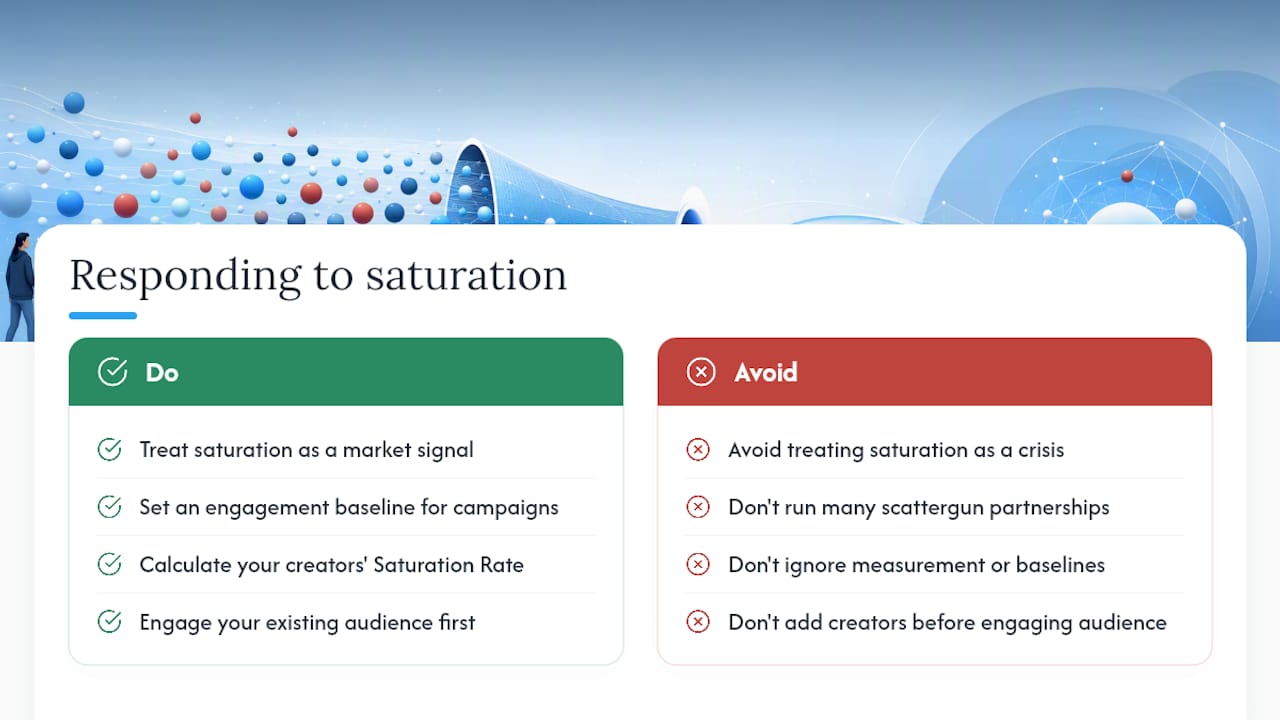
Getting your existing audience engaged before you add more creators to the mix tends to make every subsequent partnership perform better, because a visibly active profile gives new followers a reason to trust what they’re seeing. If you’re weighing up a smaller, more selective creator pilot, it’s worth pairing that with a social media growth strategy built for small businesses so your own channels aren’t the weak link in the campaign.
Sources
- Consumers Are Fatigued, Influencers Are Burnt Out. What Now? | Vogue
- Study on social media influencer over-endorsement and consumer purchase intentions | ScienceDirect
- How excess sponsorships affect influencer marketing and what advertisers can do | Forbes
- Influencer saturation is weakening brand trust | Kadence
- Marketing briefing: saturation and cost concerns push brands to concentrate influencer spend | Digiday
FAQ
What does influencer saturation mean in simple terms?
It means a niche has so much similar sponsored content that audiences tune it out, causing engagement and campaign returns to drop.
How do you calculate the Saturation Rate?
Does influencer saturation affect small businesses more than large brands?
Yes, generally, because small businesses have less budget to absorb rising CPM and CPA, and less brand recognition to fall back on when a creator relationship underperforms.
What is the “human premium” in influencer marketing?
It’s the industry term for audiences rewarding creators who share lived experience and relevant expertise over polished, generic sponsored content, as described by researchers at Mintel and Kantar.