
Influencer reach is the count of unique accounts that have seen a specific piece of content at least once. Not how many times it appeared on screens. Not how many people follow the creator. Just the number of distinct individuals who actually saw it, and that single distinction changes how you read almost every campaign report you will ever encounter.
What does influencer reach mean, exactly?
Reach counts unique people, full stop. If one person scrolls past a post three times in a single day, that registers as one in the reach figure and three in impressions. The difference sounds minor until you are comparing two campaigns and one has been shown repeatedly to the same small group.
Each major platform labels the metric slightly differently, though the underlying concept is consistent:
- Instagram: Accounts Reached
- TikTok: Reach
- YouTube: Unique Viewers
- Facebook: Reach (split into organic, paid, and viral)
Two other figures sit alongside reach in most dashboards. Frequency tells you how many times, on average, each person saw the content. Effective Frequency is the sweet spot, and professionals target a moderate number of exposures per person per week for awareness campaigns. Go below that and the message may not register; go above it and you are burning budget on the same faces.
How does reach differ from impressions and follower count?

These three metrics are routinely confused, and conflating them leads to poor decisions.

| Metric | Definition | Counting method | Typical use case |
|---|---|---|---|
| Reach | Unique individuals who saw the content | Each person counted once | Measuring true audience exposure |
| Impressions | Total times content was displayed | Every view counted, including repeats | Gauging content frequency and visibility |
| Follower count | Total accounts subscribed to a creator | Static snapshot | Estimating potential audience size |
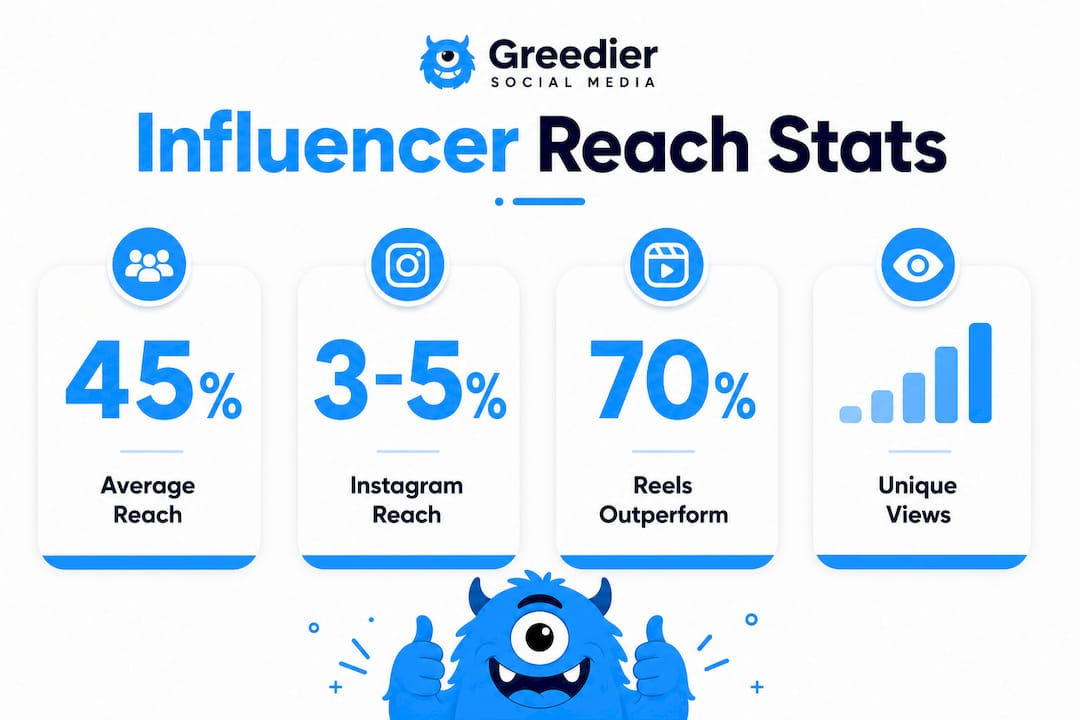
Follower count is potential, not reality. Actual reach is almost always lower than follower count because algorithms filter content, inactive followers never see posts, and timing affects distribution. Organic reach on Instagram is generally 3–5% of follower counts, which means a brand relying on follower numbers to estimate campaign exposure will consistently overestimate its actual audience. That overestimation affects budget decisions, creator selection, and post-campaign reporting.
Reach also reframes how you evaluate influencer tiers. Smaller nano and micro-influencers tend to generate higher-quality reach because their audiences are more genuinely connected to them. Raw reach numbers favour mega-influencers, but the proportion of that reach that is attentive and relevant often favours smaller creators. For UK brands working with tighter budgets, that distinction shapes where spend goes.
Reach alone does not close sales. It is an awareness metric and works best when paired with strong calls to action and engagement metrics to assess real campaign impact. Treating reach as a sales metric leads to disappointment; treating it as the starting point for a conversion funnel is accurate.
Pro Tip: When briefing influencers, ask for post-campaign screenshots from their native platform dashboards, not estimated or projected figures. Instagram Insights, TikTok Analytics, and YouTube Studio all show actual reach, and those numbers are the only ones worth putting in a report.
How to interpret reach data and improve it
Reading reach figures accurately requires understanding a few pitfalls that inflate or distort the numbers.
The most common problem is adding reach across platforms without deduplication. If a campaign runs on Instagram, TikTok, and YouTube simultaneously, the same person may appear in all three reach totals. Raw reach added across platforms inflates actual audience size due to overlap, and the professional solution is Net Unique Reach (NUR), which counts each person once regardless of how many platforms they encountered the content on.
CP1K-U (Cost per 1,000 Net Unique Reach) is a more honest efficiency metric than standard CPM because it reflects the cost of reaching genuinely different people, not the cost of accumulating views that may include the same individuals repeatedly. For UK brands comparing creator performance across a multi-platform campaign, CP1K-U levels the playing field.
Practical steps to improve reach:
- Post when your specific audience is most active, using platform analytics rather than generic advice
- Prioritise formats the algorithm currently favours (short-form video on Instagram and TikTok, long-form on YouTube)
- Encourage shares and saves, since both signal quality to algorithms and extend content to new audiences
- Use relevant hashtags and location tags to surface content to non-followers
- Build organic reach strategies that compound over time rather than relying on one-off spikes
- For cross-platform campaigns, track NUR rather than summed platform totals to avoid inflated figures
How to accurately measure influencer reach
Accurate measurement starts with the right data source. Post-campaign analytics from influencers’ native dashboards give authentic reach figures rather than theoretical estimates based on follower counts. Always request these screenshots or exports before signing off on a campaign report.
Platform-native tools each offer reach data in slightly different formats. Instagram Insights shows Accounts Reached broken down by follower and non-follower. TikTok Analytics reports Reach directly in the post performance tab. YouTube Studio provides Unique Viewers as the closest equivalent. Facebook’s Page Insights separates organic, paid, and viral reach, which is useful for understanding how content spread beyond the initial audience.
For campaigns spanning multiple creators or platforms, third-party analytics tools can aggregate data and apply deduplication. The key output to request is Net Unique Reach rather than a summed total. Without deduplication, a campaign reaching the same 50,000 people across three platforms looks like 150,000 on paper. Understanding how to measure social media growth accurately is what separates credible reporting from inflated vanity numbers.
Engagement rate calculated against reach, rather than follower count, gives a cleaner read of content quality. The formula is straightforward: total engagements divided by reach, multiplied by 100. A Facebook post receiving 280 interactions from 10,000 unique viewers produces a 2.8% reach-based engagement rate. That figure tells you how the content landed with people who actually saw it, which is the question that matters for creative decisions.
What factors affect influencer reach?
Algorithm behaviour is the single biggest variable. Both Instagram and TikTok have shifted from connection-based distribution (showing content to followers) toward interest-based discovery (showing content to anyone whose behaviour suggests they would engage with it). That shift means a creator with 20,000 followers can reach 200,000 people on a strong post, and a creator with 500,000 followers might reach only 25,000 on a weak one.
Content format drives significant reach differences across platforms. Reels consistently outperform static posts on Instagram reach. On TikTok, the For You Page (FYP) algorithm can distribute content far beyond the creator’s follower base when early engagement signals are strong. YouTube’s recommendation engine rewards watch time and click-through rate, so reach on that platform correlates more with content quality than subscriber count.
Audience engagement quality feeds back into reach. Posts that generate quick likes, comments, and shares in the first hour signal to the algorithm that the content is worth distributing further. This is why follower quality matters more than quantity: an engaged audience of 10,000 will often produce better reach than a disengaged audience of 100,000. For brands exploring influencer partnerships, this dynamic is worth building into creator selection criteria from the outset.
Timing, posting frequency, and even caption length all play secondary roles. None of them override algorithm quality signals, but they can nudge distribution at the margins. Consistent posting schedules tend to build algorithmic trust over time, which gradually lifts baseline reach.
How Greediersocialmedia can help you grow your reach
Reach without a growth plan behind it stays flat. Greediersocialmedia has been helping UK businesses and creators build genuine social media presence since 2013, supporting over a million users with real followers, likes, and views across Instagram, Facebook, and beyond. No passwords required, no inflated vanity metrics.
If you want to turn reach data into actual audience growth, the social media growth tactics at Greediersocialmedia are built around authentic engagement, the kind that algorithms reward with wider distribution. That is how reach compounds rather than stalls.
Key takeaways
Influencer reach counts unique individuals exposed to content, making it the most accurate measure of true audience exposure in any campaign.
| Point | Details |
|---|---|
| Reach vs impressions | Reach counts each person once; impressions count every view, including repeats by the same person. |
| Follower count is not reach | Organic reach on Instagram averages just 3–5% of follower counts, so follower numbers overstate real exposure. |
| Net Unique Reach matters | Adding platform reach figures without deduplication inflates audience size; NUR counts each person once across all channels. |
| CP1K-U for efficiency | Cost per 1,000 Net Unique Reach is a more honest efficiency metric than CPM for cross-platform campaigns. |
| Measure from native dashboards | Request post-campaign analytics from Instagram Insights, TikTok Analytics, or YouTube Studio for accurate reach data. |
FAQ
What does “reach” mean in social media?
Reach is the number of unique users who saw a piece of content at least once during a given period. Each person is counted once, regardless of how many times they viewed it.
Is reach the same as followers?
No. Follower count is the potential audience; reach is the actual audience. Actual reach is lower than follower count due to algorithmic filtering and inactive accounts.
What is a good reach on Instagram?
There is no single benchmark, but Instagram organic reach averages 3–5% of follower counts. A post reaching above that range is performing well organically.
Which is better, views or reach?
Reach is generally more useful for awareness campaigns because it counts unique people. Views (or impressions) tell you frequency, which matters for understanding how often your message landed with the same individuals.
How do reach and engagement rate connect?
Calculating engagement rate against reach rather than followers gives a cleaner measure of content quality, because it reflects how the audience that actually saw the content responded to it.