
Knowing what does follower growth rate mean helps you judge progress beyond raw follower counts.
TL;DR:
- Follower growth rate measures how quickly an account’s followers change over time relative to its initial count, serving as a key indicator of audience momentum. Tracking net growth provides a clearer picture of genuine audience expansion by accounting for unfollows, while consistent measurement helps evaluate content and campaign effectiveness. A healthy growth rate is around 1–2% monthly for established accounts, emphasizing patience and long-term consistency over viral spikes.
Follower growth rate is defined as the percentage change in an account’s followers over a set period, calculated relative to the starting follower count for fair comparison across accounts of any size. Hootsuite describes it as how quickly a profile gains or loses followers, making it one of the clearest indicators of audience momentum on platforms like Instagram, TikTok, and LinkedIn. Unlike raw follower counts, this metric normalises performance by starting audience size, so a creator with 2,000 followers and a creator with 200,000 can be compared meaningfully. Tools like Hootsuite and Advergize both treat it as a core awareness metric rather than a vanity number.
What does follower growth rate mean for your strategy?
Follower growth rate measures the speed and direction of your audience expansion as a percentage, not an absolute number. The standard follower growth definition separates it from total follower count precisely because percentage change accounts for scale. A brand gaining 500 followers from a base of 1,000 is growing far faster than one gaining 500 from a base of 500,000. Advergize emphasises that this comparative advantage makes the metric more actionable than raw counts when evaluating campaign performance or benchmarking against competitors.

The metric also captures direction. A negative growth rate tells you that unfollows are outpacing new followers, which is a signal worth investigating before it compounds. Tracking this figure weekly or monthly gives you a reliable read on whether your content strategy is building momentum or losing it.
How to calculate follower growth rate accurately
The standard formula is straightforward and consistent across platforms.
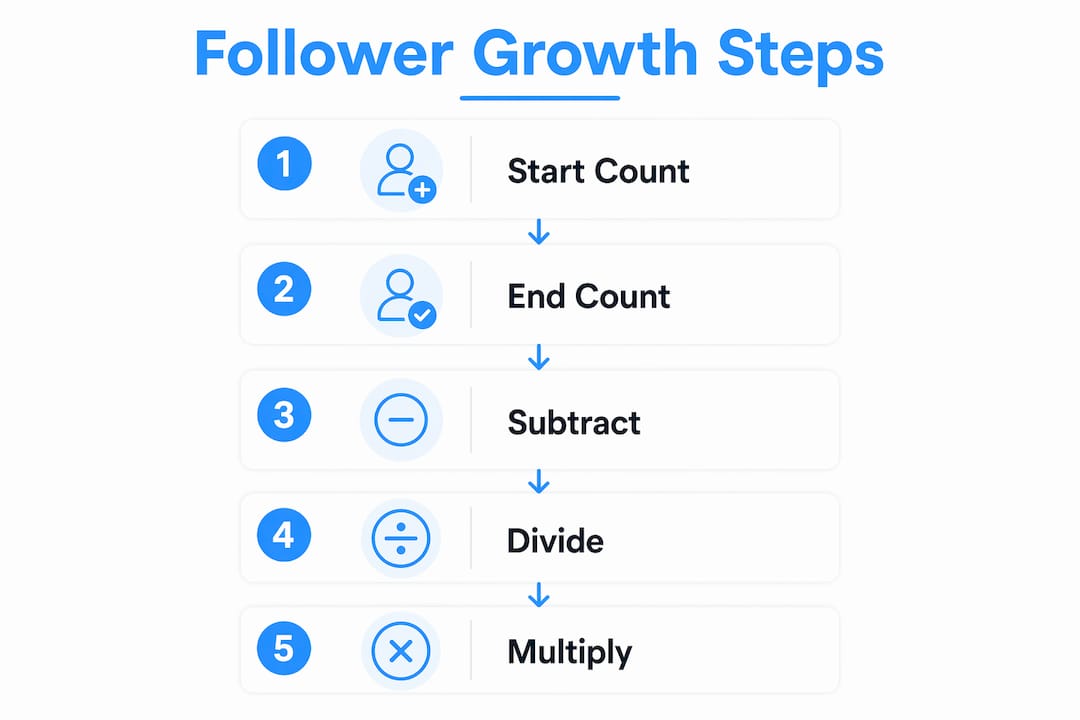
- Record your starting follower count at the beginning of the period (e.g., 1 january).
- Record your ending follower count at the close of the same period (e.g., 31 january).
- Apply the formula: ((End followers − Start followers) ÷ Start followers) × 100.
- For net follower growth, replace the raw gain with (new followers gained − followers lost) to get a cleaner picture of true audience expansion.
Here is a worked example. You start the month with 4,000 followers and end with 4,200. The calculation is ((4,200 − 4,000) ÷ 4,000) × 100, which gives a 5% monthly growth rate. Now apply the net version: if you gained 300 new followers but lost 100, your net gain is 200. The net growth rate is ((200) ÷ 4,000) × 100, giving 5% gross but only 5% net if you use the same base. The difference matters because gross figures can mask a churn problem hiding beneath the surface.
Net follower growth is crucial to understanding true audience expansion, as gross increases alone can be misleading. A profile that gains 1,000 followers but loses 900 in the same period has a very different story to tell than its gross number suggests.
Choosing your reporting window is equally important. Consistent tracking over defined periods is essential because strategies can appear differently in short-term spikes versus longer trends. A viral post might inflate a weekly figure dramatically, making monthly tracking a more reliable baseline for most accounts.
Pro Tip: Always capture your follower count at the same time of day on the same day of the week. Platform data refreshes at different intervals, and consistent timing reduces noise so you can attribute changes to specific campaigns rather than data lag.
Why follower growth rate matters beyond vanity metrics
The importance of follower growth extends well beyond a number to show off. Used correctly, it functions as a diagnostic tool for your entire content strategy.
- Content resonance signal. Rising growth rate confirms your content is reaching and converting new viewers. A plateau or decline points to a content or distribution problem worth addressing.
- Engagement mismatch detector. Rising growth but low engagement can reveal a follower-audience mismatch, meaning you are attracting people who do not connect with your content after following. This is a common sign of misaligned hashtag targeting or paid promotion reaching the wrong demographic.
- Campaign effectiveness indicator. Tracking growth rate before, during, and after a campaign tells you whether it actually expanded your audience or simply generated temporary impressions.
- Business outcome proxy. Paired with link click data and conversion tracking, follower growth rate helps you connect audience expansion to commercial results rather than treating them as separate concerns.
“Follower growth rate helps indicate if Instagram marketing campaigns are effective beyond vanity metrics, especially when paired with net growth and business outcome metrics.” — Hootsuite
A good Instagram follower growth rate benchmark sits at around 1–2% monthly for established accounts. That figure sounds modest, but compounded over 12 months it represents meaningful audience expansion. Chasing higher numbers without monitoring engagement quality is where many social media managers go wrong.
What is a good growth rate by platform and account size?
Benchmarks differ significantly depending on where you are posting, how large your account already is, and whether you operate in B2B or B2C markets.
| Platform | Account Stage | Typical Monthly Growth Rate |
|---|---|---|
| Established brand | 1–2% | |
| New or viral account | 10–30% | |
| TikTok | Growing creator | 5–15% |
| B2B brand | 0.5–1.5% | |
| Established page | 0.5–1% |
Smaller accounts naturally show higher percentage growth because the maths favours them. Gaining 100 followers on a 500-follower account is a 20% growth rate. The same 100 followers on a 50,000-follower account is 0.2%. Neither figure is inherently better. Context determines meaning.
B2B accounts on LinkedIn grow more slowly than B2C accounts on Instagram because the addressable audience is smaller and the buying cycle is longer. Expecting LinkedIn growth to mirror TikTok figures is a category error. When analysing social media growth across platforms, always benchmark against accounts in the same niche and at a similar follower scale, not against the platform average.
Viral or new accounts can sustain 10–30% monthly growth for short bursts, but this almost always normalises over time. Treating a viral spike as your new baseline leads to unrealistic targets and demoralising performance reviews.
How to use follower growth rate to improve your content
Knowing how to improve follower rate requires more than tracking the number. It requires building a monitoring system that connects growth data to decisions.
- Combine growth rate with engagement rate. A rising growth rate alongside a stable or rising engagement rate confirms genuine audience quality. If engagement drops as growth rises, investigate the source of new followers.
- Set goals using compounding assumptions. Compounding growth projections provide more realistic follower milestone estimates than linear ones. If you grow at 2% monthly, you do not simply add the same number each month. You add 2% of a larger base, which accelerates progress over time.
- Watch for algorithmic timing effects. Platform algorithm updates on Instagram and TikTok can cause sudden drops or spikes in follower counts that have nothing to do with your content. Cross-reference growth data with known platform updates before drawing conclusions.
- Prioritise sustainable growth over spikes. A single viral post can inflate your monthly figure dramatically, but if those new followers do not engage, they dilute your engagement rate and can hurt algorithmic reach over time.
- Assess follower quality alongside growth rate. An account with 10,000 highly engaged followers outperforms one with 100,000 passive ones in almost every commercial metric that matters.
Pro Tip: Set a monthly review where you record gross growth, net growth, engagement rate, and reach in a single spreadsheet. Patterns become visible over three to four months that are invisible in weekly snapshots.
Common misconceptions about follower growth rate
Several persistent errors undermine how social media managers interpret this metric.
- Confusing gross and net growth. Gross follower count rises whenever anyone follows you. Net growth subtracts unfollows. Reporting only gross figures makes an account look healthier than it is.
- Treating rapid growth as automatic success. Fast growth driven by a giveaway, a controversial post, or a paid campaign that targets the wrong audience can actively harm long-term performance by flooding your account with disengaged followers.
- Ignoring fake or inactive followers. Purchased fake followers inflate gross counts but contribute zero engagement. Over time, they suppress your engagement rate and signal poor content quality to platform algorithms.
- Isolating follower growth from other metrics. No single metric tells the full story. Growth rate combined with reach, engagement rate, and conversion data gives a far more accurate picture of account health than any figure in isolation.
- Assuming platform counts are always accurate. Instagram and TikTok periodically purge inactive or spam accounts, which can cause sudden drops in follower count that look alarming but actually improve the quality of your remaining audience.
Key takeaways
Follower growth rate is the single most comparable metric for measuring audience momentum across accounts of different sizes, but it only delivers value when tracked consistently alongside engagement and net growth data.
| Point | Details |
|---|---|
| Standard follower growth definition | Percentage change in followers over a period, divided by the starting count for fair comparison. |
| Net vs gross growth | Always track net growth to account for unfollows and get an accurate picture of audience expansion. |
| Good growth rate benchmarks | Around 1–2% monthly for established Instagram accounts; higher rates are typical for new or viral profiles. |
| Compounding projections | Use compound growth models rather than linear estimates to set realistic follower milestones. |
| Multi-metric analysis | Combine follower growth rate with engagement rate and reach to assess true content performance. |
The metric that rewards patience
I have tracked follower growth rates across dozens of accounts over the years, and the pattern that surprises most social media managers is this: the accounts with the most consistent long-term growth are rarely the ones with the most dramatic monthly spikes. They are the ones where net growth stays positive every single month, even modestly.
The obsession with viral moments is understandable. A post that doubles your follower count overnight feels like a breakthrough. But I have watched accounts gain 10,000 followers from a viral reel and then lose 6,000 of them within three weeks because the content that went viral had nothing to do with what the account normally publishes. The net result is a distorted audience and a suppressed engagement rate.
What I find most practitioners overlook is the relationship between growth rate and content consistency. Accounts that post on a reliable schedule, in a consistent niche, with a recognisable voice tend to show steady 1–3% monthly growth that compounds into something genuinely significant over 12 to 18 months. That is not a flashy story to tell in a quarterly review, but it is the one that actually builds a brand. Track your net growth, set compounding targets, and resist the temptation to treat a spike as a strategy.
— Luna
How Greediersocialmedia can accelerate your growth
Understanding your follower growth rate is the first step. Acting on it is where Greediersocialmedia comes in. Since 2013, Greediersocialmedia has helped over a million UK clients build authentic audiences on Instagram, Facebook, and beyond, without requiring passwords or compromising account security.

Whether you are a content creator looking to establish credibility or a business aiming to convert audience size into commercial results, Greediersocialmedia’s tailored packages are built around real engagement, not inflated numbers. Explore the social media growth packages designed to deliver sustainable follower growth that holds up under scrutiny, or browse the growth tactics guide for practical strategies you can apply immediately.
FAQ
What is the follower growth rate formula?
The standard formula is ((end followers − start followers) ÷ start followers) × 100. For net growth, replace the raw gain with new followers minus unfollows before dividing.
What is a good monthly follower growth rate on instagram?
A good Instagram follower growth rate is around 1–2% monthly for established accounts, according to Hootsuite. New or viral accounts can see 10–30% in short bursts, but this typically normalises over time.
How does net follower growth differ from gross growth?
Gross growth counts every new follower gained. Net growth subtracts unfollows from that total, giving a more accurate measure of true audience expansion and revealing hidden churn.
How often should i calculate my follower growth rate?
Monthly tracking suits most accounts because it smooths out short-term spikes from individual posts. Weekly tracking is useful during active campaigns, provided you capture data at the same time each week to reduce platform data noise.
Why does follower growth rate matter more than total follower count?
Follower growth rate normalises performance by starting audience size, making it comparable across accounts of different scales. A 5% growth rate means the same thing whether your account has 1,000 or 100,000 followers, whereas raw counts do not offer that context.