
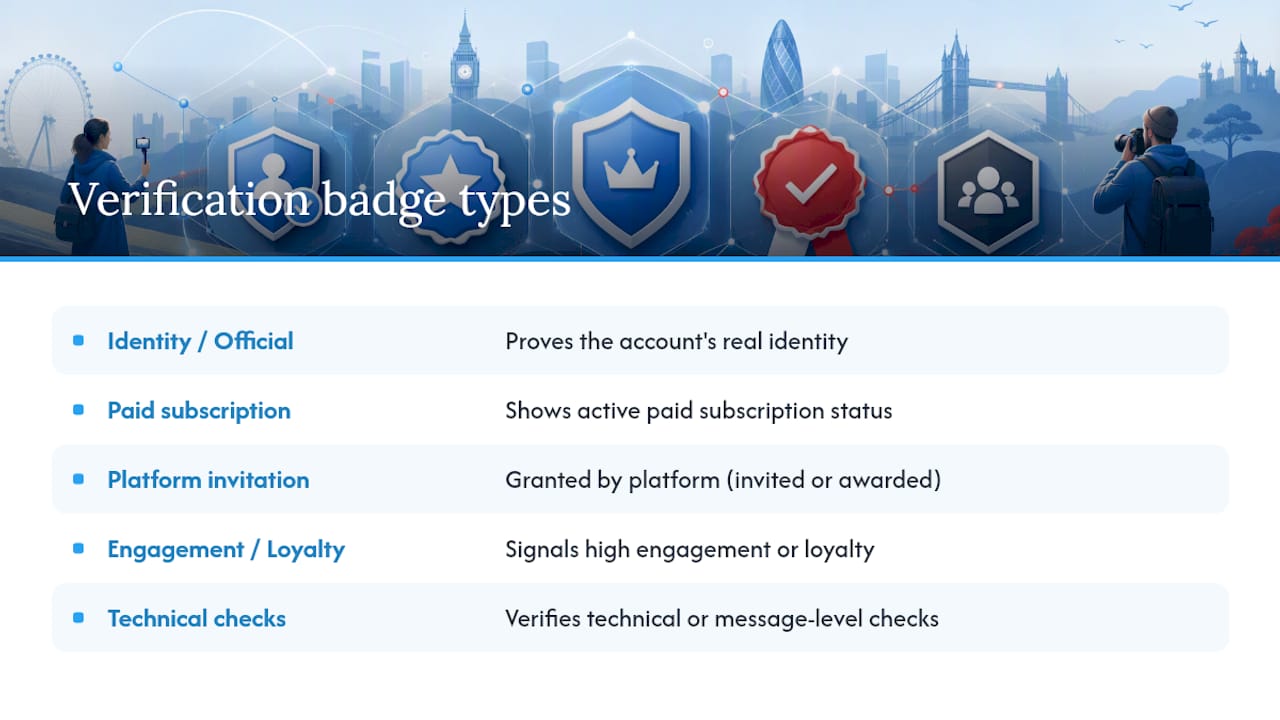
Verification badges are visual authenticity signals that confirm an account belongs to who it claims to be. They are not platform endorsements. The main types of influencer verification badges break into five categories: identity/official badges (editorial checks confirming real identity), paid-subscription badges (tied to a monthly fee plus ID), platform-invitation or award badges (invite-only programmes for creators), engagement and loyalty badges (Top Fan, moderator, subscriber milestones), and technical message-level checks (Gmail BIMI/VMC, computed per message rather than per profile). For UK creators, the most consequential badge depends on your goal: an identity badge builds credibility with brands and press, while an engagement badge builds community loyalty.
- Identity/official badges: editorial verification confirming who you are (blue or gold ticks on Instagram, X, LinkedIn)
- Paid-subscription badges: a monthly subscription plus government ID (Meta Verified, X Premium)
- Platform-invitation/award badges: invite-only creator programmes (TikTok Creator Marketplace, YouTube Official Artist Channel)
- Engagement and loyalty badges: community-facing signals (Facebook Top Fan, Twitch subscriber loyalty badges, moderator roles)
- Technical/message-level checks: per-message verification (Gmail BIMI, Verified Mark Certificate) rather than a persistent profile icon
Types Of Influencer Verification Badges: Key Takeaways
Verification badges confirm identity, not quality, and the type of badge you pursue should match your specific credibility goal as a UK creator.
| Point | Details |
|---|---|
| Five badge types exist | Identity, paid-subscription, invitation/award, engagement/loyalty, and technical message-level checks each prove something different. |
| Badge ≠ endorsement | Platforms confirm who you are, not whether your content is trustworthy or high quality. |
| Editorial beats paid for brand trust | Legacy editorial badges carry more weight with brand managers than paid-subscription badges on most platforms. |
| Engagement signals come first | Building genuine community engagement before applying for identity verification strengthens your editorial application. |
| Greediersocialmedia supports the foundation | UK creators can use Greediersocialmedia’s authentic engagement services to build the activity signals platforms evaluate before a verification review. |
Table of Contents
- What a verification badge is and why it matters more in 2026
- The five types of social media verification badges explained
- Platform-by-platform badge guide for UK creators in 2026
- How to get verified on the major platforms: a UK checklist
- What a verification badge actually changes for your account
- Common misconceptions, scams, and compliance notes for UK users
- Identity badges versus engagement badges: how to use both strategically
- Verification in 2026 is more layered than most creators realise
- Build your credibility before the badge arrives
- Sources
- FAQ
What a verification badge is and why it matters more in 2026
A verification badge started life as a simple editorial promise: a platform’s way of saying “this account is who it claims to be.” It was never meant to signal quality, influence, or trustworthiness in any deeper sense. Account verification began as editorial checks for public figures, with Twitter introducing the concept in 2009, and has since evolved into a patchwork of paid subscriptions, technical flows, and invitation-only programmes.
The timeline matters. Early verification was purely editorial: a journalist, politician, or celebrity submitted a request, a human reviewed it, and a badge appeared. By the mid-2010s, platforms expanded eligibility to brands, athletes, and creators. Then came the pivot: X moved its blue check to a paid model in 2022, and Meta followed with Meta Verified as a subscription product. By 2026, the model is genuinely hybrid. You can earn a badge through editorial review, pay for one via subscription, receive one through an invitation programme, or in Facebook’s case, verify your identity through a short video selfie at no cost.
Why does this matter for UK creators specifically? Because the badge you pursue signals different things to different audiences. A brand manager vetting an influencer for a campaign reads a legacy editorial badge differently from a paid-subscription badge. Knowing which track you are on, and what it actually proves, is the difference between using verification strategically and treating it as a vanity metric.
Pro Tip: Before applying for any badge, map out what you actually need it to do. If your goal is press credibility, pursue editorial verification and build your citation trail first. If your goal is impersonation protection on Instagram, Meta Verified’s paid track may be the faster route.
Verification is a signal about identity, not a signal about quality. A verified account can post misinformation; an unverified account can be the most authoritative voice in a niche. The badge tells you who, not how good.
The five types of social media verification badges explained
Understanding the taxonomy of badge types lets you recognise what each one actually proves when you see it on a profile.
Identity/official badges
These are the original verification badges: editorial checks carried out by the platform to confirm that an account genuinely belongs to the person or organisation it represents. They typically appear as a blue or white tick inside a coloured circle, placed next to the account name. Instagram’s legacy blue tick, X’s gold tick for organisations, and LinkedIn’s verified identity badge all fall here. The platform is asserting: “We have checked this person’s identity.” Verification approaches vary by platform, but the common thread is that identity badges signal authenticity rather than a quality endorsement.

Paid-subscription badges
These emerged from the 2022–2024 platform monetisation wave. You pay a monthly subscription, submit a government-issued ID, and receive a badge. Meta Verified and X Premium are the clearest examples. The badge looks similar to an editorial one on the surface, though X distinguishes between its gold (organisation) and blue (individual subscriber) ticks. The key difference from editorial verification: the platform is confirming you are a real person who has paid and passed an ID check, not that you are notable.
Platform-invitation/award badges
Some badges are neither earned through an application nor purchased. TikTok’s creator programme badges and YouTube’s Official Artist Channel designation are awarded by the platform based on content quality, audience size, or a direct invitation. These tend to carry more weight with brands precisely because they cannot be bought.
Engagement and loyalty badges
These are community-facing rather than identity-facing. Facebook’s Top Fan badge rewards the most active commenters and reactors on a Page. Twitch’s subscriber loyalty badges change appearance as a viewer accumulates months of consecutive subscription. Moderator badges signal a community role. Facebook group and page badges function differently from identity verification: a Top Fan badge tells the community “this person is highly engaged here,” not “this person’s identity has been checked.”
Technical/message-level checks
This category sits outside social media profiles entirely but is worth understanding for any creator or brand working with email marketing. A verified profile badge and a message-level verification check serve different technical purposes: profile badges are a persistent account-level signal, while Gmail’s BIMI/VMC system computes verification per message and depends on DMARC, SPF, and DKIM authentication. A Verified Mark Certificate (VMC) lets your brand logo appear in Gmail inboxes next to your emails. It is not a social media badge, but it is part of the same broader authenticity infrastructure.
Statistic callout: LinkedIn’s attribute-level verification uses third-party providers including CLEAR and Persona to issue separate small badges for verified identity, workplace, and education, rather than a single universal tick.
Platform-by-platform badge guide for UK creators in 2026
Meta: Instagram and Facebook
Meta runs two parallel tracks. The legacy editorial badge still exists for public figures, journalists, and brands that meet Meta’s notability criteria: you apply through the app, submit a government ID, and wait for a human review. Separately, Meta Verified is a subscription product that verifies identity via government ID and offers tiered business plans. The subscription badge appears on both Instagram and Facebook and comes with additional features including impersonation protection and direct support access.
Facebook added a third option in July 2026: a free Facebook Verified badge that uses a short video selfie checked against your profile photos. It requires users to be 18 or over and in good standing with Community Standards. The badge appears across Marketplace, Dating, Groups, and Profile. Notably, it is not available for Pages or ProMode accounts.
X (formerly Twitter)
X moved its blue check to a paid model in 2022. Today, the blue tick on X signals an X Premium subscriber who has passed an ID check, not editorial notability. Gold ticks are reserved for verified organisations, and grey ticks appear on government accounts. If you are a UK creator buying Twitter followers to build initial social proof, note that the blue tick itself requires an active X Premium subscription regardless of follower count.
TikTok
TikTok’s verification remains largely editorial and invite-only. There is no mass paid verification track as of 2026. A blue tick on TikTok indicates the platform has confirmed the account belongs to a notable creator, brand, or public figure. Creator programme badges are awarded separately through TikTok’s creator marketplace and are not the same as the identity verification tick.
YouTube
YouTube ties its verification badge to channel size and application. Channels that reach a significant subscriber count may apply, but meeting that threshold does not guarantee approval. A separate Official Artist Channel badge exists for musicians, awarded through a distributor or label relationship with YouTube. The standard verification badge appears as a grey tick next to the channel name; the Official Artist badge appears as a music note icon.
LinkedIn uses attribute-level verification via third-party providers. Rather than one universal tick, it issues small separate badges for verified identity, verified workplace, and verified education. Identity verification uses providers such as CLEAR or Persona and requires a government ID. Workplace verification links to a company email address. These badges appear on your profile card and are visible to anyone who views your profile.
Twitch, Snapchat, and Pinterest
Twitch’s verified badge (a purple tick) is editorial and invite-only, reserved for established streamers. Separately, Twitch’s subscriber loyalty badges are engagement signals: they change appearance at 3, 6, 9, and 12 months of consecutive subscription and are visible in chat. Snapchat’s Official Account badge (a gold star) confirms a public figure or brand. Pinterest’s verified merchant badge confirms a business account meets its merchant standards, while a separate verified account badge confirms identity for notable accounts.
Pro Tip: When planning which badge to pursue first, prioritise the platform where your audience is most active and where brand partnerships are most likely to originate. For most UK lifestyle and fashion creators, that is Instagram. For gaming creators, Twitch’s editorial verification carries more weight with sponsors than a paid badge elsewhere.
How to get verified on the major platforms: a UK checklist
Getting verified is less about luck and more about building the right signals before you apply. Here is what to prepare.
General preparation (all platforms)
- Confirm your profile is complete: professional photo, full bio, website link, and consistent name across all platforms.
- Gather identity documents: a UK passport, driving licence, or national identity card. Most platforms accept these.
- Build a citation trail: press mentions, interviews, podcast appearances, and Wikipedia entries all strengthen an editorial application. Google yourself before applying.
- Cross-link your accounts: your Instagram bio should link to your website, which should link back to your social profiles.
- Check for existing impersonation: report any fake accounts before applying, as platforms look more favourably on applications where impersonation is a documented risk.
Platform-specific steps
Meta (Instagram and Facebook editorial badge):
- Go to Settings > Account > Request Verification.
- Submit your full legal name, account category (creator, journalist, brand), and a copy of your government ID.
- Add supporting links: press articles, Wikipedia, or official website.
- Review typically takes up to 30 days. There is no fee for the editorial track.
Meta Verified (paid subscription):
- Available via Settings on Instagram or Facebook.
- Submit a government ID and a selfie for matching.
- Subscription pricing is not publicly fixed and varies; check the Meta Verified page for current UK pricing.
Facebook Verified (free selfie flow):
- Available to personal profiles aged 18+.
- Complete a short video selfie in the app; Meta matches it against your profile photos.
- No fee, but not available for Pages or ProMode accounts.
X Premium (blue tick):
- Subscribe to X Premium via the app or web.
- Submit a government ID when prompted for ID verification.
- The blue tick appears once the subscription is active and ID is confirmed.
YouTube:
- Reach 100,000 subscribers, then go to youtube.com/verify.
- Submit your phone number for a verification code.
- For the Official Artist Channel, contact your music distributor or label to initiate the process with YouTube directly.
LinkedIn:
- Go to your profile and select “Verify” next to your name or workplace.
- Follow the prompts for CLEAR or Persona identity verification using a government ID.
- Workplace verification requires access to a company email address.
TikTok:
- No public application form for the blue tick. Build notability: press coverage, cross-platform presence, and consistent content output are the signals TikTok’s editorial team evaluates.
- Apply through TikTok’s creator marketplace for programme-level badges.
Pro Tip: The single strongest signal for editorial verification on any platform is third-party press coverage that you did not pay for. A profile mentioned in The Guardian, BBC News, or a major trade publication carries more weight than 500,000 followers with no external citations.
What a verification badge actually changes for your account
A badge is not a magic switch. The realistic benefits are narrower than most creators expect, and the limits are worth knowing before you invest time in the process.
The clearest benefit is impersonation protection. A verified account makes it harder for bad actors to convincingly clone your identity, and most platforms prioritise removing fake accounts that impersonate verified users. For UK creators working with brands, this matters: a brand manager who spots two accounts with your name will trust the verified one.
Discovery advantages exist but are modest. Some platforms give verified accounts a slight boost in search results or recommendation feeds, though none publish the exact weighting. The role of followers in credibility is often more significant for algorithmic reach than the badge itself.
Feature access is the most concrete benefit. Meta Verified subscribers get direct customer support, which is genuinely valuable when an account is hacked or wrongly restricted. X Premium subscribers get longer posts, reduced ads, and reply prioritisation. These are tangible, not just symbolic.
What a badge does not do: it does not guarantee reach, it does not improve content quality, and it does not prevent all abuse. A verified account can still be reported, restricted, or have its badge revoked. Platforms including Meta and X have revoked badges for policy violations, account inactivity, or changes in the account’s public status. If your badge is removed, the appeal route is through the platform’s official help centre; keep documentation of your original verification submission as it speeds up the process.
Metrics worth tracking after verification: profile visit rate, direct message enquiry volume from brands, and campaign click-through rates on sponsored content. These give you a cleaner read on whether the badge is shifting behaviour than raw follower counts.
Common misconceptions, scams, and compliance notes for UK users
The most persistent misconception about verification badges is that they represent a platform’s endorsement of your content or opinions. They do not. Verification badges are primarily authenticity signals rather than platform endorsements: a blue tick confirms identity, nothing more. A verified account spreading false information is still spreading false information.
Scams targeting creators seeking verification are common and worth knowing in detail:
- Fake verification services: third-party sites offering to “get you verified” for a fee. No legitimate service can guarantee a platform badge. Any site claiming otherwise is either fraudulent or selling something the platform will eventually revoke.
- Password requests: no platform verification process requires your account password. Any “verification service” asking for login credentials is attempting to steal your account.
- Impersonation offers: messages claiming to be from a platform’s “verification team” asking you to click a link or pay a fee. Platforms communicate through in-app notifications and official email domains only.
- Paid badge reselling: some accounts claim to sell verified accounts. Buying an account violates platform terms of service and risks permanent suspension.
For UK influencers, the Advertising Standards Authority (ASA) and the Competition and Markets Authority (CMA) require clear disclosure of paid partnerships regardless of whether an account is verified. A verification badge does not change your disclosure obligations under the ASA’s influencer guidance. Label paid posts with #ad or equivalent, verified or not.
A verification badge tells your audience who you are. It does not tell them whether to trust what you say. That trust is built through consistent, honest content over time, not through a tick next to your name.
Pro Tip: If you receive an unsolicited message offering to verify your account, report it through the platform’s official reporting tool immediately. Screenshot the message first. Platforms use these reports to identify and remove scam accounts.
For spotting fake engagement in influencer marketing more broadly, the same scepticism applies: if an offer sounds too easy, it almost certainly violates platform policies.
Identity badges versus engagement badges: how to use both strategically
The distinction between identity badges and engagement badges is not just taxonomic. It has real implications for how you build credibility over time.
An identity badge answers the question “is this account real?” An engagement badge answers “does this community value this person?” Both matter, but they matter to different audiences. A brand running a campaign wants identity verification as a baseline trust signal. A community manager building a loyal audience cares more about Top Fan badges and subscriber milestones because they signal that real people are actively invested.
A mature credibility strategy layers identity verification with engagement rewards. Identity badges give legitimacy; engagement badges reward and retain active followers. Neither alone is sufficient for a creator building long-term authority.
The practical sequence for UK creators:
- Build engagement signals first: consistent posting, genuine replies, and content that earns shares and saves. Platforms evaluate these signals when reviewing editorial verification applications.
- Pursue engagement badges on the platforms where your community is most active. A Twitch subscriber loyalty badge or a Facebook Top Fan badge tells your audience that their participation is recognised.
- Apply for identity verification once your citation trail is strong enough. For most UK creators, that means at least a handful of press mentions, a Wikipedia entry or equivalent, and a consistent cross-platform presence.
- Layer the signals: a creator with a verified identity badge, strong engagement metrics, and a documented press presence is far more compelling to a brand than one with only a blue tick.
Influencer trust signals on Instagram extend well beyond the badge itself: engagement rate, comment quality, and story reply rates all feed into how brands and algorithms assess your account. The badge is the door; the engagement is what keeps it open.
For social proof to work at scale, the combination of verified identity and genuine community engagement is what separates creators who convert brand interest into long-term partnerships from those who plateau after a single campaign. Influencer marketing strategies that perform consistently tend to treat verification as one layer of a broader credibility architecture, not the whole structure.
Pro Tip: Track your engagement rate separately from your follower count when preparing a verification application. A 4% engagement rate on 20,000 followers is a stronger editorial signal than a 0.5% rate on 200,000.
Verification in 2026 is more layered than most creators realise
The platforms have made verification simultaneously more accessible and more complicated. Free selfie flows on Facebook, paid subscriptions on Meta and X, editorial checks on TikTok and YouTube, attribute-level badges on LinkedIn: there is no single path, and there should not be. Different badge types serve different purposes, and the creators who use them most effectively are the ones who understand what each one actually proves.
The direction of travel is clear: more hybrid models, more technical checks, and more granular attribute verification. LinkedIn’s approach, where separate badges confirm identity, workplace, and education independently, is likely a preview of where other platforms move. Identity verification will become more rigorous, not less, as deepfake technology makes visual impersonation easier.
What will not change is the underlying logic: a badge confirms who you are, not what you are worth. The creators building durable credibility in 2026 are the ones treating verification as one layer of a broader strategy, not the destination.
Build your credibility before the badge arrives
Verification takes time, and some platforms make it genuinely difficult for smaller creators to qualify. Greediersocialmedia works with UK creators and small businesses to build the authentic engagement signals that platforms actually evaluate when reviewing verification applications.
The service delivers real followers, likes, and views across Instagram, Facebook, TikTok, YouTube, and Threads, with no password required and no fake accounts. For UK creators who need to demonstrate genuine audience interest before an editorial review, building a credible engagement baseline is a practical first step. It does not replace verification, and it does not claim to. What it does is give your profile the activity signals that make a verification application more compelling and a brand partnership more likely.
Greediersocialmedia has supported over a million users since 2013. If you are ready to build the foundation that makes verification achievable, explore the social media growth services available for UK creators today.
Note: engagement services support organic growth signals and do not guarantee platform verification. Always follow each platform’s terms of service.
Sources
The following official platform pages and reference sources were used to build this guide. Platform policies change frequently; always check the official page for the most current requirements.
- Introducing Facebook Verified
- Meta Verified: Get the verified badge on Instagram & Facebook
- Account verification
- Verified Check vs Verified Badge: What Each One Actually Proves — Signet
- What ‘Verified’ Actually Means on Every Platform – Online Reputation Management Agency
This guide was built using official platform documentation, industry analysis, and Greedier Social Media’s experience supporting UK creators since 2013. Platform rules change; verify current requirements directly with each platform before applying.
FAQ
What are the main types of verification badges on social media?
The five main types are identity/official badges (editorial checks confirming real identity), paid-subscription badges (monthly fee plus ID), platform-invitation or award badges (invite-only programmes), engagement and loyalty badges (Top Fan, subscriber milestones), and technical message-level checks such as Gmail BIMI. Each type proves something different about an account.
What do the different coloured ticks on X mean?
On X, a blue tick indicates an X Premium subscriber who has passed an ID check. A gold tick is reserved for verified organisations, and a grey tick appears on government and multilateral organisation accounts. The colour distinguishes account type, not level of notability.
What are the four main influencer tiers by audience size?
Influencer tiers vary depending on platform and genre; typically, larger accounts have easier verification access. Verification eligibility on most platforms is more accessible at higher follower counts, though LinkedIn and Facebook’s newer flows are open to smaller accounts.
Can a verification badge be removed?
Yes. Platforms including Meta and X revoke badges for policy violations, significant account changes (such as a name change that no longer matches the verified identity), or prolonged inactivity. If your badge is removed, appeal through the platform’s official help centre and keep documentation of your original verification submission to speed up the process.
Does a verified badge improve your reach on social media?
A badge can provide a modest discovery advantage in search results and recommendation feeds on some platforms, but the effect is not dramatic. Genuine engagement rate and content quality remain the stronger algorithmic signals. The most concrete benefit is impersonation protection and, for paid tiers, access to direct platform support.