
Spam account names are fake or bot profiles built to send unsolicited content or artificially inflate followers, likes, and views, usually spotted through predictable naming patterns and rushed profile setup. If you’re buying paid engagement right now, stop and sample-audit twenty account names before you accept any delivery. Security researchers tracking brand impersonation on social platforms found squatted usernames are deliberately built to look “close enough” to trick a quick glance, and behavioural studies of bot accounts show they post more, and more repetitively, than real people ever do.
Three things to scan for in the first minute:
- A wall of random letters and numbers where a name should be.
- A brand or service word (support, help, official) glued to a normal-sounding name.
- A follower count in the thousands with almost nothing posted.
Pro Tip: Sort a follower list by username alphabetically first. Bot batches often sit next to each other because they were generated in sequence, so clusters jump out fast.
Key Takeaways
Spam account names follow predictable patterns, random strings, combosquatting, excessive digits, and pairing that pattern with profile and behavioural checks catches most fake engagement in under ten minutes.
| Point | Details |
|---|---|
| Spot the naming formula | Random strings, brand-plus-suffix combos and heavy digit sequences flag most spam accounts by name alone. |
| Read the profile together | No bio, stolen photo, and thin activity history combined, not alone, build a real case. |
| Watch for lockstep clusters | Accounts created the same week, liking the same posts within seconds, signal a bot network rather than coincidence. |
| Sample before you pay | Auditing 20 to 50 accounts before accepting delivery catches most problems before money changes hands. |
| Choose vetted delivery | Greediersocialmedia offers sample audits, password-free delivery, and refund terms to reduce spam-account risk. |
Table of Contents
- What Do Common Spam Username Patterns Look Like?
- What Profile Signals Point to a Fake Account?
- How Do Behaviour and Network Clustering Expose Bots?
- What Checks Can You Run in Under Ten Minutes?
- What Should You Ask a Paid-Engagement Provider?
- What If You’ve Already Bought Spammy Engagement?
- An Editorial Note on Vetting Engagement Providers
- How Greediersocialmedia Keeps Your Growth Real
- Where to Learn More and Run Your Own Checks
- Sources
- FAQ
What Do Common Spam Username Patterns Look Like?
Spam accounts rarely get creative with names, because creativity doesn’t scale. Automated account creation tools favour formulas, and four formulas cover most of what you’ll see.
Random alphanumeric strings (jk29xkq1, user8837291) are the laziest and most obvious, generated in bulk with no thought given to passing a human glance test. Excessive numeric sequences tacked onto an otherwise normal name (sarah_jones19283) usually mean the “nice” version of that name was already taken, so a script simply appended digits until it found a free handle. Combosquatting pairs a trusted word with a functional suffix, brand names glued to “support”, “help”, “official” or “team”, designed to borrow legitimacy it hasn’t earned. Typosquatting and fuzzysquatting swap a single character or use a lookalike letter, close enough that a busy scroller won’t notice the difference.

A measurement study of username squatting generated hundreds of thousands of these variants for popular accounts and found a substantial share of the active ones were malicious or automated. Bait words like “win”, “free” and “cash” show up constantly in these names, because they’re designed to bite on volume, not subtlety.
What Profile Signals Point to a Fake Account?
Think of the profile page as a crime scene. The username raises suspicion; the profile confirms or clears it. Run through this checklist before you decide either way:
- No bio, or a bio that’s a single generic line copied across dozens of accounts.
- A stock photo, a stolen photo, or no photo at all.
- No verification or authentication markers where the platform offers them.
- Display name identical to the username, with zero personalisation.
- A handful of posts total, often all from the same day.
- Captions or comments in a language that doesn’t match the stated location.
None of these signals alone proves an account is fake. Parody accounts and genuine fan pages can tick two or three of these boxes and still be entirely human. What separates spam from harmless quirk is the combination: research into bot behaviour found fake accounts consistently lack authentication and carry abnormal, template-style descriptions together, not one or the other. Consumer security guidance from Bitdefender lists the same combination, generic photo plus thin bio plus odd ratios, as the pattern worth acting on. Our own breakdown of fake follower warning signs walks through more of these in detail.
Pro Tip: Right-click the profile photo and run a reverse image search. Stolen stock photos and stock-site headshots turn up on dozens of unrelated profiles within seconds, which is about as clean a tell as you’ll get.
How Do Behaviour and Network Clustering Expose Bots?
A single odd username is a hunch. A pattern across dozens of accounts acting the same way is evidence. That’s where behavioural and network signals earn their keep.
Watch for accounts posting at a rate no real person sustains, dozens of times a day, always on the same narrow topic, with almost no variation in tone or subject. Look at the posts-to-followers ratio: an account with 4,000 posts and 40 followers has priorities that don’t match a normal user’s. Check the follow/following balance too, thousands followed with almost no one following back is the signature of a follow-back network built purely to inflate someone else’s numbers.
Individually, none of these prove much. Together, and especially when the same odd accounts turn up liking the same posts within seconds of each other, they build a case a single check never could. This is the network effect: bot accounts tend to move in lockstep, appearing repeatedly in the same comment threads or follower lists because they were switched on by the same script at the same time.
Clustering research using account attributes such as follower count, account age, and digit ratio in usernames has separated high-bot-score groups from likely humans with far more reliability than any single metric checked alone.
To sample this yourself, pull the first 30 to 50 accounts from a follower list or a comment thread, note creation dates and posting frequency for each, and look for a cluster sharing near-identical stats. One outlier is noise. Ten identical outliers are a pattern. For more on this at scale, see how fake engagement shows up in influencer marketing.
What Checks Can You Run in Under Ten Minutes?
You don’t need specialist software to catch most spam engagement. A tight, repeatable manual audit does the job in the time it takes to make a coffee.
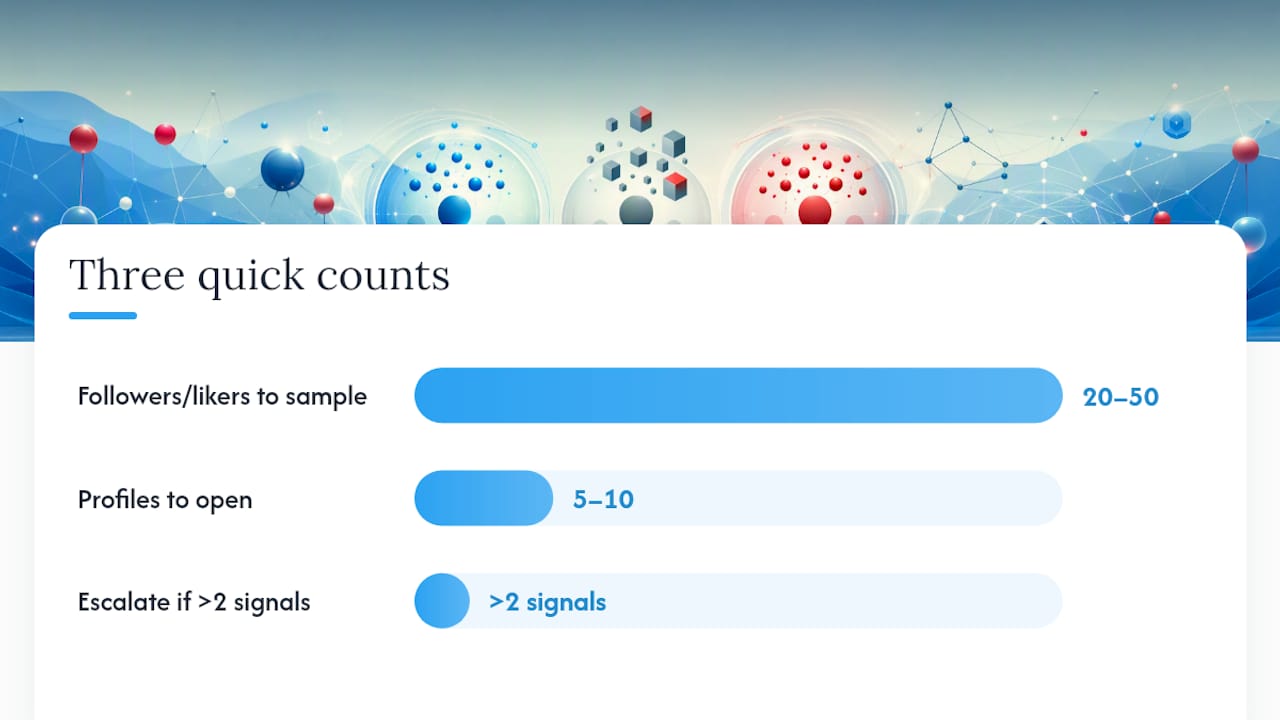
- Pull the first 20 to 50 followers or likers from the batch you’re checking.
- Scan usernames for the patterns above, random strings, brand-plus-suffix combos, heavy digit sequences.
- Open five to ten profiles and check bio, photo, and post count against the checklist.
- Run a reverse image search on any photo that looks stock or overly polished.
- Check account creation dates. A cluster of accounts all created within days of each other is a strong signal.
- Read the actual comments, not just the count. Generic one-word comments (“Nice!”, “Great post”) repeated across unrelated accounts are a classic tell.
- Note the follower:following ratio for a handful of accounts in the sample.
A “good” sample looks messy in a healthy way, mixed account ages, varied bios, photos of actual people, comments that reference the specific post. A “bad” sample looks suspiciously tidy: usernames from the same template, accounts all created the same week, comments that could paste onto any photo on the platform.
For automated checks, tools like Botometer give a rough bot-probability score, and a basic browser search for a username often surfaces identical handles elsewhere. Combining several weak signals beats trusting one strong-looking one, which is exactly what the SPADE detection framework demonstrated when it layered behavioural, content and timing signals together and cut false positives sharply compared with single-signal checks. If your sample fails on more than two fronts, don’t accept the delivery yet, escalate to the provider.
What Should You Ask a Paid-Engagement Provider?
Vetting the account, not just the accounts, catches problems before you’ve spent a penny. Ask these before you pay anything:
- Can you provide a sample of accounts before delivery, not just after?
- Are followers created for this order or sourced from an existing pool?
- What’s your retention policy if accounts drop off within 30 or 90 days?
- What’s the refund or replacement window if a sample audit fails?
- Do you ever ask for account passwords? (If yes, that’s a hard stop.)
Insist on contract language covering a replacement window, a stated quality guarantee, and your right to audit a sample before final payment clears. Walk away from any provider that refuses to show samples, guarantees a follower count with no retention terms attached, or asks for your account password under any pretext, legitimate services never need it. Document every audit you run, screenshots, dates, sample size, because that record is what gets you a refund when a provider disputes a complaint. Our guide to spotting fake engagement in influencer marketing covers more of these red flags in practice, and the team at voraiq has written a useful case study on building genuinely authentic engagement systems worth reading alongside this.
What If You’ve Already Bought Spammy Engagement?
- Pause the campaign immediately and screenshot the suspect accounts before they vanish.
- Contact the provider with your evidence and request a replacement or refund under their stated policy.
- Remove obviously fake followers using your platform’s own tools where available.
- Report clusters of fake accounts to the platform directly, individual reports feed the wider detection systems everyone relies on.
- Run an authenticity cleanse over the following weeks and rebuild trust through genuine campaigns.
Pro Tip: Export your follower list and engagement numbers before removing anything. You’ll want a “before” snapshot to prove what changed and why, especially if you’re disputing a delivery with a provider.
Our piece on why authentic engagement outperforms fake engagement has more on rebuilding after a bad batch.
An Editorial Note on Vetting Engagement Providers
Every audit we run starts the same way, sample first, judge second. Accounts get checked against username patterns, profile completeness and posting history before anything is called good or bad. Buyers who skip this step and pay on trust are the ones who end up disputing deliveries months later. Ask for samples. Insist on quality guarantees in writing. That single habit prevents most of the damage.
How Greediersocialmedia Keeps Your Growth Real
If you’ve read this far, you already know the risk: paying for engagement and getting a pile of accounts you’d flag yourself using the checklist above. Greediersocialmedia’s whole model is built around avoiding that outcome, sample audits before delivery, no password requests ever, and replacement or refund terms if what lands doesn’t match what was promised.
Every package, whether it’s followers, likes, or views across Instagram, Facebook, TikTok, YouTube, or Threads, comes with instant, password-free delivery so your account credentials never leave your hands. If you’re unsure whether a batch you’re considering will pass the kind of audit outlined in this guide, ask for a sample first, that’s standard practice, and any legitimate provider will offer one without hesitation. Ready to see what a properly vetted delivery looks like? Check the social media growth tactics page and request a sample audit before you commit to a full order.
Where to Learn More and Run Your Own Checks
The clearest evidence base here comes from the brand impersonation study on squatting techniques and the PLOS ONE behavioural analysis of bot posting patterns. For quick manual checks, use a reverse image search tool, a public bot-scoring site like Botometer, and your platform’s own reporting page. Keep these links handy, providers respond faster to refund requests backed by named sources.
Sources
- The imitation game: exploring brand impersonation attacks on social media platforms
- Bot behaviour and detection using behavioural signals (PLOS ONE)
- Measurement study of username squatting and confusion on OSNs
- The ultimate guide to spotting and fighting bots on social media (Bitdefender)
- Clustering approaches to detect bot accounts on Twitter (ComTech DOI)
FAQ
What Are Spam Account Names?
Spam account names are usernames belonging to fake, bot, or automated profiles built to send unsolicited content or artificially inflate followers, likes, and views.
What Are the Most Common Spam Username Patterns?
Random alphanumeric strings, brand names combined with words like “support” or “official” (combosquatting), and normal names followed by long digit sequences are the most frequent patterns.
How Do I Check if My Followers Are Fake?
Sample 20 to 50 followers, check their usernames against known patterns, review their bios and photos, and look at account creation dates and follower:following ratios.
Should I Report Spam Accounts to the Platform?
Yes. Reporting individual fake accounts feeds the wider detection systems platforms rely on, and it’s the right step once you’ve confirmed an account matches multiple spam indicators.
Does Greediersocialmedia Guarantee Real Followers?
Greediersocialmedia offers sample audits and password-free, instant delivery with refund or replacement terms, built specifically to help buyers avoid the spam-account risks covered in this guide.