
TL;DR:
- Social media trust signals include verified badges, engagement quality, and consistent posting, which influence credibility. Building genuine trust requires a clear voice, regular interaction, and a visual identity that suggests professionalism. Focusing on meaningful engagement and consistent authenticity is more effective than merely increasing follower counts.
Social media trust signals are defined as the visible cues on a social platform that tell your audience, at a glance, whether your brand is credible and worth engaging with. For small business owners and marketers, understanding these signals is not optional. They shape whether a stranger scrolls past or stops to enquire. This guide covers social media trust signals explained from first principles, including the psychology behind them, the metrics that actually matter, and the practical steps you can take right now to build a more credible presence in 2026.
What are social media trust signals and why do they matter?
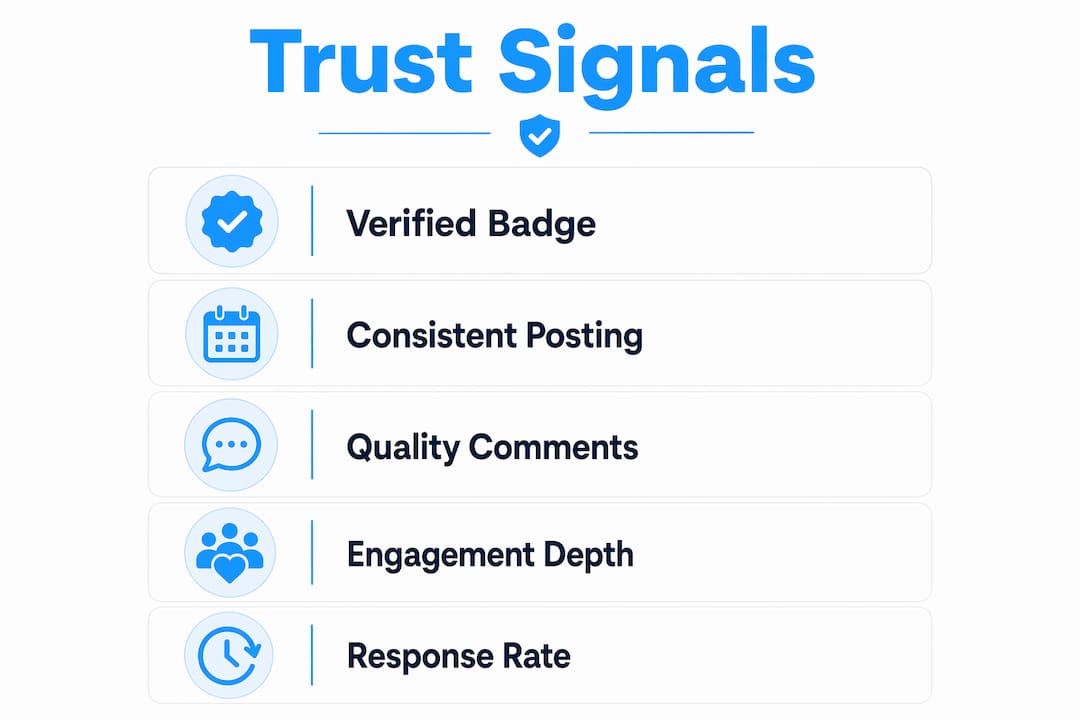
Social media trust signals are the credibility indicators that users and algorithms read within seconds of encountering your profile or content. They include verified badges, follower counts, engagement quality, posting consistency, and the visual coherence of your brand identity. Each one sends a fast, subconscious message about whether your business is legitimate.

The importance of trust signals goes beyond first impressions. AI prioritises brands with verified and consistent activity when ranking content in search and discovery feeds. That means your trust signals now directly affect how visible your business is, not just how credible it appears.
The industry distinguishes between two types of trust: Cognitive Trust, which is based on perceived competence, and Affective Trust, which is based on emotional connection and integrity. Brands sharing clear opinions build both types simultaneously. A business that posts consistently, takes clear stances, and engages genuinely builds the kind of authority that converts followers into clients.
What types of social media trust signals matter most today?
The shift in what counts as a trust signal is one of the most important changes in social media marketing over the past few years. Vanity metrics such as raw likes and passive views no longer carry the weight they once did.
200 thoughtful comments provide more data to AI systems than 10,000 passive views. That is a striking gap. It means a small business with an engaged community of 500 followers can outperform a brand with 50,000 disengaged ones, both in algorithmic reach and in genuine buyer trust.
The trust signals that carry the most weight today fall into two categories:
Qualitative engagement signals:
- Thoughtful comments that tag others or ask follow-up questions
- Direct messages and enquiries generated by content
- Saves and shares, which signal that content has lasting value
- Replies and two-way conversations in comment threads
Structural credibility signals:
- Verified badges on Instagram, Facebook, and LinkedIn
- A consistent posting schedule with no long unexplained gaps
- Milestone follower numbers that align with genuine engagement levels
- A coherent visual identity across profile images, banners, and content
Verified status and structured posting significantly enhance credibility signals for both human audiences and machine algorithms. The bandwagon effect means that when users see a verified badge alongside a healthy follower count, they are far more likely to trust the account without needing further evidence.
Pro Tip: Post at a fixed cadence, even if that means fewer posts per week. Predictability signals reliability. Bursting with content and then going silent does the opposite.
How do psychology and the halo effect shape social media trust?
Two psychological principles drive most of the trust formation that happens on social media. Understanding them helps you design signals that work with human behaviour rather than against it.
The halo effect
The halo effect causes users to form an immediate judgement about your professionalism based on visual and numerical cues. 94% of first impressions are design-related, formed within 50 milliseconds. That means your profile photo, banner image, bio formatting, and follower count are doing most of the credibility work before anyone reads a single word of your content.
A polished, consistent visual identity tells the brain: “This is a real, professional business.” An inconsistent or neglected profile sends the opposite signal, regardless of how good the underlying product or service is.
The bandwagon effect
The bandwagon effect is the tendency to trust what others already trust. When a user sees that hundreds of others follow, comment on, and share your content, they interpret that activity as social proof that your brand is worth their attention. This is why social proof in marketing is not just a nice addition to your strategy. It is a core mechanism of trust formation.
The three-step process most users follow when evaluating a new brand on social media works like this:
- Visual scan. Profile image, banner, and bio are assessed in under a second. Inconsistency here ends the evaluation immediately.
- Social proof check. Follower count, engagement numbers, and verified status are read as a quick credibility shortcut.
- Content quality test. A user reads two or three recent posts to confirm whether the brand’s voice matches the credibility signals they have already observed.
“Mismatch between follower counts and genuine engagement triggers suspicion in both human users and AI systems. A brand with 20,000 followers and three likes per post signals neglect or artificial inflation. Either reading destroys trust.”
This cognitive dissonance is one of the most damaging trust signal failures a brand can have. Dissonance between followers and engagement immediately erodes credibility with both audiences and algorithms.
How can small businesses create effective social media trust signals?
Building authentic trust signals does not require a large budget. It requires consistency, clarity, and a willingness to show up as a real business with a real point of view.
Establish a consistent brand identity. Use the same profile image, colour palette, and tone of voice across every platform. Visual coherence is the fastest trust signal you can deploy, and it costs nothing beyond a clear brand decision.
Commit to a posting schedule. Predictability in posting schedules is foundational to sustained trust. Choose a frequency you can maintain, whether that is three times a week or daily, and stick to it. Audiences learn to expect your content, and that expectation itself becomes a trust signal.
Pursue verified status on every platform that offers it. Verified handles signal authenticity to both users and machine algorithms. Verification reduces impersonation risk and improves conversion rates. Treat it as a non-negotiable credibility asset.
Blend professional content with personal stories. Brands that combine professional content (80%) with personal stories (20%) build a presence that is both authoritative and relatable. Sharing the occasional behind-the-scenes moment or honest opinion builds the affective trust that purely corporate content never achieves.
Engage in two-way conversations. Reply to comments. Answer direct messages promptly. Ask questions in your captions. Each interaction signals to both your audience and the platform’s algorithm that your account is active, human, and worth amplifying. You can find more on this in Greediersocialmedia’s guide to using social media for business.
Pro Tip: Treat your social media bio as a trust statement, not a tagline. State clearly who you help, what you do, and include a link to a canonical website page. This helps AI systems identify your brand as legitimate and distinct from imitators.
How do you measure whether your trust signals are working?
Most small businesses measure social media performance with the wrong metrics. Follower growth and total likes are easy to track, but they tell you very little about whether your audience actually trusts you.
The metrics that reveal genuine trust are qualitative and behavioural. Inquiry velocity, defined as the frequency with which your content leads to direct messages or meeting requests, is the clearest indicator that your trust signals are converting. A post that generates five genuine enquiries outperforms one with 500 likes and no follow-up action.
Use this framework to audit your trust signal effectiveness regularly:
| Metric | What it measures | Strong signal |
|---|---|---|
| Inquiry velocity | Content leading to DMs or meeting requests | Consistent enquiries per post |
| Engagement depth | Comment quality and conversation length | Thoughtful replies, not just emoji |
| Professional audience reach | Followers matching your target client profile | Decision-makers engaging with content |
| Follower-to-engagement ratio | Alignment between audience size and activity | No significant mismatch |
| Posting consistency | Gap between scheduled and actual post dates | Fewer than two missed posts per month |
The engagement depth metric is particularly telling for B2B businesses. When professionals in your sector comment substantively on your posts, it signals that your content carries genuine authority. That kind of peer validation is a trust signal that no paid metric can replicate.
Pro Tip: Review your last 10 posts and count how many generated a direct message or a meaningful conversation. If the answer is fewer than two, your content is building awareness but not trust. Adjust your content to include clearer opinions, direct questions, or specific calls to engage.
Key takeaways
Social media trust signals work because they combine psychological cues, algorithmic preferences, and genuine engagement into a credibility system that audiences read instantly and act on.
| Point | Details |
|---|---|
| Quality beats quantity | 200 thoughtful comments carry more algorithmic weight than 10,000 passive views. |
| Verification matters | Verified badges signal authenticity to both users and AI ranking systems. |
| Consistency builds trust | A predictable posting schedule signals reliability and sustains audience confidence. |
| Measure inquiry velocity | Track how often content leads to direct messages, not just likes or impressions. |
| Avoid engagement mismatch | A large follower count with low engagement destroys credibility faster than a small one. |
Why I think most small businesses are building trust signals backwards
Most small businesses I have observed focus almost entirely on growing their follower count before they have established any of the qualitative signals that make a large following credible. The result is a profile that looks impressive at a glance but collapses under scrutiny. A prospect who notices 8,000 followers and four likes per post does not think “this brand is popular.” They think something is wrong.
The brands that build genuine trust on social media do the opposite. They start with a clear, opinionated voice. They post consistently, even when the audience is small. They reply to every comment and treat each interaction as a relationship, not a metric. By the time their follower count grows, the engagement signals are already strong enough to make that growth credible.
Being “too corporate” is the other trap I see regularly. Formal, polished content with no personality reads as generic in 2026, especially as AI-generated content floods every feed. The brands that stand out take positions. They share opinions their audience might not expect. They write captions that sound like a person, not a press release. That human, opinionated voice is now a trust signal in itself, because it is increasingly rare. If you want to build a social media strategy that actually earns trust, start with your voice, not your follower count.
— Luna
How Greediersocialmedia supports your trust signal strategy
Building trust signals takes time, but the starting point matters enormously. Greediersocialmedia has supported over a million users since 2013, helping UK businesses establish the kind of visible credibility that makes audiences stop and pay attention.
Greediersocialmedia offers real followers, likes, and views without requiring your password, giving your profile the social proof foundation that makes your organic trust-building efforts land harder. When your engagement signals align with your follower numbers, both human audiences and AI systems read your brand as legitimate. Explore Greediersocialmedia’s social media growth tactics to find the right approach for your business size and goals.
FAQ
What are social media trust signals?
Social media trust signals are visible cues, such as verified badges, engagement quality, posting consistency, and follower counts, that tell users and algorithms whether a brand is credible. They form within seconds of a user encountering your profile.
Why do qualitative comments matter more than likes?
200 thoughtful comments provide more data to AI ranking systems than 10,000 passive views, making qualitative engagement a stronger trust and discoverability signal than passive metrics.
How does verified status help small businesses?
Verified badges reduce impersonation risk, improve conversion rates, and signal authenticity to both human audiences and the machine algorithms that determine content reach.
What is inquiry velocity and why does it matter?
Inquiry velocity is the rate at which your content generates direct messages or meeting requests. It is the clearest measure of whether your trust signals are actually converting audience attention into business interest.
How often should a small business post to build trust?
Consistency matters more than frequency. A predictable schedule, maintained without long unexplained gaps, signals reliability to both your audience and social platform algorithms.