
Social media recognition explained simply: it’s public credit given to build trust and visibility.
TL;DR:
- Social media recognition publicly celebrates achievements to enhance brand visibility and community engagement. It involves timely, authentic posts like videos and shoutouts that leverage social proof and algorithmic rewards. Consistent, personalized recognition strategies build trust, loyalty, and organic growth for small businesses.
Social media recognition is the public acknowledgment of achievements, contributions, or positive behaviours on social platforms to increase brand visibility and drive meaningful audience engagement. Platforms like Instagram, LinkedIn, and TikTok have become the primary venues where this practice plays out, and the stakes are real. Social recognition turns internal achievements into shareable moments that build community pride, making it far more than a feel-good gesture. For individuals and small businesses, understanding social media recognition is the difference between a passive presence and one that actively attracts loyal followers and qualified leads.
What is social media recognition and why does it matter?
Social media recognition is the practice of publicly celebrating people, moments, or milestones on social platforms to build credibility and community. It is distinct from private HR rewards or internal praise. The goal is to create visible, shareable content that amplifies your brand’s authority while making contributors feel genuinely valued.

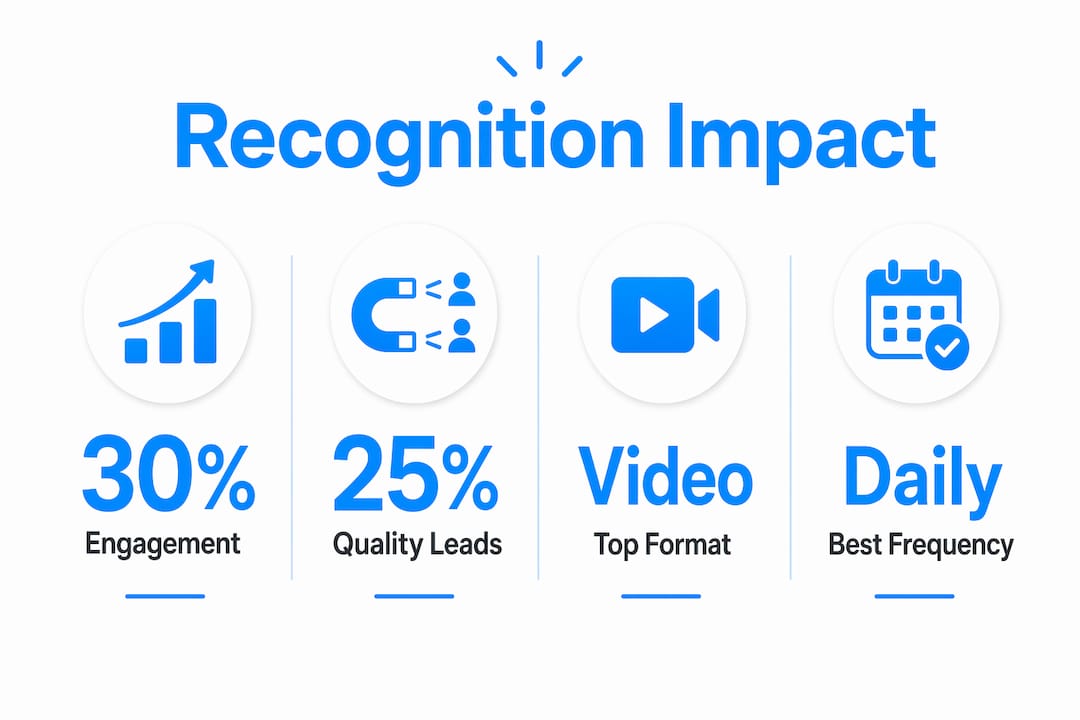
Businesses with structured recognition programmes see a 30% increase in social media engagement and a 25% uplift in qualified lead generation. That figure signals something critical: recognition is not just a morale exercise. It is a marketing mechanism that attracts new audiences organically, without paid advertising.
The concept draws on a deeper social principle. Online recognition functions as a modern equivalent of social honour, where algorithms act as status gatekeepers, affecting visibility beyond content merit alone. For small businesses, this means that recognising your customers, collaborators, or team members publicly does double duty. It rewards the individual and signals to the algorithm that your content generates real interaction.
How does social media recognition drive brand visibility?
Recognition amplifies brand impressions by creating content that people want to share. When you publicly celebrate a customer’s success story on Instagram or acknowledge a collaborator’s contribution on LinkedIn, you generate organic reach that a standard promotional post rarely achieves. This is the core mechanism behind the benefits of social media recognition for growing brands.
Three specific mechanisms explain why recognition outperforms generic content:
- Social proof creation. When you recognise a real person publicly, their network sees it. That audience did not follow you, but they now have a reason to. Social proof strategies can boost engagement by 270% compared to content without third-party validation.
- Algorithmic reward. Platforms reward posts that generate early, genuine interaction. A recognition post tagged with the recipient’s account immediately pulls in their followers as commenters and likers, triggering distribution to wider audiences.
- Community loyalty. Employees and contributors who receive regular recognition are up to 5 times more likely to feel connected to company culture. That connection translates directly into repeat engagement and word-of-mouth referrals.
Timeliness matters as much as the act itself. Delayed recognition loses emotional impact and fails to reinforce the behaviours you want to encourage. Same-day acknowledgment is the standard to aim for, not a nice-to-have.
Pro Tip: Set a daily five-minute window to scan mentions, tags, and comments so you never miss a recognition opportunity. Consistency builds the habit before it becomes a system.
What types of social media recognition work best?
Recognition takes many forms, and the format you choose should match both the platform and the relationship you have with the person you are celebrating. The most effective types for small businesses fall into five categories.
Peer-to-peer shoutouts are the simplest entry point. A tagged post on Instagram or a LinkedIn recommendation costs nothing and generates genuine goodwill. The importance of social media shoutouts lies in their authenticity: they feel personal rather than corporate, which is precisely why they perform well with real audiences.
Public awards and digital badges work particularly well on LinkedIn, where professional credibility is the currency. Announcing a “supplier of the month” or a “community contributor” award creates a shareable moment that the recipient will almost certainly repost to their own network.
Video recognition is the highest-performing format across all platforms in 2026. Short-form native videos capturing authentic reactions outperform polished corporate posts in social algorithms. A 30-second TikTok or Instagram Reel showing a genuine reaction to a customer’s review will consistently outreach a static graphic.
Gamification elements such as leaderboards, points, and milestone badges sustain participation over time. These work especially well for community-driven brands on platforms like Facebook Groups or Discord-adjacent communities.
| Type | Best platform | Key engagement feature |
|---|---|---|
| Peer-to-peer shoutout | Instagram, LinkedIn | Tagged reach into recipient’s network |
| Public award or badge | LinkedIn, Facebook | Shareable credential, professional credibility |
| Short-form video recognition | TikTok, Instagram Reels | Algorithmic amplification, emotional resonance |
| Gamification and leaderboards | Facebook Groups, community apps | Sustained participation, repeat engagement |
| Customer success story | LinkedIn, Instagram | Social proof, qualified lead attraction |
Pro Tip: Treat recognition content like a publisher would treat editorial. Use platform-native formats and real-time distribution to turn each recognition moment into an always-on marketing asset.
How to build a social media recognition programme that lasts
Building a recognition programme that sustains itself requires structure, not just good intentions. The most effective approach moves through clear tiers, from micro-recognition to milestone celebrations.
- Start with micro-recognition. Reply to every comment, repost user-generated content, and tag contributors within 24 hours. These small acts cost nothing and establish the habit of consistent acknowledgment.
- Create a monthly spotlight. Choose one customer, collaborator, or community member each month for a dedicated post. Write a short narrative about their contribution, include a photo or short video, and tag them across your active platforms.
- Introduce a quarterly award. A “community champion” or “best review of the quarter” award gives your audience something to aspire to. Announce it with a short video and a written post to maximise reach across formats.
- Run an annual recognition campaign. Year-end celebrations perform strongly on LinkedIn and Instagram because they generate nostalgia and shareability simultaneously. Compile your top recognition moments into a short video or carousel post.
- Measure and adjust. Track engagement rates, follower growth, and the reach of recognition posts versus standard promotional content. Use platform analytics tools like Instagram Insights, LinkedIn Analytics, or Meta Business Suite to identify which formats and recipient types generate the most secondary reach.
Pitfalls to avoid are as important as the steps themselves. Repetitive praise with identical wording loses impact quickly. Rotating your language, format, and the type of contribution you celebrate keeps recognition feeling genuine rather than formulaic. Over-recognition is also a real risk: if every post is a celebration, none of them carry weight.
Pro Tip: Build a simple recognition calendar in a tool like Notion or Google Sheets. Map out monthly spotlights and quarterly awards three months in advance so recognition never gets deprioritised during busy periods.
What are the risks and challenges of social media recognition?
The most significant risk in social media recognition is recognition mimicry. Recognition mimicry is the risk of engagement signals like likes acting as fake recognition that lacks relational substance, which erodes brand authenticity over time. Chasing likes and follower counts without genuine relational intent produces hollow metrics that do not convert into loyalty or leads.
Several specific challenges deserve attention:
- Vanity metric dependency. Focusing on likes and impressions rather than comments, shares, and saves misrepresents the true impact of recognition content. Saves and shares indicate that someone found the content worth returning to or worth showing others.
- Algorithmic bias. Algorithms determine perceived status, not just content quality. A recognition post with strong early engagement will reach far more people than an equally sincere post that goes live at the wrong time or in the wrong format.
- Automated sentiment tools. Automated social listening tools often misinterpret sentiment and sarcasm. Human-in-the-loop processes improve insight quality over raw engagement volume, meaning a human review of your recognition responses will always outperform a fully automated approach.
- Inauthenticity creep. When recognition becomes a scheduled marketing task rather than a genuine response to real contributions, audiences notice. The language becomes templated, the timing feels mechanical, and the credibility of the brand suffers.
“Authentic recognition aligns with brand values and responds to real contributions. The moment it becomes a content formula, it stops working.”
Balancing automated scheduling tools with genuine, personalised responses is the practical answer. Use scheduling for consistency, but write the actual recognition copy yourself, or at least review it before it goes live. Authenticity is not scalable through automation alone. For a deeper look at why genuine interaction outperforms manufactured engagement, the case for authentic engagement is worth reading in full.
Social Media Recognition Explained: Common Mistakes
Most newcomers to social media recognition treat it as an occasional gesture rather than a consistent practice. They post a shoutout when they remember to, celebrate a customer milestone once a quarter, and then wonder why their engagement does not grow. The truth is that recognition only compounds when it is regular enough to become part of your brand’s identity.
What I have observed working with small businesses is that the ones who grow fastest are not the ones with the biggest budgets. They are the ones who make their community feel seen, consistently and specifically. A generic “thanks for the support” comment does almost nothing. A personalised reply that names the person, references what they said, and adds something genuine creates a micro-moment of connection that people remember and share.
Start simple. Pick one person to recognise publicly each week. Write something specific about why their contribution matters. Tag them, use a native format, and post it at a time when your audience is active. Do that for three months and watch what happens to your comment sections and your follower growth. Scale the programme only after the habit is solid. Recognition that feels rushed or formulaic does more damage than no recognition at all.
— Luna
Grow your brand with Greediersocialmedia
Greediersocialmedia has helped over a million users build genuine visibility on Instagram, Facebook, and beyond since 2013, and recognition strategy sits at the heart of that growth.
If you are ready to move from occasional shoutouts to a structured approach that drives real engagement, Greediersocialmedia offers practical social media growth hacks designed specifically for UK individuals and small businesses. For those who want a complete solution, the growth packages combine recognition-led tactics with real follower and engagement growth, all without requiring your passwords. Fast, secure, and built for results.
Key takeaways
Social media recognition works because consistent, authentic public acknowledgment of real contributions drives algorithmic reach, social proof, and community loyalty simultaneously.
| Point | Details |
|---|---|
| Define recognition clearly | Social media recognition is public acknowledgment on platforms like Instagram and LinkedIn to build visibility and trust. |
| Timeliness is critical | Same-day acknowledgment reinforces behaviour and maximises emotional impact for the recipient and their network. |
| Format determines reach | Short-form native videos outperform static posts in social algorithms for recognition content. |
| Avoid recognition mimicry | Likes and follower counts are vanity metrics; focus on shares, saves, and genuine comments as true engagement signals. |
| Build a tiered programme | Move from daily micro-recognition to monthly spotlights and quarterly awards to sustain participation over time. |
FAQ
What is social media recognition?
Social media recognition is the public acknowledgment of a person’s achievements, contributions, or positive behaviours on platforms like Instagram, LinkedIn, or TikTok to build brand credibility and community engagement.
How does recognition improve social media engagement?
Businesses with structured recognition programmes see a 30% increase in social media engagement, because tagged recognition posts pull in the recipient’s network and trigger algorithmic distribution to wider audiences.
What are the best formats for social media recognition?
Short-form native videos, peer-to-peer shoutouts, and public awards are the most effective formats. Native videos capturing authentic reactions consistently outperform polished corporate posts in platform algorithms.
How do I avoid fake or hollow recognition?
Focus on specific, personalised acknowledgment tied to real contributions rather than generic praise. Avoid over-relying on automated tools, and always review recognition copy before publishing to maintain authenticity.
How often should a small business post recognition content?
A minimum of one dedicated recognition post per week is a practical starting point. Daily micro-recognition through replies and reposts, combined with monthly spotlights, builds the consistency needed for compounding engagement growth.