
TL;DR:
- A social media growth strategy involves a deliberate, consistent plan combining content pillars, audience research, and paid amplification to expand reach and engagement. Focusing on a few platforms, maintaining a sustainable posting cadence, and tracking leading indicators help small businesses build trust and predict growth over time. Consistency, organic testing, and integrated tactics are more effective than short-term bursts or relying solely on paid ads.
A social media growth strategy is a deliberate, consistent plan to expand your audience, increase engagement, and build brand authority across platforms like Instagram, TikTok, LinkedIn, and X. Without one, you are posting into a void and hoping something sticks. The good news: modern growth is not about luck or viral moments. It is about understanding what the algorithm rewards, showing up consistently, and combining organic content with smart paid amplification. This guide breaks down exactly how that works, from content pillars to measurement frameworks.
What are the essential components of a social media growth strategy?
A social media growth strategy explained properly starts with four non-negotiable pillars: clear goals, audience research, content pillars, and a posting cadence you can actually sustain. Miss any one of these and the rest of your effort produces diminishing returns.
Setting goals that connect to business outcomes
Your goals must be specific and measurable. “Get more followers” is not a goal. “Grow Instagram from 800 to 2,500 followers in 90 days by posting four times per week and engaging daily” is a goal. Every tactic you choose should trace back to a business outcome, whether that is leads, sales, or brand recognition.
Knowing your audience and choosing the right platform
Audience research determines where you show up and what you say. A B2B accountancy firm belongs on LinkedIn. A fashion brand targeting 18 to 30-year-olds belongs on TikTok and Instagram. Spreading yourself across every platform from day one dilutes your effort and slows growth. Pick one or two platforms that match your audience and commit.

Defining your content pillars
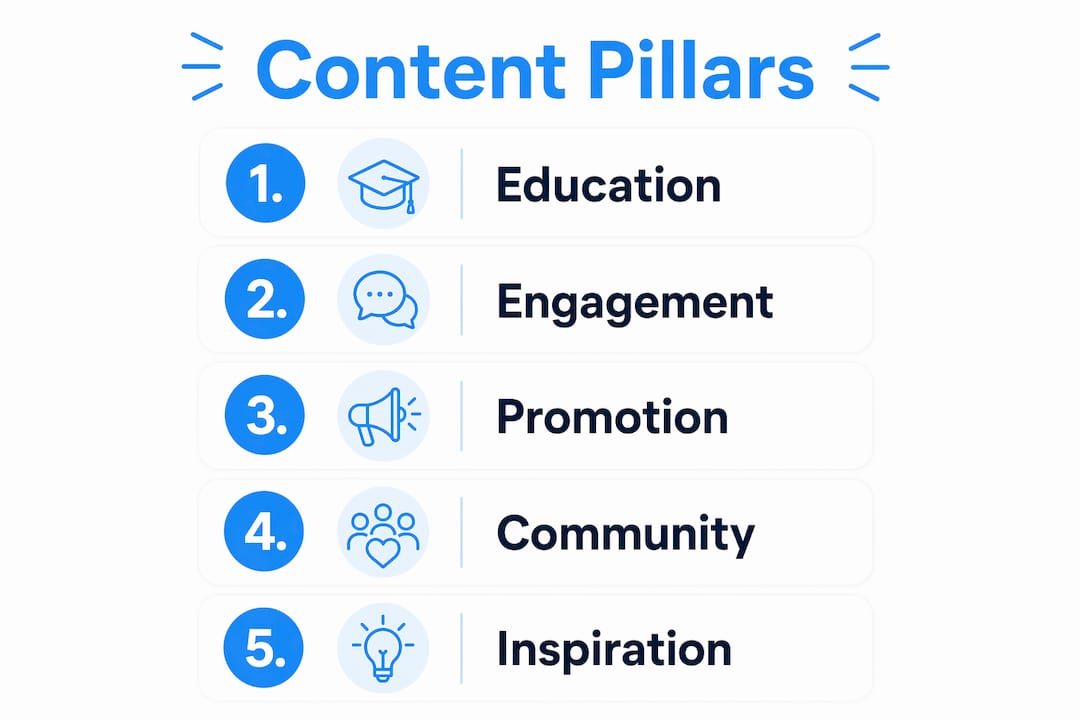
Content pillars are the recurring themes your account covers. Aim for three to five: for example, educational posts, opinion pieces, behind-the-scenes content, customer stories, and curated industry news. Pillars give your audience a reason to follow you and give your team a framework for producing content without starting from scratch every week. Focused content pillars avoid burnout and improve follower retention over time.
Establishing a posting cadence
- Post a minimum of three times per week across your chosen platforms
- New accounts need 90 days of consistent posting before algorithm priority kicks in
- Prioritise comments, shares, and saves as your primary engagement signals
- Respond to every comment within 24 hours to extend content lifetime
- Review performance every four weeks and adjust pillar ratios based on what resonates
Pro Tip: Schedule your posts in batches using tools like Buffer or Later. Batching one week of content in a single session reduces decision fatigue and keeps your cadence intact even during busy periods.
How does combining organic content and paid ads boost growth?
Organic and paid social are not separate strategies. They are one integrated system, and treating them as competitors is one of the most common mistakes small businesses make.
Organic content builds trust, tests ideas, and warms up your audience at no direct cost. When a post performs well organically, that is your signal: the message resonates. Paid amplification then takes that proven content and puts it in front of a far larger audience, including lookalike audiences and people who have already engaged with your profile. This approach removes the guesswork from your ad spend because you are scaling what already works.
| Approach | Strengths | Best used for |
|---|---|---|
| Organic content | Builds trust, tests messaging, costs no media spend | Audience warming, brand voice, community building |
| Paid amplification | Guarantees reach, scales proven content, targets precisely | Lead generation, conversions, retargeting engagers |
| Creator whitelisting | Higher click-through rates, authentic feel, better conversions | Product launches, awareness campaigns, new market entry |
Budget allocation matters here. Growth-stage businesses split their social media budget 40 to 60% on content production and 40 to 60% on paid promotion for optimal revenue growth. That balance shifts depending on your stage, but the principle holds: neither side should be starved.
Creator partnerships add a third dimension. Whitelisted creator content running from the creator’s own handle outperforms brand-produced ads by two to four times on click-through rates and conversions. For small businesses without large production budgets, partnering with a micro-creator in your niche and running their content as a paid ad is one of the most cost-effective tactics available. You can explore influencer-driven amplification strategies to understand how creator partnerships translate into measurable brand growth.
Pro Tip: Before scaling any paid campaign, let a post run organically for 48 to 72 hours. If it earns strong saves and shares, it is ready to amplify. If it underperforms organically, paid spend will not rescue it.
Which content formats drive the best results by platform?
Platform choice shapes everything about how you create and distribute content. Cross-posting raw content does not work. Adapting your content format per platform increases engagement and follower retention significantly. Here is what works where in 2026.
- TikTok and Instagram: Short-form video (15 to 60 seconds) and carousels dominate. Hook viewers in the first two seconds. Use on-screen text because most people watch without sound. Carousels earn high save rates because people swipe back to re-read them.
- LinkedIn: Value-driven text posts and document carousels outperform video. Write in short paragraphs with clear line breaks. Personal stories tied to professional lessons consistently outperform promotional content.
- X (formerly Twitter): Punchy threads of five to ten tweets perform best. Lead with a bold claim or surprising fact, then unpack it across the thread. Engagement happens fast on X, so timing your posts to peak hours matters more than on other platforms.
- Facebook: Still relevant for community groups and local businesses. Video and event posts drive the most organic reach.
Posting frequency should be sustainable, not aggressive. Three to five posts per week is the baseline that establishes algorithmic priority without burning out your team. Higher frequency works only if quality holds. One excellent post beats five mediocre ones every time.
Hashtag strategy also varies by platform. On Instagram, eight to fifteen niche-relevant hashtags still extend reach. On LinkedIn, three to five broad industry tags work better. On TikTok, hashtags are primarily for content categorisation rather than discovery. On X, one or two topical tags per tweet is sufficient.
Replying to comments within 24 hours creates ongoing engagement, extends content lifetime, and signals value to the algorithm. This is one of the most under-used levers available to small business accounts. Set aside 15 minutes after every post goes live to respond to early comments and watch your reach extend.
How can small businesses manage social media growth sustainably?
Sustainability is the word most social media advice ignores. Posting 14 times a week for three weeks and then going silent for a month destroys the algorithmic momentum you built. A lower but consistent cadence over months beats aggressive short bursts every time.
Here is a practical system for managing growth without burning out:
- Choose your platforms first. Focusing on one or two platforms outperforms a diluted presence across five. Master one before adding another.
- Build a content calendar. Map out your pillar ratios for the month. If you have five pillars, rotate through them so no single theme dominates your feed.
- Batch your content production. Set aside one day per week or fortnight to film, write, and schedule content in bulk. This protects your posting schedule from daily disruptions.
- Collaborate with complementary accounts. Joint Lives on Instagram, co-authored LinkedIn posts, and TikTok duets with creators in adjacent niches expose your account to warm, relevant audiences at no media cost.
- Track leading indicators weekly. Saves, shares, watch-time, and comment velocity tell you what is working before follower counts move.
Pro Tip: Treat your content calendar like a client deadline. Block the production time in your diary and protect it. Accounts that batch content consistently outperform those that create reactively, regardless of budget.
Successful brands also move followers onto owned channels, such as email lists or private communities, as a long-term asset. Social platforms change their algorithms. Your email list does not. Building that bridge from social follower to email subscriber protects your audience from platform volatility. You can find practical guidance on organic growth sustainability to complement your paid efforts.
What metrics should you track to measure social media growth?
Measuring the right things separates businesses that grow from those that stay stuck. Most small businesses track follower counts and likes. Both are lagging indicators that tell you what already happened. Leading indicators tell you what is about to happen.
| Metric type | Examples | What they tell you |
|---|---|---|
| Leading indicators | Saves, shares, watch-time, comment velocity, DM volume | Content quality and future algorithmic reach |
| Lagging indicators | Follower count, overall engagement rate, conversion rate | Historical performance and business outcomes |
| Business metrics | Pipeline, revenue attributed to social, cost per lead | Return on social media investment |
Saves, shares, and watch-time predict follower and revenue growth 60 to 90 days before those metrics appear in your dashboard. This means you can course-correct your strategy months before a problem becomes visible in your follower count.
Use tools like Meta Business Suite for Facebook and Instagram analytics, LinkedIn Analytics for professional content performance, and TikTok Studio for video metrics. For cross-platform reporting, tools like Sprout Social, Hootsuite, or Buffer consolidate your data into one view and allow caption A/B testing. Multi-touch attribution matters too: social often assists a conversion rather than closing it directly, so credit it fairly across your reporting. Understanding audience engagement for algorithmic visibility helps you connect social metrics to broader marketing performance.
Key takeaways
A social media growth strategy works when consistency, platform-specific content, and integrated organic and paid tactics operate together as a single system.
| Point | Details |
|---|---|
| Consistency drives growth | Posting at least three times per week for 90 days establishes algorithm priority and compounds engagement. |
| Content pillars prevent burnout | Three to five recurring themes give your team a production framework and your audience a reason to follow. |
| Organic informs paid | Test content organically first, then amplify what earns strong saves and shares with paid spend. |
| Leading metrics predict results | Track saves, shares, and watch-time now to forecast follower and revenue growth 60 to 90 days ahead. |
| Platform focus beats spread | Mastering one or two platforms produces stronger, more consistent growth than a diluted multi-platform presence. |
Why consistency is the most underrated growth lever
Most small business owners I speak with want to know the secret tactic. The thread format, the hashtag set, the posting time. My honest view after years of watching accounts grow and stall: none of those details matter as much as simply showing up, week after week, with content that is genuinely useful or interesting to your audience.
Creators who maintained a consistent posting schedule for 20 or more weeks saw approximately 450% more engagement per post than sporadic posters. That figure is not surprising to me. What surprises me is how few businesses act on it. They post intensely for a month, see modest results, and pull back. Then they wonder why growth stalled.
The other thing I would push back on is the idea that you need a large budget to compete. The businesses I have seen grow fastest on Instagram and LinkedIn are not the ones with the biggest ad spend. They are the ones who respond to every comment, engage with accounts in their niche daily, and adapt their content format to the platform rather than duplicating the same post everywhere. Paid amplification accelerates growth, but it cannot substitute for the trust that consistent organic engagement builds.
Set a posting goal you can sustain for six months, not one you can sustain for six weeks. That is the real social media growth strategy explained in one sentence.
— Luna
Grow faster with Greediersocialmedia
If you are ready to move beyond trial and error, Greediersocialmedia has supported over a million users since 2013 in building genuine, measurable social media presence across Instagram, Facebook, and beyond. Their approach centres on authentic engagement, real followers, and tactics that do not require you to hand over your passwords.
Whether you need a structured plan, paid amplification support, or a shortcut to building early credibility, their social media growth packages are designed specifically for small businesses and marketers who want results without the guesswork. You can also explore their growth hacks and tactics to find the approach that fits your current stage and budget.
FAQ
What is a social media growth strategy?
A social media growth strategy is a planned, consistent approach to expanding your audience and engagement across platforms like Instagram, TikTok, and LinkedIn. It combines content pillars, posting cadence, audience research, and paid amplification into one coordinated system.
How often should I post to grow my social media?
Post a minimum of three times per week and maintain that cadence for at least 90 days. New accounts need this sustained rhythm before the algorithm begins prioritising their content in feeds.
Which metrics matter most for measuring growth?
Track leading indicators first: saves, shares, watch-time, and comment velocity. These predict follower and revenue growth 60 to 90 days before lagging metrics like follower counts reflect the change.
Should I use organic content or paid ads for growth?
Use both together. Organic content tests your messaging and builds trust; paid amplification scales what already works. Splitting your budget 40 to 60% between content production and paid promotion is the approach that produces the strongest results for growth-stage businesses.
How do I avoid burnout when managing social media?
Batch your content production weekly or fortnightly, focus on one or two platforms rather than spreading across many, and set a posting goal you can sustain for six months. A lower, consistent cadence outperforms aggressive short bursts that exhaust your team and stall momentum.