
TL;DR:
- Presenting purchased engagement to brands is safe when you supply auditable evidence, honest disclosure, and clear conversion tracking. Reputable providers deliver geo-targeted, timestamped reports and UTM links without requesting account passwords, ensuring credibility. A credible proof workflow involves planning, capturing evidence, attaching UTMs, and providing a detailed one-pager with metrics and disclosures.
You can present purchased engagement to brands safely, provided you supply auditable evidence, honest disclosure, and clear conversion tracking. That is the short answer. The longer one is a workflow.
Here is the minimum checklist before you pitch any sponsor:
- Export platform analytics (CSV or PDF) covering the boosted period, with timestamps
- Include audience breakdown: geography, age, and gender from native Insights
- Attach UTM-tracked link data showing clicks, signups, or sales
- Stagger boosts across several days rather than applying them in a single spike
- Disclose paid amplification in your pitch, in line with ASA guidance on paid endorsements
- Use Meta branded-content tools to give the brand direct access to post metrics
Greediersocialmedia delivers all of this without requesting your account password, which is the professional baseline.
Table of Contents
- What are paid engagement packages and how do they work?
- What do UK brands actually check when vetting creators?
- How do you package purchased engagement as credible evidence?
- What are the risks and how do you stay compliant?
- Brand-facing one-pager: a template you can use now
- How do you measure and report results brands care about?
- How a UK creator used Greediersocialmedia to win a sponsor
- Key takeaways
- The real gap most creators miss
- Greediersocialmedia helps you build the evidence brands want
- Useful sources
- FAQ
What are paid engagement packages and how do they work?
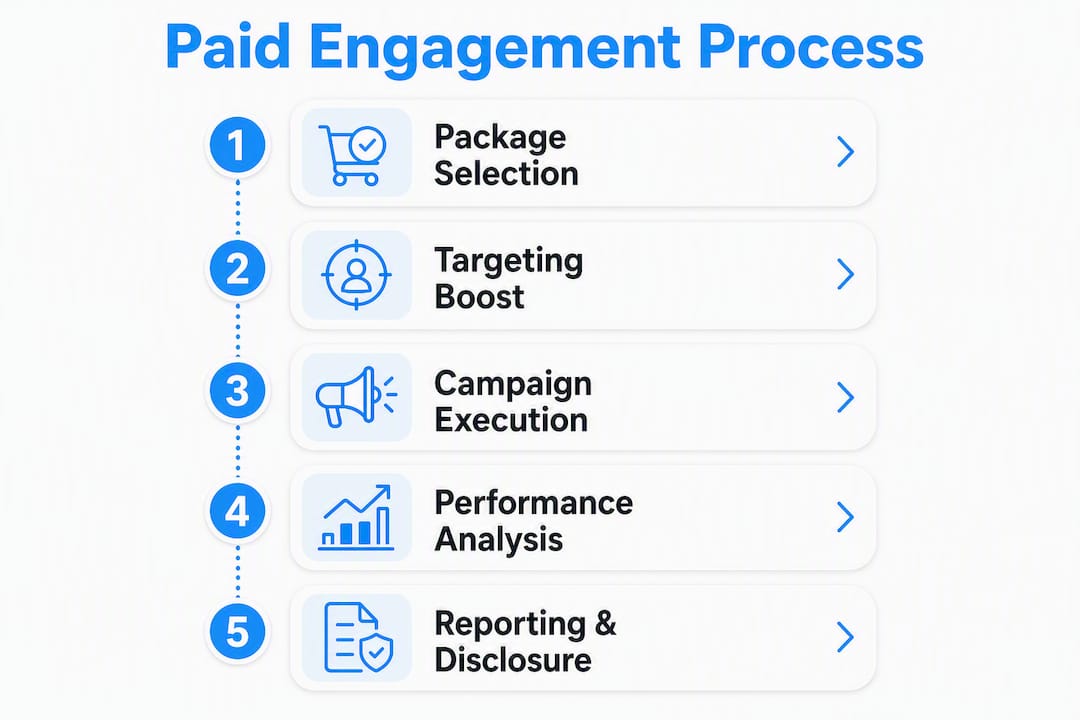
Paid engagement packages fall into a few clear categories: followers, likes, views, auto-likes, and auto-followers. Followers add to your account’s subscriber count. Likes and views are applied to specific posts. Auto-likes and auto-followers trigger automatically on new content, so your account maintains consistent activity without manual top-ups.
The delivery method matters as much as the package itself. Reputable providers never ask for your password or two-factor authentication code. Scammers routinely request credentials or payment through unverified channels, then either hijack accounts or deliver nothing. Password-free delivery is not a feature worth noting in passing; it is the baseline that separates legitimate services from fraud.
Pro Tip: Before purchasing any package, verify four things: the provider offers geo or interest targeting, supplies timestamped reporting exports, has accessible customer support, and never requests login credentials.
Geo-targeted boosts matter specifically because brands will check whether your audience geography matches their market. A UK fashion brand will not pay for an audience that is 80% outside the UK.
What do UK brands actually check when vetting creators?

UK brands have moved away from raw follower counts and now favour audience credibility scores and past campaign results. The shift is practical: a creator with 20,000 genuinely engaged followers in Manchester is worth more to a regional brand than one with 200,000 passive followers spread across five continents.
The primary vetting dimensions are:
- Engagement rate: — likes and comments relative to follower count. A rate above a certain level is a common benchmark for accounts with larger follower counts, per UK industry data
Brands also run practical checks: reach-to-follower ratio, comment authenticity (generic emoji-only comments are a red flag), and geography match. For the evidence package itself, most brand teams will ask for Insights screenshots, CSV exports, timestamps, UTM reports, and confirmation of any partnership ad approvals. Understanding how to spot fake engagement from the brand’s perspective helps you anticipate exactly what they will scrutinise.
How do you package purchased engagement as credible evidence?
This is a four-step process you can repeat for every campaign.
Plan the boost window. Before applying any paid amplification, record your intended targeting (geography, interest, platform), the dates you plan to run the boost, and the post it will apply to. This creates a paper trail showing the boost was deliberate and targeted, not a random spike.
Capture evidence before and after. Take timestamped screenshots of your Insights immediately before the boost begins and again at 24, 48, and 72 hours after. Export reach, impressions, and audience geography as a CSV or PDF. These are the hardest evidence to fabricate and the most widely accepted by brands.
Attach UTM parameters. Every link in the boosted post should carry a unique UTM string so you can attribute clicks, signups, or purchases directly to that content window. Without UTMs, a brand cannot distinguish your campaign’s contribution from organic traffic or other channels.
Run a pilot first. A small paid test on a single post, with a control window and clear UTMs, creates an auditable case study before you offer larger packages to prospective sponsors. A staged approach reduces brand risk and gives you real before/after KPIs to present.
The one-pager you hand to a brand should contain: campaign objective, channel, post date, boost timing and spend, audience breakdown, KPIs (reach, impressions, engagement rate, link clicks), and attached evidence files in PDF and CSV format.
Pro Tip: Use Meta’s branded-content ‘Paid partnership’ tag on sponsored posts. This grants the brand direct access to your reach, impressions, and engagement data, removing any doubt about the numbers you present.
What are the risks and how do you stay compliant?
Purchased engagement carries three distinct risk categories, and each has a mitigation.
Platform risk. Buying followers or likes can breach platform terms of service, potentially reducing organic distribution or triggering account reviews. Staggering boosts over several days rather than applying them in a single overnight spike reduces the signal that triggers automated detection. Never buy fake comments; manufactured comment threads are the easiest thing for both platforms and brands to identify.
Regulatory risk. The ASA requires clear disclosure when content is commercially amplified. If a brand pays you and you also boost the post with paid engagement, both the commercial relationship and the amplification should be disclosed. Failing to do so creates liability under UK advertising standards.
Contractual risk. Many brand contracts include clauses defining fraudulent engagement and specifying remedies, including clawback of fees. Fake likes inflate visible metrics without improving downstream signals such as saves, shares, or link clicks, and a brand that audits post-campaign data will notice the gap. The mitigation is to use real, geo-targeted engagement from a reputable provider, keep your full reporting folder, and include a clause in your own contract that defines what paid amplification means and how it will be disclosed.
The paid engagement versus organic growth question is not binary. The safest position is to treat paid boosts as reach amplification for content that already performs organically, not as a substitute for audience fit.
Brand-facing one-pager: a template you can use now
| Field | What to include |
|---|---|
| Objective | One sentence: what the campaign aimed to achieve (awareness, clicks, sales) |
| Channel and post | Platform, post URL or screenshot, publish date |
| Boost timing and spend | Dates of paid amplification, targeting parameters, approximate spend |
| Audience breakdown | Geography %, age range, gender split from native Insights |
| KPIs | Reach, impressions, engagement rate, link clicks, conversions |
| Evidence files | Timestamped screenshots, CSV/PDF Insights export, UTM report |
| Disclosure note | One line confirming paid amplification was used and disclosed per ASA guidance |
Keep the document to a single page. Attach the evidence files as a ZIP or shared folder link. PDF is the preferred format for the one-pager itself; CSV for raw data exports.
Sample phrasing for the boost disclosure line: “Reach for this post was supported by a paid engagement package targeting UK audiences aged 25–34, applied between [date] and [date]. All metrics are drawn from native platform Insights and are available for third-party audit.”
How do you measure and report results brands care about?
Post-campaign reporting is where most creators lose brand confidence. Sending a screenshot of likes three days after a campaign ends is not a report.
The KPIs brands prioritise are: verified reach, link clicks, conversions (sales or signups), saves and shares, and audience growth attributable to the campaign window. Partnership ads generate roughly 30% more incremental conversions than brand-only ads, which is why brands increasingly ask creators to enable whitelisting.
A tight post-campaign report covers:
- Summary: two or three sentences on what ran, when, and the headline result
- Top-performing content: the post with the highest engagement rate and conversion, with a screenshot
- Raw exports: reach and impressions CSV from the platform
- UTM performance: clicks, sessions, and conversions from Google Analytics or the brand’s tracking tool
- Suggested next steps: one recommendation based on what the data shows
Pro Tip: Use unique discount codes alongside UTMs. A code like BRAND10 gives the brand a second attribution signal independent of link tracking, which is useful when customers screenshot posts and buy later.
For measuring social media growth progress over multiple campaigns, keep a running spreadsheet with each campaign’s KPIs so you can show trend data to prospective sponsors.
How a UK creator used Greediersocialmedia to win a sponsor
A UK lifestyle creator with roughly 18,000 Instagram followers wanted to pitch a mid-size British homeware brand. The problem: their engagement rate had plateaued and their previous pitch had been rejected on the grounds of insufficient conversion evidence.
They used Greediersocialmedia to run a geo-targeted likes and followers package, delivered without any credential request, targeting UK users aged 25–44 interested in home décor. The boost was staggered across five days. Before the boost, they captured timestamped Insights screenshots and set up UTM links on the product link in their bio.
Results after the pilot post:
- Reach increased from approximately 2,100 to 4,800 for that post
- Engagement rate moved from 2.1% to 3.8%
- UTM data showed 47 link clicks and 6 confirmed purchases during the campaign window
- Audience geography held at 74% UK, satisfying the brand’s market-fit requirement
The one-pager they submitted included all of the above, the timestamped exports, and a disclosure note. The brand signed a three-month contract.
The lesson: the boost was not the pitch. The evidence workflow was.
Key takeaways
Purchased engagement wins brand partnerships only when paired with auditable evidence, honest disclosure, and conversion tracking from a reputable, password-free provider.
| Point | Details |
|---|---|
| Evidence exports are non-negotiable | Supply timestamped screenshots and CSV/PDF Insights exports covering the boosted period. |
| Geography match closes deals | Audience breakdown must show your followers align with the brand’s target market. |
| UTM links prove conversions | Attach unique UTM parameters to every campaign link so clicks and sales are attributable. |
| Disclosure protects you | Include a one-line ASA-compliant disclosure in every brand pitch and post caption. |
| Greediersocialmedia delivers the evidence layer | Password-free, geo-targeted packages with timestamped reporting give you the auditable proof brands require. |
The real gap most creators miss
The conventional wisdom says purchased engagement is either fine or fraudulent. Both camps miss the point. The question is not whether you boosted a post. It is whether you can prove what that boost actually did.
Brands in 2026 are not naive about paid amplification. Many run it themselves through partnership ads. What they cannot tolerate is a creator who presents inflated numbers with no supporting data, because that creates contractual and reputational exposure for them too. A creator who hands over a clean evidence pack, a geography-matched audience breakdown, and a UTM conversion report is not hiding anything. They are doing the job properly.
The risk is not the boost. The risk is the gap between the metric you show and the outcome you can prove. Close that gap with a reporting folder, and paid engagement becomes a legitimate, auditable input rather than a liability.
Greediersocialmedia helps you build the evidence brands want
Winning a brand deal in 2026 takes more than strong numbers. It takes a reporting pack a brand’s marketing team can actually verify. Greediersocialmedia provides UK creators and small businesses with geo-targeted engagement packages delivered securely, without password requests, alongside the timestamped Insights data you need to build a credible one-pager.
Start with a pilot. A small, targeted boost on a single post, tracked with UTMs and documented with before/after Insights exports, gives you a real case study to present to prospective sponsors. Greediersocialmedia’s Instagram follower packages are built for exactly this workflow: UK-targeted, instant delivery, no credentials required. For a broader look at what is available, the social media growth hacks page covers the full range of packages across Instagram, Facebook, TikTok, YouTube, and Threads. Pick a post, run the pilot, and take the evidence pack to your next brand conversation.
Useful sources
Further reading on the policies and standards referenced in this article:
- How UK brands are shifting from vanity to value metrics — The Drum on what brand teams now demand from creators
- Instagram paid follower scams: what to avoid — Bitdefender on credential-harvesting scams targeting creators
- Greediersocialmedia: how to spot fake engagement — red flags and verification checks for creators and brands
- Audience engagement strategies for business growth — third-party analysis of what brands look for in engagement quality
FAQ
Can you legally use paid engagement when pitching brands in the UK?
Using paid engagement packages is not prohibited by UK law, but you must disclose paid amplification in line with ASA guidelines and ensure your brand contract does not contain clauses that define purchased boosts as fraudulent activity.
What evidence do brands ask for when reviewing a creator’s metrics?
Most UK brand teams request timestamped Insights screenshots, CSV or PDF analytics exports, audience geography breakdowns, and UTM-tracked conversion data covering the campaign window.
How do you stop a paid boost from looking suspicious to a brand?
Stagger the boost across several days, use geo-targeted packages that match the brand’s market, and present the full evidence pack including before/after KPIs and a disclosure note explaining the amplification.
Does Greediersocialmedia provide the reporting data needed for brand pitches?
Yes. Greediersocialmedia delivers geo-targeted packages with timestamped reporting and requires no account credentials, giving creators the auditable evidence layer brands expect to see.
What is the difference between partnership ads and standard paid engagement?
Partnership ads are creator posts amplified through the brand’s own paid channels via Meta’s branded-content tools, giving the brand direct analytics access. Standard paid engagement packages boost reach and interactions through the creator’s account independently.