
Watch time and reach predict growth far better than likes to do, so the first thing to check on any Reel is average watch time in Instagram Insights, not the like count. If that number looks weak, your next move is a quick test: rewrite the first three seconds and compare the watch time on the next post.
TL;DR:
- Plays count every start, including loops and replays, while reach counts unique accounts; rising impressions without rising reach points to repeat viewing, not fresh discovery.
- If viewers leave early, rewrite the opening three seconds; if they stay briefly then drop, move the payoff earlier and compare watch time.
- Calculate engagement rate using likes, comments, saves, and shares divided by reach, not follower count; reach reflects the accounts that actually saw the Reel.
- Repeat each change across three to five posts before drawing conclusions, tracking average watch time first and saves after payoff or call to action edits.
- Use paid likes or views only after a Reel earns watch time and reach organically; purchased activity cannot substitute for retention signals Instagram weighs.
Table of Contents
- What a ‘view’ on Reels counts as and where to check it
- What likes measure and their limitations as a success signal
- Why views and likes diverge: a short diagnostic framework
- Which Reel metrics predict growth and how to combine them
- Action checklist: how to interpret a single Reel and what to test next
- The role of engagement pods and bought engagement in inflating metrics
- Case studies: how shifts in likes versus views shape account growth
- How content quality and relevance shape the views-to-likes ratio
- How format and length influence views and likes distribution
- What the data actually changes about how I advise creators
- How Greedier Social Media fits once you’ve validated what works
- FAQ
What a ‘view’ on Reels counts as and where to check it
A view registers the moment someone’s screen plays your Reel, even for a fraction of a second, which is why view counts often look inflated compared with likes or comments. A single viewer who loops back and rewatches a Reel three times can add three plays to that number, so raw views measure attention, not approval.
This is different from reach, which counts unique accounts that saw the Reel once, however many times they replayed it. Instagram Insights separates these clearly once you open the Reel’s detailed stats:
- Plays: total number of times the Reel started, including replays and auto-loops.
- Accounts reached: unique accounts that saw the Reel at least once.
- Impressions: total times the Reel was displayed, including repeat views by the same account.
- Average watch time: how long, on average, viewers stayed on the Reel.
Auto-looping on short Reels and casual rewatching both inflate plays without adding new viewers, which is why a view spike alone is not proof that a Reel is reaching fresh people.
What likes measure and their limitations as a success signal
A like is a deliberate action. Likes represent explicit approval but tend to be the weakest single indicator of growth compared with watch time and reach, because tapping the heart takes effort that most viewers skip even when they enjoyed what they watched.
Plenty of Reels rack up thousands of plays and a handful of likes, and that gap is rarely a sign of failure. Common reasons include:
- Passive viewing: people watch while scrolling and move on without engaging further.
- No prompt: the caption or Reel never asks for a reaction.
- Content that informs but doesn’t delight: useful Reels get watched fully but rarely liked.
Likes still carry weight as social proof for new visitors to your profile, and a comment-baiting caption can lift them, but treating them as your main success metric will mislead you. Our guide on generating more likes on Instagram covers ways to nudge that number up once your content is already working.
Why views and likes diverge: a short diagnostic framework
A views-heavy, likes-light Reel usually falls into one of four scenarios. Work through them in order before changing anything else.
- Weak hook: people scroll past within the first second, so plays rack up but watch time and likes both stay flat. Test it by rewriting the first three seconds and comparing average watch time on the next post.
- Strong hook, weak payoff: viewers stay briefly, then drop off because the content doesn’t deliver. Test it by restructuring the middle of the Reel so the payoff arrives sooner.
- Passive distribution: the Reel reaches people through auto-play feeds rather than genuine interest, so impressions climb but reach and likes lag. Test it by adding a direct call to action asking viewers to comment or save.
- Measurement shift: a sudden change in the ratio between plays and likes with no change in your content usually points to a platform metric definition change rather than a content problem, so check Instagram’s own help pages before overhauling your strategy.
Pro Tip: After any hook or structure change, watch average watch time first. Likes and comments move later and more slowly.
Which Reel metrics predict growth and how to combine them
Average watch time is the strongest single signal because it tells Instagram’s distribution system whether people actually stay, and practitioner advice consistently points to watch time and saves as higher-value signals than likes when judging whether a Reel deserves wider push.
Reach versus impressions matters too. If impressions climb faster than reach, people are rewatching rather than new viewers discovering the Reel, and that is not necessarily bad: rewatching is a sign that content held attention, not that distribution has stalled.
Beyond watch time, rank your signals roughly like this:
- Saves and shares: these show someone found the Reel useful enough to revisit or pass on, and saves and shares correlate with deeper intent than likes.
- Comments: slower to arrive but often the clearest sign the content sparked a reaction.
- Likes: the lightest signal, useful mainly as visible social proof for new visitors.
When calculating an engagement rate, divide total interactions (likes, comments, saves, shares) by reach rather than by follower count, since reach reflects who actually saw the Reel.
Average watch time, not likes, is the metric most consistently tied to Instagram’s willingness to keep showing a Reel to new viewers, which is why a Reel with modest likes but strong watch time often keeps growing for days.
Action checklist: how to interpret a single Reel and what to test next
Run through this sequence on any Reel that isn’t performing the way you expected:
- Record your baseline: note average watch time, reach and impressions before changing anything.
- Test the hook: rewrite the first one to three seconds, post a similar piece of content, and compare watch time.
- Test the payoff: shorten or clarify the middle section so the reward arrives faster, then remeasure watch time and saves.
- Test the CTA and caption: add a specific prompt (“save this for later”, “tell me your answer below”) and watch whether comments and saves shift.
Treat each experiment as iterative: a single Reel tells you very little, so repeat each test across three to five posts before drawing conclusions. Our reel engagement guide for 2026 walks through longer-running tactics once your baseline tests are done.
The role of engagement pods and bought engagement in inflating metrics
Engagement pods, groups of creators who like and comment on each other’s posts within minutes of publishing, can push early numbers up artificially. Community discussions frequently describe creators noticing unusual gaps between likes and views, and pod activity is one common cause: a burst of pod likes can make a Reel look like it is resonating before real viewers have even seen it.
Bought engagement works differently. Purchased likes or views add visible numbers without claiming to replicate the exact behavioural signals Instagram’s distribution system weighs most heavily, such as average watch time. That distinction matters for how you use these tools: they are tactical additions, not substitutes for content that already holds attention.
The honest approach is sequencing. Validate a Reel organically first, confirming that it earns decent watch time and reach on its own, and only then consider paid engagement as a way to accelerate the social proof around a piece of content that has already proven itself. Using paid views or likes to prop up content that hasn’t earned organic attention risks paying to amplify something viewers will still scroll past.
Case studies: how shifts in likes versus views shape account growth
Creators who track their numbers closely often notice the same pattern: a few Reels post wildly different plays and likes from the rest of their catalogue, and the account’s broader growth tends to follow the Reels with strong watch time, not the ones with the highest like counts.
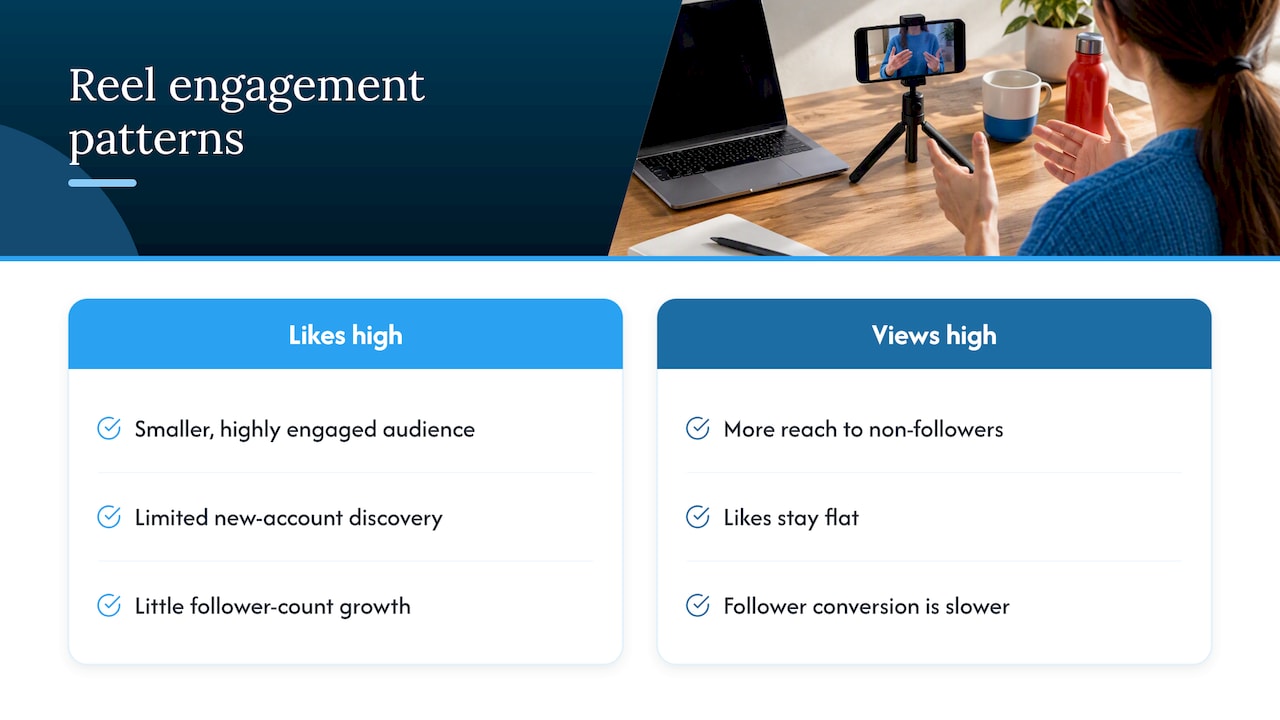
One widely shared creator account described a Reel with far more likes relative to views than their usual posts, which on inspection usually points to a smaller but highly engaged audience segment reacting to a specific, relatable hook, rather than broad discovery. That kind of Reel can lift engagement rate without moving follower count much, because it isn’t reaching new accounts.
The reverse pattern, where views spike but likes stay flat, tends to coincide with wider reach into audiences who don’t yet follow the creator. Those Reels often convert into new followers more slowly, because a single watch rarely builds enough familiarity to prompt a follow, but they expand the pool of accounts that see future content. Tracking which pattern a Reel falls into, rather than comparing raw totals across posts, gives a clearer read on which type of growth is actually happening.
How content quality and relevance shape the views-to-likes ratio
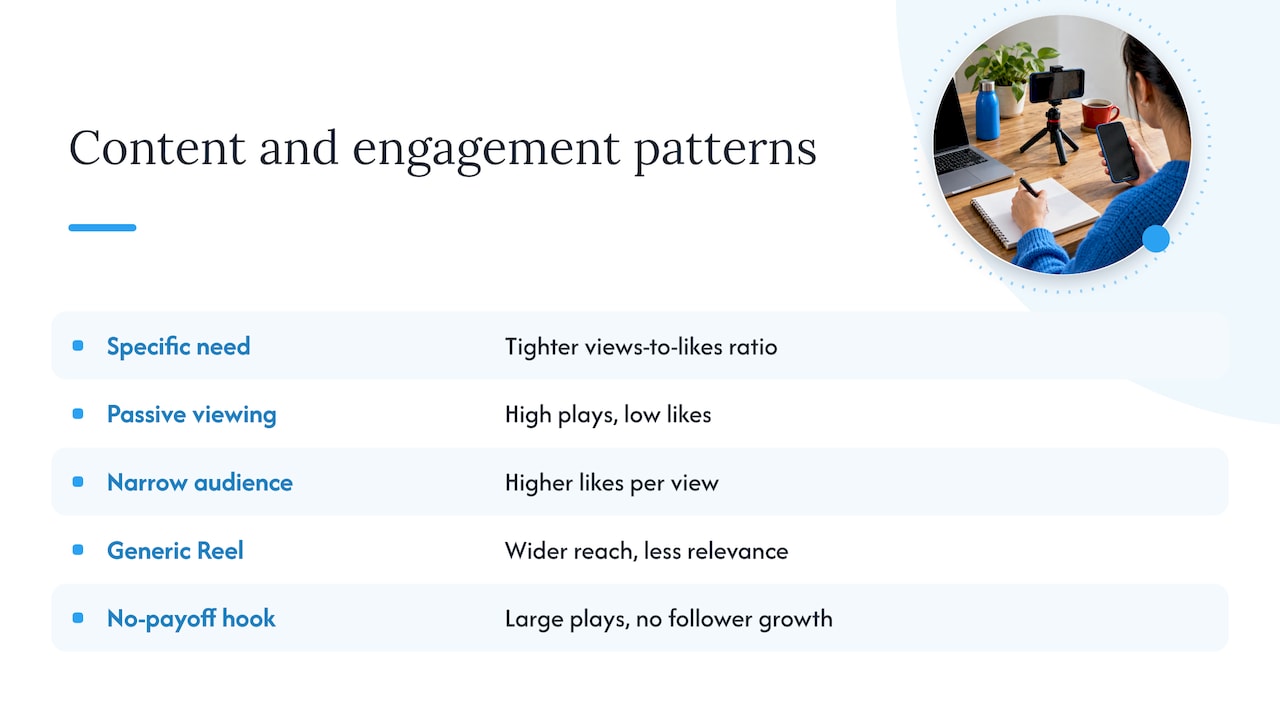
Content that answers a specific, felt need tends to produce a tighter ratio between views and likes, because viewers who find something genuinely useful are more likely to act on it. A Reel that only entertains passively, background content people watch while doing something else, usually produces the opposite: high plays, low likes, because there was never a moment that demanded a reaction.
Relevance to the specific audience matters as much as polish. A Reel aimed precisely at a narrow, engaged audience (a specific hobby, profession or local community) often earns a higher proportion of likes relative to its views than a broader, generic Reel that reaches far more people but means less to most of them.
This is why chasing views alone can mislead a creator. A Reel engineered purely for a scroll-stopping first second, with no real payoff, can post large play counts while doing nothing for the account’s credibility or follower growth. The content that moves accounts forward is usually the content that earns likes, saves and comments from people who feel the Reel was made for them, even if its total view count sits lower than the account’s average.
How format and length influence views and likes distribution
Shorter Reels (under 15 seconds) tend to post higher completion rates and, as a result, stronger average watch time relative to their length, which helps them surface to more viewers. Longer Reels can still perform well, but they need a clearer structure, usually a hook, a build, and a payoff, to hold attention long enough to avoid a watch time penalty.
Format matters too. Talking-head Reels tend to draw more comments and likes because they feel personal, while text-overlay or meme-style Reels often rack up higher plays through fast consumption and sharing but fewer likes, since viewers absorb the point quickly and move on. Tutorial or list-style Reels tend to generate more saves than likes, because viewers plan to come back to them rather than react immediately.
None of these patterns are fixed rules. They describe tendencies, not guarantees, which is why the diagnostic checklist earlier in this piece matters more than any single assumption about what format “should” work for your niche.
What the data actually changes about how I advise creators
Working through this framework with clients again and again, the lesson that sticks is simple: a Reel with modest likes but strong watch time is usually healthier than one with the reverse. Our approach pairs that diagnostic thinking with secure, transparent engagement options, so creators can validate content honestly before deciding where to add support — including practical advice on setting up Instagram auto replies for UK small businesses to capture leads effectively.
— Irwin Lee
How Greedier Social Media fits once you’ve validated what works
Once a Reel has proven itself, strong watch time, decent reach, a clear hook that holds attention, paid engagement becomes a reasonable way to speed up the social proof around it rather than a shortcut around testing. There are services built for exactly that stage:
- Buy Reel Views: adds visible plays to a Reel that has already earned strong watch time organically, helping new visitors see it as worth stopping for.
- Buy Instagram Likes: boosts the visible approval signal on content you’ve confirmed resonates, reinforcing the social proof a cautious new follower looks for.
- Buy Instagram Followers: builds the account-level credibility that makes future Reels look established to anyone who lands on your profile.
All our services deliver without needing your password, with UK-targeted support if you run into questions. Once you’ve run the hook and payoff tests above and found what sticks, visit our Instagram product range to pick the package that matches where your Reel already stands.
FAQ
How many plays on Instagram Reels are good?
There’s no fixed number that applies across accounts, since plays depend heavily on follower count, niche and how long the Reel has been live. A more useful benchmark is comparing a Reel’s plays and average watch time against your own account’s recent average, rather than against an outside figure.
What is the 3/8/12 rule for Reels?
This isn’t a documented Instagram rule, and definitions of it vary across creator discussions, so treat any specific version cautiously. The consistent idea behind it, hooking viewers in the first few seconds and restructuring content around short attention windows, lines up with the hook and payoff testing covered earlier in this guide.
Do Reels show likes to other viewers?
Yes, Instagram displays the like count on Reels to anyone who views them, unless the creator has hidden like counts on their account through Instagram’s settings. That visible number still functions as social proof even though it’s a weaker predictor of reach than watch time or saves.
How can I increase the reach of my Instagram Reels?
Reach improves most reliably when average watch time rises, since Instagram’s distribution responds to how long people stay rather than to raw plays. Testing your hook, tightening the content’s payoff and prompting saves or shares, as outlined in the checklist above, are the most direct levers; our guide to getting more Reel views covers additional organic tactics.
Why does my Reel have more likes than views compared with others?
This pattern often points to a smaller, highly engaged audience segment reacting strongly to a specific, relatable hook rather than broad discovery. It can also follow engagement pod activity, where a cluster of creators like posts quickly after publishing, which inflates likes relative to genuine reach.