
TL;DR:
- Performance marketing on social media involves paying only for measurable actions like clicks or sales, not just ad impressions. Small businesses benefit from precise targeting, scalable results, and better cost control by focusing on outcomes instead of vanity metrics. Success depends on proper tracking, continuous testing, and a structured approach to optimize campaigns effectively.
Most small business owners assume that spending money on social media ads automatically qualifies as performance marketing. It does not. What is performance marketing social media really about? It is a specific model where you only pay when a measurable action happens: a click, a lead, a purchase. Unlike boosting posts for visibility, performance marketing on social media ties every pound you spend to a result you can track. This guide breaks down how it works, what metrics matter, how to run effective campaigns, and how to avoid the mistakes that drain budgets without delivering results.
Table of Contents
- Key takeaways
- What is performance marketing on social media?
- Metrics and conversion tracking
- How to plan and launch a performance campaign
- Common pitfalls in performance marketing
- Benefits of performance marketing for small businesses
- My honest take on performance marketing
- How Greediersocialmedia can support your growth
- FAQ
Key takeaways
| Point | Details |
|---|---|
| Pay only for results | Performance marketing means payment is triggered by specific actions like clicks or sales, not just ad placement. |
| Metrics determine success | CPA, ROAS, and CTR tell you whether your spend is generating real business value. |
| Tracking setup is non-negotiable | Without correct conversion tracking, you cannot optimise campaigns reliably or measure true ROI. |
| Volume thresholds matter | Meta requires roughly 50 conversions per week per ad set before its algorithm can optimise effectively. |
| Testing drives improvement | Continuous A/B testing of creatives and audiences is what separates improving campaigns from stagnating ones. |
What is performance marketing on social media?
Performance marketing is a pay-for-action model where payment only occurs after a specific, trackable outcome takes place. That outcome might be a click on your ad, a form submission, or a completed purchase. No result, no payment. This is fundamentally different from traditional advertising where you pay for placement and hope for the best.
On social media, performance marketing focuses on paid ads targeted through platform demographics, interests, and behaviours. You are not simply broadcasting a message. You are reaching people who are genuinely likely to act, and you are paying only when they do.
The core channels for performance marketing in social media include:
- Paid social ads on Facebook and Instagram, where you target users by age, location, interests, and purchase behaviour
- LinkedIn ads for B2B audiences, targeting by job title, company size, or industry
- TikTok ads for reaching younger, highly engaged audiences through short video formats
- Affiliate marketing on social platforms, where creators earn a commission per sale they drive
Each of these channels shares one defining characteristic. Payment is tied to measurable outcomes rather than impressions alone. The metrics you will see most often are cost per click (CPC) and cost per acquisition (CPA). These tell you precisely how much each interaction or customer is costing you, which gives you real control over your budget.
If you are choosing which social platforms suit your business, understanding where your audience spends their time is the starting point for any performance campaign.
Metrics and conversion tracking
Understanding which numbers to watch is what separates a marketer who guesses from one who knows. The most important metrics in social media advertising performance are:
| Metric | Definition | When to use it |
|---|---|---|
| CPA (Cost per acquisition) | Total ad spend divided by the number of acquisitions | Measuring the cost of each customer or lead |
| CPL (Cost per lead) | Total spend divided by leads generated | Lead generation campaigns |
| ROAS (Return on ad spend) | Revenue generated per pound spent on ads | Evaluating profitability of sales campaigns |
| CTR (Click-through rate) | Percentage of people who clicked your ad after seeing it | Assessing creative and audience relevance |
| CVR (Conversion rate) | Percentage of clicks that result in a desired action | Diagnosing landing page and offer quality |
ROAS is expressed as a ratio, such as 5:1, meaning you earn £5 for every £1 spent. For most e-commerce businesses, a ROAS of 3:1 or above is the minimum target before a campaign becomes viable.
Conversion tracking is what makes any of this possible. Conversion tracking measures valuable actions such as purchases or sign-ups that result from ad interactions. On Meta platforms, this means installing the Meta Pixel or Conversions API on your website and defining specific conversion events, for example, a “Purchase” event triggered when someone reaches your order confirmation page.
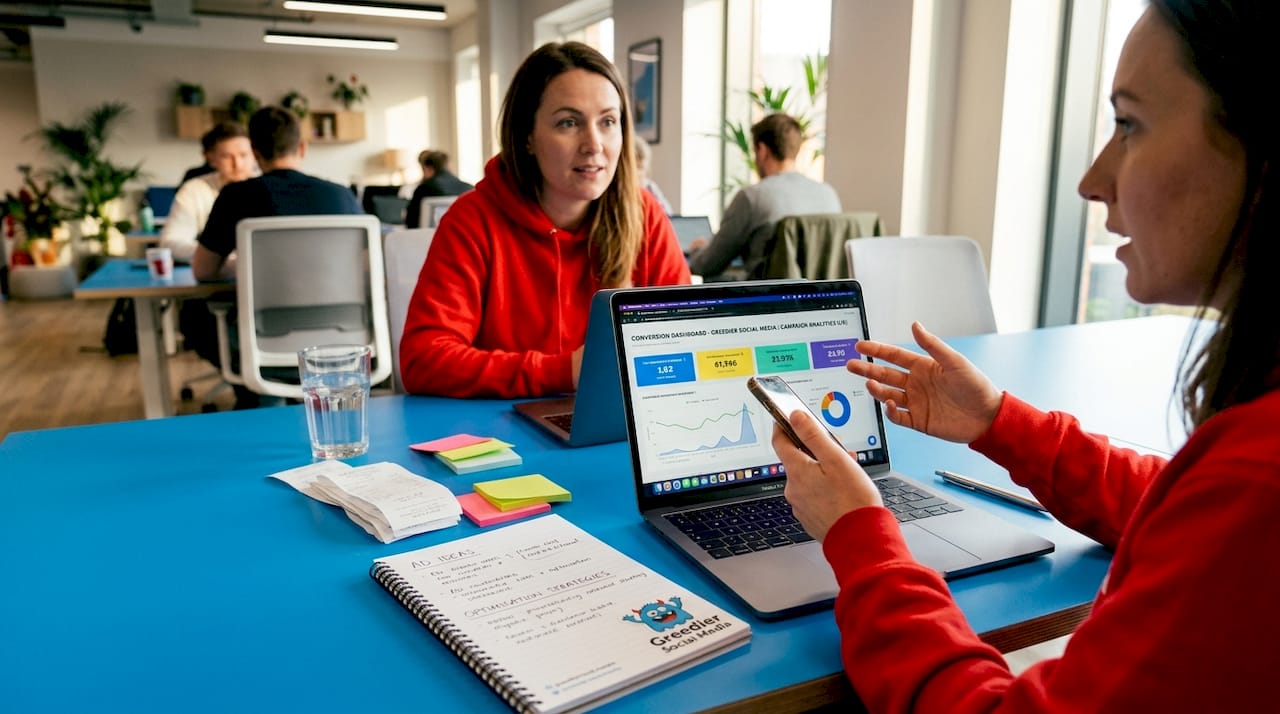
Without this setup, the platform has no signal to learn from. Your campaign will spend money but cannot tell you why some ads work and others do not.
Pro Tip: Always verify your conversion events are firing correctly before launching a campaign. Use Meta’s Events Manager or Google Tag Assistant to confirm every event is tracked accurately. One misconfigured event can skew your entire campaign’s data.
A crucial nuance that many overlook: metrics must be viewed in context. A high cost per click is not automatically a problem. If your conversion rate is strong and your ROAS holds up, that higher CPC is simply the price of a profitable customer.
How to plan and launch a performance campaign
A structured approach is what prevents wasted spend. Here is a practical workflow for running effective social media campaigns as a small business or creator.
- Define your goal clearly. Are you selling a product, collecting email addresses, or driving app installs? Your goal determines every decision that follows, including which campaign objective you select on the platform.
- Choose the right channel. Facebook and Instagram work well for consumer products. LinkedIn suits professional services. TikTok favours products that demo well visually. Match the channel to your audience and product type.
- Set your budget and KPIs before you launch. Decide what an acceptable CPA looks like based on your margins. If your product costs £40 and your margin is 50%, a CPA above £15 probably makes the campaign unviable.
- Build your campaign structure. Create separate ad sets for distinct audiences rather than lumping everyone together. This allows the algorithm to learn which audience responds best.
- Launch and enter the learning phase. A recommended workflow includes defining goals, selecting channels, and then optimising based on real-time data. On Meta, your ad sets need roughly 50 conversions per week to exit the learning phase and reach stable performance.
- Optimise continuously. Kill underperforming ads after sufficient data. Scale what works. Refresh creatives before they fatigue.
Continuous A/B testing of creatives and audiences is where campaigns genuinely improve over time. Test one variable at a time: swap the headline, change the image, or shift the audience age range. Small changes can produce significant differences in click-through rates and conversion volumes. For more practical social media tips, these principles apply across both organic and paid strategies.
Pro Tip: If your purchase volume is too low for Meta’s algorithm to optimise effectively, use a higher funnel event like “Add to Cart” or “Initiate Checkout” as a proxy conversion. Once volume builds, switch your optimisation event to Purchase.
Common pitfalls in performance marketing
Even experienced marketers run into the same traps. Knowing them in advance saves significant time and budget.
- Chasing vanity metrics. Reach, impressions, and page likes feel encouraging but tell you nothing about revenue. If your campaign objective is sales, optimise for sales, not engagement.
- Poor tracking setup. Discrepancies between platform and CRM tracking lead to misleading KPIs. If your Meta dashboard shows 50 purchases but your Shopify store shows 30, you have a tracking problem that needs fixing before you make any spend decisions.
- Optimising for the wrong event. Incorrect conversion tracking can mislead you into optimising for clicks instead of qualified leads or sales. This misalignment produces volume without profit.
- Ignoring the conversion event hierarchy. If you are getting fewer than 50 purchase conversions per week, the Meta algorithm cannot learn efficiently. Using higher funnel proxy events gives the algorithm the data volume it needs.
- Scaling too fast. Doubling a budget overnight shocks the algorithm back into the learning phase. Increase budgets by no more than 20% every 48 hours when a campaign is performing well.
- Misaligned landing pages. Aligning your offer with what you track as a conversion is critical. If your ad promises a discount but your landing page does not mention it, your conversion rate will suffer regardless of how good your targeting is.
Inside professional agencies, performance marketing runs as a structured test system with pre-locked business outcomes and KPIs to prevent exactly this kind of metric chasing. You can apply the same discipline by writing down your success criteria before you launch, not after.
Benefits of performance marketing for small businesses
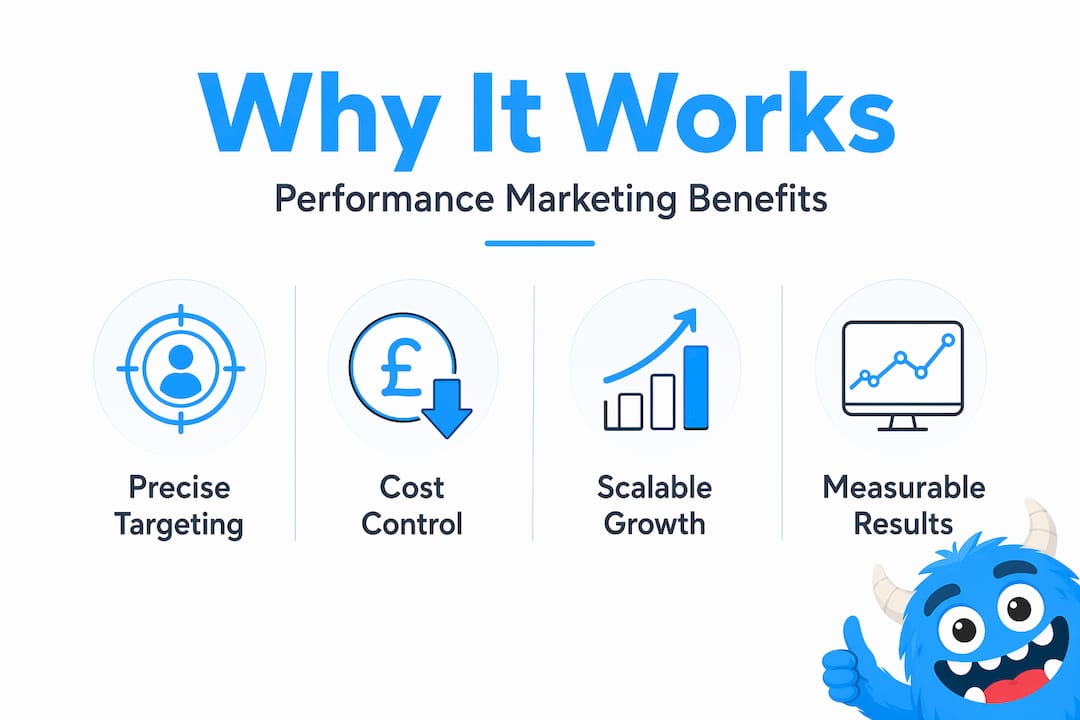
The clearest reason to adopt performance marketing in social media is financial control. You are not gambling on whether an ad campaign will pay off. Every pound is tied to a defined action, which means you can calculate profitability before you scale.
“Performance marketing shifts financial risk onto the publisher because payments occur only after specified outcomes, incentivising stronger alignment between advertiser goals and campaign execution.” This model contrasts directly with brand advertising, where you pay upfront regardless of what happens next.
Beyond cost control, the benefits of performance marketing for small businesses include targeting precision that was simply not available a decade ago. You can reach people aged 30 to 45, living within 10 miles of your shop, who have shown interest in your product category and visited competitor websites. That level of specificity is what makes performance campaigns so efficient compared to traditional media.
Scalability is another major advantage. Once you identify a campaign that achieves your target CPA, you can increase budget incrementally and grow revenue in a predictable way. The Facebook ad conversion benchmarks show that average conversion rates vary significantly by industry, which means understanding your own baseline matters enormously before you judge a campaign as succeeding or failing.
For content creators, performance marketing explains how sponsored content deals are structured around measurable actions. Brands pay creators a commission per sale or lead rather than a flat fee, which rewards creators whose audiences genuinely convert. Understanding Facebook Ads KPIs in this context helps both brands and creators agree on fair, outcome-based terms.
My honest take on performance marketing
I have worked with enough small businesses to know the most common mistake is not a tracking error or a poor creative. It is confusion about what the campaign is actually supposed to achieve. Owners launch ads because they feel they should be advertising, not because they have defined a specific, profitable outcome they are working toward.
Performance marketing sounds technical, but its core logic is straightforward. Pay for results, measure everything, and stop doing what does not work. Where I see businesses struggle is in the middle part. They track their data but then refuse to act on it, either because they are emotionally attached to a particular ad creative or because a low-performing campaign has not been given enough time to exit the learning phase.
My honest advice: treat your first 30 days of any performance campaign as a research exercise, not a profit exercise. You are buying data. Once you know your CPA and conversion rate, then you can make informed decisions about scale. Chasing ROAS in week one is how budgets disappear without useful information.
Brand building and direct response are not opposites. The businesses I have seen succeed long-term use performance marketing for immediate sales and invest separately in organic social presence to lower their cost of acquisition over time. One feeds the other.
— Luna
How Greediersocialmedia can support your growth
Getting performance marketing right on social media is significantly easier when your account already has credibility. A profile with strong follower counts and engagement signals sends trust cues to both your audience and the platforms you advertise on, which can improve your ad relevance scores and lower costs.
Greediersocialmedia has been helping UK businesses and creators build genuine social media presence since 2013, supporting over a million satisfied users. Whether you need to grow your followers quickly or increase your social media audience before launching a performance campaign, the team provides real followers, likes, and views without requiring your password. That combination of trust, speed, and security is what makes Greediersocialmedia a practical first step for any business looking to compete seriously on social.
FAQ
What is performance marketing on social media?
Performance marketing on social media is a paid advertising model where you only pay when a specific, measurable action occurs. That action might be a click, a lead, or a completed sale, depending on your campaign objective.
How is performance marketing different from boosting posts?
Boosting posts pays for reach and visibility with no guarantee of a measurable outcome. Performance marketing tracks specific conversion events and optimises your spend toward the actions that drive real business results.
What metrics matter most in social media performance campaigns?
CPA, ROAS, and CTR are the core metrics for assessing whether a performance campaign is profitable. ROAS in particular tells you how much revenue you are generating for every pound spent on advertising.
Why does Meta need 50 conversions per week?
Meta’s algorithm requires roughly 50 conversions per week per ad set to exit the learning phase and optimise reliably. Below this threshold, the platform lacks sufficient data to identify which users are most likely to convert.
Can small businesses compete using performance marketing?
Yes, and they are often better placed than large brands to iterate quickly. With a clear goal, correct tracking, and a willingness to test, even modest budgets can generate strong results when campaigns are structured properly.