
Finding the right Instagram follower drop fix starts with understanding why the drop happened in the first place.
If the drop you are seeing followed a bot-based follower purchase elsewhere, this is very likely a purge, real accounts do not get removed the same way. If you are looking to top your numbers back up with something that will not repeat this cycle, see our Instagram Followers page for real, gradually-delivered growth.
Most sudden follower drops are one of three things: a platform purge removing bots and inactive accounts, a slow content strategy problem, or a temporary glitch. Check Instagram Insights for net follows and profile visits, then open Account Status. If engagement held steady or improved, this is likely a purge and needs no panic. If the loss exceeds 5% over several weeks, it’s a strategy issue worth fixing now.
TL;DR:
- If follower drops coincide with a sudden overnight loss and engagement remains steady or improves, it’s likely a platform purge affecting fake accounts.
- Sustained weekly follower loss above 5% over several weeks indicates a content or strategy issue, not just normal churn.
- A drop in both followers and profile visits suggests reach or content-match problems, while stable visits with falling followers point to a purge or cleanup.
- Genuine account restrictions, policy strikes, or login issues can reduce reach and followers, but glitches usually recover within 24 to 48 hours without strategy changes.
- Prioritize tracking engagement, saves, and shares over follower count, as higher-quality followers who engage drive more meaningful growth and visibility.
Table of Contents
- Instagram follower drop fix: a 15-minute diagnosis checklist
- Why did my followers drop? The real causes explained
- How do I use Instagram Insights to diagnose a follower drop?
- What’s the 30-day plan to fix a follower drop?
- Content formats that actually earn shares and saves
- Is the drop a glitch, a purge, or an account problem?
- What should you track instead of raw follower count?
- Greedier Social Media’s proven approach to follower recovery
- Why cross-promotion keeps your follower count stable
- Quality followers versus follower count: which one matters?
- Could a shadowban be behind your follower drop?
- How community engagement helps you regain lost followers
- Recovery isn’t instant, and that’s the point
- Greedier Social Media: managed recovery without the guesswork
- Sources
- FAQ
Instagram follower drop fix: a 15-minute diagnosis checklist
Before changing anything about your content, work out what actually happened. Guessing wastes time, and the wrong fix (posting more, buying followers, deleting content) can make a strategy problem worse or undo the benefit of a healthy purge.
Run through this in order:
- Check the timing. Open Insights and look at your follower graph over the last 30 days. A steep, overnight drop of dozens or hundreds of followers points to a platform-wide purge. A gradual slide over two or three weeks points to a content or cadence problem.
- Compare engagement rate against the drop. If your engagement rate per post held steady or rose while followers fell, the accounts you lost weren’t engaging anyway. That’s a purge, not a strategy failure.
- Look at profile visits. A fall in both followers and profile visits together suggests fewer people are finding you at all, which usually means a reach or content-fit issue rather than a cleanup.
- Open Account Status in Settings. Instagram flags policy strikes, restricted distribution, and other account-level issues here. If it’s clean, technical account trust probably isn’t the cause.
- Check Login Activity. An unfamiliar login or device you don’t recognise can trigger automated restrictions that quietly suppress reach and cost you followers over time.
- Search creator forums or Downdetector. If hundreds of other accounts are reporting the same pattern on the same day, you’re looking at a platform-wide event, not something you did.
Ten minutes on these six checks tells you almost everything. If the drop coincided with a known cleanup window and your engagement rate improved, move straight to the recovery plan below and treat this as a non-issue. If the numbers point to declining reach and falling profile visits with no known purge event, the problem is your content or cadence, and that needs a different set of fixes.
Pro Tip: Screenshot your Insights weekly. A single snapshot tells you little, but four weeks of screenshots let you see whether a drop was a one-off event or the start of a trend, which changes how urgently you need to act.
Why did my followers drop? The real causes explained
Follower loss almost always traces back to one of seven patterns. Some are entirely healthy. Others need direct action.
- Bot and fake-account purges. Instagram removed over 490 million fake accounts in a single year as part of ongoing platform cleanups. If you or a previous marketing effort ever attracted low-quality followers, a purge will remove them in a single sweep, and your engagement rate typically rises afterwards because the denominator shrank while genuine engagement stayed flat.
- Content drift. When your posts gradually stop matching what people followed you for, unfollows creep up slowly rather than all at once. This is the hardest cause to spot because no single post triggers it.
- Over-posting and content fatigue. Flooding the feed multiple times a day trains your existing audience to scroll past you, and the algorithm often responds by showing your content to fewer of your own followers.
- Hashtag misuse. Reusing the identical hashtag set on every post, or using tags that have been restricted or banned, measurably limits distribution. One analysis linked 17% of follower loss incidents directly to hashtag problems.
- Follow/unfollow tactics and purchased low-quality followers. Accounts that mass-followed to get follow-backs, or bought cheap followers years ago from disreputable sources, see those numbers decay as the platform periodically cleans house.
- Algorithm distribution shifts. The 2026 algorithm weights shares and saves far more heavily than likes when deciding who sees your content next. If your format never earned saves or DM shares, you were already losing quiet reach before the follower count showed it.
- Account trust issues. Unusual login activity, reported content, or policy strikes can trigger reduced distribution, which indirectly drives unfollows because fewer people ever see you show up in their feed.
1–3% monthly churn is normal for every active Instagram account. Anything sustained above 5% over several weeks is the threshold where you should stop assuming it’s natural and start diagnosing, according to industry benchmarking.
The useful insight buried in all this: a smaller, more engaged following consistently outperforms a larger, passive one. Losing fake or dormant followers is frequently a net positive, even though it never feels that way on the day the number drops. If you’ve previously relied on low-quality follower purchases, this is also the point where it’s worth understanding the long-term effects of buying followers before repeating that mistake.
How do I use Instagram Insights to diagnose a follower drop?
Insights gives you five numbers that, read together, tell you almost exactly what happened. Read them in isolation and you’ll misdiagnose the problem.
- Net follows. The raw gain minus loss figure for the period. Useful only as a starting point, never the whole picture.
- Profile visits. Falling visits alongside falling followers means fewer people are discovering you. Stable or rising visits alongside falling followers means people are seeing you but choosing not to follow, or you’re mid-purge.
- Saves. The strongest single signal of content-market fit. A save means someone valued the post enough to want it again later.
- Shares (DM sends). In 2026, shares carry more algorithmic weight than almost any other engagement type, because a share is a direct endorsement to another person.
- Reach and Reel retention. Watch-through percentage on Reels tells you whether your hook is working in the first three seconds, which drives how widely the platform distributes the rest.
Pull each of these across two consecutive 7-day windows and compare them side by side. A drop of more than 5% in reach or saves week-on-week, on top of falling followers, is a genuine warning sign rather than noise. If saves and profile visits held steady while followers fell, that pairing typically signals a purge rather than a content problem, because the people still engaging with you never left.
Never hand your login credentials to a third-party follower tracker to get this data. Use Instagram’s own data export tools or built-in Insights instead. Handing over your password to an unofficial app is how genuine account trust problems start, and it’s an unnecessary risk when the native tools already answer the question.
Pro Tip: If engagement rate rose in the same week followers dropped, don’t touch your content strategy. You’d be fixing something that isn’t broken and potentially disrupting a format that’s actually working.
What’s the 30-day plan to fix a follower drop?
Recovery follows a predictable shape: stabilise first, rebuild structure second, push engagement third, then refine based on what the data tells you. Trying to skip straight to step three without the foundation in place is the most common reason recovery plans stall.
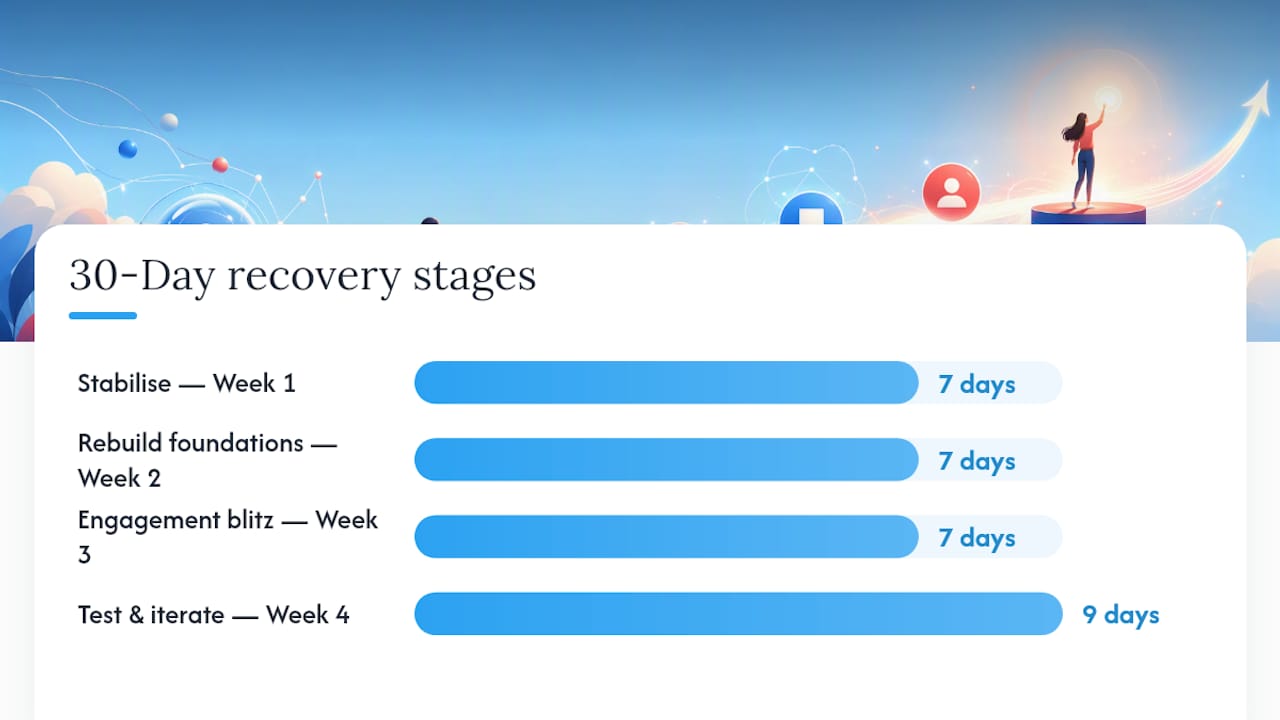
Week 1: Stabilise.
Pause any post types that seemed to trigger the drop until you understand the cause. Set two fixed daily windows to reply to comments and DMs. Post to Stories every single day, even something minor, to keep the algorithm reading you as active. Check Account Status once at the start of the week and again at the end.
Week 2: Rebuild the foundations.
- Choose three to four content pillars that define what your account is actually for.
- Batch-create 10 to 15 posts against those pillars in one sitting, rather than scrambling daily.
- Schedule three to five feed posts for the week, which research consistently identifies as the cadence with the best stability-to-growth ratio, alongside your daily Stories.
Week 3: Engagement blitz.
- Reply to every comment and DM within 60 minutes of it landing, particularly on new posts, since the first hour after publishing shapes how far the algorithm pushes it.
- Use Story stickers (polls, questions, quizzes) daily to generate two-way interaction rather than passive viewing.
- Spend 15 to 20 minutes genuinely engaging with 10 to 15 accounts in your niche, leaving real comments rather than generic emoji.
Week 4: Test and iterate.
- Pull your saves and shares data from weeks 2 and 3 and identify which formats produced the most of each.
- Run a simple A/B test on captions: one direct call-to-action version against one open-question version, across similar posts.
- Drop anything that produced neither saves, shares, nor comments, no matter how much you personally like the format.
By day 30 you should see net follows flatten or turn positive, and saves or shares per post trending upward against your week 1 baseline. If those numbers are moving in the right direction but slowly, keep running the same plan for another two to three weeks. Full stabilisation typically takes two to six weeks once the underlying strategy issue is actually fixed, so don’t panic if day 30 shows progress rather than a finished result. If nothing has moved at all by day 21, the diagnosis in week 1 was probably wrong, and it’s worth running the checklist again before continuing.
Content formats that actually earn shares and saves
Followers don’t come back because you post more. They come back because your content earns the two signals the algorithm rewards most: shares and saves. Build around formats that naturally produce them.
- Send-to-a-friend content. Relatable one-liners, a quick “did you know” fact, or a surprising statistic in your niche. The test for this format is simple: would a stranger tag a specific friend in your comments?
- Save-worthy carousels. Step-by-step how-tos, checklists, or “swipe for the full breakdown” formats that people bookmark to revisit rather than consume once and scroll past.
- Strong Reel hooks. The first three seconds decide whether someone keeps watching. Open with a question, a bold claim, or a visual that contradicts expectation, since retention in that opening window drives how far the Reel travels afterwards.
- Caption CTAs that don’t sound like begging. Ask a specific question that invites a DM reply, or explicitly say “save this for later” when the post is genuinely reference material. A vague “like and share” prompt earns nothing.
- Rotating hashtag sets. Build three to five different sets of 15 to 20 relevant tags and rotate between them rather than pasting the same block on every post. Check each tag periodically, since previously fine hashtags occasionally get restricted without warning.
The underlying shift here matters more than any single tactic: stop asking “would someone like this?” and start asking “would someone send this to a specific friend?” That single reframe changes what you post far more than any hashtag adjustment. For a deeper breakdown of formats that consistently earn saves, see how saves influence Instagram ranking and how to build genuinely engaging content around it.
Is the drop a glitch, a purge, or an account problem?
Three technical scenarios get mistaken for strategy failures constantly, and each needs a different response.
Purges show up as a large, sudden overnight loss, often across many accounts at once. Your engagement rate typically improves afterwards because the accounts removed were never engaging in the first place. There’s nothing to fix here; treat it as routine platform maintenance.
Glitches look similar but tend to correct themselves. If your follower count drops sharply and then partially or fully recovers within 24 to 48 hours with no corresponding change in engagement, it was likely a display or reporting error rather than a real loss.
Account trust issues are the one that genuinely needs your attention:
- Check Account Status for any policy strikes, restricted distribution notices, or flagged content.
- Review Login Activity for devices or locations you don’t recognise, since an unauthorised login can trigger automatic restrictions.
- Look for security alerts in your notifications you might have dismissed without reading properly.
- If Account Status shows a genuine restriction with no clear cause, that’s the point to contact Instagram support directly, understanding that response times are often measured in days rather than hours.
Don’t overhaul your content strategy in response to something that was never a strategy problem. Wait the 24 to 48 hours first, run the checks above, and only start making changes once you’ve ruled out a glitch or a purge.
What should you track instead of raw follower count?
Follower count is the number everyone watches and the least useful one for judging whether your account is actually healthy. Engagement rate, saves, and shares tell you far more, because they measure whether the people who do follow you actually care.
Normal monthly churn sits at 1 to 3% for virtually every active account, purge or no purge. Only treat a decline as a genuine problem once it’s sustained above 5% across several weeks, checked against the diagnosis steps earlier in this piece.
| Metric | Healthy signal | Warning sign |
|---|---|---|
| Monthly follower churn | 1–3% | Sustained above 5% for 3+ weeks |
| Saves per post | Rising or stable week-on-week | Falling alongside follower loss |
| Shares (DM sends) | Rising or stable | Falling alongside follower loss |
| Profile visits | Stable or rising during a follower dip | Falling in step with followers |
Check these weekly rather than daily, since daily figures are too noisy to act on reliably. Followers tend to follow engagement, not the other way round.
Greedier Social Media’s proven approach to follower recovery
Some social media services have supported over one million users since 2013, and the core lesson from that experience is simple: stabilising an account is a process, not a single fix.
- Deliveries often run through secure, password-free access, so clients do not have to hand over login credentials to get support.
- Some packages include drop protection periods, giving accounts breathing room while a content strategy fix takes effect.
- Such services often suit creators dealing with recurring purge cycles, busy business owners without time to run a full diagnostic and 30-day plan themselves, and those wanting faster stabilisation than a purely organic timeline allows.
Free diagnosis and the 30-day plan above are genuinely enough for most accounts with a straightforward content or cadence issue. Paid support makes more sense when drops keep recurring despite fixes, when there’s no time to run weekly Insights checks, or when an account previously relied on low-quality bought followers that need replacing with something more durable. Knowing which category you’re in is the real decision, not the tactics themselves.
Why cross-promotion keeps your follower count stable
Cross-promotion and collaborations do something the algorithm can’t: they introduce you to an audience that’s already primed to trust you, because someone they already follow vouched for you first.
A shoutout swap, a joint Reel, or a guest slot on someone else’s Story pulls in followers who convert at a far higher rate than cold discovery through hashtags or Explore. These followers tend to stick, because they arrived through a recommendation rather than an algorithmic guess about their interests.
Collaborations also protect you against the single-platform risk that makes follower drops feel so alarming in the first place. If your growth depends entirely on Instagram’s own distribution deciding to favour you, a purge or algorithm shift can knock your numbers around badly. If part of your growth comes from partnerships with accounts in adjacent niches, that channel keeps functioning regardless of what Instagram’s algorithm does that week.
The most durable version of this isn’t a one-off shoutout swap. It’s an ongoing relationship: a recurring collaboration series, a regular guest-feature format, or a standing agreement to tag and feature each other’s relevant content. That consistency compounds in a way single collaborations never do, because your audiences slowly merge rather than briefly overlapping once.
If you’ve been treating your follower count as the only metric that matters, cross-promotion is also a useful reminder that where followers come from matters as much as how many arrive.
Quality followers versus follower count: which one matters?
A thousand followers who save, share, and comment will outperform ten thousand who scroll past you every time, in almost every metric that actually affects your reach. The algorithm doesn’t care how large your audience is. It cares how many of them do something after seeing your post.
This is why losing followers after a purge often coincides with your engagement rate visibly improving. The accounts removed were dead weight in the calculation: they counted towards your total but contributed nothing to the signals that determine who sees your next post. Once they’re gone, the same number of saves and comments gets divided across a smaller base, and the percentage climbs.
Chasing raw follower count with cheap growth tactics tends to make this worse over time, not better, because it inflates the denominator without touching the numerator. The healthier long-term move is optimising for engagement quality first and treating follower growth as something that follows from it, rather than a target in itself. Accounts that flip this priority, chasing numbers over engagement, are usually the ones that experience the sharpest, most painful drops later.
Could a shadowban be behind your follower drop?
A shadowban means Instagram has quietly reduced your content’s distribution, usually to non-followers, without any formal notice. It’s harder to prove than most creators assume, and a genuine sustained shadowban is rarer than the term’s popularity online suggests.
The clearest signs: your reach on Explore and hashtag pages collapses even though your engagement rate among existing followers stays normal, your reach drops sharply right after using a hashtag that’s since been flagged, or non-follower reach falls to near zero for several consecutive posts with no other explanation.
To check it, post using a hashtag not currently in your regular rotation and ask a few people who don’t follow you to search that tag and see if your post appears. If it consistently doesn’t show up under hashtags you’re using correctly, that’s a stronger signal than a single post’s low reach, which can just be normal variance.
The usual causes are the ones already covered here: banned or flagged hashtags, a recent policy strike, or content reported by other users. The fix is rarely dramatic. Stop using the suspect hashtag, avoid repeating whatever triggered a report, and give it a week or two, since most shadowban effects fade once the triggering pattern stops rather than requiring any special appeal process.
How community engagement helps you regain lost followers
The fastest way to rebuild a following isn’t posting more. It’s spending time in other people’s comment sections, genuinely.
Engaging with 10 to 15 accounts in your niche daily, leaving specific comments rather than generic ones, puts your name in front of an audience that’s already interested in your subject matter. This works because it’s the inverse of paid discovery: instead of hoping the algorithm shows your content to the right people, you go directly to where they already are.
Responding to every comment and DM on your own posts matters just as much. An account that replies feels active and worth following. An account that posts and disappears feels like a broadcast, and broadcasts get unfollowed at a higher rate over time.
Community engagement compounds slowly, which is exactly why most people give up on it too early. Two weeks of consistent, genuine interaction with your niche rarely produces a dramatic follower spike. What it does produce is a steadier trickle of new, well-matched followers who arrived because they saw you show up repeatedly in spaces they already trust, not because an algorithm pushed your Reel once.
Recovery isn’t instant, and that’s the point
The uncomfortable truth about follower drops is that most creators want a same-day fix for something that took weeks to build up, in one direction or the other. A purge resolves itself immediately because there was never a real problem. A genuine content or cadence issue takes the two to six weeks this piece has already laid out, and no tactic shortens that meaningfully without risking a worse rebound later.
What I’d push back on is the instinct to treat every drop as a crisis demanding an overhaul. Engagement quality is the number that predicts your account’s future, not the follower count sitting at the top of your profile. An account that loses 200 followers but gains a 20% lift in saves has had a good month, even though it doesn’t feel that way when you check your profile.
— Luna
Greedier Social Media: managed recovery without the guesswork
If running weekly Insights audits and a 30-day content overhaul isn’t something you have time for, some services offer a direct alternative for creators and businesses who want stabilisation handled for them.
Some services focus on secure, password-free delivery of followers, likes, and views, with drop protection built into packages so a fresh purge or algorithm shift doesn’t undo the work. They suit creators dealing with recurring drop cycles, business owners juggling too much to run a full diagnostic themselves, and anyone whose account previously relied on low-quality followers from a disreputable source and needs a cleaner foundation to rebuild on. Compared against buying cheap engagement from unverified sellers, these services often emphasize accountability, with defined recovery windows rather than one-off, unsupported purchases.
If a recurring drop pattern is what brought you here, the practical next step is to look at growth hacks built for exactly this problem and see whether managed support fits your situation better than another month of manual fixes.
Sources
For readers who want to verify the figures and thresholds used throughout this piece, these are the primary sources:
- Why you’re losing Instagram followers (and how to fix it) — Mysocial
- How the Instagram algorithm works in 2026 — Hootsuite
- Why am I losing followers on Instagram? — InstantDM
- Sudden drop in Instagram followers — Dicloak
FAQ
What is the 5-3-1 rule on Instagram?
Definitions of this rule vary across creator communities, and there’s no single authoritative version tied to Instagram’s own guidance, so it’s best treated as informal advice rather than an official benchmark. The cadence figures backed by industry data in this piece, three to five feed posts weekly plus daily Stories, are a more reliable target.
Why did my Instagram followers suddenly drop today?
A sharp, single-day loss usually means a platform-wide purge removed fake or inactive accounts, especially if your engagement rate stayed flat or improved. Check Account Status to rule out a policy issue before assuming it’s strategy-related.
How do I fix an Instagram follower count glitch?
If the count drops and then partially recovers within 24 to 48 hours with no matching change in engagement, wait it out rather than reacting. Genuine glitches self-correct; if the number doesn’t recover and Account Status shows a flag, that’s a different, real issue.
How long does it take to recover lost Instagram followers?
Measurable stabilisation typically takes two to six weeks once the underlying cause is correctly diagnosed and fixed. Accounts that want faster, managed stabilisation can also consider structured growth support alongside the organic plan.