
TL;DR:
- Creating saveable resource posts, short videos, and community engagement are the most effective ways to increase visibility without paid ads. Focus on signals like saves, private sends, and watch-time rather than likes, and dedicate just five hours weekly to planning, producing, posting, and engaging. Consistent posting of targeted formats and strategic community participation within 30 days can lead to measurable organic growth and stronger algorithmic distribution.
Short-form video (Instagram Reels, TikTok, YouTube Shorts), saveable reference posts, and community surfaces (Facebook Groups, personal profiles) are the highest-impact ways to increase post visibility without paid ads. The signals that move algorithms are saves, private sends, watch-time retention, and non-follower reach — not likes. Start this week: publish one saveable post, one sendable post, and one short video. Budget approximately 5 hours per week and measure from there.
What to watch from day one:
- Saves and private sends (shares via DM) over likes
- Non-follower reach percentage in native analytics
- Watch-time retention on any video content
- Profile visits triggered by discovery posts
Table of Contents
- What does a 30/90-day organic plan actually look like?
- How do you design posts people actually save and send?
- Which platforms should UK SMBs focus on in 2026?
- Community-first engagement tactics that expand your reach
- How do you structure content so AI search can find and cite it?
- Which metrics matter, and what free tools can you use?
- What results do UK clients typically see?
- Common mistakes that quietly kill your organic reach
- Key takeaways
- Why consistency beats chasing trends
- Useful sources and further reading
- FAQ
What does a 30/90-day organic plan actually look like?
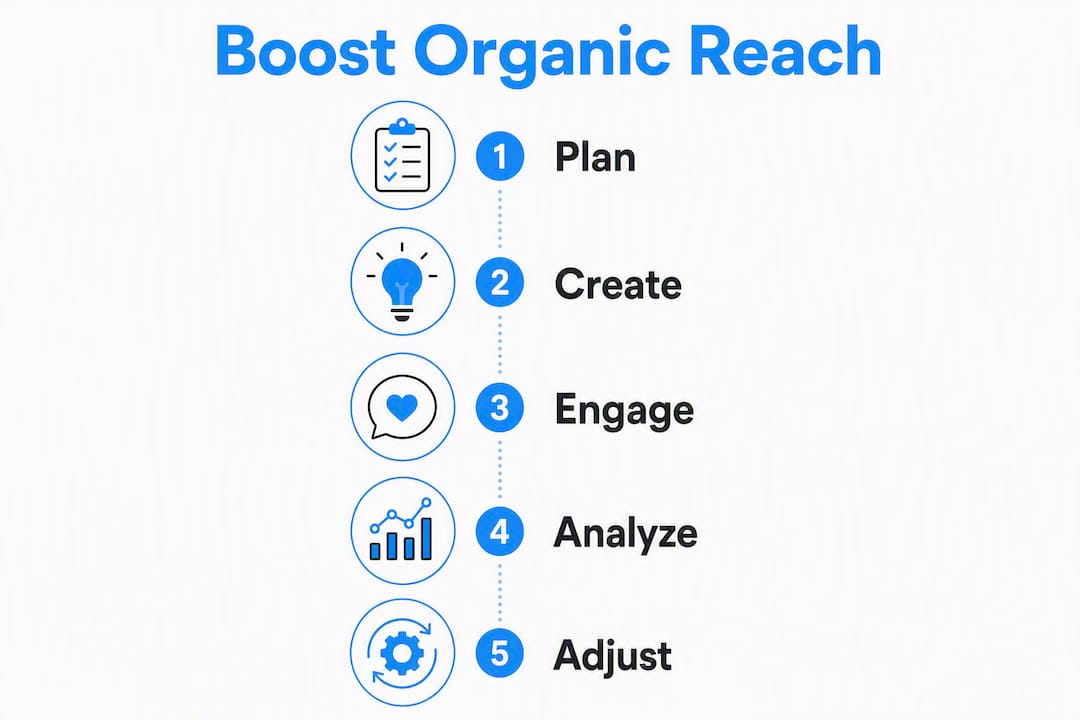
A structured cycle beats random posting every time. Here is a realistic schedule for a small UK team.
Week 1 — baseline audit
- Pull the last 20 posts from native analytics (Instagram Insights, TikTok Pro, YouTube Studio).
- Sort by saves and shares, not likes. Identify your top two performers.
- Note which formats they used (video, carousel, single image, text post).
Weeks 2–4 — test and cross-post
- Publish one saveable resource post (checklist, template, how-to carousel).
- Publish one sendable post (framed so a reader would forward it to a specific person).
- Publish one short vertical video with a strong opening hook.
- Cross-post adapted versions across platforms; rewrite captions per platform, remove watermarks.
- Reply to every comment within the first hour of publishing.
Months 2–3 — double down and compound
Platforms reward relevance and meaningful interaction, so doubling down on your two top-performing formats compounds faster than experimenting with everything at once. Add one creator collaboration or a user-generated content prompt. Expect measurable signal movement within a month; compounding results typically appear within a few months.
Weekly time budget (5 hours):
- Planning and scripting: 1.5 hours
- Production (filming, designing, writing): 2 hours
- Posting and first-hour engagement: 1 hour
- Analytics review: 30 minutes
How do you design posts people actually save and send?
Saves and private sends carry more algorithmic weight than likes. The practical implication: design every post to earn one of those two actions, not both simultaneously.
Format checklist for saveability:
- Carousels and multi-image posts earn swipes, which extend dwell time and signal interest.
- Reference-style captions (numbered steps, checklists, definitions) give people a reason to return.
- Templates readers can screenshot or download invite saves almost automatically.
Hook patterns that work:
- Open mid-action: “You’re losing reach because of this one caption mistake.”
- Front-load the payoff: put the most useful line first, not last.
- Promise exactly what you deliver. Clickbait kills the save rate because disappointed readers do not return.
Write one explicit CTA per post. “Save this for your next content planning session” outperforms a generic “let me know your thoughts.” For sendability, phrase the post so a specific person would forward it.
Pro Tip: Design one post per week as a ‘shareable gift’. Frame it as: “Send this to the freelancer who keeps undercharging.” The specificity is what makes people actually send it.

Which platforms should UK SMBs focus on in 2026?
Short vertical video is the most reliable surface for reaching people who do not already follow you. For UK businesses, shifting effort toward groups, personal profiles and vertical video consistently outperforms broadcasting from a static business page.
| Platform | Organic reach strength | Best use case |
|---|---|---|
| Instagram Reels | High (non-follower discovery) | Short tutorials, behind-the-scenes, product demos |
| TikTok | Very high (For You feed) | Raw, authentic content; trending audio; niche expertise |
| YouTube Shorts | High (search + feed) | Evergreen how-to clips; repurposed long-form snippets |
| Facebook Groups | Medium-high (community feed) | Local UK audiences; B2C community building |
| Medium (B2B feed + search) | Document posts, thought leadership, professional tips |
Cross-posting rules:
- Rewrite captions for each platform; keyword-first on TikTok and LinkedIn, conversational on Instagram.
- Remove TikTok watermarks before posting to Reels or Shorts — platforms actively suppress watermarked content.
- Use native upload rather than sharing links; native video gets preferential treatment on every platform.
For deeper tactics on organic video reach, the platform-specific breakdown covers Reels and Shorts in detail.
Community-first engagement tactics that expand your reach
Discovery is only half the job. When someone lands on your profile, the engagement history they see determines whether they follow or leave.
Posting in groups:
- Lead with value: share a tip, answer a question, or post a resource before any promotional content.
- One promotional post for every four to five value posts is a sustainable ratio in most UK Facebook Groups.
- Tag the group admin when sharing something genuinely useful — it often earns a pin or a feature.
First-hour engagement routine:
- Reply to every comment within 60 minutes of publishing. Early engagement helps algorithmic distribution by signalling that the post is generating conversation.
- Seed a follow-up question in your own comments to extend the thread.
- Share the post to Stories immediately after publishing to give it a second wave of visibility.
Advocate activation:
Ask team members to comment (genuine reactions, not generic praise) and send the post to one relevant contact. Avoid coordinated engagement pods — platforms detect and discount them. Treat your personal profile as a storefront: a searchable bio, a pinned best-performing post, and conversion-ready content in the highlights. For a full breakdown of community engagement tactics, the 2026 guide covers group etiquette and profile optimisation in depth.
How do you structure content so AI search can find and cite it?
Generative AI search creates a new visibility layer called Content GEO (Generative Engine Optimisation). The principle: structure and factual accuracy make content extractable and citable by AI engines, increasing brand authority beyond the platform feed.
- Use question-and-answer structure. Write captions and document posts that open with a clear question and answer it in the first two lines.
- Write short declarative sentences. AI engines extract clean, factual statements more reliably than long, hedged paragraphs.
- Put keywords in the first line. On TikTok, Instagram, and LinkedIn, the first 1–2 lines of a caption are indexed for in-app search.
- Include verifiable facts. Specific figures and named sources inside captions give generative engines something to cite and trust.
- Build structured lists. Numbered steps and bullet checklists map directly to the query formats AI search uses to surface answers.
Pro Tip: Create one evergreen reference post per month — a checklist or template structured for extractability. Repurpose it across platforms with platform-specific tweaks. These posts continue earning saves and citations long after publication. For practical GEO copywriting techniques, the linked resource covers AI-citation formatting in detail.
Which metrics matter, and what free tools can you use?
Primary metrics to track:
- Saves and private sends per post
- Non-follower reach percentage
- Watch-time retention (aim for above 50% average view duration on short video)
- Comments per 100 impressions
- Profile visits from discovery posts
Free tools available to UK businesses:
- Instagram Insights, TikTok Pro analytics, YouTube Studio, Facebook Page/Group Insights, LinkedIn Analytics — all free and sufficient for most SMBs.
- Google Sheets for a simple cross-platform tracker: one row per post, columns for saves, shares, reach, and retention.
Experiment template:
- Hypothesis: “A carousel checklist will earn more saves than a single-image tip post.”
- Hook variants: test two different opening lines across five posts each.
- KPI: save rate and share rate per post.
- Sample size: 20 posts baseline before drawing conclusions.
- Decision rule: if the winning format outperforms by a consistent margin across 10 posts, double production of that format and cut the underperformer. Defining content pillars and measuring save/share rates per pillar helps predict which topics earn algorithmic distribution over time.
What results do UK clients typically see?
Greediersocialmedia works with UK SMBs and creators across Instagram, Facebook, TikTok, YouTube, and Threads. The pattern across engagements is consistent: clients who commit to a structured organic plan typically see measurable signal movement — saves, shares, non-follower reach — within 30 days. Compounding results follow within a few months, particularly when short-form video is part of the mix.
- Time commitment: about 5 hours per week generally covers planning, production, posting, and engagement for a one-person operation.
- Staffing note: a single person can manage this system; splitting content creation and community management across two people accelerates results noticeably.
- Proof point: Greediersocialmedia has supported over a million users since 2013, helping UK businesses build authentic presence through real engagement strategies — no passwords required, instant delivery, and dedicated customer support.
When organic traction is already building, authentic engagement from real followers compounds the signal rather than inflating vanity metrics.
Common mistakes that quietly kill your organic reach
The most frequent errors:
- Chasing likes instead of saves and sends. Likes feel good; they move algorithms far less than the other two.
- Inconsistent cadence. Three well-crafted posts every week outperform ten posts in one burst followed by silence.
- Weak CTAs. “Like and comment” is low-value. “Save this checklist” or “Send this to your business partner” drives the signals that matter.
- Over-relying on a business Page for discovery. Pages have limited organic reach; groups and personal profiles reach further.
- Failing to adapt formats per platform. A watermarked TikTok reposted to Reels is actively suppressed.
Paid amplification without organic traction tends to waste budget. Only amplify posts that already show organic traction — paid should accelerate winners, not rescue weak content. Quick remediation: audit your last 20 posts for save rate, rewrite the hooks on your three lowest performers, and pin your best-performing post to the top of your profile.
Key takeaways
Organic reach grows fastest when you engineer for saves and private sends, commit to short-form video on discovery surfaces, and maintain a consistent 5-hour weekly routine across a focused set of platforms.
| Point | Details |
|---|---|
| Saves and sends beat likes | Design every post to earn a save or a private send — these signals drive algorithmic distribution. |
| Short-form video leads discovery | Instagram Reels, TikTok, and YouTube Shorts reach non-followers more reliably than any other format. |
| 5 hours per week is enough | A structured weekly routine covering planning, production, posting, and engagement fits within 5 hours. |
| Expect results in 30–90 days | Signal movement typically appears within 30 days; compounding results follow within 8–12 weeks. |
| Test before you amplify | Baseline 20 posts, identify winners by save/share rate, then double down on those formats. |
Why consistency beats chasing trends
Most small UK teams burn out trying to be everywhere at once. The accounts that compound steadily are usually doing something less exciting: they pick two or three surfaces, batch a week of content in one sitting, and show up reliably every week. That is the whole system.
The one operational observation worth making: batching content on a Sunday evening and scheduling it removes the daily decision fatigue that kills consistency. Pair that with a 5-hour weekly budget and a clear experiment cycle, and organic growth stops feeling like a lottery. It becomes a process you can actually manage alongside running a business.
Useful sources and further reading
- Instagram Insights — platform-specific Reels and Shorts tactics for UK creators
- Organic reach strategies for 2026 — practical examples and mini test cycles
- Social media growth hacks — deeper catalogue of organic and paid growth tactics
- Grow social media organically — sustainable cadence and pillar strategy for long-term compounding
- How to optimise for AI search visibility (GEO) — Lumar’s guide to Content GEO and generative engine extractability
- Generative Engine Optimisation explained — partner resource on structuring content for AI citation
FAQ
What are the highest-impact free tactics to boost organic reach?
Short-form video (Reels, TikTok, YouTube Shorts), saveable carousels, and active participation in Facebook Groups are the three highest-impact free tactics. Saves and private sends are the signals that most reliably expand algorithmic distribution.
How long does it take to see results from organic social media?
Measurable signal movement — saves, shares, non-follower reach — typically appears within 30 days of a consistent strategy. Compounding results usually follow within 8–12 weeks.
How many hours per week does organic social media management take?
A structured plan covering planning, production, posting, and engagement fits within approximately 5 hours per week for a small team or solo operator.
Does hashtag use still improve organic reach in 2026?
Hashtags help with in-app search discovery on Instagram and TikTok, but keyword-first captions now carry more weight than hashtag volume. Use 3–5 specific, relevant hashtags rather than broad or high-volume ones.
Should I use paid ads alongside organic content?
Paid amplification works best when it accelerates posts that already show organic traction. Amplifying a post with strong save and share rates compounds its reach; spending on weak content rarely recovers it.