

What if the strongest case for social proof isn’t a bigger follower count, but clearer evidence that customers are moving towards a decision? If you’re weighing buying social proof for business UK, your boss may ask the same question: what will it contribute to a business goal?
It’s reasonable to be cautious. Followers, likes and views can look like vanity metrics if they aren’t linked to a defined audience, customer journey or outcome. They also aren’t the same as genuine reviews, organic social activity or paid advertising. A credible proposal should explain these differences and set out what each approach can and can’t show.
This guide will help you build an evidence-led case that connects suitable metrics to business objectives. You’ll learn how to compare organic activity, paid promotion and direct engagement services without conflating them, then set safeguards and success measures before asking for approval. The aim isn’t to promise that a metric will deliver sales. It’s to help your boss make a balanced decision with platform rules, brand reputation and customer trust in view.
Key Takeaways
- Separate visible social metrics from verified customer evidence, and be clear about what each can demonstrate.
- Build a proposal around one business priority, a defined audience and a measurable objective, not a bigger number alone.
- When assessing buying social proof for business uk, distinguish direct engagement services from organic activity and paid advertising.
- Use a scorecard to check relevance, transparency, platform fit, reporting and reputational risks before choosing an option.
- Give your manager a clear decision request, with safeguards, success measures and a review point agreed in advance.
Why social proof matters to a UK business case, and what it can prove
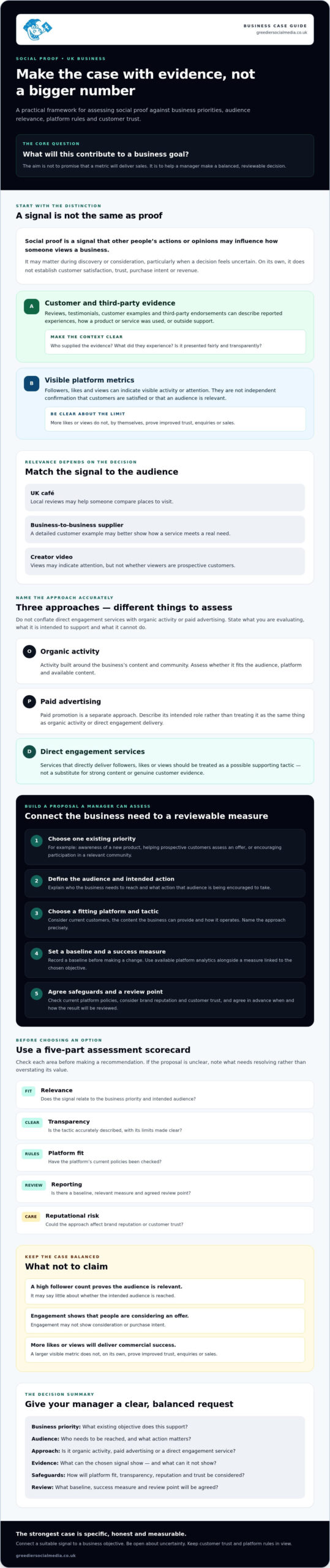
A manager needs a business rationale, not simply a bigger number on a profile. Social proof can help explain how people respond to a business, but different signals support different claims. A proposal is stronger when it states what a metric can show, what it cannot, and how it relates to an existing business priority.
Social proof is a signal that other people’s actions or opinions may influence how someone views a business; it is not, by itself, proof of customer satisfaction. The Social proof concept describes how people may look to others when deciding how to act, particularly when a situation is uncertain. In business, that influence may matter during discovery or consideration, but it doesn’t establish trust, purchase intent or revenue on its own.
Which forms of social proof can support a business?
Separate customer evidence from platform engagement. Reviews and testimonials describe reported customer experiences. Customer examples can show how a product or service was used. Third-party endorsements indicate that an outside person or organisation has expressed support. For each, provide context: who supplied it, what they experienced and whether it is presented fairly and transparently.
Followers, likes and views are different. They are visible platform metrics, not independent confirmation that customers are satisfied or that an audience is relevant. For a UK café, local reviews may help someone compare places to visit. For a business-to-business supplier, a detailed customer example may better show how its service meets a real need. A creator’s video views may indicate attention, but not whether viewers are prospective customers. The useful signal depends on the audience and the decision being considered.
Why might a decision-maker be sceptical?
The concerns are reasonable. A high follower count can look like a vanity metric if it says little about the intended audience. Engagement may not show whether people are considering an offer. Any tactic that could affect the brand’s reputation deserves scrutiny, and unclear measurement makes return on investment difficult to assess.
Start with the business problem, not a requested follower count. Is the priority to raise awareness of a new product, help prospective customers assess an offer, or encourage participation in a relevant community? Then explain which signal might support that objective and how you’ll judge its relevance. Be explicit about the limits: an increase in likes or views doesn’t prove that trust, enquiries or sales have improved.
This matters especially when discussing buying social proof for business uk. Treat a direct engagement service as a possible supporting tactic, not a substitute for strong content or genuine customer evidence. Before proposing one, check current platform policies and decide what would count as a useful result. A cautious manager is more likely to engage with a balanced case that acknowledges uncertainty than with a promise that a larger number will deliver commercial success.
How to build a persuasive social proof investment proposal
Make the decision easy to assess. A strong proposal links a specific business challenge to a relevant audience, a suitable tactic and a way to review the result. Focus on one existing priority, such as awareness, consideration or community participation. Don’t begin with a target for followers or likes. First explain why that metric might be relevant.
Start with the business objective and audience
Ask who the business needs to reach and what action you want that audience to take. Then choose a platform that fits current customers, the content you can provide and how the business operates. For example, a product business using short-form video might assess views as an indicator of attention, whilst a professional service might prioritise evidence that helps potential clients evaluate its offer. Neither metric proves intent. Nielsen Norman Group’s Social Proof in the User Experience offers useful context on how social signals can influence decisions in digital interfaces.
A proposal about buying social proof for business uk should name the tactic accurately. Organic activity, paid advertising and direct delivery of followers, likes or views are different approaches. State which one you’re evaluating, what it is intended to support and what it won’t do. Check the platform’s current policies and agree reputation safeguards before recommending a test.
Make the proposal measurable and reviewable
Record a baseline before making a change. Use available platform analytics alongside a relevant business measure, such as enquiries or visits to a product page, if you can track it reliably. Keep leading indicators, such as likes or views, separate from downstream outcomes. This lets your manager see whether a visible change coincides with movement in a business measure, without assuming that one caused the other.
A useful test measures outcomes, not just the number delivered. Keep the test limited and reviewable, with an agreed owner, review date and decision criteria. Decide in advance what would prompt the team to continue, change the approach or stop. If you can’t define a meaningful measure or safeguard, pause before asking for approval.
- Challenge: What business problem needs attention?
- Audience and objective: Who needs to respond, and what action matters?
- Tactic and safeguards: What will you test, and what risks will you monitor?
- Measurement and review: What is the baseline, who owns tracking, and when will you decide?
If direct metric delivery is among the options being assessed, review the relevant social media engagement options alongside other tactics. Treat it as a possible supporting activity, not a replacement for strong content or genuine customer evidence.
How to answer concerns about paid social proof and business value
A manager who calls social metrics “vanity measures” has a fair point: visible numbers alone don’t establish trust, purchase intent or revenue. The useful response isn’t to claim that more engagement will fix that. Explain what each approach does, what evidence it can produce and what it can’t prove.
Keep the categories separate. Organic social activity involves planning and publishing content over time. Paid advertising pays to distribute messages to selected audiences. Direct engagement services deliver specific platform metrics, such as followers, likes or views. These approaches have different purposes and ways of being assessed. Direct metric delivery is not customer acquisition, organic management or a complete marketing strategy.
| Approach | Potential benefit | Limitations | Evidence to assess |
|---|---|---|---|
| Organic activity | Can build a consistent presence and invite interaction with content. | Requires ongoing planning and publishing; results may be difficult to attribute to one post or action. | Content interactions, relevant audience responses and tracked visits or enquiries where available. |
| Paid advertising | Can distribute messages to a selected audience and support a defined campaign objective. | Distribution is not proof of trust or eventual purchase; campaign management and spend need separate assessment. | Campaign reporting alongside suitable outcomes, such as tracked visits, leads or conversions. |
| Direct engagement services | Can deliver specified metrics on a social platform. | Metrics alone don’t confirm audience relevance, customer satisfaction, enquiries or sales. | Delivery records and changes in platform metrics, considered against the objective and agreed safeguards. |
Be clear about the provider’s scope. Greedier Social Media sells direct delivery of followers, likes and views across platforms including Instagram, YouTube, TikTok, Facebook and Threads. It doesn’t provide organic social media management or manage paid advertising campaigns. If a proposal for buying social proof for business uk presents one of these services as a complete growth strategy, clarify the scope before seeking approval.
What safeguards should a decision-maker expect?
Before recommending a tactic, review the platform’s current terms and relevant UK advertising guidance. Rules and enforcement can change, so don’t rely on old assumptions or make compliance claims without checking current sources. Keep customer reviews and endorsements distinct from platform metrics, and never present a follower, like or view as evidence of a customer experience.
Agree practical safeguards before committing: who controls account access, what reporting will be shared, which metrics will be monitored and who can pause the activity if concerns arise. Check that the proposed measure fits the objective, and don’t promise commercial results that the metric can’t establish. For more context, see this UK social media authority guide.
How to compare social proof options and set a sensible evaluation plan
A fair comparison starts with the objective, not the biggest promised number. Organic activity, paid advertising and direct engagement services do different jobs, so assess each against the same business need. For buying social proof for business uk, check whether a specific metric fits the intended audience and platform rather than assuming that more engagement means better performance.
What should a social proof comparison scorecard include?
Use a simple scorecard to record evidence and gaps for each option. It doesn’t need to produce a single “winner” automatically. Its purpose is to make trade-offs visible and give decision-makers a consistent basis for comparison.
- Relevance: Does the tactic support the chosen audience and business objective, or only a general growth target?
- Transparency: Can the provider explain what is delivered, what reporting is available and what the metric can’t demonstrate?
- Platform fit: Is the activity suited to the selected channel? Check current platform policies before deciding.
- Brand fit: Would the approach sit comfortably alongside the business’s content and customer evidence?
- Approval and oversight: Are internal approval, account-access boundaries and reporting responsibilities agreed?
Compare like with like. Organic activity involves ongoing planning and publishing. Advertising pays for distribution. Direct engagement services deliver specific metrics, such as Instagram likes. None is interchangeable with the others, and a change in a platform metric does not by itself show a change in customer behaviour.
Which measures help assess progress responsibly?
Before starting, record a baseline, the selected measures, the review date and the person responsible for the decision. Track relevant platform metrics alongside website visits, enquiries or sales measures where these are available and can be measured consistently. Compare similar periods and, where possible, similar content. Note other activity that could affect the results.
Separate what happened from what caused it. If likes increase but enquiries don’t, that’s useful information, not a reason to claim success. If both move, avoid crediting one tactic without supporting evidence. Agree in advance whether the team will continue, adjust or stop, based on the objective and the evidence collected.
If Instagram likes are under consideration, use this comparison of Instagram auto-likes with one-time purchases to assess the options. You can also review Instagram likes options as one part of your wider comparison.
How to present the recommendation and choose a next step
Your final pitch should make the decision clear without overstating what social metrics can achieve. Summarise the business challenge, explain why the chosen platform suits the intended audience, then state what you’re asking your manager to approve. A focused recommendation is easier to assess than a broad request to increase engagement.
What should the manager-ready recommendation say?
Use a short structure that answers the questions a decision-maker is likely to ask:
- Objective: Which existing business priority does this support?
- Audience and platform: Who are you trying to reach, and why is this channel relevant?
- Option: What activity are you proposing, and what is its specific role?
- Safeguards: What platform-policy checks, brand considerations and approval steps will apply?
- Measures and review: What will you compare with the baseline, who will assess it, and when?
Be precise about the limits. A proposed increase in followers, likes or views may support a visibility objective, but it can’t prove customer satisfaction, purchase intent or sales. Don’t present a metric as a guaranteed business result. State what evidence would inform a future decision, such as relevant platform activity alongside trackable website visits or enquiries, where available.
End with a specific request: approval to assess an option, proceed with an agreed activity or return with further information. Make clear what the manager is approving and what would prompt the team to continue, revise or stop. That gives your pitch a practical next step rather than an open-ended commitment.
When could a direct engagement service be considered?
Consider one only when its purpose is understood, the use case fits the business objective and the team has checked current platform rules. Greedier Social Media provides direct delivery of followers, likes and views across Instagram, YouTube, TikTok, Facebook and Threads. It is not a full-service agency, organic social media manager or advertising campaign manager. Treat its services as a possible supporting tactic, not a replacement for strong content or genuine customer evidence.
A clear proposal about buying social proof for business uk should leave room for a manager to say no, ask for safeguards or request a different measure. If the option fits your defined need, you can explore Greedier Social Media services and assess the relevant metric against your criteria. Keep the decision grounded in audience relevance, transparency and the evidence you’ll review, not the appeal of a larger number alone.
Make your next step evidence-led
A persuasive pitch starts with a business objective, not a target for likes or followers. Match the proposed metric to a relevant audience and platform, then agree safeguards, a baseline and a review point before asking for approval. Keep the limits clear: increased engagement alone doesn’t prove trust, enquiries or sales.
If you’re assessing buying social proof for business uk, treat direct engagement as one possible supporting tactic, not a replacement for genuine customer evidence, strong content or a wider marketing plan. Greedier Social Media offers followers, likes and views across Instagram, YouTube, TikTok, Facebook and Threads. Its services focus on direct metric delivery, not organic social media management or advertising campaigns.
Review the available options against your stated objective, platform fit and evaluation criteria. Explore Greedier Social Media services if direct engagement metrics suit your proposal. With a clear request and honest measures, you can give your manager a practical basis for deciding what to test, change or leave aside.
Frequently Asked Questions
How do I convince my boss to invest in social media growth?
Connect the proposal to a business priority, not a target follower count. Explain which audience the business needs to reach, why the platform fits and what action you hope to support. Set out the tactic, safeguards, baseline measures and review date. Be clear that engagement metrics can show activity, but they don’t prove sales or customer trust. A balanced case gives your manager a practical basis for approving, changing or declining the proposal.
Is social proof worth investing in for a small business?
It may be worth considering if it supports a specific business need and you can assess its value. A small business might use genuine customer testimonials to help prospective customers evaluate a service, or track relevant social activity around a product launch. Start with the lowest-risk option that fits your objective. Set a baseline and review the results before committing further, and don’t assume a larger audience automatically creates more customers.
Can social media followers and likes help a business build credibility?
Followers and likes can act as visible signals of activity, but they don’t independently verify customer satisfaction or expertise. A prospective customer may notice them, yet still look for relevant reviews, clear product information or examples of customer experience before deciding. Treat engagement as one possible supporting signal, not a substitute for evidence. Check whether the audience and platform suit your business, and avoid claiming that increased metrics guarantee credibility or sales.
What should I include in a social media investment proposal?
Include the business challenge, intended audience, objective, relevant platform and proposed tactic. Explain what the tactic can support and what it can’t prove. Add safeguards, a baseline, the measures you’ll track, a named decision owner and a review date. Finish with a specific request, such as approval to assess an option or run a defined test. This helps your manager understand the scope, expected evidence and basis for a future decision.
How can a business measure whether social proof is working?
Record the starting point, then track relevant platform metrics alongside business measures such as website visits or enquiries, if these are available. Use comparable periods and content where possible, and note other activity that could affect the results. Separate leading indicators, such as likes or views, from outcomes such as enquiries. A change in both doesn’t prove one caused the other, so interpret results carefully and use them to guide the next decision.
How much should a business invest in social proof?
There’s no universal budget for buying social proof for business uk. First define the objective, the option being considered and the evidence needed to judge its value. Check the current cost directly with the provider, then set a limit that the business can approve and review. Don’t commit based on a promise of sales or trust from a higher metric. If you can’t identify a suitable measure or safeguard, pause before spending.
Is buying social media engagement the same as social media management?
No. Buying engagement means paying for direct delivery of specified metrics, such as followers, likes or views. Social media management usually refers to planning and publishing content over time, which is a separate service. Greedier Social Media provides direct metric delivery across Instagram, YouTube, TikTok, Facebook and Threads; it doesn’t offer organic social media management or manage advertising campaigns. Check the scope carefully so you know what is and isn’t included.