
TL;DR:
- Tracking social media growth involves focusing on audience expansion, engagement, and conversion metrics that directly impact business results. Using consistent tools and measurement practices enables small businesses to interpret trends accurately and avoid common pitfalls like chasing vanity metrics or neglecting unfollows. A small, goal-oriented set of metrics tracked over time produces more meaningful insights and sustainable growth than overwhelming dashboards with data.
Measuring social media growth progress is the process of tracking defined metrics to understand how your audience expands, how engaged they are, and whether your content drives real business results. For small business owners and content creators, the difference between guessing and knowing comes down to which numbers you watch and how consistently you watch them. Tools like Hootsuite, SocialPreviewHub, and native platform insights such as Instagram Insights and Facebook Analytics give you the data. The challenge is knowing which data actually matters. This guide walks you through the metrics, tools, and methods that turn raw numbers into decisions.
Which social media growth metrics matter most?
Tracking social media growth progress starts with choosing the right metrics. Not every number tells a useful story, and chasing too many at once leads to paralysis rather than progress.

The core metrics to calculate first
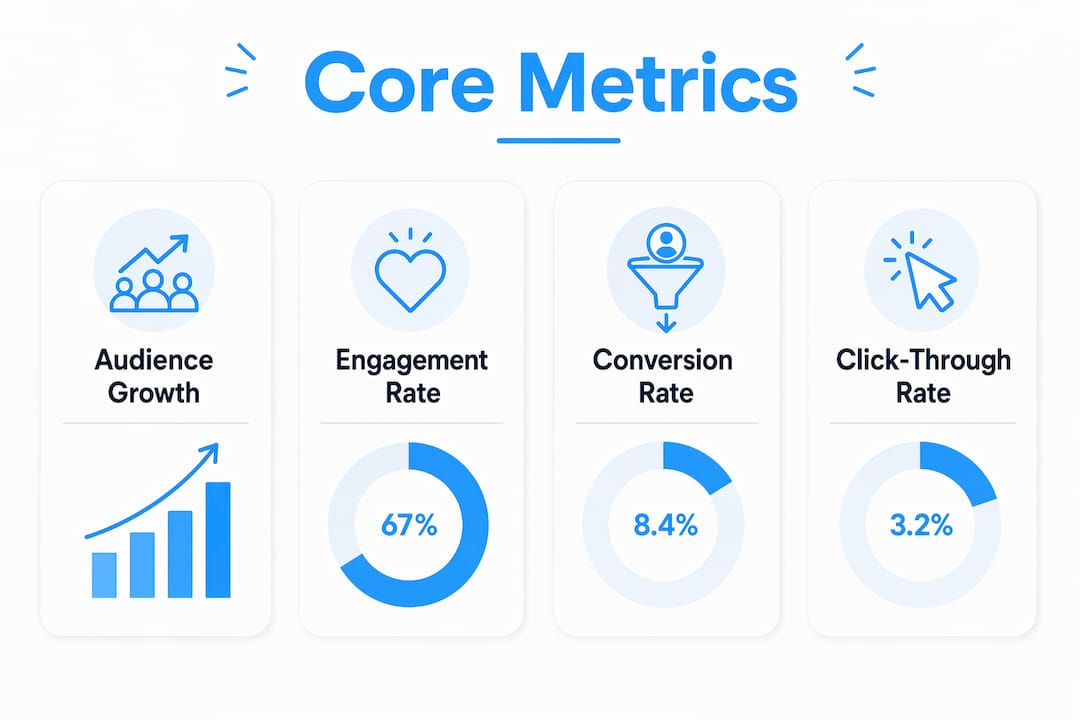
The three most important categories are audience growth, engagement, and conversion. Each answers a different question about your performance.
Audience growth rate is the most honest measure of momentum. The formula is straightforward: (Net New Followers / Total Followers at the start of the period) x 100. A result of 3% monthly on Instagram is solid. 8% monthly growth is exceptional for accounts with over 10,000 followers. Most established accounts sit in the 1–3% range, so use that as your baseline before drawing conclusions.
Engagement metrics include likes, comments, shares, and saves. Engagement rate divides total interactions by total followers, then multiplies by 100. A high follower count with a low engagement rate signals that your audience is not connecting with your content.
Conversion metrics are where social media activity links to business outcomes. Click-through rate (CTR), conversion rate, and cost per acquisition (CPA) tell you whether your social presence is generating revenue, not just attention.
A tiered approach to metric prioritisation
Organising your metrics into tiers prevents you from treating all numbers as equally important.
- Tier 1 (ROI-focused): Social-attributed revenue, CPA, and conversion rate. These measure direct business outcomes.
- Tier 2 (Engagement-focused): Engagement rate, comments, shares, and saves. These measure content resonance.
- Tier 3 (Awareness-focused): Reach, impressions, and share of voice. These measure visibility.
Experts recommend prioritising Tier 1 metrics like CPA over Tier 3 vanity metrics like reach. Reach tells you how many people saw a post. CPA tells you how much it cost to win a customer. The second number is the one that keeps a business alive.
Pro Tip: Limit yourself to 1–2 primary business goals and 2–3 meaningful metrics per goal. More than that and you will spend more time reading dashboards than improving your content.
What tools work best for tracking social media performance?
Choosing the right tools to analyse social media metrics depends on your budget, the platforms you use, and how much time you can dedicate to reporting.
Native tools versus third-party platforms
| Tool | Type | Best For | Cost |
|---|---|---|---|
| Instagram Insights | Native | Instagram-only audience and reach data | Free |
| Facebook Analytics | Native | Facebook page performance and demographics | Free |
| Twitter Analytics | Native | Tweet impressions and follower growth | Free |
| Hootsuite | Third-party | Cross-channel reporting and scheduling | Paid |
| SocialPreviewHub | Third-party | Follower growth projection and tracking | Paid |
| Social9 | Third-party | ROI attribution and cross-channel metrics | Paid |
Native tools are free and accurate for single-platform tracking. Their weakness is isolation. Instagram Insights cannot tell you how your Facebook performance compares, and neither platform connects social activity to your website revenue without additional setup.
Third-party platforms like Hootsuite and Social9 solve this by consolidating data across channels. Automated, consolidated analytics platforms offering cross-channel metrics and predictive scoring reduce reliance on manual data aggregation. That matters when you are managing multiple accounts and need a single view of what is working.
Setting up consistent tracking
Consistency in data collection is as important as the tools you use. Record follower counts at the same day and time each week or month. A count taken on a Monday morning will differ from one taken on a Friday evening simply because of posting activity. Consistent timing in recording follower counts improves the accuracy of your growth trend analysis significantly.
Use UTM parameters on every link you share from social media. Multi-touch tracking with UTM parameters is required to accurately credit social media efforts with revenue. Without them, your analytics platform cannot distinguish a sale driven by an Instagram post from one driven by a Google search. You can learn more about setting these up correctly through this guide on UTM parameter tracking.
Pro Tip: Create a simple spreadsheet that logs follower counts, engagement totals, and CTR weekly. Even if you use a paid platform, a manual record gives you a backup and forces you to actually look at the numbers.
How do you interpret social media data and spot real trends?
Collecting data is the easy part. Knowing what it means is where most small business owners and creators struggle.
Net growth versus raw numbers
Raw new follower counts can be deceptive because they ignore unfollows. An account that gains 500 followers but loses 480 has not grown in any meaningful sense. Tracking net growth (new followers minus unfollows) reveals true audience sentiment. A high unfollow rate often signals a content mismatch, meaning you attracted people with one type of post and then failed to deliver what they expected.
Interpreting net follower growth alongside engagement and sentiment metrics helps detect whether your content is genuinely resonating or simply catching passing attention. If your follower count grows but your engagement rate drops, your new audience is not as interested as your original one.
Viral spikes versus sustainable growth
A single viral post can distort your monthly numbers dramatically. One-off viral posts rarely indicate genuine strategic success without consistent engagement and audience growth across content formats. The test is simple: look at your metrics the month after the spike. If engagement returns to its previous level, the viral moment did not build lasting momentum.
Sustainable growth shows up as a gradual upward trend across multiple metrics over several months. That pattern is far more valuable than a single outlier week.
Adjusting your reporting cadence
How often you review your data affects the quality of your conclusions. The most effective reporting cadence combines weekly light reviews to catch anomalies and monthly deep-dive analyses to track sustainable trends. Checking your numbers daily creates noise. You start reacting to normal fluctuations as if they are crises.
Hootsuite advises shifting from broad macro performance views to micro campaign-specific analytics to keep KPIs aligned with actual business needs. Review your KPIs at least quarterly. A metric that mattered six months ago may no longer reflect your current goals. You can find a practical framework for this in the Greediersocialmedia guide on social media KPIs for 2026.
Common mistakes that undermine your growth measurement
Even experienced marketers make measurement errors that skew their understanding of performance. These are the most damaging ones to avoid.
- Tracking too many metrics without goal alignment. Focusing on 15 different numbers without knowing which two actually connect to your business goal is a waste of time. Limiting focus to 1–2 primary goals and 2–3 meaningful metrics prevents distraction and improves measurement impact.
- Ignoring unfollow rates. A growing follower count that masks a high churn rate is a warning sign, not a success story. Always calculate net growth.
- Inconsistent data collection. Pulling numbers at random times on random days introduces variance that has nothing to do with your actual performance.
- Overvaluing viral moments. One exceptional post does not define your strategy. Sustained trends do.
- Failing to connect social activity to revenue. Value derived from social media metrics lies in linking them closely to business outcomes, not just social channel activity. If you cannot draw a line from your Instagram posts to your sales, your measurement system is incomplete.
- Never revisiting your KPIs. Every analytics report is a chance to reconsider which KPIs remain relevant as business priorities evolve. Set a quarterly reminder to ask whether you are still measuring the right things.
Pro Tip: Use a tool like SocialPreviewHub to forecast when you will hit your next follower milestone based on your current growth rate. Forecasting milestone achievement dates from current growth rates helps you plan campaigns and partnership outreach with realistic timelines rather than wishful thinking.
You can also explore metrics that predict conversion to sharpen how you connect social performance to actual sales outcomes.
Key takeaways
Effective measurement of social media growth progress requires tracking net audience growth, engagement rate, and conversion metrics consistently, using the right tools, and linking every data point to a defined business goal.
| Point | Details |
|---|---|
| Use the growth rate formula | Calculate (Net New Followers / Starting Followers) x 100 monthly to measure true momentum. |
| Prioritise Tier 1 metrics | Focus on CPA and conversion rate before reach or impressions for business-relevant insight. |
| Track net growth, not raw counts | Subtract unfollows from new followers to reveal genuine audience sentiment and content fit. |
| Use UTM parameters on every link | Without UTM tracking, attributing revenue to social media activity is guesswork. |
| Review weekly and monthly | Light weekly checks catch anomalies; monthly deep dives reveal sustainable growth trends. |
Why fewer metrics and more patience win every time
I have worked with dozens of small business owners who open their analytics dashboards, see 40 different numbers, and immediately feel overwhelmed. The instinct is to track everything. The result is that they act on nothing.
The accounts I have seen grow most consistently share one habit: they pick two or three metrics that connect directly to a business goal, and they watch those numbers for at least 90 days before drawing conclusions. That patience is genuinely rare. Most people abandon a strategy after three weeks because the follower count did not jump fast enough.
The other thing I have noticed is that qualitative context matters as much as the numbers. A comment that says “I bought this because of your post” tells you something a click-through rate cannot. Combining that kind of feedback with your quantitative data gives you a far richer picture of what is actually working.
My honest view is that the brands winning on social media in 2026 are not the ones with the most sophisticated tools. They are the ones who defined clear goals, chose a small number of honest metrics, and had the discipline to keep measuring consistently even when the numbers were uncomfortable. Analytics is not a report you file. It is a conversation you keep having with your own data.
For small businesses especially, a social media growth strategy built around a handful of meaningful metrics will outperform any approach that chases every trend.
— Luna
How Greediersocialmedia can accelerate your growth results
Knowing what to measure is only half the work. Getting the numbers moving in the right direction requires a strategy built on authentic engagement, not inflated vanity metrics.
Greediersocialmedia has supported over a million users since 2013, helping UK businesses and creators build real, measurable presence on Instagram, Facebook, and beyond. Their social media growth packages are designed to deliver genuine follower growth and engagement that shows up in your Tier 1 metrics, not just your reach figures. If you want tactics that move your numbers in the right direction, explore the full range of growth hacks and presence tactics that Greediersocialmedia has refined over more than a decade of working with UK brands.
FAQ
What is the audience growth rate formula?
Audience growth rate is calculated as (Net New Followers / Total Followers at the start of the period) x 100. This gives you a percentage that reflects true momentum rather than raw follower additions.
How often should i review my social media metrics?
The most effective cadence combines weekly light reviews to catch sudden changes and monthly deep-dive analyses to identify sustainable trends. Reviewing daily creates noise and leads to reactive decisions.
What is a good monthly follower growth rate on instagram?
A monthly growth rate of 1–3% is typical for established Instagram accounts with over 10,000 followers. A rate of 8% per month is considered exceptional and indicates strong content performance or a well-executed campaign.
Why does net follower growth matter more than total new followers?
Raw new follower counts ignore unfollows. An account gaining 300 followers but losing 280 has barely grown. Net growth reveals whether your content is retaining the audience it attracts, which is a far more honest measure of progress.
How do i connect social media activity to actual revenue?
Use UTM parameters on every link you share across social platforms. Without UTM tracking, your analytics tools cannot distinguish traffic or sales driven by social media from other sources, making ROI attribution unreliable.