
Learning how to build social media marketing proposal client meetings actually go well takes real preparation.
TL;DR:
- A social media marketing proposal converts client interest into a signed contract by showcasing understanding and tailored strategies. It should be concise, well-structured, and based on thorough discovery and data analysis, emphasizing clear deliverables and pricing. Prompt follow-up and operational clarity are essential for winning and retaining clients.
A social media marketing proposal is a structured, persuasive document that converts a prospect’s interest into a signed contract. When you build a social media marketing proposal for a client, you are not simply listing services. You are making a business case, addressing risk, and proving you understand their world better than anyone else who pitches them. The best proposals are specific, concise, and built around the client’s language and goals. Most losing proposals fail due to poor discovery and a lack of tailored content, not poor writing. Structure and clarity are what busy decision-makers need to say yes.
What research and preparation should precede writing a social media proposal?
The quality of your proposal is decided before you write a single word. Client discovery is the foundation. During your discovery call, listen for the exact words your prospect uses to describe their problems, goals, and frustrations. Mirror that language back in your proposal. Proposals that echo client language and specific business context outperform generic templates significantly. That mirroring signals that you listened, and it builds trust faster than any case study.

After the discovery call, run a social media audit. Professionals invest 2–4 hours auditing client data before writing a single proposal section. That audit should cover engagement rates, posting frequency, follower growth trends, and how the client compares to industry benchmarks. The numbers you surface become the evidence base for every recommendation you make.
Your audit findings serve a second purpose: they differentiate you. When you walk into a proposal with data the client has never seen about their own accounts, you demonstrate expertise before the contract is signed. That credibility is the single most powerful conversion tool available to you.
Use the audit to identify the platforms where the client’s audience is most active, the content formats generating the highest engagement, and the gaps competitors are exploiting. A platform-specific social media strategy is not optional. Research shows 68% of businesses require platform-specific strategies rather than unified approaches. Clients notice when your plan is built for their platforms, not copied from a generic template.
Pro Tip: Record your discovery call with the client’s permission. Replay it before writing to catch exact phrases and priorities you may have missed in your notes.
- Review the client’s last 90 days of posts across all active platforms.
- Note engagement rates, comment sentiment, and which content formats performed best.
- Benchmark their metrics against published industry averages for their sector.
- Identify the top two or three content gaps their competitors are filling.
- Compile findings into a one-page audit summary to include in the proposal.
How to structure a social media marketing proposal for clarity and persuasion
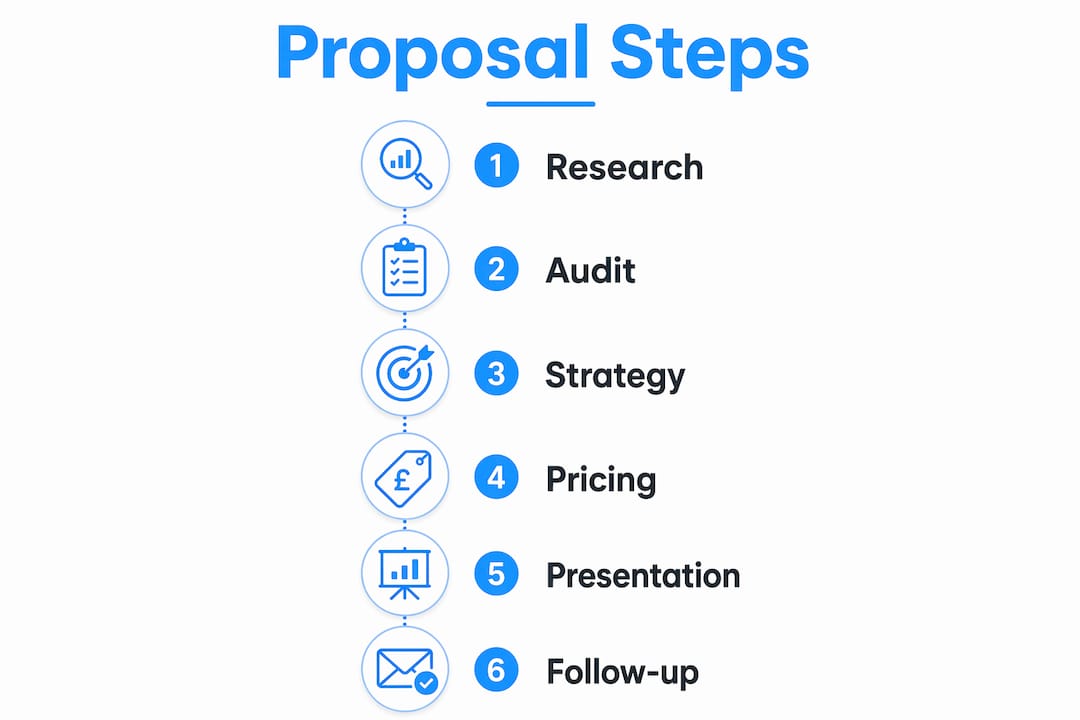
An effective social media proposal is typically 8–12 pages long, structured in 7–10 clear sections for easy skimming by decision-makers. That page count matters. Too short and you appear unprepared. Too long and you lose the reader before they reach the pricing page.
Cover page. Include the client’s logo, your agency name, the date, and a proposal title that names their business specifically. Personalisation starts here.
Executive summary. Write two to three paragraphs focused on outcomes, not services. Tell the client what their business will achieve, not what you will post. Be specific: “increase Instagram engagement by 40% in 90 days” beats “grow your social media presence.”
Client understanding and audit findings. Present the data from your pre-proposal audit. Show what you found, what it means, and why it matters for their growth.
Platform recommendations. Name the platforms you recommend and explain why. A LinkedIn strategy for a B2B accountancy firm looks nothing like an Instagram plan for a fashion retailer. Specificity here proves you have done your homework.
Content strategy and posting schedule. Define content formats, posting cadence, and themes. Include examples of post types: educational carousels, short-form video, user-generated content reposts, and community polls. A concrete client social media campaign outline removes ambiguity and sets expectations early.
KPIs and reporting cadence. Define what success looks like and how you will measure it. Monthly reporting with weekly check-ins is a standard starting point. Name the metrics: reach, engagement rate, follower growth, click-through rate, and conversion rate where applicable.
Tiered pricing. Present three packages with clear deliverables and investment levels. More on this in the next section.
Timeline and team introduction. Show the onboarding phases, key milestones, and who the client will work with. Faces and names reduce perceived risk.
Terms and next steps. Keep terms plain and readable. End with a single, clear call to action. Clear, singular calls to action at the proposal’s end reduce client decision friction and increase conversion. “Book a 20-minute call to confirm your start date” is better than three options that create hesitation.
Pro Tip: Proposals that include contract-ready e-signature options close four times faster than those requiring a separate signing process. Use a tool that embeds signing directly into the document.
What are the best practices for pricing and presenting your proposal?
Pricing is where most proposals lose clients, not because the numbers are too high, but because the structure is confusing. A three-tier pricing model, typically labelled Starter, Growth, and Premium, can increase conversion rates by framing services as a business investment rather than a cost. Each tier should show increasing scope and value, not just a higher price.
Pricing by deliverables creates more predictable and confident buying decisions than hourly pricing or vague estimates. List exactly what each package includes: the number of posts per week, the platforms covered, the number of monthly reports, and the response time for community management. When a client can see precisely what they receive, the decision becomes simpler.
- Starter: Two platforms, 12 posts per month, one monthly report, email support.
- Growth: Three platforms, 20 posts per month, bi-weekly reports, priority support, one paid ad campaign.
- Premium: Four platforms, 30 posts per month, weekly reports, dedicated account manager, two paid ad campaigns, quarterly strategy review.
Position social media management as a revenue-generating function, not an administrative task. Include a brief case study or ROI reference relevant to the client’s sector. Even one concrete example of results you have achieved for a similar business shifts the conversation from “how much does this cost?” to “how quickly can we start?”
Follow up 3–5 days after sending the proposal. If you use a document-tracking tool, follow up earlier when you see the client has opened the proposal multiple times. High engagement signals high intent. Timing your follow-up to that moment is one of the most underused tactics in proposal management. For deeper insight into audience engagement strategies, understanding what drives client behaviour can sharpen both your proposal content and your outreach timing.
Pro Tip: Never present three pricing tiers of equal visual weight. Make the middle tier (Growth) the most prominent. Clients naturally gravitate toward the middle option, and that is usually your most profitable package.
How to define deliverables, workflows, and approval processes
The difference between a proposal that wins and one that causes problems six weeks into the contract is operational clarity. Leading proposals around workflow and organisational systems rather than just “posting content” prevents you from competing on price with low-cost providers. Your process is your product.
Define deliverables with numbers, not adjectives. “Regular Instagram posts” is vague. “12 Instagram feed posts, 20 Stories, and four Reels per month” is a deliverable. Clients sign contracts based on specifics, not generalities.
- List every deliverable with a quantity and a platform.
- Define the content production timeline: when briefs are due, when drafts are delivered, and when final approval is required.
- Set a 48-hour approval window for all content sign-offs. This prevents late content and strained relationships by eliminating the “approved by silence” trap.
- Specify your community management SLA: for example, a two-hour response time during business hours.
- Name the client’s responsibilities: providing brand assets, approving content on time, and nominating a single point of contact for escalations.
Strong proposals also define a layered operational workflow that separates daily, weekly, and monthly tasks. Daily tasks cover community management and monitoring. Weekly tasks cover content scheduling and performance checks. Monthly tasks cover reporting, strategy reviews, and planning for the next cycle. That structure shows the client exactly how their account will be managed, not just what will be posted.
“Clients do not fear the investment. They fear the unknown. A proposal that maps out every step of the first 90 days removes that fear and replaces it with confidence.”
Set clear milestones for the onboarding phase. The first 30 days should cover account access, brand guidelines review, and content calendar creation. Days 31–60 should cover the first full content cycle and an initial performance review. Days 61–90 should cover strategy refinement based on real data. That 30–90 day roadmap turns your proposal from a sales document into a project plan, and clients respond to that level of preparation.
Key Takeaways: Build Social Media Marketing Proposal Client
A winning social media proposal is built on client-specific research, clear deliverables, and a pricing structure that frames your service as a business investment.
| Point | Details |
|---|---|
| Research before writing | Spend 2–4 hours auditing the client’s accounts before drafting a single section. |
| Structure for skimmability | Use 7–10 clearly labelled sections across 8–12 pages so decision-makers can navigate quickly. |
| Price by deliverables | List exact quantities per platform and package to remove pricing ambiguity. |
| Define workflows explicitly | Set approval SLAs, client responsibilities, and a 30–90 day onboarding timeline. |
| Follow up with intent | Send your follow-up 3–5 days after delivery, or sooner if document tracking shows high engagement. |
What I have learned from writing proposals that actually win
The most common mistake I see is treating the proposal as a formality after a great discovery call. Marketers assume the call did the selling and the proposal just confirms the details. That assumption costs contracts.
Speed matters more than most people realise. Sending a proposal within 48 hours of the discovery call increases close likelihood by around 30%. The client is still in the emotional high of the conversation. Every hour you wait, that energy fades and competing priorities fill the gap.
Specificity is the real differentiator. Vague KPIs like “grow your audience” tell the client nothing. Specific KPIs like “increase Instagram reach by 25% in 60 days, measured via native analytics” tell the client you know what you are doing and that you will be accountable. Accountability is what separates agencies that retain clients from those that churn them.
The proposals I have seen fail most consistently share one trait: they describe what the agency does rather than what the client will gain. Flip that. Every section should answer the client’s unspoken question: “What does this mean for my business?” Answer that question clearly in every section, and the pricing conversation becomes much easier.
— Luna
Greediersocialmedia: grow the presence your proposal promises
Winning a client with a strong proposal is only the beginning. Delivering the growth you promised is where the real work starts. Greediersocialmedia has supported over a million users since 2013, helping UK businesses build genuine visibility on Instagram, Facebook, and beyond through real engagement, not shortcuts.
Whether you are building your client’s Instagram presence from scratch or accelerating an existing account, the tactics that drive real results are well documented. Explore Greediersocialmedia’s guide to social media growth hacks for practical, tested methods that complement the strategies you outline in your proposals. When your deliverables are backed by proven growth methods, client retention follows naturally.
FAQ
How long should a social media marketing proposal be?
An effective social media proposal is typically 8–12 pages, structured across 7–10 clearly labelled sections. That length gives decision-makers enough detail to evaluate your offer without losing their attention.
What sections must a social media proposal include?
A strong proposal includes an executive summary, audit findings, platform recommendations, a content strategy, KPIs, tiered pricing, a timeline, and a clear call to action. Each section should address a specific concern the client holds.
How do I price social media services in a proposal?
Price by deliverables rather than hours, and present three tiers (Starter, Growth, Premium) with exact quantities per package. Tiered pricing structures increase conversion rates by making the investment decision straightforward.
When should I follow up after sending a proposal?
Follow up 3–5 days after sending, or sooner if document tracking shows the client has opened the proposal multiple times. Early engagement signals high intent and is the best moment to re-open the conversation.
How do I avoid scope creep after the proposal is signed?
Define every deliverable with a specific quantity and platform, set a 48-hour content approval SLA, and name the client’s responsibilities in writing. Clear boundaries in the proposal prevent misunderstandings once work begins.