

What if the next step to boost instagram reel views isn’t posting more, but finding out where viewers lose interest? Regular posting can still bring modest reach. When results are disappointing, it can be hard to tell whether the issue is the idea, the opening seconds or distribution.
Advice about Instagram’s algorithm can sound absolute, but no single tweak can promise a viral result. Views are only one part of a Reel’s performance. Watch time, shares, saves and profile visits can help you judge how people respond and what to test next.
This UK guide gives you a practical way to review your creative, caption and performance metrics, then make one change at a time. You’ll learn how to compare Reels fairly, improve discoverability and choose sensible next steps. We’ll also explain how paid Reel views can support visibility as a separate option, without confusing a higher view count with retention, engagement, sales or guaranteed organic reach.
Key Takeaways
- Separate views from reach, watch time and interactions to understand what a Reel’s results actually show.
- To boost instagram reel views, test clearer openings and relevant creative choices rather than relying on a supposed viral formula.
- Diagnose low reach by reviewing the content, audience fit, distribution and measurement before changing your approach.
- Use a simple testing record to compare each Reel’s topic, opening, format and selected performance measures.
- Consider paid Reel views as a separate visibility-support option, not proof of engagement, sales or future organic reach.
What does it mean to boost Instagram Reel views?
To boost Instagram Reel views is to increase the number of times a Reel is played or counted as a view in Instagram’s reporting. The phrase can refer to improving discoverability through creative choices, using paid visibility support, or combining the two. It doesn’t mean every view came from a different person, or that viewers watched to the end.
Views count play activity; reach counts unique accounts. One account can contribute more than one view by replaying a Reel, while reach reflects how many distinct accounts saw it. A Reel with repeated plays from a smaller audience can therefore have more views than its reach figure. For context on Instagram as a platform, see this Instagram platform overview.
Views, reach and engagement: what each metric tells you
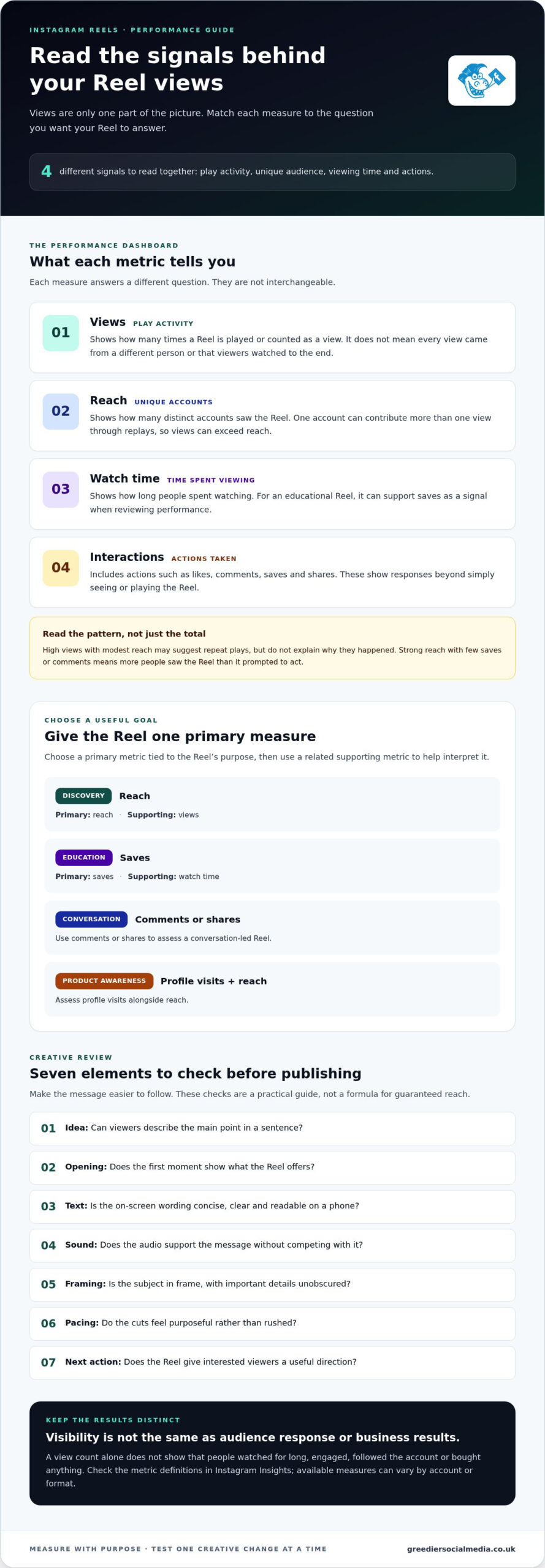
Use each measure to answer a different question. Views indicate play activity. Reach indicates the size of the unique-account audience. Watch time shows how long people spent viewing, whilst interactions record actions such as likes, comments, saves and shares. Check the labels and definitions in Instagram Insights, as available measures can vary by account or format.
These numbers aren’t interchangeable. High views alongside modest reach may suggest repeat plays, but don’t explain why they happened. Strong reach with few saves or comments means the Reel was seen by more people than it prompted to act. Read the metrics together, then consider the Reel’s purpose and audience before drawing a conclusion.
Set a useful goal before trying to increase views
Choose a goal that fits the job of the Reel. A discovery Reel might aim to reach new accounts. An educational one might aim to earn saves. A conversation-led Reel could be judged by comments or shares, whilst product-awareness content might be assessed through profile visits alongside reach.
Set one primary metric and one supporting metric before publishing. For discovery, use reach as the primary measure and views as support. For an educational Reel, saves could be primary, with watch time as a supporting signal. This keeps your review focused instead of treating every number as equally important.
- Primary metric: the result most closely tied to the Reel’s purpose.
- Supporting metric: a related signal that helps you interpret the primary result.
Views can create exposure, but exposure is only an opportunity to get someone’s attention. A view count alone doesn’t show that viewers watched for long, engaged, followed the account or bought anything. Those are separate outcomes that depend on what happens after the Reel is seen. Keep visibility, audience response and business results distinct when assessing performance. That gives you a clearer basis for deciding what to improve, rather than assuming a larger view total means the Reel worked.
How to improve Instagram Reel views through stronger creative choices
Creative choices are worth testing, but they aren’t guaranteed triggers for recommendations. If you want to boost instagram reel views, make it easy for the right viewer to understand why they should keep watching. Start with a clear idea, remove distractions and review the results against a specific objective. A stronger Reel can make the message easier to follow, but no single edit can promise a particular view count.
Make the opening and core idea easy to understand
Give viewers a reason to stay from the first moment. Open with the question they’re asking, the result you’ll show or a point of curiosity that the Reel actually answers. For example, a quick cooking tip could begin with the finished dish and a direct explanation of what the tip helps solve. Keep the rest focused on that one idea, rather than adding unrelated advice or competing messages.
Make the text work with the footage. Use concise on-screen wording to clarify the point, not to repeat every spoken sentence. Keep captions relevant and readable on a phone screen. If a viewer needs to pause to decipher the text, simplify it. End with one useful next action, such as inviting viewers to save a how-to or share an opinion. A clear prompt gives interested viewers direction without forcing a sales message into every Reel.
Use sound, captions and format with purpose
Choose audio that supports the message and suits the audience. Speech-led advice may need clear, prominent voice audio. A visual demonstration may work with background sound that doesn’t compete with what viewers need to see. Add captions when they make spoken information easier to follow, support accessibility or help people watching without sound. Check that the words match the audio and stay on screen long enough to read.
Before publishing, preview the Reel on a mobile screen. Check that the subject stays in frame, important details aren’t obscured by interface elements, and cuts feel purposeful rather than rushed. Make the first visual relevant to the opening line. If the footage is unclear or the pacing interrupts the explanation, revise that element and compare it with a previous version.
Before you publish, review the idea, opening, text, sound, framing, pacing and next action. This is a practical checklist, not a formula for guaranteed reach. Where possible, change one creative element at a time, then use relevant performance measures to see whether the adjustment helped. That makes it easier to learn from each post instead of changing everything at once.
- Idea: Can viewers describe the main point in a sentence?
- Opening: Does the first moment show what the Reel offers?
- Text and sound: Are they clear, readable and useful together?
- Format: Is the subject easy to follow on a phone?
- Next action: Is there one relevant thing viewers can do?
Once the creative is clear, consider visibility support separately. Instagram Reel Views from Greedier Social Media can add to a Reel’s view metric, but don’t replace relevant content or show that viewers watched, engaged or took action.
Why Instagram Reels get few views: diagnose the right issue
A low view count is a signal to investigate, not a verdict on your content or proof that Instagram has restricted it. No single edit, hashtag or posting time can guarantee viral distribution or a fixed number of views. Before deciding how to boost instagram reel views, work out what the available evidence suggests: a creative issue, an audience-fit problem, a distribution question or a measurement mismatch.
Start with the Reel’s purpose. If it was designed to reach new people, check reach alongside views. If it was meant to teach, look for signs that viewers stayed with the explanation or saved it. If your goal was conversation, review comments and shares. Open Instagram Insights where available, and use the metric names and definitions shown in your account. Reporting labels and available data can change, so avoid comparing figures that measure different things.
Read performance signals without overinterpreting them
Read signals in combination. Lower watch time may be a reason to review the opening or pacing, but it doesn’t prove either caused the result. Few interactions could reflect a weak prompt, an audience that wasn’t interested, or a Reel designed for viewing rather than response. Early figures are observations, not a diagnosis of Instagram’s recommendation system.
Compare like with like where possible. Look at Reels with a similar purpose, topic and format, and note the differences before drawing conclusions. A short demonstration and a personal story may perform differently because they offer different experiences. One post is rarely enough to establish a pattern. Record what you can see, then choose a specific element to review.
Check common reasons a Reel may underperform
Review the viewer’s experience from the first frame to the final moment. Does the opening make the topic clear to the intended audience? Does the rest of the Reel deliver on that promise? A tutorial that takes too long to show the relevant step, or a product clip that never explains what viewers are looking at, can lack clarity even when the footage is polished.
Consider audience relevance and distribution choices too. Ask whether the topic, wording and examples suit the people you want to reach, and whether the Reel was shared in places relevant to its purpose. Don’t change the opening, subject, length and caption all at once. If results shift, you won’t know which change mattered.
- Content: Is the central idea clear, useful and delivered as promised?
- Audience fit: Does the subject speak to the people you want to reach?
- Distribution: Did you use relevant sharing options for the Reel’s goal?
- Measurement: Are you comparing the same metric across similar posts?
Work through these checks before reaching for a quick fix. If you’re considering additional visibility support, Instagram Reel Views from Greedier Social Media offer a separate way to add to the view metric, not a substitute for relevant creative. Views alone don’t show watch time, genuine interactions, recommendations or sales.
A repeatable way to test and improve your Instagram Reel views
A simple testing routine helps you make decisions from evidence rather than reacting to one disappointing post. To boost instagram reel views, set a clear objective, publish with one idea to test, review the relevant Insights and choose one adjustment for the next comparable Reel. There’s no universally correct posting frequency or review window. Choose a cadence you can maintain, then compare results consistently.
Build a simple Reel testing routine
Start with one audience question or content idea. Decide what the Reel should do, such as introduce a topic to new viewers or explain a useful process. Select one primary measure and one supporting signal that fit the objective. Keep the test focused: if you’re investigating whether a direct opening works better, avoid changing the subject, format and call to action at the same time.
Keep a basic record for each post. A notes app or spreadsheet is enough. Include the publication date, topic, opening, format, objective and performance observations available in Instagram Insights. Use the metric labels displayed in your account, and note when you review them so you can compare results consistently.
- Date and topic: When it went live and what the Reel covered.
- Creative: Opening, format and the one element being tested.
- Objective: The main response you wanted from viewers.
- Observations: Relevant views, reach, watch-time or interaction signals shown in Insights.
Turn results into the next practical improvement
After reviewing the post, write down one finding and one next step. If a clear question at the start appears to hold attention better across comparable Reels, test another opening built around a different audience question. If a topic earns useful saves, try a fresh explanation of it. Treat these as patterns to explore, not rules that will work for every audience.
Keep the context beside the numbers. A topic can matter as much as its presentation, and different formats may attract different responses. Don’t call a test successful based on a single Reel or a small set of posts. Look for a repeated signal across comparable content, then decide whether it’s strong enough to guide another test. If the result is mixed, keep the learning modest and choose a clearer variable to examine next.
This process keeps improvement manageable: set the goal, publish, review and adjust one thing. For more ideas to shape your next experiment, use this guide to getting more Instagram Reel views. If you’re considering a separate visibility-support option, explore Instagram Reel Views, while keeping view totals distinct from watch time, engagement or business outcomes.
When paid Instagram Reel views may support your visibility plans
Organic creative improvements and paid view support have different jobs. Strong creative helps make a Reel relevant, clear and worth watching. Reviewing audience response helps you learn what to refine. Paid view support adds to a Reel’s view metric. It doesn’t replace thoughtful content, and neither approach guarantees viral reach.
That distinction matters when you decide how to boost instagram reel views. If your priority is improving watch time, encouraging saves or prompting conversation, focus first on the content and the response you want from viewers. If your immediate aim is to add views as a visibility measure, paid support may be relevant. Be clear about which outcome you’re choosing, so a change in one metric isn’t mistaken for progress in another.
Organic improvements and paid view support serve different roles
Organic improvement is a learning process. Develop ideas for a particular audience, make the message easy to follow, then use available performance signals to decide what to test next. Results can vary between Reels, and a better creative choice still doesn’t promise broader recommendations.
Greedier Social Media provides Instagram Reel Views as a direct metric service. This support is separate from organic creative development. A higher view count alone doesn’t guarantee that people watched for longer, interacted, followed your account, saw the Reel recommended more widely or became customers. Treat the view figure as one measure, not a complete account of performance.
Decide whether a view-focused service fits your objective
Before choosing view support, name the result you need. Is the immediate goal a higher view metric, or are you looking for deeper audience action, such as comments, saves, profile activity or sales? These goals require separate reporting. Record views alongside interactions and profile activity, then assess business outcomes independently. That keeps the meaning of each result clear.
A view-focused service may suit a visibility plan where the view metric itself matters. It’s not a substitute for a Reel that needs a clearer explanation, a more relevant topic or a more compelling next step. Keep those improvements in your content process, and don’t treat paid views as proof of retention, engagement or future organic distribution.
- For stronger creative: refine the idea and learn from audience response.
- For a view-focused objective: consider direct metric support, while tracking other outcomes separately.
- For business results: assess the actions that matter to your organisation, rather than relying on views alone.
Use the Instagram Reel views guide to explore how view support may fit a visibility plan. Choose it with a specific metric in mind, and keep expectations grounded: a view count is not a promise of audience response or business impact.
Make your next Reel a deliberate step forward
Choose one audience question to answer next, then give the Reel a clear purpose before you start filming. A focused plan makes it easier to create with intention and decide what you want viewers to do. Keep your next experiment manageable. Progress comes from considered choices and learning what fits your audience, not chasing a result no one can promise.
If adding to the view metric is part of your visibility plan, explore Instagram Reel Views from Greedier Social Media. Treat that option as one part of your approach, alongside the creative decisions that give viewers a reason to watch. Set a clear objective, keep your expectations grounded and choose the next step that makes sense for your account.
You don’t need a perfect formula to move forward. Start with one useful idea, put it into practice and build from what you learn.
Frequently Asked Questions
Can I boost Instagram Reel views without paying?
Yes, you can work to improve views without paying. Make the Reel easy to understand for its intended audience, then use available Insights to decide what to test next. For example, if a short product demonstration gets attention but few profile visits, try making the product or next step clearer. Share it through relevant Instagram features, too. These actions may support discoverability, but they can’t guarantee a particular view count or recommendation placement.
How do I get more views on Instagram Reels quickly?
There’s no reliable shortcut to fast views. Make the subject clear from the start, and ensure each part of the Reel supports the same idea. For a quick recipe, show what the viewer will learn rather than opening with unrelated footage. Check the result against similar posts and test one adjustment at a time. A single edit may not change reach immediately, so don’t treat an early result as a promise or verdict.
Do hashtags increase Instagram Reel views?
Hashtags can label a Reel’s subject, but they aren’t a guaranteed way to increase views. Choose tags that accurately describe the content, such as a specific topic rather than a broad label that doesn’t fit. Make the caption and spoken or on-screen message clear without relying on tags to explain the Reel. Instagram’s features and guidance can change, so check current platform information and judge hashtags as one part of your approach.
What is the best time to post Instagram Reels in the UK?
There isn’t one best posting time for every UK account. A lunchtime audience and an evening audience may behave differently, depending on their routines and interests. Use any activity information available in your account to choose a couple of suitable time windows, then compare similar Reels published in those windows. Keep the topic and format in mind when reviewing the results. Treat timing as a test, not a guarantee of more views.
Can Instagram Reel views turn into followers or sales?
Yes, views can create an opportunity for follows or sales, but they don’t cause either result automatically. A viewer needs a reason to visit your profile and a clear next step once there. For example, a Reel showcasing a product can direct interested people to relevant information on your profile. Track profile activity, follows or enquiries separately from views, then assess whether those actions support your business objective.
Do paid Instagram Reel views guarantee organic reach?
No, paid Instagram Reel views don’t guarantee organic reach or recommendations. They also don’t promise that viewers will watch for longer, comment, follow or buy. If you use view support, treat it as a way to add to the view metric, not as proof of broader audience response. Keep measuring other results separately and continue improving the Reel for the people you want to reach. Check Instagram’s current guidance before making platform-specific decisions.