
TL;DR:
- Storytelling boosts engagement by triggering neurochemical responses that enhance attention, trust, and memory.
- The key lies in initiating action, shifting the hero to the audience, and responding promptly to comments.
Storytelling reliably increases engagement by turning passive audiences into emotionally invested participants who pay attention, remember your message, and act on it. Three things you can do today: open your next post in the middle of the action rather than with context; shift the hero from your brand to your customer or employee; and reply to every comment within the first hour of publishing. The mechanism behind all three is neurochemical. Stories trigger dopamine, which sustains attention, and oxytocin, which builds trust and empathy. Together, those responses make your message stickier than any fact-only alternative.
- Write your opening line as if the story has already started (“She had three days to save the campaign…”).
- Replace “we help businesses grow” with a sentence about the person you helped and what changed for them.
- Set a timer for 60 minutes after you publish and reply to every comment that arrives.
Table of Contents
- Why does storytelling increase engagement at a brain level?
- What engagement outcomes does storytelling reliably improve?
- What building blocks does every engaging story need?
- Ten techniques that make storytelling more engaging
- How do you adapt storytelling for different channels?
- How do you measure whether storytelling improved engagement?
- Short UK-relevant examples: what does storytelling lift look like?
- Applying storytelling to social growth: a Greediersocialmedia experiment template
- A one-page checklist and story template you can use this week
- Key takeaways
- The part most guides skip
- Accelerate your story-led content with Greediersocialmedia
- Useful sources and further reading
- FAQ
Why does storytelling increase engagement at a brain level?
The short answer is that stories bypass the part of your brain that argues back. When you read a list of facts, your analytical mind evaluates each claim. When you enter a story, something different happens: researchers call it narrative transportation, a state in which attention narrows, sceptical processing drops, and emotional arousal rises. You are, in a measurable sense, inside the story rather than judging it from outside.
The neurochemistry is specific. Dopamine supports sustained attention and is released when a narrative creates tension or anticipation. Oxytocin, released in response to emotionally resonant characters and situations, correlates with empathy and trust. Both responses are measurable, and both predict whether an audience will remember your message and act on it.
Stories activate not just the language-processing areas of the brain but also the sensory and motor cortices associated with the experiences being described. A story about running activates the motor cortex; a story about coffee activates the olfactory cortex. That multisensory activation is why narrative memory outlasts factual memory.
The persuasion evidence is equally clear. A large meta-analysis comparing narrative and analytical messages found that narrative processing correlated at r≈0.39 with persuasion outcomes versus r≈0.24 for analytical processing. The strongest effects came from messages that blended story with facts: the story creates the emotional bridge; the facts supply the rational justification. Neither alone is as effective as both together.
The practical implication: do not choose between a compelling narrative and credible data. Use the story to open the door, then walk the reader through it with evidence.

Pro Tip: Map your story to the linear process: hook → emotional activation → memory formation → action. If any step is missing, engagement drops at that point. A hook with no emotional payoff creates curiosity without conversion.
What engagement outcomes does storytelling reliably improve?
Storytelling does not improve everything equally. The benefits cluster around specific, measurable outcomes, and knowing which one you are targeting helps you choose the right story structure.
Attention and completion rates. Narrative-led content can deliver engagement uplifts of 68% compared with non-narrative content in some datasets. For video, story structure increases watch-through rates because the brain is wired to resolve tension. Contexts: social video, training modules, product demos.
Trust and credibility. Oxytocin release during story consumption is directly linked to trust. For UK brands trying to build authority in a sceptical market, this is the mechanism that makes testimonials and case studies work harder than feature lists. Contexts: email newsletters, landing pages, internal comms.
Retention and recall. Information embedded in a narrative is retained significantly better than the same information presented as bullet points. Harvard Business School research on effective storytelling for learning attributes this to the way stories create contextual memory cues. Contexts: training, onboarding, change communications.
Sharing and social amplification. Emotionally arousing content is shared more. Stories that trigger high-arousal emotions (awe, amusement, anxiety) consistently outperform neutral content on share rates. Contexts: social media campaigns, PR, community content.
Motivation to act. Interactive storytelling formats such as polls, branching narratives, and quizzes can increase engagement by around 70% compared with passive story formats, because they give the audience a role in the outcome. Contexts: social campaigns, e-learning, live events.
User-generated content and community. When you make your customer the hero, they are more likely to share their own version of the story. User-generated content consistently outperforms brand-created content on trust and engagement metrics. Contexts: Instagram, TikTok, community forums.
What building blocks does every engaging story need?
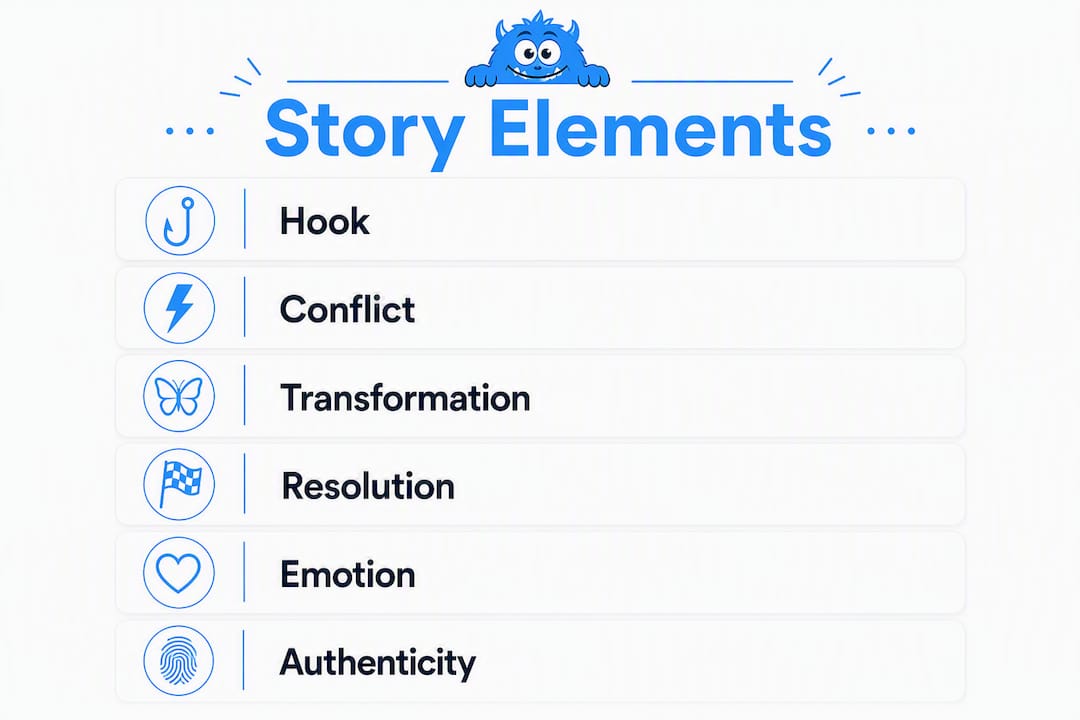
Six elements appear consistently in stories that drive measurable engagement. Miss one and the whole structure weakens.
| Element | What it does | Common mistake |
|---|---|---|
| Protagonist (not your brand) | Creates identification and emotional investment | Making the brand the hero; the customer or employee should occupy that role |
| Conflict or tension | Triggers dopamine and sustains attention | Skipping straight to the resolution; tension is what keeps people reading |
| Stakes | Tells the audience why they should care | Vague stakes (“it was challenging”) versus specific ones (“we had 48 hours”) |
| Transformation | Shows what changed and makes the story worth finishing | Describing activity rather than outcome; “we ran a campaign” versus “sales doubled in six weeks” |
| Sensory detail | Activates multisensory brain regions and deepens immersion | Abstract language; concrete sensory words (“the screen went blank at 11 PM”) outperform adjectives |
| Fact anchor | Provides rational justification after emotional engagement | Omitting data entirely, or leading with data before the story has created investment |
A compact six-step story template you can use for any format:
- Open in action. Drop the audience into a moment already in progress.
- Name the protagonist. A real person (customer, employee, founder) with a specific goal.
- Introduce the obstacle. What stood between them and that goal?
- Raise the stakes. What would happen if they failed?
- Show the turning point. The decision, discovery, or help that changed things.
- State the transformation. What is measurably different now?
Pro Tip: The most common execution mistake is spending 80% of the story on context and 20% on transformation. Invert that ratio. Audiences will forgive a thin backstory; they will not forgive a weak payoff.

Ten techniques that make storytelling more engaging
These tactics work across formats. Pick three to test this week rather than trying all ten at once.
Hooks and openings
Start in media res. Beginning in the middle of the action avoids the long preamble that loses audiences in short-form channels. “The email arrived at 2 AM” beats “Our client had been struggling with their marketing for several months.”
Use a defined hook type. Narrative practitioners and live-story formats like The Moth recommend five hook categories: hope, humour, heart, help, and healing. Each targets a different emotional entry point. Choose the one that matches your audience’s current state.
Open with a question that has no obvious answer. “What would you do if your best campaign was also your most controversial?” creates a curiosity gap the brain is compelled to close.
Structure and tension
Use micro-drama. A single moment of tension, even in a 150-word social post, is enough to trigger dopamine. You do not need a full narrative arc; you need one moment where the outcome is uncertain.
Serialise deliberately. Cliffhangers and controlled information release keep audiences returning across posts, emails, or training modules. End each instalment with an unresolved question rather than a tidy conclusion.
Juxtapose the expected and the actual. “We expected 50 sign-ups. We got 12. Here is what that taught us.” Contrast creates tension without requiring a dramatic backstory.
Audience and community
Shift the POV to your audience. Rewrite “we launched a product” as “you no longer have to…”. The reader becomes the protagonist immediately.
Prompt user-generated stories. Ask your community a question that invites their own narrative (“What was the moment you realised X?”). UGC consistently outperforms brand-created content on trust and engagement, and it multiplies your story supply.
Frame your CTA as a story continuation. Instead of “Buy now,” try “Find out what happened next.” The call to action becomes part of the narrative rather than an interruption.
Community follow-up
- Reply first, within the hour. Prompt replies within the first hour of posting amplify reach and signal liveliness to platform algorithms. This is not a nice-to-have: it is the difference between a story that travels and one that stalls.
Channel quick tips:
- Social (Instagram, TikTok): Lead with a visual hook in the first frame; use captions to deepen the story rather than repeat it.
- Email: A story-led subject line (“She almost quit. Then this happened.”) outperforms feature-led ones on open rate. Blend the narrative with a fact anchor in the body.
- Video and presentations: Open with the protagonist’s problem, not your agenda. Save your credentials for after the audience is emotionally invested.
- LinkedIn carousels: Each slide is a story beat; the last slide is the transformation. Carousels perform especially well on LinkedIn for this reason.
How do you adapt storytelling for different channels?
Format matters as much as content. The same story told the wrong way for the channel loses most of its engagement potential.
| Channel / context | Best story format | Hook style | Primary KPI |
|---|---|---|---|
| Instagram feed post | Single transformation moment, 150–300 words | Emotional (“She was about to give up…”) | Saves, shares, comments |
| Instagram Stories | Sequential micro-story across 3–5 frames | Visual cliffhanger per frame | Completion rate, replies |
| LinkedIn carousel | Problem → insight → transformation, one beat per slide | Contrarian or data-led (“Most marketers get this wrong”) | Impressions, saves, DMs |
| Email newsletter | Narrative lead + fact anchor + CTA as continuation | Curiosity gap subject line | Open rate, CTR |
| Training module | Case study with protagonist, conflict, resolution | Relatable obstacle | Completion rate, quiz score |
| Internal comms | Employee-as-hero vignette | Specific moment, not abstract value | Read rate, response rate |
| X (formerly Twitter) | Single-sentence hook + thread | Strong declarative or question | Replies, retweets |
Dos and don’ts by context:
Social posts: Do open with the story beat, not the brand name. Don’t end with a passive “let us know your thoughts” — ask a specific question that invites a narrative response.
Email: Do blend story with a sourced fact in the same paragraph. Don’t save the emotional hook for paragraph three; blended written messages outperform purely narrative or purely analytical ones, but only when the story comes first.
Training: Do make the learner the protagonist of the scenario. Don’t use a fictional company name so generic it creates no identification (“Acme Corp”).
Internal comms: Do name a real employee (with consent) as the hero. Don’t let the story become a performance review in disguise.
For serialisation, seed the next instalment in your reply thread rather than in the post itself. On Instagram and Threads, native video and reply threads extend reach beyond the initial post audience. Polls work well as a mid-series engagement check: “Which outcome do you think happened?” keeps the audience invested between episodes.
How do you measure whether storytelling improved engagement?
Measurement is where most storytelling efforts fall apart. Without a baseline and a control, you cannot separate the effect of the story from the effect of the topic, the timing, or the algorithm.
Setting up your measurement
Define your primary metric before you publish. Choose one: share rate, comment rate, watch-through rate, CTR, or email open rate. Secondary metrics (saves, return visits, completion) are useful context but should not dilute your primary hypothesis.
Establish a baseline. Pull the average performance of your last five comparable posts or emails. That number is your control.
Run a simple A/B test. Publish two versions of the same content: one story-led (protagonist, conflict, transformation), one fact-led (same information, no narrative structure). Keep the topic, timing, and audience identical. The difference in your primary metric is the storytelling lift.
Track qualitative signals. Comments that reference the story’s protagonist or ask “what happened next?” are strong signals that narrative transportation occurred. Screenshot and log these; they are evidence that the story worked even when the quantitative lift is modest.
Measure retention separately from reach. A story that reaches 10,000 people but generates no return visits has not built engagement. Track return visitor rate and email list retention alongside reach metrics.
Allow enough time. A single story-led post tells you very little. Run the experiment across at least four comparable posts before drawing conclusions.
| Metric | Baseline (control) | Short-term lift target | Longer-term indicator |
|---|---|---|---|
| Comment rate | Your current average | Aim for a meaningful increase versus control | Rising average over 30 days |
| Share / repost rate | Your current average | Aim for a meaningful increase versus control | Share rate trend across series |
| Watch-through rate | Your current average | Aim for a meaningful increase versus control | Completion rate trend |
| Email CTR | Your current average | Aim for a meaningful increase versus control | List retention rate |
| Return visitor rate | Your current average | Aim for a meaningful increase versus control | Monthly return visitor growth |
Pro Tip: Do not measure storytelling success by reach alone. A story that reaches fewer people but generates ten times the comments and saves is doing more work for your brand than a viral post that nobody remembers.
Short UK-relevant examples: what does storytelling lift look like?
Marketing: a UK challenger brand’s email series
A UK direct-to-consumer brand restructured its weekly email from a product roundup to a three-part customer story series. Each email opened with a named customer’s specific problem, introduced the obstacle in paragraph one, and held the resolution until the following week. The serialised format created a curiosity gap that lifted open rates on the second and third instalments compared with the brand’s previous product-led emails. The lesson: serialisation works in email as well as social, and the cliffhanger does not need to be dramatic. An unresolved question is enough.
Narrative-led content can deliver substantially higher engagement compared with non-narrative content in some datasets. For email, the mechanism is the curiosity gap: the brain is compelled to resolve open narrative loops.
Training: NHS-adjacent onboarding
A UK healthcare communications team replaced a compliance onboarding module with a case-study format. Instead of presenting rules as a list, they structured each module around a named (anonymised) practitioner who faced a real compliance decision. Learners identified with the protagonist, which increased module completion rates and improved quiz scores on the first attempt. The structural change was minimal: the same information, reordered around a person and a decision rather than a regulation and a consequence.
Internal comms: a manufacturing firm’s change programme
A UK manufacturer running a factory-floor digitalisation programme replaced its monthly all-staff update with a short “employee of the fortnight” story. Each story named a specific worker, described the moment they first used the new system, and quoted what changed for them. Read rates on the internal newsletter rose substantially. More importantly, the qualitative signal was clear: employees began submitting their own stories unprompted, which is the strongest indicator that narrative transportation had occurred and that the change programme had community buy-in.
Applying storytelling to social growth: a Greediersocialmedia experiment template
This section gives you a practical sequence to run a 30-day story-led social test, with the kind of support Greediersocialmedia provides to accelerate early reach.
Preparation and publication checklist
- Choose your protagonist. A real customer, employee, or founder moment. Avoid fictional composites.
- Write your hook first. Test two versions: one emotional (“She had 24 hours to fix it”), one contrarian (“Most advice on this is wrong”). Pick the one that creates genuine tension.
- Blend in a fact anchor. One specific number or sourced claim in the body of the post.
- Schedule for your audience’s peak time. Check your platform analytics for the 2-hour window when your followers are most active.
- Publish and stay online. Replying within the first hour amplifies reach and signals liveliness to platform algorithms.
- Seed the next instalment. In your reply thread, drop a one-sentence teaser for the next story beat.
- Log your baseline metrics (comments, shares, saves, reach) within 24 hours.
30-day cadence
- Week 1: Publish two story-led posts. Measure comment rate and share rate against your baseline.
- Week 2: Add a serialised element. End one post with an unresolved question; publish the resolution three days later.
- Week 3: Introduce a UGC prompt. Ask your community a question that invites their own story.
- Week 4: Review your primary metric trend. If comment rate or share rate has risen versus your baseline, the story structure is working. If not, test a different hook type.
Success criteria: a meaningful rise in comment rate or share rate versus your pre-test baseline, and at least one piece of organic UGC generated by the community.
Authenticity and compliance note: all stories should use real people with explicit consent, or clearly anonymised composites. For UK brands, any customer story used in marketing content should comply with GDPR data-use requirements. Greediersocialmedia’s engagement packages are password-free and delivered without account access, which means your account security is never compromised during a reach-acceleration test.
Pro Tip: The 30-day template works best when you treat week one as a calibration exercise, not a performance test. Your first story-led post will rarely be your best. The data from week one tells you which hook type and format your specific audience responds to, and that information is worth more than the post itself.
A one-page checklist and story template you can use this week
Seven-item story-readiness checklist
| Item | Question to answer before you publish |
|---|---|
| Audience | Who is this story for, and what do they already believe? |
| Hero | Is the protagonist your customer or employee, not your brand? |
| Conflict | Is there a specific, concrete obstacle — not a vague challenge? |
| Sensory detail | Does the story contain at least one specific sensory or situational detail? |
| Fact anchor | Is there one sourced number or verifiable claim in the body? |
| Hook | Does the first sentence create tension, curiosity, or emotional recognition? |
| CTA | Does the call to action feel like a story continuation rather than an interruption? |
Three-sentence story template
Sentence 1 (hook, in action): “[Name/role] had [specific time/resource] to [specific goal] — and [specific obstacle] was in the way.”
Sentence 2 (turning point): “The moment [specific decision or discovery], everything changed: [concrete outcome].”
Sentence 3 (CTA as continuation): “If you want to see how [they/you] got there, [link/next step].”
This template works for social captions, email openers, and presentation slides. The specificity in each sentence is what separates it from generic copy.
Editorial QA checklist
Before publishing, confirm: the tone matches your brand voice; every claim is truthful and verifiable; any customer quote has explicit consent and complies with GDPR; the story has been tested on at least one person outside your team who can confirm the hook lands. Test small batches first: two story-led posts before committing to a full serialised campaign.
Pro Tip: Run your draft through the “so what?” test. After every sentence, ask whether a reader who has never heard of your brand would care. If the answer is no, the sentence is serving your brand, not your audience. Cut it or rewrite it from the protagonist’s perspective.
For more on high-engagement post formats that pair well with story structure, Greediersocialmedia’s resource library covers platform-specific templates updated for current algorithm behaviour.
Key takeaways
Storytelling increases engagement because it triggers dopamine and oxytocin, which sustain attention and build trust, and blending narrative with facts produces stronger persuasion outcomes than either approach alone.
| Point | Details |
|---|---|
| Neuroscience drives engagement | Dopamine sustains attention; oxytocin builds trust. Both are triggered by narrative and predict whether audiences remember and act. |
| Blend story with facts | Meta-analysis shows blended written messages outperform purely narrative or purely analytical ones on persuasion and purchase willingness. |
| Make the audience the hero | Shifting the protagonist from brand to customer or employee increases retention, trust, and UGC generation across marketing and internal comms. |
| Measure with a baseline | Set a primary metric before publishing, run a story-led versus fact-led A/B test, and track comment and share rates over at least four posts. |
| Greediersocialmedia accelerates early reach | For UK brands testing story-led content, Greediersocialmedia offers password-free engagement packages to amplify visibility during the critical first-hour window. |
The part most guides skip
Most storytelling advice stops at structure. Hook, conflict, resolution. The 5 C’s. The hero’s journey. All of it is correct, and almost none of it addresses the thing that actually determines whether your story travels: what you do in the 60 minutes after you publish.
The neuroscience is clear that stories create emotional investment. What it does not tell you is that emotional investment expires fast on social platforms. A reader who finishes your story and feels something will act on that feeling within minutes or not at all. If they comment and you do not reply, the conversation dies. If they share and you do not acknowledge it, the community signal fades. The algorithm notices both.
The brands that consistently outperform on engagement are not necessarily the best storytellers. They are the ones who treat the post as the beginning of a conversation rather than the end of a production process. They reply fast, they ask follow-up questions, they feature the responses they get in the next story. That loop, story to community to story, is what compounds over 30 days into a measurable engagement lift.
There is also a subtler point about authenticity that the UK market in particular rewards. British audiences are sceptical of polished brand narratives in a way that, for example, US audiences are not. The stories that work here tend to be slightly rougher, more honest about failure, and more specific about the person at the centre. A story about a founder who nearly went under in 2023 and what they learned will outperform a story about a brand that “overcame challenges to deliver exceptional results” every single time. Specificity is not just a craft choice; it is a trust signal.
Accelerate your story-led content with Greediersocialmedia
The first 60 minutes after publishing are when story-led posts either gain traction or stall. Greediersocialmedia gives UK brands and creators a concrete advantage in that window: real followers, likes, and views delivered without needing your password, so your story reaches a wider audience at the exact moment it needs momentum.
Since 2013, Greediersocialmedia has supported over a million users across Instagram, Facebook, TikTok, YouTube, and Threads. The approach is straightforward: you write the story, we help it reach the people who need to see it. No lock-in contracts, no account access required, and UK-targeted delivery so your engagement signals are relevant to your actual market.
For UK small businesses and content creators running a 30-day story test, the social media growth strategy for small businesses page outlines the packages best suited to early-stage reach acceleration. If you want to understand the difference between paid reach and organic growth before committing, the paid engagement versus organic growth guide covers exactly that.
Useful sources and further reading
- How Stories Change the Brain, Greater Good Magazine (UC Berkeley) — the foundational neuroscience piece on oxytocin, narrative transportation, and behavioural change; essential reading for anyone building a business case for storytelling.
- Meta-analysis: should your marketing tell a story or state the facts? — quantitative evidence comparing narrative versus analytical persuasion, with specific findings on blended messages.
- Audience engagement through storytelling, InfluenceFlow — practitioner summary of engagement uplifts, interactive formats, and UGC data.
- Storytelling tips for better engagement, Narrative Arts — practical hook categories and in-media-res technique from live-story practitioners.
- What makes storytelling so effective for learning?, Harvard Business Review — covers the retention and buy-in benefits of narrative in organisational and training contexts.
- How to increase social media engagement, Postory — platform-specific format recommendations and the reply-first engagement data.
- The power of storytelling: boost brand engagement, Babylove Growth — practitioner-focused overview of storytelling impact with format and measurement guidance for marketers.
- Storytelling training to promote stakeholder engagement, PMC/NIH — peer-reviewed research on storytelling in professional and health communication contexts; useful for training and internal comms applications.
FAQ
Do stories genuinely increase engagement?
Yes. Research shows narrative-led content can deliver 68% higher engagement than non-narrative content in some datasets, and a large meta-analysis found narrative processing correlates more strongly with persuasion outcomes than analytical processing alone.
What are the 5 C’s of storytelling?
Definitions vary across practitioners, but a widely used version covers: Character (a specific protagonist), Conflict (the obstacle they face), Context (the situation that makes the conflict meaningful), Climax (the turning point), and Conclusion (the transformation or resolution). The framework is a useful QA tool rather than a rigid formula.
How do you make storytelling more engaging?
Start in the middle of the action rather than with background, make your customer or employee the hero rather than your brand, blend one specific fact into the narrative body, and reply to every comment within the first hour of publishing. Serialisation and cliffhangers also increase return rates by creating unresolved narrative loops.
What are the main benefits of storytelling for marketers?
Storytelling reliably lifts attention and completion rates, builds trust through oxytocin release, improves information retention, increases share rates by triggering high-arousal emotions, and motivates action when the call to action is framed as a story continuation rather than an interruption.
How does Greediersocialmedia support story-led content?
Greediersocialmedia offers UK-targeted engagement packages (followers, likes, views) delivered without account password access, which means brands can accelerate the reach of story-led posts during the critical first-hour window without compromising account security. The service is available across Instagram, Facebook, TikTok, YouTube, and Threads.