
Understanding how social campaigns are optimised takes the guesswork out of budget decisions.
TL;DR:
- Effective social campaign optimization involves designing campaign structures and tracking systems that provide high-quality data to ad algorithms. Structuring campaigns by funnel stage and using Campaign Budget Optimization enhances learning speed, while robust tracking with Meta Pixel, CAPI, and standardized UTM parameters ensures accurate conversion measurement. Maintaining disciplined budget increases, continuous creative production, and patience during the learning phase are crucial for scalable, reliable advertising performance.
Social campaign optimisation is defined as the deliberate structuring of campaign architecture, tracking infrastructure, and creative management to deliver clean, learnable signals to ad algorithms. The biggest lever in this process is not adjusting audiences or creatives at random. It is engineering the campaign so the algorithm receives consistent, high-quality data to act on. Tools like Meta Ads Manager, Google Analytics 4, and UTM tagging are the operational backbone of how social campaigns are optimised effectively. Achieving at least 50 conversion events per week per ad set, structuring by funnel stage, and maintaining creative pipelines are the non-negotiable foundations of 2026 best practice.
What campaign structures drive faster algorithm learning?
Campaign structure is the single most controllable variable in social media strategy optimisation. The way you organise ad sets directly determines how quickly Meta’s algorithm exits the learning phase and begins delivering efficiently.

Separate campaigns by funnel stage
Structuring campaigns by funnel stage (cold, warm, and retention) gives each audience type its own bidding rules, creative logic, and budget. Cold audiences require broader messaging and awareness-led creative. Warm audiences respond to social proof and direct offers. Retention campaigns focus on loyalty and repeat purchase signals. Mixing these into a single campaign forces the algorithm to serve conflicting objectives, which degrades performance.
CBO vs ABO: which wins?
Campaign Budget Optimisation (CBO) consistently outperforms Ad Set Budget Optimisation (ABO) because it consolidates spend and allows Meta’s system to allocate budget dynamically across ad sets. ABO gives you manual control, which sounds appealing but often fragments your budget across too many ad sets. Fragmentation is the enemy of learning. When spend is spread too thin, no single ad set reaches the threshold needed to exit learning phase.
The threshold matters. Optimising for at least 50 conversions per week per ad set is the standard Meta recommends for reliable signal gathering. If your campaign cannot hit that volume on a purchase event, move up the funnel and optimise for add-to-cart or initiate checkout instead. This keeps the algorithm fed with enough data to learn.
- Keep the number of ad sets per campaign low. More ad sets split your budget and slow learning.
- Avoid narrow audiences below 500,000 for cold campaigns. Small audiences trigger “Learning Limited” status quickly.
- Use broad or advantage+ audiences for cold traffic to give the algorithm room to find converters.
- Consolidate creatives within ad sets rather than duplicating ad sets for each creative variation.
Pro Tip: Schedule creative swaps and audience edits before launch or after the learning phase exits. Edits made mid-learning reset the clock and force the algorithm to start over.
How does tracking infrastructure power reliable optimisation?
Tracking is not a technical afterthought. It is the foundation that every optimisation decision rests on. Broken or inconsistent tracking means your campaign is being optimised on false data.
Pixel plus conversions API: the non-negotiable combination
Using Meta Pixel alongside the Conversions API (CAPI) with proper deduplication stabilises conversion measurement in an era of browser-level ad blocking and cookie restrictions. The Pixel captures client-side events. CAPI captures server-side events. Together, they fill the gaps each leaves individually. Without deduplication using matching event IDs, conversion counts inflate and ROAS figures distort. Distorted ROAS misleads the algorithm and produces poor spend decisions.
Standardising UTM parameters for ga4
UTM parameters must be standardised with at least utm_source, utm_medium, and utm_campaign, and written in lowercase consistently. GA4 is case-sensitive. “Facebook” and “facebook” are recorded as two separate sources. That split corrupts attribution reports and makes it impossible to accurately measure social campaign success across channels.
Here is a reliable tracking setup sequence for 2026:
- Install Meta Pixel on all key pages and verify via Meta Events Manager.
- Implement Conversions API via server-side integration or a partner such as Shopify or Zapier.
- Set matching event IDs on both Pixel and CAPI events to enable deduplication.
- Define a UTM naming convention and document it in a shared reference sheet.
- Connect GA4 to Meta Ads Manager via the native integration to align attribution windows.
- Audit UTM data in GA4 monthly to catch case inconsistencies or broken parameters.
Pro Tip: Use a UTM tracking guide to build a naming convention before your first campaign launches. Retrofitting UTMs after the fact creates data gaps that are impossible to close.
Measuring what actually matters
Focus social media performance metrics on business outcomes: conversions, cost per acquisition (CPA), return on ad spend (ROAS), and attributed revenue. Reach and engagement rate are useful for context but should never drive budget decisions. Connecting ad performance to downstream quality outcomes such as sales conversion rate and customer retention sharpens decision-making considerably. You can track the right KPIs more consistently by reviewing the social media KPIs that matter most in 2026.
What budget scaling rules prevent optimisation disruptions?
Budget management is where most marketers inadvertently destroy the performance they have built. The learning phase is fragile, and large or frequent budget changes reset it entirely.
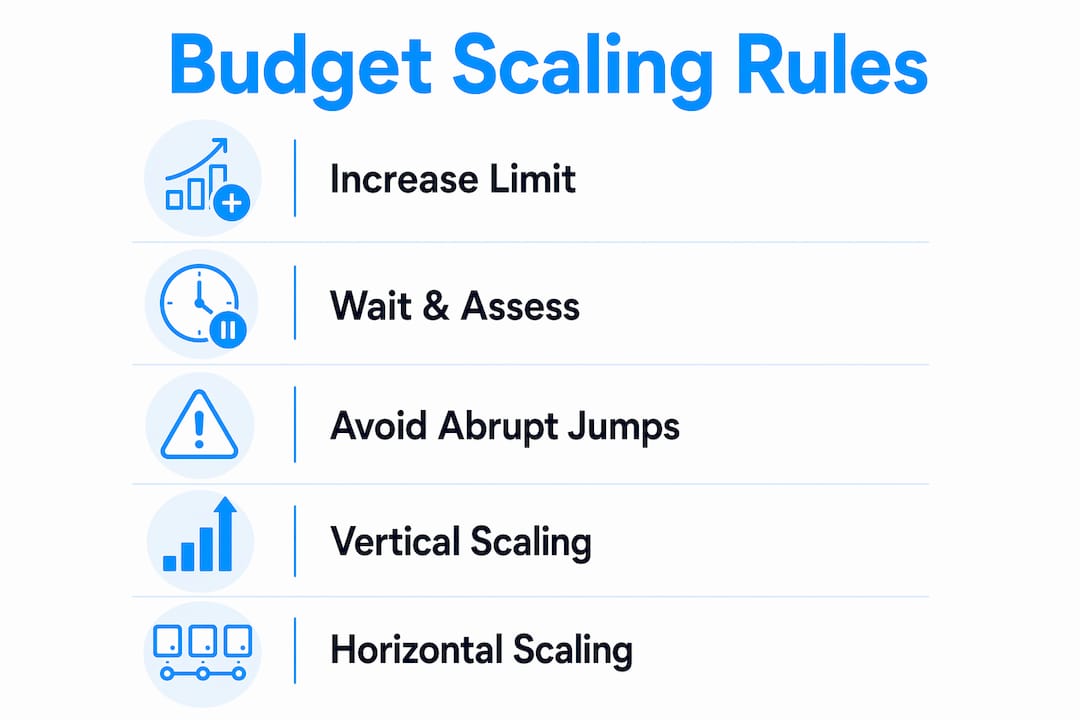
| Scaling Action | Recommended Approach | Likely Outcome |
|---|---|---|
| Budget increase | Raise by no more than 20% per step | Stable learning, gradual CPA improvement |
| Large budget jump (50%+) | Avoid during active learning phase | Learning reset, volatile CPA, wasted spend |
| Post-change evaluation | Wait 48–72 hours before judging results | Accurate read on performance impact |
| Audience expansion | Add new ad sets rather than editing existing | Preserves existing learning signal |
| Creative swap | Replace after learning phase exits | No disruption to algorithm signal |
Meta’s 20% budget increase rule exists because abrupt spend jumps force the algorithm to re-explore audience segments it had already mapped. That re-exploration period produces volatile CPAs and inflated costs. Patience here is not passive. It is a deliberate tactic.
Early underperformance in the first 48 hours almost always reflects unstable attribution during learning, not a failing campaign. Marketers who pause or edit campaigns in this window are the ones who never see stable results. Wait the full seven days before drawing conclusions on a new or recently edited ad set.
Vertical scaling means increasing budget on a single winning ad set. Horizontal scaling means duplicating that ad set into new audiences or placements. Both approaches work, but horizontal scaling carries less risk of disrupting the original ad set’s learning. For budget-conscious growth, horizontal scaling with tested creative is the lower-risk path.
How do creative management and audience segmentation improve results?
Creative fatigue is the silent killer of otherwise well-structured campaigns. At higher budgets, even strong creative wears out faster than most marketers expect.
Producing 20–30 new creative assets weekly is the standard recommended for campaigns scaling aggressively. That volume sounds high, but it reflects how quickly audiences at scale exhaust a static creative set. A continuous creative pipeline is not a luxury. It is a structural requirement for sustained performance.
Single-variable creative testing is the only reliable way to attribute performance shifts to specific changes. Changing the headline, the visual, and the call to action simultaneously makes it impossible to know what drove the result. Change one element, run it against the control, and let data decide before moving to the next variable.
Audience segmentation by temperature (cold, warm, retention) does more than organise your campaigns. It allows you to set frequency caps, tailor messaging, and allocate budget according to where each audience sits in the buying journey. Retargeting audiences, in particular, need frequency caps to avoid ad fatigue and negative brand associations.
- Rotate at least three to five creatives per ad set to reduce frequency-driven fatigue.
- Flag creative for replacement when frequency exceeds three impressions per user per week.
- Test hooks first. The opening two seconds of a video ad determines whether the rest is watched.
- Use dark posts for retargeting to control messaging without cluttering your organic feed.
- Align creative format to placement. Stories and Reels require vertical video. Feed placements suit square or landscape formats.
Pro Tip: Build a creative testing calendar. Assign each week a specific variable to test across your active ad sets. This turns creative iteration from reactive firefighting into a planned social media strategy.
Key Takeaways: How Social Campaigns Are Optimised
Social campaigns are optimised through structured campaign architecture, clean tracking infrastructure, disciplined budget management, and a continuous creative pipeline working together.
| Point | Details |
|---|---|
| Structure by funnel stage | Separate cold, warm, and retention campaigns to give each audience distinct bidding and creative rules. |
| Use CBO over ABO | Campaign Budget Optimisation reduces fragmentation and lets Meta allocate spend more efficiently. |
| Combine Pixel and CAPI | Server-side and client-side tracking together produce accurate conversion data for reliable optimisation. |
| Apply the 20% budget rule | Increase budgets in 20% increments and wait 48–72 hours before evaluating the impact. |
| Maintain a creative pipeline | Produce new assets consistently and test single variables to sustain performance at scale. |
The part most marketers skip until it’s too late
I have reviewed dozens of Meta accounts where the campaign structure looked textbook-perfect on the surface. Funnel stages separated, CBO active, UTMs in place. Yet performance was erratic and scaling attempts kept failing. The common thread was almost always the same: the tracking was broken in a way nobody had noticed.
Pixel and CAPI events were firing without matching event IDs. Conversions were being counted twice. ROAS figures were inflated by 30–40%, and the algorithm was optimising toward phantom revenue. The campaigns were not underperforming. They were performing exactly as instructed, just toward the wrong signal.
The lesson I keep returning to is this: optimisation is only as good as the data feeding it. You can have the most disciplined budget strategy and the most creative ad sets in your industry, but if your measurement layer is compromised, every decision downstream is built on sand.
The other mistake I see constantly is impatience during the learning phase. Marketers see a high CPA on day two and panic. They edit the ad set, reset the learning clock, and then wonder why results never stabilise. The algorithm needs time. Giving it that time feels counterintuitive when money is being spent, but it is the most cost-effective thing you can do.
Balancing automation with active monitoring is the real skill in 2026. Let the algorithm do its job, but audit your tracking weekly, review creative frequency every few days, and treat budget changes as deliberate interventions rather than reflexive reactions.
— Luna
Take your social media growth further
Optimising campaigns at the structural level is only one part of building a strong social media presence. Greediersocialmedia has supported over a million users since 2013, helping UK businesses and creators grow their presence through authentic engagement strategies on platforms including Instagram and Facebook.
Whether you are scaling paid campaigns or building organic authority alongside them, the right growth tactics make both work harder. Explore Greediersocialmedia’s social media growth hacks for practical, tested approaches to increasing brand visibility and engagement. For businesses at earlier stages, the small business growth strategy guide breaks down exactly where to focus first.
FAQ
What does social campaign optimisation actually mean?
Social campaign optimisation is the process of structuring campaigns, tracking, and creative assets to give ad algorithms clean, consistent data. The goal is better business outcomes, not higher vanity metrics.
How many conversions does a meta ad set need per week?
Meta recommends at least 50 conversion events per week per ad set for reliable learning. If volume is too low, optimise for a higher-funnel event such as add-to-cart instead.
How much should you increase a meta campaign budget at once?
Increase budgets by no more than 20% per step and wait 48–72 hours before evaluating the result. Larger jumps reset the learning phase and produce volatile costs.
Why should you use both meta pixel and conversions API?
The Pixel captures client-side events while CAPI captures server-side events, filling gaps caused by browser restrictions. Together with proper deduplication, they produce accurate conversion data for reliable optimisation.
What is the biggest mistake marketers make during the learning phase?
Editing campaigns within the first seven days is the most common error. Early underperformance usually reflects unstable attribution, not a failing campaign, and edits reset the learning clock entirely.