
Understanding how shares amplify content reach explains why some posts spread far beyond their original audience.
Shares multiply your content’s reach by doing two things at once: they trigger platform algorithms to surface your post on recommendation feeds, and they put your content in front of entirely new networks through a personal endorsement. A single share on Instagram, TikTok, or Facebook is not just a metric — it is a signal that someone trusted your content enough to attach their name to it. Research by Beresford Research quantifies that directly: extremely positive shares lift purchase intent by 9.5%, while negative sharing experiences reduce purchase incidence by 11%. The practical implication for UK small businesses is straightforward. Watch your first 2–4 hours of organic share signals after posting, then use those signals to decide which content deserves paid amplification through packages on Instagram, TikTok, Facebook, or via Greediersocialmedia’s engagement services, following best practices.
Table of Contents
- How shares amplify content reach differently from likes or comments
- What does the evidence say about shares and business value?
- What makes content people actually want to share?
- How to use share signals to guide paid social spend
- How do you measure share-driven lift and prove ROI?
- Common mistakes that kill your share strategy
- How Greediersocialmedia applies this for UK small businesses
- Key takeaways
- Why the share-first approach is the one most small businesses skip
- Greediersocialmedia turns share signals into measurable growth
- FAQ
How shares amplify content reach differently from likes or comments
A like is passive. A comment is a conversation. A share is a personal endorsement — the user is staking their own reputation on your content reaching their network. That distinction matters mechanically, not just philosophically.
Platforms treat shares as a stronger quality signal than likes or comments because a share creates a new distribution event. On TikTok, a shared video can appear on a second user’s For You Page independently of the original post’s performance. On Instagram, a shared Reel lands in Stories and DMs, generating fresh impressions outside the original Explore or feed placement. Facebook’s algorithm weights reshares heavily when deciding whether to push content into suggested feeds. On X (formerly Twitter), a retweet exposes content to the retweeter’s entire follower graph in real time. YouTube’s share function drives external traffic from messaging apps and embeds, which the algorithm reads as off-platform demand.
The network multiplier works like this: one share to a follower with 800 connections creates 800 potential new impressions. If even 2% of those connections reshare, the cascade begins. Sharing to large public platforms consistently drives higher demand than sharing limited to private messaging, which is why content designed for public resharing outperforms content designed only for DMs.

| Platform | Strong amplification signal | Benchmark threshold |
|---|---|---|
| Amplification rate (shares ÷ followers × 100) | Above 1% indicates strong reach | |
| TikTok | Shares-to-views ratio | 3–5% suggests viral potential |
| Reshare count relative to reactions | High reshare-to-reaction ratio triggers suggested feeds | |
| X (Twitter) | Retweet velocity in first hour | Rapid early retweets trigger trending signals |
Pro Tip: Remove every unnecessary tap from your sharing flow. Sharing friction can reduce share counts by up to 86% in some UX patterns — so if your link destination loads slowly or your CTA is buried, you are losing shares before they happen.
What does the evidence say about shares and business value?
The Beresford Research figures are worth sitting with. A +9.5% lift in purchase intent from a positive share is not a vanity metric — for a small e-commerce brand selling £40 products, that shift in intent across a few thousand reached users translates into real orders. The −11% figure for negative shares is the sharper warning: amplifying content that generates hostile resharing actively damages conversion rates.
Digital strategists treat shares as earned media with a measurable cash value, comparable to a word-of-mouth recommendation. When you calculate your amplification rate using the formula (total shares ÷ total followers) × 100, you get a number you can benchmark. On Instagram, above 1% is considered strong; on TikTok, a shares-to-views ratio of 3–5% signals content with viral potential. These thresholds give you a concrete go/no-go decision point before spending on paid distribution.
Consider a UK food brand posting an unboxing clip. If that clip hits a 1.2% amplification rate within three hours of posting, the evidence says: this content is already spreading. Paying to accelerate it at that point is backing a proven asset, not a guess.
What makes content people actually want to share?
Shareability is not accidental. These are the elements that consistently drive shares across Instagram Reels, TikTok clips, Facebook posts, and YouTube Shorts:
- Emotional trigger first. Surprise, humour, or genuine usefulness prompt sharing. Content that makes someone think “my friend needs to see this” gets shared; content that makes them think “that’s nice” gets a like.
- Short video formats. Reels and TikTok clips under 30 seconds generate disproportionate share rates because they are low-commitment to watch and easy to forward.
- Explicit share CTAs. Asking “send this to someone who needs it” in the caption or on-screen text measurably increases shares. Passive content rarely gets shared at the rate prompted content does.
- Utility or information. “How to” content and quick tips are shared because they make the sharer look helpful. A 15-second tip relevant to your niche travels further than a polished brand video.
- User-generated content (UGC). Reposting a customer’s genuine review or reaction gives your audience a real person to identify with, and that person’s own network often reshares it.
For timing: post when your audience is active, then observe the 2–4 hour window of organic shares and saves. That window is your real-time focus group. If shares are accumulating, the content has legs. If they are flat, adjust before spending a penny on paid promotion.
Pro Tip: Employee advocacy is an underused amplification lever for UK small businesses. Asking your team to share a post from their personal accounts costs nothing and can double your initial organic reach, giving you a stronger signal before you decide to buy paid amplification.
How to use share signals to guide paid social spend
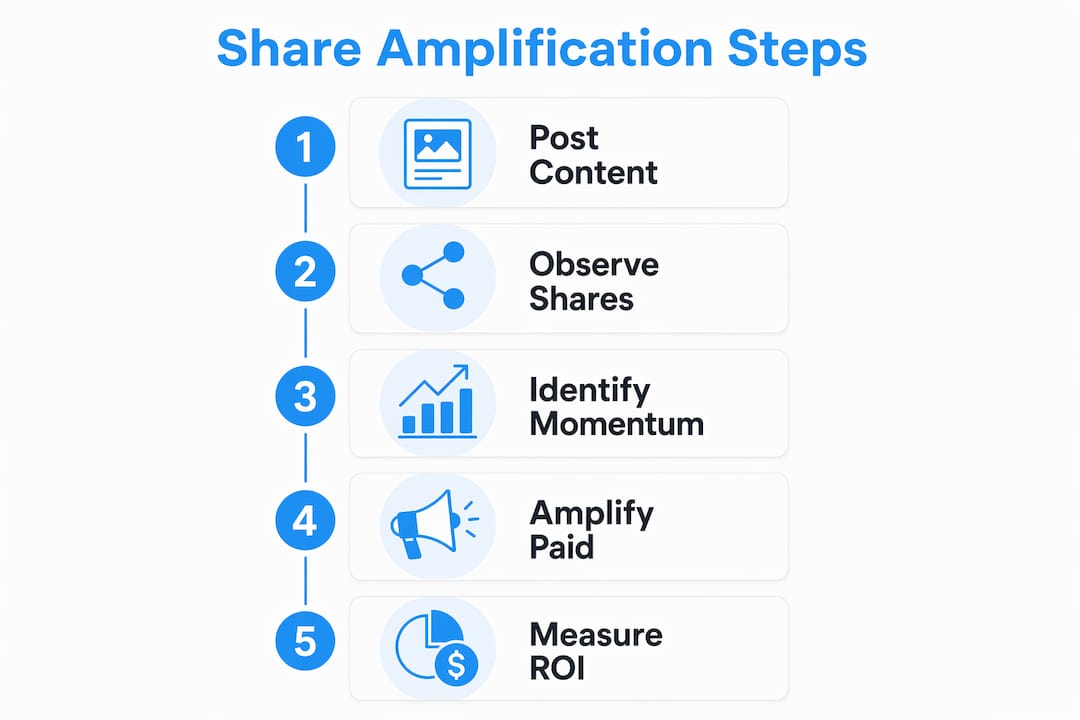
The sequence that works is: publish → observe 2–48 hours → identify posts with strong share momentum → amplify those posts using formats that preserve social proof.
Creator-authentic content scaled as paid ads consistently outperforms brand-studio assets because it retains the look and feel that earned the shares in the first place. On TikTok, Spark Ads let you boost an existing organic post rather than creating a separate ad, so the share count and comments remain visible. Meta’s Partnership Ads work similarly for Instagram and Facebook. Preserving that social proof in the paid placement is not a cosmetic choice — it is what keeps the conversion rate high.
For audience targeting, build retargeting lists from people who engaged with or shared your top posts. Then use audience segmentation to create lookalike audiences modelled on your sharer profiles. Sharers are your highest-intent audience segment; mirroring them in paid targeting is one of the most efficient uses of a small budget.
Pro Tip: Never lead with paid spend. Organic share momentum is your proof of concept. Paid budget that follows organic signals consistently outperforms paid budget that tries to create them from scratch.
How do you measure share-driven lift and prove ROI?
Track these metrics for every post you consider amplifying:
- Amplification rate: (total shares ÷ total followers) × 100
- Shares-to-views ratio: total shares ÷ total video views (TikTok benchmark: 3–5%)
- Reach and impressions: what reach actually means versus impressions tells you how many unique accounts your content touched
- Click-through rate from shared links: use UTM parameters on any link in bio or caption to attribute traffic to specific posts
- Conversion rate from share-driven traffic: compare UTM-tagged sessions against your baseline conversion rate
For a clean measurement test, run an A/B or holdout design: amplify one validated post with paid spend and hold back a comparable post as organic-only. After 7 days, compare reach, clicks, and conversions between the two groups. The difference is your paid lift estimate.
| Metric | Formula | What it tells you |
|---|---|---|
| Amplification rate | (Shares ÷ Followers) × 100 | How broadly your audience distributes content |
| Share-attributed reach | Shares × average sharer follower count | Estimated new audience exposure |
| Share-to-conversion rate | Conversions from UTM-tagged share traffic ÷ total share clicks | Revenue value of each share event |
| Paid lift | (Amplified post conversions − Organic-only conversions) | Incremental return on paid spend |
Common mistakes that kill your share strategy
Amplifying too early is the most expensive error. Pushing paid spend behind a post within the first hour, before organic signals have had time to form, means you are betting on a hunch rather than evidence.
- Buying engagement without organic validation first. Paid followers or likes on a post that has not yet earned shares do not create the cascade effect. Validate organically, then amplify.
- Ignoring negative comments before scaling. If early comments are hostile or the resharing context is mocking, scaling paid spend accelerates the damage. The −11% purchase incidence figure from negative shares is a real commercial risk.
- Frictioned share flows. A slow-loading landing page or a broken link in bio kills the share chain the moment someone tries to pass it on.
- Buying inauthentic share imitations. Paid engagement that mimics personal recommendations without genuine social proof undermines brand trust. Platforms detect unnatural share patterns, and audiences notice when the comment quality does not match the share volume.
Pro Tip: Watch the ratio of shares to comments. Genuine viral content generates both. If you see high share counts but near-zero comments or comments that look templated, treat that as a false-positive signal and investigate before scaling.
How Greediersocialmedia applies this for UK small businesses
Greediersocialmedia’s approach follows the share-first validation workflow described above. The process starts with identifying creator-led content that already shows early share signals, then amplifying those posts using paid engagement packages that preserve the original social proof rather than replacing it with artificial signals.
With over a million users supported since 2013, Greediersocialmedia has built its UK-focused method around one principle: paid amplification works best when it accelerates content that has already demonstrated organic resonance. Packages covering real followers, likes, and views on Instagram, TikTok, Facebook, and YouTube are delivered without requiring account passwords, keeping the process secure and straightforward for small business owners who do not have a dedicated social media team.
The ethical line Greediersocialmedia draws is clear: the service amplifies reach and social proof, but it does not fabricate personal recommendations. A share is only valuable when it is genuine. Paid engagement packages are designed to give validated content the distribution it has already earned, not to manufacture the appearance of endorsement from scratch.
Pro Tip: For your first test with paid amplification, pick the post that earned the most shares in its first four hours organically. That is your strongest signal and the safest starting point for a paid package.
Key takeaways
Shares are the single highest-leverage signal for UK small businesses: they trigger algorithmic distribution, carry personal endorsement weight, and lift purchase intent by 9.5% when positive, as detailed in social proof strategies to boost engagement.
| Point | Details |
|---|---|
| Design for shareability first | Use emotional triggers, short video formats, and explicit share CTAs before spending on paid amplification. |
| Use the 2–4 hour validation window | Observe organic shares and saves in the first 2–4 hours to confirm a post has legs before allocating paid budget. |
| Amplify with social proof intact | Use creator-preserving formats (Spark Ads, Partnership Ads) so share counts and comments remain visible in paid placements. |
| Measure with UTMs and holdouts | Tag links with UTM parameters and run A/B holdout tests to calculate real paid lift from share-driven traffic. |
| Greediersocialmedia for UK amplification | Greediersocialmedia’s password-free, UK-targeted packages amplify validated posts on Instagram, TikTok, Facebook, and YouTube without fabricating personal recommendations. |
Why the share-first approach is the one most small businesses skip
Most UK small businesses either post and pray, or buy paid reach immediately on publish without waiting to see what the content actually does. Both approaches waste money. The share-first validation method is not complicated, but it requires patience that most people do not have when they have just published something they are excited about.
The deeper point is this: a share is the only social signal that carries someone else’s reputation. A like costs the user nothing. A share costs them something — their credibility with their own network. That is why shares predict downstream conversion in a way that likes simply do not, and why the Beresford Research figures show such a sharp asymmetry between positive and negative share effects. The −11% damage from negative shares is larger in absolute terms than the +9.5% gain from positive ones, which tells you that sentiment monitoring before scaling is not optional.
For small businesses buying paid engagement packages, the practical takeaway is to treat organic shares as your editorial filter. Let the audience tell you what is worth amplifying, then use paid spend to accelerate what they have already validated.
Greediersocialmedia turns share signals into measurable growth
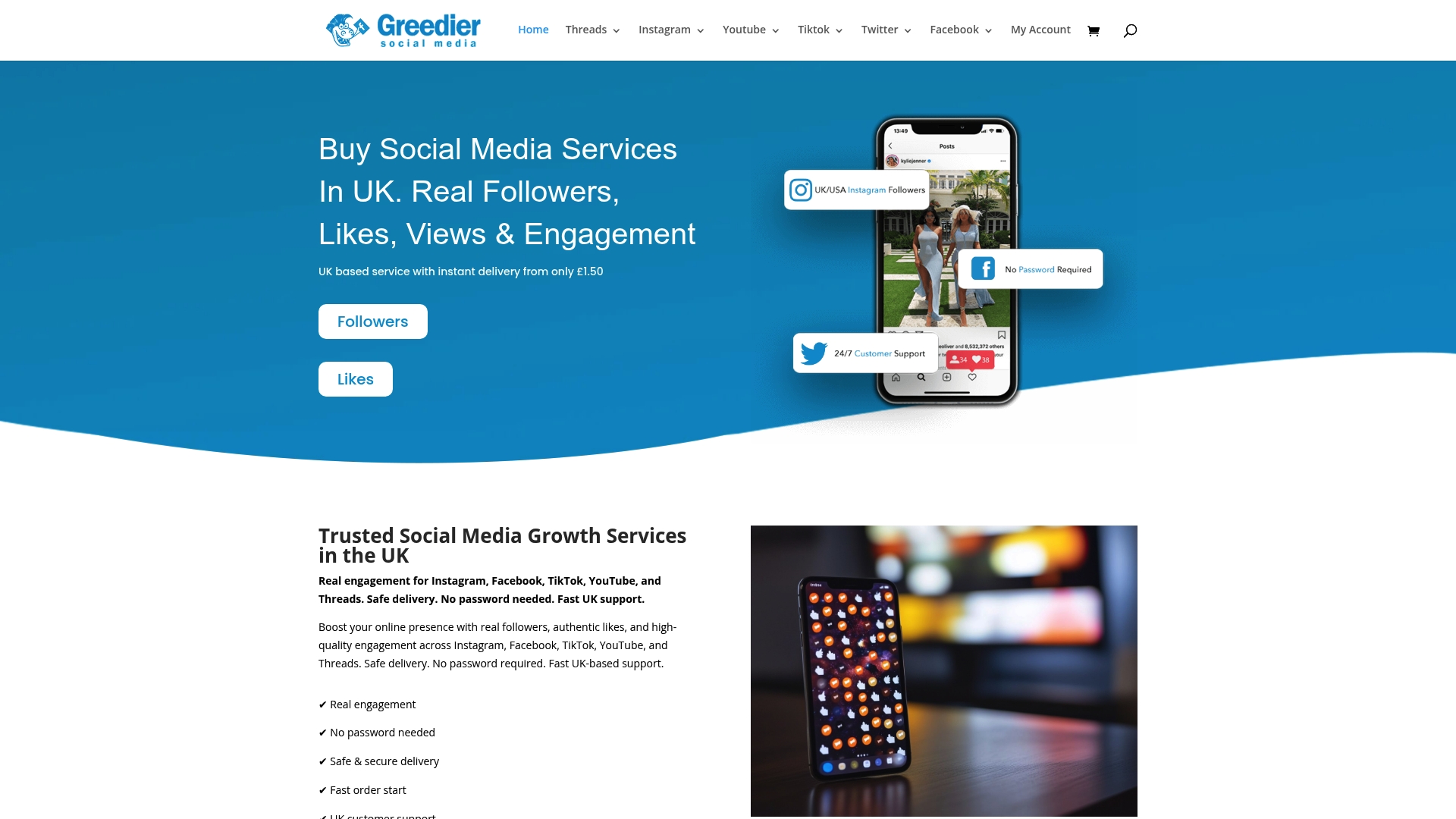
For UK small businesses ready to move from organic validation to paid amplification, Greediersocialmedia offers a faster route than building from zero. The service delivers real followers, likes, and views across Instagram, TikTok, Facebook, and YouTube, with UK-targeted delivery, no password required, and customer support built for small teams who need answers quickly.
The share-first workflow described in this article works best when your paid amplification partner understands the difference between genuine social proof and artificial inflation. Greediersocialmedia’s packages are designed to extend the reach of content that has already earned organic shares, not to replace the validation step. Check out the social media growth strategy page to find a starter package matched to your platform and budget, or browse the growth tactics guide to plan your first share-validated campaign.
FAQ
What is the difference between a share and a like for reach?
A share distributes your content to an entirely new network and signals strong relevance to platform algorithms, while a like registers as passive approval with no distribution effect. Shares consistently generate higher downstream reach and conversion impact.
How long should you wait before boosting a post with paid spend?
Wait 2–4 hours for short-form video content to observe organic share and save signals; for slower formats, some practitioners recommend up to 48–72 hours before committing paid budget.
Does buying engagement affect how shares amplify reach?
Paid engagement packages that add real followers, likes, or views to validated content can increase the base audience that sees and shares your post. Greediersocialmedia’s packages are built around authentic engagement, which preserves the social proof that makes shares credible to both platforms and audiences.
How do you calculate amplification rate?
Divide your total shares by your total followers, then multiply by 100. On Instagram, above 1% is a strong result; on TikTok, a shares-to-views ratio of 3–5% indicates content with viral potential.
Can negative shares actually hurt sales?
Yes. Research shows negative sharing experiences reduce purchase incidence by 11%, which means monitoring sentiment before scaling paid spend is a commercial necessity, not just a brand management concern.